Thank you for visiting SNEWPapers!
Sign up free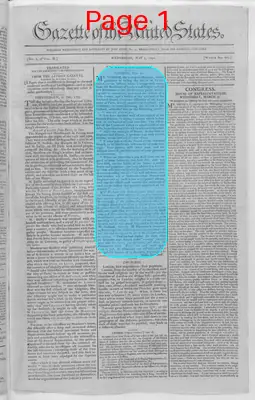
Gazette Of The United States
New York, New York County, New York
What is this article about?
Young English midshipman Mr. Nesbitt heroically saved M. Plantaire from execution by a Paris mob mistaking him for an aristocrat, earning a Civic Crown and National Guard sword from the French Assembly of the Commons, which praised his bravery and Anglo-French esteem.
Clipping
OCR Quality
Full Text
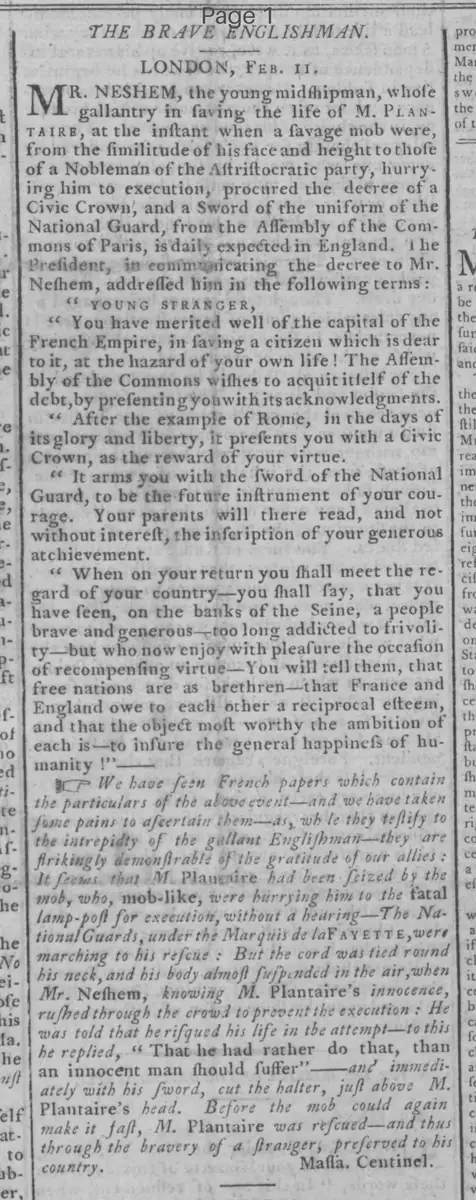
LONDON, FEB. II.
Mr. NESBITT, the young midshipman, whose gallantry in saving the life of M. PLANTAIRE, at the instant when a savage mob were, from the similitude of his face and height to those of a Nobleman of the Aristocratic party, hurrying him to execution, procured the decree of a Civic Crown, and a Sword of the uniform of the National Guard, from the Assembly of the Commons of Paris, is daily expected in England. The President, in communicating the decree to Mr. Nesbitt, addressed him in the following terms:
YOUNG STRANGER,
You have merited well of the capital of the French Empire, in saving a citizen which is dear to it, at the hazard of your own life! The Assembly of the Commons wishes to acquit itself of the debt, by presenting you with its acknowledgments.
After the example of Rome, in the days of its glory and liberty, it presents you with a Civic Crown, as the reward of your virtue.
It arms you with the sword of the National Guard, to be the future instrument of your courage.
Your parents will there read, and not without interest, the inscription of your generous achievement.
When on your return you shall meet the regard of your country—you shall say, that you have seen, on the banks of the Seine, a people brave and generous too long addicted to frivolity—but who now enjoy with pleasure the occasion of recompensing virtue—You will tell them, that free nations are as brethren—that France and England owe to each other a reciprocal esteem, and that the object most worthy the ambition of each is—to ensure the general happiness of humanity!
We have seen French papers which contain the particulars of the above event—and we have taken some pains to ascertain them—as, while they testify to the intrepidity of the gallant Englishman—they are strikingly demonstrable of the gratitude of our allies:
It seems that M. Plantaire had been seized by the mob, who, mob-like, were hurrying him to the fatal lamp-post for execution, without a hearing—The National Guards, under the Marquis de la FAYETTE, were marching to his rescue: But the cord was tied round his neck, and his body almost suspended in the air, when Mr. Nesbitt, knowing M. Plantaire's innocence, rushed through the crowd to prevent the execution: He was told that he risked his life in the attempt—to this he replied, "That he had rather do that, than an innocent man should suffer" and immediately with his sword, cut the halter, just above M. Plantaire's head. Before the mob could again make it fast, M. Plantaire was rescued—and thus through the bravery of a stranger, preserved to his country.
Mass. Centinel,
What sub-type of article is it?
What keywords are associated?
What entities or persons were involved?
Where did it happen?
Foreign News Details
Primary Location
Paris
Key Persons
Outcome
m. plantaire rescued from execution; mr. nesbitt awarded civic crown and sword of the national guard by assembly of the commons
Event Details
Mr. Nesbitt saved M. Plantaire from a mob in Paris who mistook him for an aristocrat and were about to hang him; National Guards under Marquis de la Fayette were approaching but Nesbitt cut the halter with his sword; Assembly praised Nesbitt's bravery and presented awards, emphasizing Anglo-French esteem.