Thank you for visiting SNEWPapers!
Sign up free
Richmond Enquirer
Richmond, Richmond County, Virginia
What is this article about?
Proceedings of the 18th US Congress, Senate and House, Dec 29-31, 1823: resolutions on constitutional amendments for elections, Alabama land pre-emptions, post routes, Navy Yard; debates on discriminating duties, military academy, bankruptcy, Indian affairs, patent costs; bills passed on relief, marshal fees, Cumberland Road extension.
Merged-components note: These components form a continuous report on congressional proceedings from December 29-31, 1823, with sequential reading orders (42-45) and text flow indicating a single logical article on domestic news.
Clippings
1 of 2
OCR Quality
Full Text
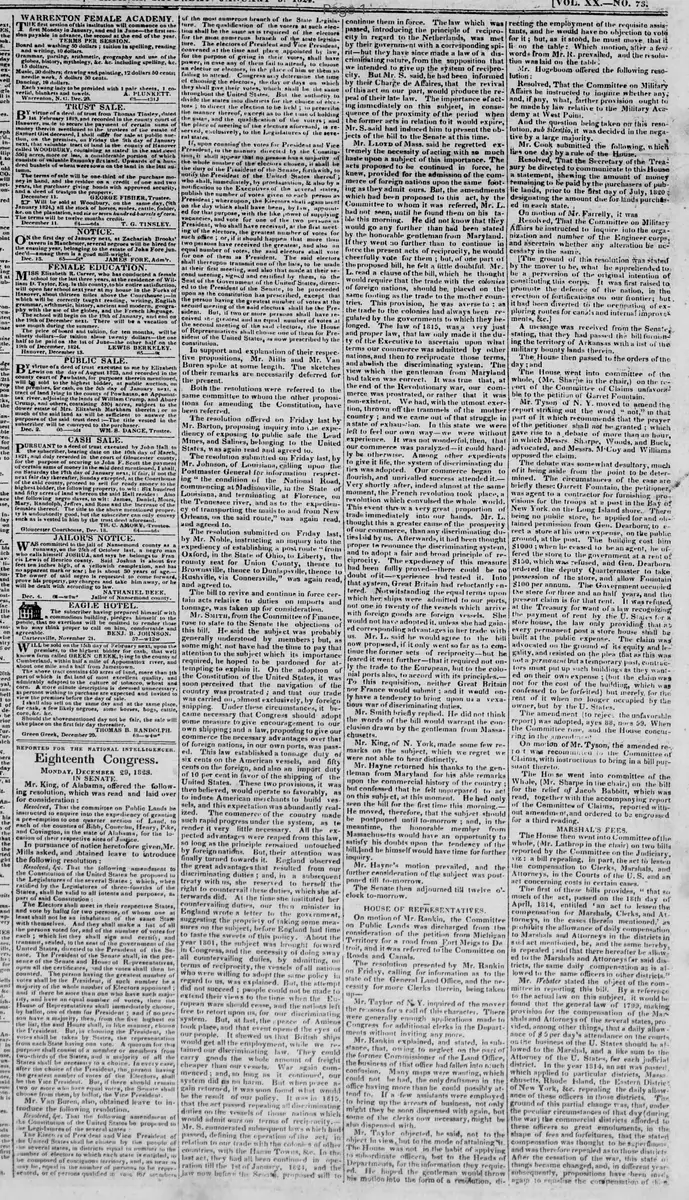
Eighteenth Congress.
Monday, December 29, 1823.
IN SENATE.
Mr. King, of Alabama, offered the following resolution, which was read and laid over for consideration:
Resolved, That the committee on Public Lands be instructed to enquire into the expediency of granting a pre-emption to one quarter section of Land, to each of the counties of Bibb, Conecuh, Henry, Pike, and Covington, in the state of Alabama, for the location of their respective sites of Justice.
In pursuance of notice heretofore given, Mr. Mills asked, and obtained leave to introduce the following resolution:
Resolved, &c. That the following 'amendment to the Constitution of the United States be proposed to the Legislatures of the several States; which, when ratified by the Legislatures of three-fourths of the States, shall be valid to all intents and purposes, as part of said Constitution:
The Electors shall meet in their respective States, and vote by ballot for two persons, of whom one at least shall not be an inhabitant of the same State with themselves. And they shall make a list of all the persons voted for, and of the number of votes for each; which list they shall sign and certify, and transmit, sealed, to the seat of the government of the United States, directed to the President of the Senate. The President of the Senate shall, in the presence of the Senate and House of Representatives, open all the certificates, and the votes shall then be counted. The person having the greatest number of votes shall be the President, if such number be a majority of the whole number of Electors appointed; and if there be more than one who have such majority, and have an equal number of votes, then the House of Representatives shall immediately choose, by ballot, one of them for President; and if no person have a majority, then, from the five highest on the list, the said House shall, in like manner, choose the President. But, in choosing the President, the votes shall be taken by States, the representation from each State having one vote. A quorum for this purpose shall consist of a member or members from two-thirds of the States, and a majority of all the States shall be necessary to a choice. In every case, after the choice of the President, the person having the greatest number of votes of the Electors, shall be the Vice President. But, if there should remain two or more who have equal votes, the Senate shall choose from them, by ballot, the Vice President.
Mr. Van Buren, also, obtained leave to introduce the following resolution.
Resolved, &c. That the following amendment of the Constitution of the United States be proposed to the Legislatures of the several states
The Electors of President and Vice President of the United States shall be chosen by the people of the several states, in districts equal in number to the number of electors to which each state is entitled, to be composed of contiguous territory, and, as near as may be, equal in the number of persons to be represented, or of persons qualified to vote for members of the most numerous branch of the State Legislature. The qualification of the voters at such election shall be the same as is required of the electors for the most numerous branch of the state legislature. The electors of President and Vice President, convened at the time and place appointed by law, for the purpose of giving in their votes, shall have power, in case any of them fail to attend, to choose an elector or electors, in the place of him or them so failing to attend. Congress may determine the time of choosing the electors, the day or days on which they shall give their votes, which shall be the same throughout the United States. But the authority to divide the states into districts for the choice of electors; to direct the election to be held; to prescribe the manner thereof, except as to the time of holding the same, and the qualification of the voters; and the place of meeting of the electors aforesaid, is reserved, exclusively, to the Legislatures of the several states.
If, upon counting the votes for President and Vice President, in the manner directed by the Constitution, it shall appear that no person has a majority of the whole number of the electors chosen, it shall be the duty of the President of the Senate, forthwith, to notify the President of the United States thereof; who shall, immediately, by proclamation, & also by a notification to the Executives of the several states, publish the number of votes given to each person as President; whereupon, the Electors shall again meet on the day which shall have been, by law, appointed for that purpose, with the like power of supplying vacancies, and vote for one of the two persons as President, who shall have received, at the first meeting of the electors, the greatest number of votes for such office; or, if it should happen that more than two persons have received the greatest, and also an equal number of votes, the said electors shall vote for one of them as President. The said electors shall thereupon transmit one of the lists, to be made at their first meeting, and also that made at their second meeting, signed and certified by them, to the Seat of the Government of the United States, directed to the President of the Senate, to be proceeded upon as the constitution has prescribed, except that the person having the greatest number of votes at the second meeting of the said electors shall be the President. But, if two or more persons shall have received such greatest and an equal number of votes at the second meeting of the said electors, the House of Representatives shall choose one of them for President of the United States, as now prescribed by the constitution.
In support and explanation of their respective propositions, Mr. Mills and Mr. Van Buren spoke at some length. The sketches of their remarks are necessarily deferred for the present.
Both the resolutions were referred to the same committee to whom the other propositions for amending the Constitution, have been referred.
The resolution offered on Friday last by Mr. Barton, proposing inquiry into the expediency of exposing to public sale the Lead Mines, and Salines, belonging to the United States, was again read and agreed to.
The resolution submitted on Friday last, by Mr. Johnson, of Louisiana, calling upon the Postmaster General for information respecting "the condition of the National Road, commencing at Madisonville, in the State of Louisiana, and terminating at Florence, on the Tennessee river, and as to the expediency of transporting the mails to and from New Orleans, on the said route," was again read, and agreed to.
The resolution submitted on Friday last, by Mr. Noble, instructing an inquiry into the expediency of establishing a post route "from Oxford, in the State of Ohio, to Liberty, the county seat for Union County, thence to Brownsville, thence to Dunlapsville, thence to Rushville, via Connersville," was again read, and agreed to.
The bill to revive and continue in force certain acts relative to duties on imports and tonnage, was taken up for consideration.
Mr. Sansom, from the Committee of Finance, rose to state to the Senate the objects of this bill. He said the subject was probably generally understood by members; but, as some might not have had the time to pay that attention to the subject which its importance required, he hoped to be pardoned for attempting to explain it. On the adoption of the Constitution of the United States, it was soon perceived that the navigation of the country was prostrated; and that our trade was carried on, almost exclusively, by foreign shipping. Under these circumstances, it became necessary that Congress should adopt some measure to give encouragement to our own shipping; and a law, proposing to give our commerce the necessary advantages over that of foreign nations, in our own ports, was passed. This law established a tonnage duty of six cents on the American vessels, and fifty cents on the foreign, and also an import duty of 10 per cent in favor of the shipping of the United States. These two provisions, it was then believed, would operate so favorably, as to induce American merchants to build vessels, and this expectation was abundantly realized. The commerce of the country made such rapid progress under the system, as to render it very little necessary. All the expected advantages were reaped from this law, so long as the principle remained untouched by foreign nations. But, their attention was finally turned towards it. England observed the great advantages that resulted from our discriminating duties; and, in a subsequent treaty with us, she reserved to herself the right to countervail these duties, which she afterwards did. At the time she instituted her countervailing duties, our then minister in England wrote a letter to the government, suggesting the propriety of taking some measures on the subject, before England had time to taste the sweets of this policy. About the year 1801, the subject was brought forward in Congress, and the necessity of doing away all countervailing duties, by admitting, on terms of reciprocity, the vessels of all nations who were willing to adopt the same policy in regard to us, was explained. But, the attempt did not succeed; people could not be made to extend their views to the time when the European wars should cease, and the nations left free to retort upon us, for our discriminating system. But, at last, the peace of Amiens took place, and that event opened the eyes of our people. It shewed us that British ships would get all the employment, while we retained our discriminating law. They could carry goods the whole amount of freight cheaper than our vessels. War again commenced; and, so long as it continued, our system did us no harm. But when peace again returned, it was soon found what would be the result of our policy. It was in 1815, that the act passed repealing all discriminating duties on the vessels of those nations which would admit ours on terms of reciprocity.—
Mr. S. enumerated subsequent laws which had passed, defining the operation of the act, in relation to our trade with the colonies of other countries, with the Hanse Towns, &c. In the last act, they had all been continued in operation till the 1st of January, 1824, and the law now before the Senate, proposed still to continue them in force. The law which was passed, introducing the principle of reciprocity in regard to the Netherlands, was met by their government with a corresponding spirit—but they have since made a law of a discriminating nature, from the supposition that we intended to give up the system of reciprocity. But Mr. S. said, he had been informed by their Charge d'Affaires, that the revival of this act on our part, would produce the repeal of their late law. The importance of acting immediately on this subject, in consequence of the proximity of the period when the former acts in relation to it would expire, Mr. S. said had induced him to present the objects of the bill to the Senate at this time.
Mr. Lloyd of Mass. said he regretted extremely the necessity of acting with so much haste upon a subject of this importance. The acts proposed to be continued in force, he knew, provided for the admission of the commerce of foreign nations upon the same footing as they admit ours. But, the amendments which had been proposed to this act, by the Committee to whom it was referred, Mr. L. had not seen, until he found them on his table this morning. He did not know that they would go any further than had been stated by the honorable gentleman from Maryland. If they went no further than to continue in force the present acts of reciprocity, he would cheerfully vote for them; but, of one part of the proposed bill, he felt a little doubtful. Mr. L. read a clause of the bill, which he thought would require that the trade with the colonies of foreign nations, should be, placed on the same footing as the trade to the mother countries. This provision, he was averse to: as the trade to the colonies had always been regulated by the governments to which they belonged. The law of 1815, was a very just and proper law, that law only made it the duty of the Executive to ascertain upon what terms our commerce was admitted by other nations, and then to reciprocate those terms, and abolish the discriminating system. The view which the gentleman from Maryland had taken was correct. It was true that, at the end of the Revolutionary war, our commerce was prostrated, or rather that it was non-existent. We had, with the utmost exertion, thrown off the trammels of the mother country; and we came out of that struggle in a state of exhaustion. In this state we were left to feel our own way—we were without experience. It was not wonderful, then, that our commerce was paralyzed—it could hardly be otherwise. Among other expedients to give it life, the system of discriminating duties was adopted. Our commerce began to flourish, and unrivalled success attended it.—Very shortly after, indeed almost at the same moment, the French revolution took place, a revolution which convulsed the whole world. This event threw a very great proportion of trade immediately into our hands. Mr. L. thought this a greater cause of the prosperity of our commerce, than any discriminating duties laid by us. Afterwards, it had been thought proper to renounce the discriminating system, and to adopt a fair and broad principle of reciprocity. The expediency of this measure had been fully proved—there could be no doubt of it—experience had tested it. Into that system, Great Britain had reluctantly entered. Notwithstanding the equal terms upon which her ships were admitted to our ports, not one in twenty of the vessels which arrive with foreign goods are foreign vessels. She would not have adopted it, unless she had gained corresponding advantages in her trade with us. Mr. L. said he would agree to the bill now proposed, if it only went so far as to continue the former acts of reciprocity—but he feared it went further—that it required not only the trade to the European, but to the colonial ports also, to accord with its principles.—To this requisition, neither Great Britain nor France would submit; and it would only have a tendency to bring upon us a vexatious war of discriminating duties.
Mr. Smith briefly replied. He did not think the words of the bill would warrant the conclusion drawn by the gentleman from Massachusetts.
Mr. King, of N. York, made some few remarks on the subject, which we regret we were not able to hear distinctly.
Mr. Hayne returned his thanks to the gentleman from Maryland for his able remarks upon the commercial history of the country; but confessed that he felt unprepared to act on this subject, at this moment. He had only seen the bill for the first time this morning.—He moved, therefore, that the subject should be postponed until to-morrow; and, in the meantime, the honorable member from Massachusetts would have an opportunity to satisfy his doubts upon the tendency of the bill, and he himself would have time for further inquiry.
Mr. Hayne's motion prevailed, and the further consideration of the subject was postponed till to-morrow.
The Senate then adjourned til twelve o'clock to-morrow.
HOUSE OF REPRESENTATIVES.
On motion of Mr. Rankin, the Committee of Public Lands was discharged from the consideration of the petition from Michigan Territory for a road from Fort Meigs to Detroit, and it was referred to the Committee on Roads and Canals.
The resolution presented by Mr. Rankin on Friday, calling for information as to the state of the General Land Office, and the necessity for more Clerks therein, being taken up—
Mr. Taylor of N. Y. inquired of the mover the reasons for a call of this character. There were generally enough applications made to Congress for additional clerks in the Departments without inviting any more.
Mr. Rankin explained, and stated, in substance, that, owing to neglect on the part of the former Commissioner of the Land Office, the business of that office had fallen into much confusion. Many maps were wanting, which could not be had, the only draftsmen in the office having more than he could possibly attend to, If a few assistants were employed to bring up the arrears of business, not only might they be soon dispensed with again, but some of the clerks now necessary, might be also dispensed with.
Mr. Taylor objected, he said, not to the object in view, but to the mode of attaining it. The House was not in the habit of applying to subordinate officers, but to the Heads of Departments, for the information they required. He hoped the gentleman would throw his motion into the form of a resolution, directing the employment of the requisite assistants, and he would have no objection to vote for it; but, as it stood, he must move that it lie on the table: Which motion, after a few words from Mr. R. prevailed, and the resolution was laid on the table!
Mr. Hogeboom offered the following resolution:
Resolved, That the Committee on Military Affairs be instructed to inquire whether any; and, if any, what, farther provision ought to be made by law relative to the Military Academy at West Point.
And the question being taken on this resolution, sub silentio, it was decided in the negative by a large majority.
Mr. Cook submitted the following, which lies one day by a rule of the House.
Resolved, That the Secretary of the Treasury be directed to communicate to this House a statement, shewing the amount of money remaining to be paid by the purchasers of public lands, prior to the first day of July, 1820; designating the amount due for lands purchased in each state.
On motion of Mr. Farrelly, it was
Resolved. That the Committee on Military Affairs be instructed to inquire into the organization and number of the Engineer corps, and ascertain whether any alteration be necessary in the same.
[The ground of this resolution was stated by the mover to be, what he apprehended to be a perversion of the original intention of constituting this corps. It was first raised to promote the defence of the nation, in the erection of fortifications on our frontier; but, it had been diverted to the occupation of exploring routes for canals and internal improvements, &c.]
A message was received from the Senate stating, that they had passed the bill furnishing the territory of Arkansas with a list of the military bounty lands therein.
The House then passed to the orders of the day; and
The House went into committee of the whole, (Mr. Sharpe in the chair,) on the report of the Committee of Claims unfavorable to the petition of Garret Fountain.
Mr. Tyson of N. Y. moved to amend the report striking out the word "not," in that part of it which recommends that the prayer of the petitioner shall not be granted; which gave rise to a debate of more than an hour, in which Messrs. Sharpe, Woods, and Buck, advocated, and Messrs. McCoy and Williams opposed the claim.
The debate was somewhat desultory, much of it being aside from the point to be determined. The circumstances of the case are briefly these: Garrett Fountain, the petitioner, was agent to a contractor for furnishing provisions for the troops at a post in the Bay of New York, on the Long Island shore. There being no public store, he applied for and obtained permission from Gen. Dearborn, to erect a store at his own expense, on the public ground, at the post. The building cost him $1000; when he ceased to be an agent, he offered the store to the government at a rent of $150, which was refused, and Gen. Dearborn ordered the deputy Quartermaster to take possession of the store, and allow Fountain $100 per annum. The Government occupied the store for three and a half years, and the present claim is for that rent. It was refused at the Treasury for want of a law recognizing the payment of rent by the U. States for a store house, the law only providing that at every permanent post a store house shall be built at the public expense. The claim was advocated on the ground of its equity and legality, and resisted on the plea that as this was not a permanent but a temporary post, contractors must put up such buildings as they wanted on their own expense; (but the claim was not for the cost of the building, which was confessed to be forfeited) but merely for the rent of it when no longer occupied by the owner, but by the U. States.
The amendment (to reject the unfavorable report) was adopted, ayes 88, noes 59. When the Committee rose, and the House concurring in the amendment
On motion of Mr. Tyson, the amended report was recommitted to the Committee of Claims, with instructions to bring in a bill pursuant thereto.
The House went into committee of the Whole, (Mr. Sharpe in the chair.) on the bill for the relief of Jacob Babbitt, which was read, together with the accompanying report of the Committee of Claims, reported without amendment, and ordered to be engrossed for a third reading
MARSHAL'S FEES.
The House then went into Committee of the whole, (Mr. Lathrop in the chair) on two bills reported by the Committee on the Judiciary, viz: a bill repealing, in part, the act to lessen the compensation to Clerks, Marshals, and Attorneys, in the Courts of the U.S. and an act concerning costs in certain cases.
The first of these bills provides, "that so much of the act, passed on the 18th day of April, 1814, entitled 'an act to lessen the compensation for Marshals, Clerks, and Attorneys, in the cases therein mentioned;' as prohibits the allowance of daily compensation to Marshals and Attorneys in the districts in said act mentioned, be, and the same hereby, is repealed; and that there hereafter be allowed to the Marshals and Attorneys for said districts, the same daily compensation as is allowed to the same officers in other districts."
Mr. Webster stated the object of the committee in reporting this bill. "By a reference to the actual law on this subject, it would be found that the general law of 1799, making provision for the compensation of the Marshals and Attorneys of the several states, provided, among other things, that a daily allowance of $5 per day's attendance on the courts on the business of the U. States should be allowed to the Marshal, and a like sum to the Attorney of the U. States, for each judicial district.' In the year 1814, an act was passed, which applied to particular districts, Massachusetts, Rhode Island, the Eastern District of New York, &c. repealing the daily allowance of these officers in those districts. The ground of this partial change was, that, under the peculiar circumstances of that day (during the war) the commercial districts afforded to these officers so great emoluments, in the shape of fees and forfeitures, that the stated compensation was thought to be superfluous and was therefore repealed as to those districts After the cessation of the war, this state of things became changed, and, in different years subsequently, propositions have been made, again to equalise the compensation of these officers."
The bill was reported without amendment.
The second bill provides for the allowance of costs in certain cases of seizure under the revenue laws, where the seizure is relinquished, or where the property is restored to the claimant on bond, &c.
The bills were reported without amendment.
Officers, but for want of time, or from some other cause, they have not been acted upon.
The subject being brought before the Judiciary Committee at this session, one of two courses appeared to them obviously proper: either to extend the law to all the districts, or to repeal it as it now stood. For, whatever might be thought of the one or the other course, nothing could be said in favor of retaining the present partial character of the system of compensation. On full examination the Committee had thought the better course would be to repeal so much of the law of 1811 as relates to the subject, and to place the compensations to the officers on the same footing as they stood upon previous to its passage.
An amendment was offered by Mr. Hayden, going to restrict the fees of Clerks in certain cases, but, after some conversation, he withdrew it, with the design hereafter to present it in a distinct proposition; and the bill was agreed to.
COSTS IN SUITS BY PATENTEES.
The bill concerning costs in certain cases, was then taken up by the Committee.
This bill provides, 'That in suits commenced in the Courts of the United States, after the passage of this act, to recover damages for the violation of any right arising under Letters Patent, lawfully issued, for any new and useful invention, discovery, or improvement, costs shall be allowed to the plaintiff or plaintiffs, in all cases, where the sum recovered by him or them shall not be less than one hundred dollars.'
Mr. Webster explained the reasons of the committee for reporting this bill. The general law forbids all recovery of costs in the Courts of the United States, where the amount of the judgment is less than 500 dollars. This minimum, as applicable to cases generally, Mr. W. said, was perhaps too high, but, as related to cases of recovery of damages for violation of patent rights, it was supposed there were particularly strong reasons why it should be reduced. Suits of that description are instituted not so much to recover great damages as to establish the right of the inventors. The right may be a very important one, and yet the violation of it in particular instances may not involve heavy damages. In ordinary cases, the right of suing in the courts of the United States has been regarded as a privilege, persons possessing it having the option to avail themselves of it or to resort to the State Courts, &c. But, with respect to patent rights, as that subject is exclusively in the possession of the general government, the whole right being created by the Laws of Congress, and the injured person being obliged to sue in the courts of the United States or nowhere, it seemed right to enlarge the law so far as to allow costs to the plaintiff in all cases arising under the law of patents, where the damages awarded him amount to one hundred dollars. For that purpose this bill had been reported.
Mr. Taylor, of N. Y. moved as an amendment, that the minimum should be reduced to $50. Very useful patents often applied to articles of comparatively small value, where an infringement in any single case would not entitle the patentee to damages amounting to $100. It was incumbent on Congress to provide for these cases, and as Government charged the patentee $50 for his patent, there was a propriety in fixing upon that sum as the limit of damages on which he might obtain costs.
Mr. Webster not objecting, the amendment was agreed to.
The Committee then rose and reported both bills—and they were both ordered to be engrossed for a third reading.
The House went into a Committee of the Whole, Mr. Foote in the chair, on the bill for the relief of Wm. Bartlett, and John Stearns and others; which, after some debate, in which Messrs. Newton, M'Coy, Hobart, Rich, and Tomlinson took part, was reported without amendment, and ordered to be engrossed for a third reading.
And the House adjourned.
TUESDAY, DECEMBER 30, 1823.
IN SENATE.
The resolution offered by Mr. Eaton, some days since, providing for the biennial election of the officers of the Senate, was again taken up, modified by the mover, and postponed till to-morrow.
The resolution submitted yesterday by Mr. Hayne, instructing an inquiry into the expediency of establishing a Navy Yard at Charleston, S. C. for the building and repairing of sloops of war, and other vessels of an inferior class, was again read, and agreed to.
The resolution offered yesterday by Mr. King, of Alabama, proposing an inquiry concerning the expediency of granting a pre-emption to an quarter section of land each to several counties in the state of Alabama, for the location of their respective sites of justice, was again read, and agreed to.
The bill to revive and continue in force certain acts relating to discriminating duties on imports and tonnage, was taken up, as in Committee of the Whole. Some discussion took place in regard to the details of the bill in which Messrs. Macon, Holmes of Maine, Smith, Benton, Barbour, Lloyd of Massachusetts, Brown and Hayne, participated. The bill, as submitted by the Committee of Finance, was reported to the Senate without amendment, and passed to be engrossed and read a third time. By general consent, the bill afterwards had its third reading, was passed, and sent to the House of Representatives for concurrence.
The bill for the relief of Thomas W. Bacot, the Postmaster at Charleston, S. C. was taken up in Committee of the whole. Mr. Holmes stated that the object of the bill was merely to refund to the Postmaster the sum of $500, which he had paid as a reward for the arrest of a mail robber, and which he could not receive from the proper department, because the expenditure did not come within the strict letter of his instructions. This bill passed the Senate at the last session, but was not acted upon in the House. It had now passed that body, and Mr. H. trusted, would meet with no opposition in the Senate. The bill was then reported to the Senate without amendment, and passed to a third reading.
Mr. Elliott offered the following resolution, which was read, and laid over for consideration:
Resolved, That the President of the United States be requested to cause an article to be addressed to the British government, through our minister at the Court of St. James, to correct before it is too late, some egregious errors respecting persons as may have been lost, with the view regarding to each, for faults held by them in the Florida subjects to the treaty of 1783, and of which they were deprived, on the transfer of that territory to Spain, by virtue of the said Convention.
The Senate then adjourned till 12 o'clock to-morrow.
HOUSE OF REPRESENTATIVES
Mr. Webster, from the Committee on the Judiciary, who were instructed to inquire into the expediency of establishing an Uniform System of Bankruptcy, reported that it is not expedient to establish such system.
Mr. Webster observed, that the committee had thought it proper to make an early communication of their opinion on this important subject to the House. In this opinion, a great majority of the committee concurred; indeed he believed the was the only member who had the misfortune to differ from that opinion.— The whole committee, however, were desirous of giving a fair opportunity to those gentlemen who, like himself, were in favor of the system, to bring the question before the House.
rous of giving a fair opportunity to those gentlemen who, like himself, were in favor of the system, to bring the question before the House. Such an opportunity would now be afforded, as any member might move to amend the report, by altering it from a negative to an affirmative character. It seemed to him to be proper, on several accounts, that the opinion of the House, on the general question of the expediency of a Bankrupt Law, should be taken, before a bill should be brought in. In such a bill there must necessarily be much of prolixity and detail; and very much discussion might be expected to arise on particular provisions, which would seem to be misplaced, until there should be some room to think that the general measure itself was acceptable to a majority of the House. Until there was room to believe that, such a discussion upon details would have no effect but to consume time. If the House should now reverse this report, the committee would cheerfully prepare and bring in a bill. He would take the liberty to suggest, however, whether the best way would not be to proceed by resolution. In this way, perhaps, not only the general question might be settled, but, if settled in favor of the measure, subsequent resolutions might proceed to settle some of the general outlines of the system; such, for example, as what classes of persons the system should extend to: whether only to traders, technically or legally so called, or to all persons (by proper description) who have, or ordinarily occasion to use extensive credits: and whether it shall be a temporary or permanent system. &c., &c. He made these suggestions only for the consideration of those who, like himself, were in favor of the system. And, to the end that they might have an option, to proceed by way of resolution, or by motion to amend the present report, he would move that the report lie upon the table.
The report was accordingly laid on the table.
Mr. Sloane, from the Committee on Elections presented a favorable report on the petition of Parmenio Adams, who claims the seat of Isaac Wilson, Representative from the State of New York: which with the accompanying papers, was referred to a committee of the Whole House, and ordered to be printed.
The resolution offered yesterday by Mr. Cook, calling on the Secretary of the Treasury for a statement of the amount of money remaining to be paid by the purchasers of public lands prior to the 1st of July, 1820, and designating the amount due for lands in each State, was taken up and agreed to: nem. con.
Mr. Rich offered the following:
Resolved, That the Committee on Indian Affairs be instructed to inquire into the practicability and expediency of adopting measures which shall more effectually restrain either citizens of the United States or foreigners from hunting or trapping on lands to which the Indian title has not been extinguished [and exclude foreigners from a participation in the Indian trade.]
Mr. Rich, in introducing the above resolution, said that he conceived it due to the House to state some of the reasons which induced him to offer it for adoption, and to hope that the inquiry it proposed would prove successful. During the last season, he was sorry to state, there had occurred on our Western borders, a killing and wounding of traders, and a slaughtering of Indians, which was much to be regretted. The attack made by the Indians is said to have been unprovoked: it may have been so; he hoped, for the honor of our country, that such would turn out to have been the fact. He did not entertain a doubt, that all that could, under the existing laws, be done to prevent so unhappy an occurrence, had been done by the Executive. He believed however, it would, on investigation, be found that the laws had been violated, and the rights of our red brethren infringed. In support of his remarks, Mr. R. asked leave to read certain parts of the correspondence which had been submitted to the House on this subject—[Here was read, a letter of Mr. Pilcher to Major O'Fallon, communicating a letter from Mr. Gordon, which gave an account of the arrangements for hunting made by the party. This unhappy fracas had arisen, it seemed, while our traders were marching, trapping, and counter-marching. Here Mr. Rich quoted the letter from Gen. Atkinson to General Gaines, enclosing another from Gen. Ashley to Major O'Fallon.] The object of this expedition, Mr. R. went on to say, was to procure and carry away that game to which the Indian tribes had as just a right as any of us have to the property we hold. In relation to that part of the resolution which refers to the exclusion of foreigners from this trade, unless we could effect this, he was persuaded we need look for nothing but a continual recurrence of events of the same kind as had occurred—a constant waste of human life. If more efficient means to preserve pacific relations with the Indian tribes could not be devised, or were impracticable, then we had better withdraw, at once, our troops from the Indian country altogether.
Mr. Vance moved to amend the resolution by striking out the last clause, (to exclude foreigners from the Indian trade.) but afterwards withdrew the amendment, and the resolution was adopted, as moved by Mr. Rich.
Mr. Floyd of Virginia, adverting to a Message of the President of the United States, transmitted to this House on the 8th day of January last, in answer to certain resolutions of the 8th January, 7th May, and 17th December, 1822, calling for certain information respecting the Expenditures in the Ordnance Department, said the Document to which he referred had not been ordered to be printed until the close of the session, so that, during the last session, it was not practicable to pursue the inquiry which he, as the mover of one of the resolutions calling for the information, had intended to follow up. He now moved that the Message and Documents in this case be referred to a Select Committee.
Mr. Taylor of N. York, called for the reading of the Message proposed to be referred to see whether the appointment of a Select Committee in the case was advisable.
Mr. Saunders of North Carolina, said he was glad that the attention of the gentleman from Virginia had been directed to the report of the last session respecting the expenditures of the Ordnance Department. Since the meeting of the present Congress, Mr. S. said he had occasion to look into that Report.— The examination which he had given to it satisfied him that something like a check should be put upon the expenditure of that Department, if it could be done. He preferred the Document being referred to a Select Committee, because, if gentlemen would look into it, they would find it to be very voluminous, comprising the accounts of the Ordnance Department for several years, and it would be impracticable for a committee to examine it in the manner in which it ought to be examined, without abstracting its attention from every other subject—
Mr. Taylor said the gentleman from North Carolina had mistaken him, if he understood him as opposing the reference of these documents to a select committee. He only wished the message of the President read, to understand precisely what the subject was which was proposed to be referred, with a view to ascertain whether it would be proper to refer it to a select committee or to the military committee.
The message was then read.
Mr. Saunders resumed his observations.— He disapproved of a reference of this subject to the Military Committee, because, he said, of the voluminousness of the documents, and the necessity of a more minute examination of the subject, than it would probably be in the power of that committee to give to it. He would state some of these expenditures in the Ordnance Department, which, he said, would strike this House with something like astonishment. In 1819, for example, it would be found that eight or ten dollars per barrel had been paid for corn for the use of this Department. If there had been such a scarcity of that article in any part of the country as to raise it to that price, he knew not of it. It would be found, on looking at another item, that a very large sum had been paid—
The Speaker here checked the Debate: it was not in order, on a motion of reference, to go at large into the subject proposed to be referred.
Mr. Hamilton of S. C. said, that, as a member of the Military Committee, he was not desirous of appropriating to that Committee an undue proportion of labor; but he submitted to the House whether under the general duties enjoined on that Committee, that of examining this subject did not properly fall. Unless otherwise specially instructed by the House, he thought the subject was already fully within the scope of the duties of that Committee, which, from the nature of the business which came before it, might be supposed to be fully competent to its investigation, and might therefore come to conclusions thereupon different from those of a Select Committee.
Mr. Little of Maryland, moved to refer the papers in question to the Committee on the expenditures of the War Department, whose duty he thought it peculiarly was to investigate subjects of this description.
Mr. Floyd, after expressing an unwillingness to take up the time of the House on this subject, said that it had been heretofore almost uniformly the practice (to which he knew of but a single exception,) where a subject was brought before the House by any member, with a desire to have a committee appointed upon it, that this request should be granted to him. It was perfectly competent to the gentleman from South Carolina, who was now at the head of the Military Committee, to have had this document referred to that committee at an earlier day, when the committee had little to do. The gentleman from Maryland, too, must agree that the practice of allowing a particular inquiry, when asked by a member, was an universal practice of the House. Here was an expenditure, to a vast amount, in one of the Departments. Desirous to see the nature of the expenditures Mr. Floyd said he had called for an account of them. The information was now here, and all that he asked was, that it should be referred to a committee, which would have time to examine the subject, and take it under their particular care. It was very true, as the gentleman had intimated, that the Military Committee might come to a different conclusion from a select committee. Mr. F. said he believed, however, that any committee to whom the subject should be referred, would come to the same conclusion: but, if, in making this motion, he was about to tread on any tender place, perhaps he had better withdraw it.
Mr. Little, disclaiming any intention to oppose an inquiry in this case, said it was the particular duty of the Committee on Expenditures in the War Department, to inquire into expenditures of this description, and therefore he wished the subject referred to them, presuming that they would not neglect their duty, and that every member of the House felt the same interest as he himself did in the correct administration of the public concerns.
Mr. Dwight of Mass. thought that to refer this subject to any other committee than that on the expenditures of the War Department, would be to interfere with the appropriate duties of that committee. He read a part of the rule establishing that committee, to sustain his position. It was very well known that that committee had heretofore had very little business before them. It seemed most proper, therefore, that this message should be referred to that committee; any other course, indeed, it appeared to him, would be irregular.
Mr. Hamilton said the gentleman from Massachusetts had anticipated him in what he had said; for, on reference to the rule, he was very well satisfied that the suggestion of the gentlemen from Maryland was perfectly correct. To show that it was so, Mr. H. requested the Clerk to read the rule.
The rule was read by the Clerk.
Mr. Tucker of Virginia said he hoped the motion to refer the Message to the standing committee would not prevail. The House, since it had heard the rule read, would see that the duties imposed on that committee, which consists of three members only, were very arduous. These duties could not be so well performed in the committee room, but the committee were under the necessity of going to the War Department to prosecute their inquiries. The consequence was, that, when that committee, some time ago, made a report to this House, they recommended the number of the committee to be increased, but that recommendation had not been acted upon. That committee, at least he spoke for himself as one of them, would be very much obliged to any gentleman who would divide their labor with them. If that Committee should meet every day of the Session, and the Session were to endure for twice its usual term, it would be impossible for them to examine all the vouchers, &c. for the expenditures in the Department. They were even now obliged in some measure to slur over their inquiries from the want of time to pursue them, &c. It would be very gratifying to that Committee, he said, to have the subject now before the House referred to a Select Committee.
Mr. Floyd said, in making this motion, he had not taken any course unusual in this house: he was only pursuing an enquiry which he had himself commenced. It was not because he supposed there was any unwillingness or inability in the standing committees to examine the subject, that he proposed to refer it to a select committee, but because he had commenced the inquiry himself and he wished himself to pursue it.
The question was then taken on the motion to refer the subject to the standing committee on the Expenditures of the War Department, (being first in order) and negatived, 99 votes to 67.
The question was then taken on referring to a select committee, and agreed to.
On motion of Mr. P. P. Barbour, it was
Resolved, That the Committee on Revolutionary Pensions be instructed to inquire into the propriety of reinstating Henry Hines, of the county of Louisa, Virginia, on the Revolutionary pension list.
On motion of Mr. Hayden, it was
Resolved, That the Committee on the Judiciary be instructed to inquire into the expediency of explaining and amending the third section of an act entitled 'An act for providing compensation for the marshals, clerks, attorneys, jurors, and witnesses, in the Courts of the United States, and to repeal certain parts of the acts herein mentioned, and for other purposes,' so far forth as the provisions thereof affect the compensation of clerks of the Circuit and District Courts of the United States.
The engrossed Bill 'to repeal in part an act entitled an act to lessen the compensation for Marshals, Clerks, and Attorneys, in the cases therein mentioned,' was read a third time, passed, and sent to the Senate for concurrence.
COSTS IN SUITS FOR PATENT RIGHTS.
The engrossed Bill 'concerning costs in certain cases,' was read a third time.
Mr. Vance, of Ohio, had an objection to the bill. As he understood the bill now to stand, if a party, suing in the Courts of the United States, recovered only ten dollars, he would be entitled to costs; because the clerk of the court was ordered to record a judgment of damages for three times the amount awarded by the jury; and, for the same reason, as the law formerly stood, a plaintiff recovering no more than $50 was entitled to costs, because the damages were to be entered at treble the amount. The gentleman from Massachusetts had, indeed, otherwise stated the law, and he was probably better acquainted with the law than himself, yet such were his convictions; and, with this view of the practical operation of the bill, he could view it as little else than a bill to aid individuals to impose upon the public. Such, at least, would be its effect in the Western Country. That country, he said, swarmed with persons professing to have patent rights for new discoveries. An instance had not long ago occurred, of a man coming into that country, and maintaining that he had a patent for iron gudgeons, and succeeding so far as to exact large sums of money from individuals, who were intimidated by a threat of his going to law with them. Pass this law, said he, and adventurers of this kind will come along with the law in their pocket, and threaten those on whom they practice their impositions, to drag them from the extremity of Missouri, Illinois, &c. to the Circuit Courts of the United States. No matter if, when they got them there, they should recover only ten dollars—the bill, as it now stood, would give them the costs of suit. Almost all the light machinery employed in that region of country, Mr. V. said, came from the Eastward. The articles were consigned to a merchant in some intermediate town, Pittsburg or Wheeling for example, and he sent them forward to agents in the interior. There they were purchased and used, and then comes along some man from the Eastward, claiming a patent right to the article—the user cannot trace the person from whom the articles were procured to the Eastward, and, dreading a suit, prefers to pay the unjust demand of a mere adventurer. As an instance of which, he cited the case of Wood's patent Plough, which was much used in the prairies of the Mississippi, and which had given occasion to great abuses of this description. No law could be better calculated to encourage litigation, he thought, than this.
Mr. Wright said, that he was in favor of the bill, as originally reported: in its present form, he should be opposed to its passage. By the act of 1793, where $500 or more was sued for in the U. S. Courts, and less than $500 recovered, no costs were allowed. But the case now to be provided for rests on a different principle. All costs, he said, are matter of special legislation, being, he believed, not known to the common law. They were not allowed in suits under the patent law, because that law provides, that judgment shall be given for three times the amount of the verdict obtained. This provision of the existing laws be considered as a full equivalent for costs, and a sufficient security to the rights of the patentee. He thought that a reduction of the minimum of damages, on which costs are recoverable, would have a tendency to multiply law suits. It had been said, that suitors under the patent laws were compelled to have resort to the Courts of the United States, as they could sue nowhere else. He conceived the law to be otherwise. He believed that the United States' Courts had not exclusive, but only concurrent jurisdiction, in cases of this description. Doubtless, the subject of allowing costs had been within the view of Congress when the original act was passed; and why were costs not then allowed? For the reason he had stated—the triple amount of the verdict being allowed in lieu of them.— Besides, in most cases, the damages assessed did not go to the original patentee, they went to persons who claimed to have an assignment from him. Such persons abounded. they literally swarmed, in some parts—vending patent rights had become a perfect trade. They impose upon the ignorant, and threaten the timid, till they often succeed in fleecing both. Sometimes however, they meet with an individual of sterner stuff, who consents to abide a suit; but he does not know whether the patent is valid or not—and, in the issue, he is cast—damages are awarded against him—the law trebles those damages, and now costs are to be superadded to all the rest.— He hoped the bill, at least, in its present shape, would not pass: and he therefore moved that it be recommitted to the Committee of the Judiciary, with instructions to restore it to its first form, by altering the minimum of damages on which costs should be allowed from $50 to $100.
The question being taken on this motion without further debate, it passed in the affirmative, and the bill was recommitted accordingly.
WEDNESDAY, DEC. 31, 1823.
IN SENATE
The resolutions, proposed some days since, by Mr. Eaton, respecting the election of the officers of the Senate, were taken up for consideration. The first resolution, which provides for filling, by ballot of the Senate, such of the offices as may hereafter become vacant, was agreed to. The second, which provides for the biennial election of the Secretary of the Senate, Sergeant at Arms and Doorkeeper, Assistant Doorkeeper, together with the principal and engrossing Clerks, gave rise to some discussion. Mr. Eaton stated, generally, the grounds which induced him to move this resolution. He thought the trouble of electing its officers, was not a sufficient excuse to the Senate for not exercising this important trust. He considered it important to the proper transaction of the business of the Senate, that its officers should be elective: that the best men would be most likely to be obtained in that way.— And, as a still stronger argument in favor of his motion, Mr. E. urged the constitutional requisition that the Senate should elect its own officers. Messrs. Lanman, Elliott, Mills, Holmes, of Maine, Barbour, Brown of Ohio, King, of Alabama, and Edwards of Illinois, remarked upon the resolution; which was, subsequently, postponed till Friday next.
Mr. Elliott's resolution submitted yesterday, was agreed to.
It was ordered, that, when the Senate does adjourn, it will adjourn till Friday next.
On motion of Mr. Barbour, the Senate then proceeded to the consideration of Executive business; and, some time after, Adjourned till Friday next, at twelve o'clock.
HOUSE OF REPRESENTATIVES
Mr. Beecher moved to take up the bill for extending the Cumberland Road. Carried— yeas 73, nays 70. The bill was then, on the motion of Mr. B. referred to the committee of the whole.
The bill from the Senate, concerning discriminating duties and imposts, (for reviving the laws suspending them on vessels from certain ports in the North of Europe, which expire on the 1st Jan. 1824,) was taken up for consideration, and twice read.
Mr. Newton observed, that the bill was of a highly important character, and moved that it be referred to the Committee of Commerce.
Mr. M'Lane opposed this motion, on the ground, that the nature of the bill, being to continue in force existing provisions that were just about to expire, would not admit of delay, &c.
Some debate arose on this subject, of a nature which it is not deemed necessary to report. One or two amendments were offered, which the House refused to accept, and the bill was finally ordered to a third reading this day, without any contest as to the main principle of the bill. The gentlemen who engaged in this discussion, were Messrs. Newton, M'Lane, Dwight, Cobb, Tomlinson, Gazlay, and Forsyth.
The bill from the Senate, concerning Discriminating Duties and Imposts, was read a third time, PASSED, and returned to the Senate.
The following message, from the President of the U. S. was received, by Mr. Mosher, his private Secretary
'To the House of Representatives of the U. States:
'Pursuant to the resolution of the House of Representatives of the 19th inst. requesting the President of the U. States, to lay before the House any information he may have received, and which he may not deem it improper to communicate, relating to the condition and future prospects of the Greeks.
'JAMES MONROE.
'Washington, 31st Dec. 1823'
'Department of State,
'Washington, 31st Dec. 1823.
'The Secretary of State to whom has been referred the resolution of the House of Representatives of the U. States of the 19th inst. requesting the President of the U. States, to lay before the House any information he may have received, and which he may not deem it improper to communicate, relating to the condition and future prospects of the Greeks, has the honor of reporting to the President, the papers in the possession of this Department, containing the information requested by the resolution of the House.
'JOHN QUINCY ADAMS.'
List of Papers sent
Extract of a letter from Mr. Forsyth to Mr. Adams, dated 13th Dec. 1822—with
Note, dated Corinth, St. [20th] April, 1822— translation.
Note, Mr. Luriottis to Don Evaristo San Miguel, dated 21st Nov 1822—translation.
Mr. Rush to Mr. Adams, 21st Feb. 1823—copy.
Mr. Luriottis to same, 20th
to
yo
Mr. Adams to Mr. Rush, 18th Aug. do.
do
Same to Mr. Luriottis, 18th
to
do—
Extract of a letter to Secretary of State, dated
Marseilles, 6th Aug. 1823.
Do do 27th do
Statistical table of Greece—translation—original copy received from Mr. Middleton.
The message, &c. was ordered to lie on the table
And the House adjourned to Friday.
What sub-type of article is it?
What keywords are associated?
What entities or persons were involved?
Where did it happen?
Domestic News Details
Primary Location
Washington, Dc
Event Date
December 29 31, 1823
Key Persons
Outcome
multiple resolutions agreed to or laid over; bills on discriminating duties, marshal fees, patent costs passed or recommitted; reports on bankruptcy and elections presented; debates on indian affairs, ordnance expenditures, and road extensions.
Event Details
The text details sessions of the US Senate and House of Representatives from December 29 to 31, 1823. Key actions include introducing and referring resolutions for constitutional amendments on presidential elections, land pre-emptions in Alabama counties, post routes in Ohio and Louisiana, Navy Yard in Charleston, biennial Senate officer elections, and inquiries into military academy, engineer corps, Indian affairs, and ordnance expenditures. Debates cover reviving discriminating duties on imports and tonnage, with historical context provided; claims relief for Garret Fountain and others; marshal and attorney compensations; costs in patent suits reduced to $50 minimum; bankruptcy system deemed inexpedient; Cumberland Road extension referred; message on Greek prospects received.