Thank you for visiting SNEWPapers!
Sign up free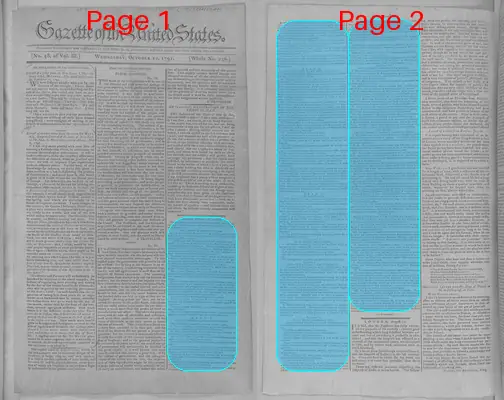
Gazette Of The United States
New York, New York County, New York
What is this article about?
On August 5, 1791, the French National Assembly, via M. Thouret's report, presented the Constitution abolishing nobility, feudalism, and privileges; guaranteeing rights, defining citizenship, and establishing a representative monarchy with a unicameral legislature.
Merged-components note: Direct continuation of the report on the French Constitution and National Assembly proceedings across page 1 and 2, with sequential reading order.
Clippings
1 of 2
OCR Quality
Full Text
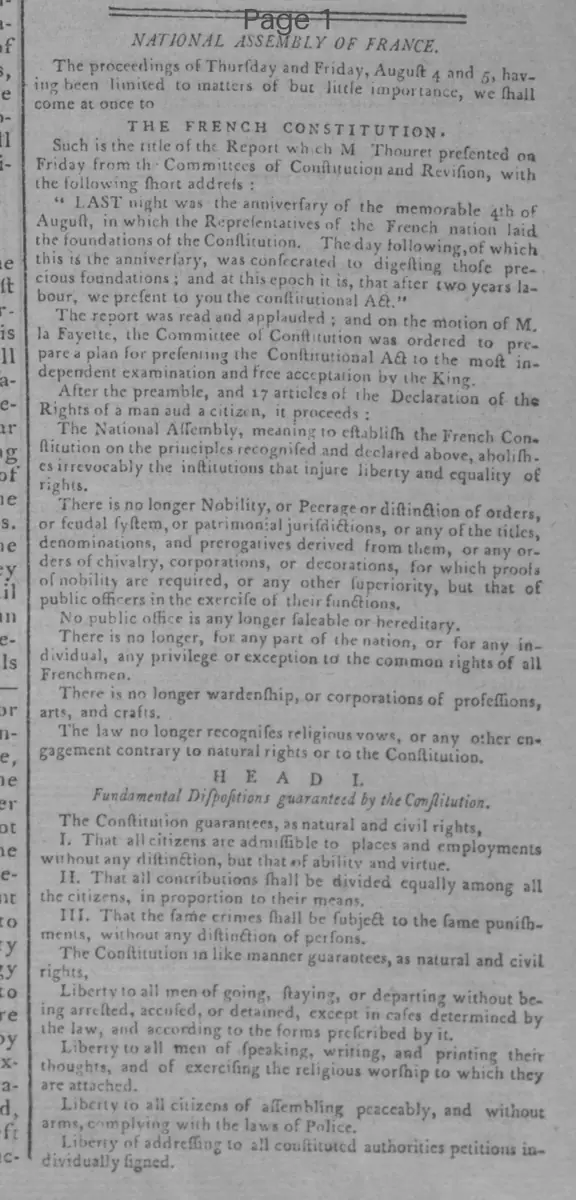
The proceedings of Thursday and Friday, August 4 and 5, having been limited to matters of but little importance, we shall come at once to
THE FRENCH CONSTITUTION.
Such is the title of the Report which M. Thouret presented on Friday from the Committees of Constitution and Revision, with the following short address:
"LAST night was the anniversary of the memorable 4th of August, in which the Representatives of the French nation laid the foundations of the Constitution. The day following, of which this is the anniversary, was consecrated to digesting those precious foundations; and at this epoch it is, that after two years labour, we present to you the constitutional Act."
The report was read and applauded; and on the motion of M. La Fayette, the Committee of Constitution was ordered to prepare a plan for presenting the Constitutional Act to the most independent examination and free acceptation by the King.
After the preamble, and 17 articles of the Declaration of the Rights of a man and a citizen, it proceeds:
The National Assembly, meaning to establish the French Constitution on the principles recognised and declared above, abolishes irrevocably the institutions that injure liberty and equality of rights.
There is no longer Nobility, or Peerage or distinction of orders, or feudal system, or patrimonial jurisdictions, or any of the titles, denominations, and prerogatives derived from them, or any orders of chivalry, corporations, or decorations, for which proofs of nobility are required, or any other superiority, but that of public officers in the exercise of their functions.
No public office is any longer saleable or hereditary.
There is no longer, for any part of the nation, or for any individual, any privilege or exception to the common rights of all Frenchmen.
There is no longer wardenship, or corporations of professions, arts, and crafts.
The law no longer recognises religious vows, or any other engagement contrary to natural rights or to the Constitution.
HEAD I.
Fundamental Dispositions guaranteed by the Constitution.
The Constitution guarantees, as natural and civil rights,
I. That all citizens are admissible to places and employments without any distinction, but that of ability and virtue.
II. That all contributions shall be divided equally among all the citizens, in proportion to their means.
III. That the same crimes shall be subject to the same punishments, without any distinction of persons.
The Constitution in like manner guarantees, as natural and civil rights,
Liberty to all men of going, staying, or departing without being arrested, accused, or detained, except in cases determined by the law, and according to the forms prescribed by it.
Liberty to all men of speaking, writing, and printing their thoughts, and of exercising the religious worship to which they are attached.
Liberty to all citizens of assembling peaceably, and without arms, complying with the laws of Police.
Liberty of addressing to all constituted authorities petitions individually signed.
As liberty consists but in the power of doing whatever neither injures the rights of another, nor the public safety, the law may establish penalties against acts, which, attacking either the rights of others, or the public safety, would be injurious to society.
The Constitution guarantees the inviolability of property, or a just and previous indemnity for that, of which public necessity, legally proved, shall require the sacrifice.
Effects that were formerly destined to services of public utility belong to the nation; those which were appropriated to the expense of worship are at the disposal of the nation.
A general establishment of public succours shall be created and organized for the relief of the infirm poor, and of the poor not infirm who want work.
A public instruction shall be created and organized, common to all citizens, gratuitous with regard to those parts of tuition indispensable for all men, and of which the establishment shall be gradually distributed in a proportion combined with the division of the kingdom.
HEAD II.
Of the Division of the Kingdom, and the State of Citizens.
I. France is divided into 83 departments, each department into districts, each district into cantons.
II. Those are French citizens who are born in France, of a French father; who, having been born in France of a foreign father, have fixed their residence in the kingdom; who, having been born in a foreign country, of a French father, have returned to settle in France, and have taken the Civic Oath; in fine, who, having been born in a foreign country, being descended in whatever degree from a Frenchman, or Frenchwoman, who have left their country from religious motives, come to reside in France and take the Civic Oath.
III. Those who, being born out of the kingdom, of foreign parents, reside in France, become French citizens after five years of continued residence in the kingdom; if, besides, they have acquired real property, or married a French woman, or formed a commercial establishment, and if they have taken the Civic Oath.
IV. The legislative power may, from important considerations, naturalize a foreigner, upon no other condition, than that of residing in France, and taking the Civic Oath.
V. The Civic Oath is: "I Swear to be faithful to the Nation, the Law, and the King; and to maintain, with all my power, the constitution decreed by the Constituent National Assembly during the years 1789, 1790, and 1791."
VI. The right of French citizenship is lost,
1st, By naturalization in a foreign country;
2dly, By being condemned to penalties which involve the Civic degradation, provided the person condemned, be not reinstated;
3dly, By a sentence of contumacy, provided the sentence be not annulled;
4thly by an initiation into any foreign order or body, which shall be supposed to require proofs of nobility.
VII. French citizens regarded in the light of those local relations, which rise out of their association in cities, and in certain divisions of territory in the country, form the Communities.
The legislative power may fix the extent of boundary of each community.
VIII. The citizens who compose each community have the right of choosing, according to the forms prescribed by the law, those among them, who, under the name of Municipal Officer, are charged with the management of the particular affairs of the community. To the Municipal Officers may be delegated certain functions relative to the general interest of the State.
IX. The rules which the Municipal Officers shall be bound to follow in the exercise, both of the municipal functions, and of those which shall be delegated to them for the general interest, shall be fixed by the laws.
HEAD III.
Of the public powers.
I. The sovereignty is one, indivisible, and appertains to the nation; no section of the people can arrogate the exercise of it.
II. The nation, from which alone flow all the powers, cannot exercise them but by delegation.
The French constitution is representative; the representatives are the legislative body and the King.
III. The legislative power is delegated to a National Assembly, composed of temporary representatives, freely chosen by the people, to be exercised by this Assembly, with the sanction of the King, in manner afterwards determined.
IV. The government is monarchical: the executive power is delegated to the King, to be exercised under his authority, by Ministers and other responsible agents, in manner afterwards determined.
V. The judicial power is delegated to judges, chosen for a time limited by the people.
CHAPTER I.
Of the Legislative National Assembly
I. The National Assembly, forming the legislative body, is permanent, and consists of one chamber only.
II. It shall be formed by new elections every two years.
Each period of two years shall form one legislature.
III. The renewal of the legislative body shall be matter of full right.
IV. The legislative body shall not be dissolved by the King.
Section I.
Number of Representatives.—Basis of Representation.
I. The number of representatives to the legislative body, shall be 745, on account of the eighty-three departments of which the kingdom is composed; and independent of those that may be granted to the colonies.
II. The representatives shall be distributed among the eighty-three departments, according to the three proportions of land, of population, and the contribution direct.
III. Of the 745 representatives, 247 are attached to the land.
Of these each department shall nominate three, except the department of Paris, which shall nominate only one.
IV. Two hundred and forty-nine representatives are attributed to the population. The total mass of the active population of the kingdom is divided into 249 parts, and each department nominates as many of the deputies as it contains parts of the population.
V. Two hundred and forty-nine representatives are attached to the contribution direct. The sum total of the direct contribution of the kingdom is likewise divided into 249 parts, and each department nominates as many deputies as it pays parts of the contribution.
Section II.
Primary Assemblies, Nomination of Electors.
I. In order to form a Legislative National Assembly, the active citizens shall convene in primary Assemblies in the cities and cantons.
II. To be an active citizen, it is necessary
To be a Frenchman, or have become a Frenchman;
To have attained 25 years complete;
To have resided in the city or canton at least for the space of one year;
To pay in any part of the kingdom a direct contribution, at least equal to the value of three days labour, and to produce the acquittance;
Not to be in a menial capacity, namely, that of a servant receiving wages;
To be inscribed in the Municipality of the place of his residence in the list of the National Guards;
To have taken the Civic Oath.
III. Every six years the Legislative Body shall fix the minimum and the maximum of the value of a day's labour, and the Administrators of the Departments shall determine the rate for every district.
What sub-type of article is it?
What keywords are associated?
What entities or persons were involved?
Where did it happen?
Foreign News Details
Primary Location
France
Event Date
August 5, 1791
Key Persons
Outcome
the report was read and applauded; committee ordered to prepare plan for presenting the constitution to the king for examination and acceptance.
Event Details
M. Thouret presented the report on the French Constitution from the Committees of Constitution and Revision, marking the anniversary of foundational work. It abolishes nobility, peerage, feudal systems, privileges, and related institutions; guarantees equal access to offices, fair taxation, equal justice, liberties of movement, expression, assembly, petition, and property; establishes public relief and education; divides France into departments; defines French citizenship criteria, civic oath, and loss of citizenship; outlines communities and municipal officers; vests sovereignty in the nation, with representative constitution featuring legislative National Assembly, monarchical executive, and delegated judicial power; details assembly composition, elections, and active citizen qualifications.