Thank you for visiting SNEWPapers!
Sign up free
The Cordele Dispatch And Daily Sentinel
Cordele, Crisp County, Georgia
What is this article about?
Scientists at Army Medical School in Washington, D.C., identify a lactic acid germ as key to tooth decay, thriving in acid from poor diet. Experiments on rats with varied diets aim to replicate human dental issues.
Merged-components note: Merged story on tooth decay with sequential images likely illustrating the scientific content.
Clipping
OCR Quality
Full Text
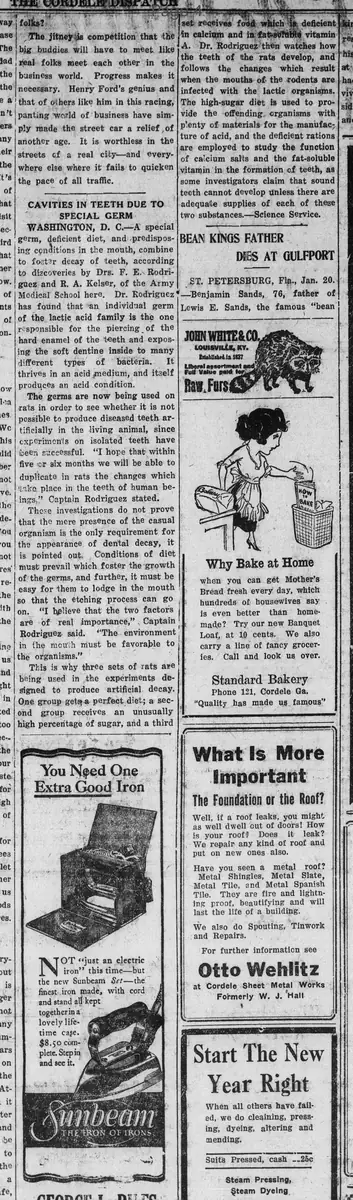
WASHINGTON, D. C.-A special germ, deficient diet, and predisposing conditions in the mouth, combine to foster decay of teeth, according to discoveries by Drs. F. E. Rodriguez and R. A. Kelser, of the Army Medical School here. Dr. Rodriguez has found that an individual germ of the lactic acid family is the one responsible for the piercing of the hard enamel of the teeth and exposing the soft dentine inside to many different types of bacteria.
It thrives in an acid medium, and itself produces an acid condition.
The germs are now being used on rats in order to see whether it is not possible to produce diseased teeth artificially in the living animal, since experiments on isolated teeth have been successful. "I hope that within five or six months we will be able to duplicate in rats the changes which take place in the teeth of human beings." Captain Rodriguez stated.
These investigations do not prove that the mere presence of the causal organism is the only requirement for the appearance of dental decay. it is pointed out, Conditions of diet must prevail which foster the growth of the germs, and further, it must be easy for them to lodge in the mouth so that the etching process can go on. "I believe that the two factors are of real importance," Captain Rodriguez said. The environment in the mouth must be favorable to the organisms."
This is why three sets of rats are being used in the experiments designed to produce artificial decay. One group gets a perfect diet; a second group receives an unusually high percentage of sugar, and a third set receives food which is deficient in calcium and in fat-soluble vitamin A. Dr. Rodriguez then watches how the teeth of the rats develop, and follows the changes which result when the mouths of the rodents are infected with the lactic organisms.
The high-sugar diet is used to provide the offending organisms with plenty of materials for the manufacture of acid, and the deficient rations are employed to study the function of calcium salts and the fat-soluble vitamin in the formation of teeth, as some investigators claim that sound teeth cannot develop unless there are adequate supplies of each of these two substances.-Science Service.
What sub-type of article is it?
What keywords are associated?
What entities or persons were involved?
Where did it happen?
Story Details
Key Persons
Location
Washington, D. C.
Story Details
Drs. F. E. Rodriguez and R. A. Kelser discover a lactic acid germ, combined with deficient diet and mouth conditions, causes tooth decay by piercing enamel. Experiments on isolated teeth succeed; now testing on rats with varied diets to replicate human decay.