Thank you for visiting SNEWPapers!
Sign up free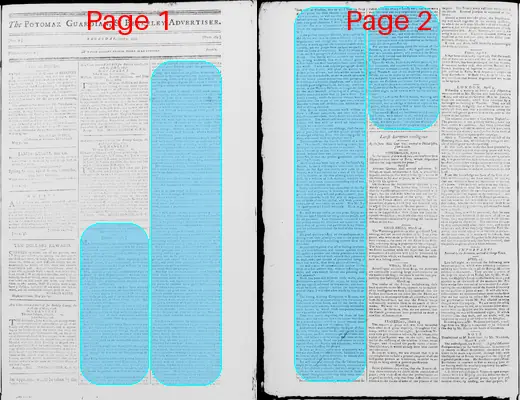
Editorial
June 9, 1796
The Patowmac Guardian, And Berkeley Advertiser
Martinsburg, Shepherdstown, Berkeley County, Jefferson County, West Virginia
What is this article about?
Mr. Rutherford delivers a speech opposing ratification of the treaty with Britain, critiquing its terms, negotiation, and violation of past agreements, while invoking revolutionary history and urging patriotic scrutiny for justice and reciprocity. (214 characters)
Merged-components note: This is a continuation of Mr. Rutherford's speech on the treaty, spanning from page 1 to page 2 with sequential reading orders.
Clippings
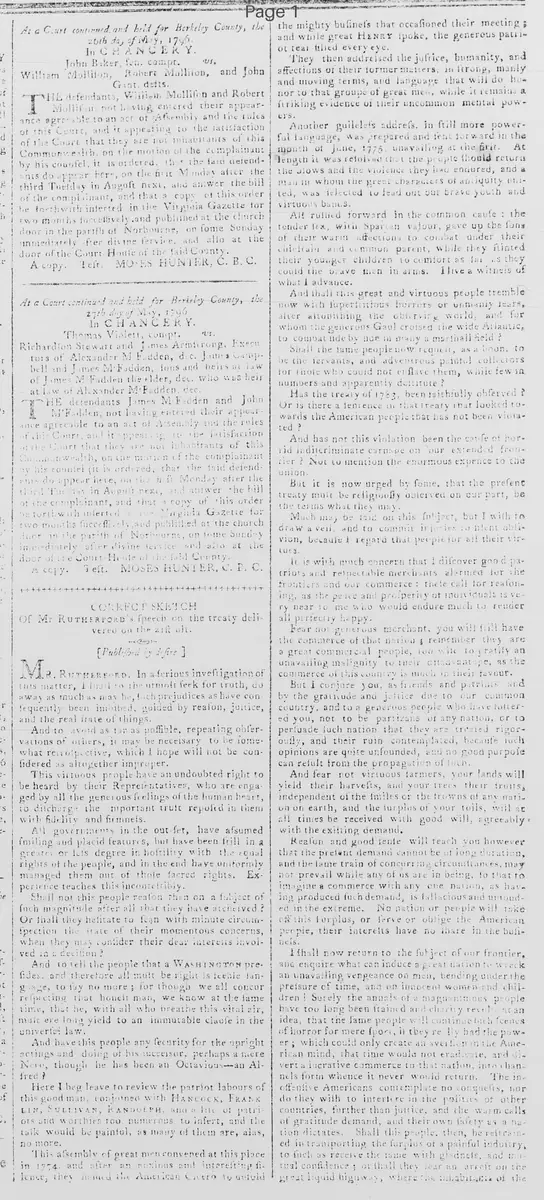
1 of 2
OCR Quality
95%
Excellent
Full Text
CORRECT SKETCH
Of Mr. Rutherford's speech on the treaty delivered on the 26th ult.
[Published by desire]
MR. RUTHERFORD. In a serious investigation of this matter, I shall to the utmost seek for truth, do away as much as may be, those prejudices as have consequently been imbibed, guided by reason, justice, and the real state of things.
And to avoid as far as possible, repeating observations of others, it may be necessary to be somewhat retrospective, which I hope will not be considered as altogether improper.
This virtuous people have an undoubted right to be heard by their Representatives, who are engaged by all the generous feelings of the human heart, to discharge the important trust reposed in them with fidelity and firmness.
All governments in the outset, have assumed smiling and placid features, but have been still in a greater or less degree in hostility with the equal rights of the people, and in the end have uniformly managed them out of those sacred rights. Experience teaches this incontestably.
Shall not this people reason then on a subject of such magnitude after all that they have suffered? Or shall they hesitate to scan with minute circumspection the state of their momentous concerns, when they must consider their dear interests involved in a decision?
And to tell the people that a Washington presides, and therefore all must be right is feeble language, to say no more; for though we all concur respecting that honest man, we know at the same time, that he, with all who breathe this vital air, must ere long yield to an immutable clause in the universal law.
And have this people any security for the upright acting and doing of his successor, perhaps a mere novice, though he has been an Octavius—an Alfred?
Here I beg leave to review the patriot labours of this good man, conjoined with Hancock, Franklin, SULLIVAN, RANDOLPH, and a host of patriots and worthies too numerous to insert, and the task would be painful, as many of them are, alas, no more.
This assembly of great men convened at this place in 1774, and after an anxious and interesting silence, there moved the American lion towards the mighty business that occasioned their meeting; and while great Henry spoke, the generous patriot tear fled every eye.
They then addressed the justice, humanity, and affections of their former masters, in strong, manly and moving terms, and language that will do honor to that groupe of great men, while it remains a striking evidence of their uncommon mental powers.
Another guileless address, in still more powerful language, was prepared and sent forward in the month of June, 1775, unavailing at the first. At length it was resolved that the people should return the blows and the violence they had endured, and a man in whom the great characters of antiquity united, was selected to lead on our brave youth and virtuous bands.
All rushed forward in the common cause: the tender sex, with Spartan valour, gave up the sons of their warm affections to combat under their chieftain and common parent, while they stinted their younger children to comfort as last as they could the brave men in arms. I have a witness of what I advance.
And shall this great and virtuous people tremble now with superstitious horrors or unholy fears, after astonishing the observing world, and for whom the generous Gaul crossed the wide Atlantic, to combat side by side in many a marshall field?
Shall the same people now require, as a boon, to be the servants, and adventurous principal collectors for those who could not enslave them, while few in numbers and apparently destitute?
Has the treaty of 1783, been faithfully observed? Or is there a sentence in that treaty that looked towards the American people that has not been violated?
And has not this violation been the cause of horrid indiscriminate carnage on our extended frontier? Not to mention the enormous expence to the union.
But it is now urged by some, that the present treaty must be religiously observed on our part, be the terms what they may.
Much more be said on this subject, but I wish to draw a veil, and to commit inputs to silent oblivion, because I regard that people for all their virtues.
It is with much concern that I discover good patriots and respectable merchants alarmed for the frontiers and our commerce: these call for reasoning, as the peace and property of individuals is very near to me who would endure much to render all perfectly happy.
Hear now, generous merchant, you will still have the commerce of that nation—remember they are a great commercial people, too wise to gratify an unavailing malignity to their class and age, as the commerce of this country is much in their favour.
But I conjure you, as friends and patriots and by the gratitude and justice due to our common country, and to a generous people who have tolerated you, not to be partisans of any nation, or to persuade such nation that they are treated rigorously, and their ruin contemplated, because such opinions are quite unfounded, and no good purpose can result from the propagation of such.
And fear not virtuous farmers, your lands will yield their harvests, and your trees their fruits, independent of the smiles or the frowns of any nation on earth, and the surplus of your toils, will at all times be received with good will, agreeably with the existing demand.
Reason and good sense will teach you however that the present demand cannot be of long duration, and the same train of concurring circumstances, may not prevail while any of us are in being, so that to imagine a commerce with any one nation, as having produced such demand, is fallacious and unfounded in the extreme. No nation or people will take off a surplus, or serve or oblige the American people, their interests have no share in the business.
I shall now return to the subject of our frontier, and enquire what can induce a great nation to wreak an unavailing vengeance on men, bending under the pressure of time, and on innocent women and children! Surely the annals of a magnanimous people have too long been stained and chiefly revolted at an idea, that the same people will continue such scenes of horror for mere sport, if they really had the power: which could only create an aversion in the American mind, that time would not eradicate, and divert a lucrative commerce to that nation, into channels from whence it never would return. The inoffensive Americans contemplate no conquests, nor do they wish to interfere in the politics of other countries, further than justice, and the warm calls of gratitude demand, and their own safety as a nation dictates. Shall this people, then, be restrained in transporting the surplus of a painful industry, to such as receive the same with gladness, and a mutual confidence? Or shall these hear an arrest on the great liquid highway, where the inhabitants of the world have an equal right?
[Note: The speech appears to be cut off at the end of the provided text.]
Sheep rove at pleasure, free as air? Has the Deity given a patent for that element to any description of his creatures; or will not the great law of all nations protect the American flag, while they support a national character? And the people of Britain are too wise, magnanimous and just, to inculcate the reproachful character of mighty free robbers.
If the present treaty is defeated, as it ought to be, the matter will then be open to friendly and equal negotiation; and though the commerce of that country is much against the common interest of this country, yet the people have no fixed antipathy to treat on terms of reciprocity. Read the second article, and first paragraph of the third article of this treaty. The second article converts our territory, to long withheld, into mere neutral ground, and to foster our most inveterate foes; these stamp the whole. I will read only the paragraph alluded to, and that I trust, will place the matter in a proper point of view, and induce some serious reflections on this business, as the warmest advocates for the treaty cannot misconstrue that paragraph.
It will evince a friendly disposition, and a desire to establish good neighbourhood, harmony, and intercourse, if the Western Posts are no longer detained by the most manifest infraction of a treaty, solemnly concluded more than 13 years since. For surely a treaty, while the hatchet of death was suspended over the heads of our aged men, and our innocent women and children, can neither be cordial or of long duration.
The British nation have too much wisdom to draw a different conclusion, and they will, on a dispassionate retrospect, surely decide with prudence and justice. The Americans demand no more than justice, and they wish to avoid all retaliation, though within their power.
This being truly the state of things, shall the temple of justice be shut, and this people denied the advantages resulting from his unerring guide to man, and coeval with the physical world.
Treaties embrace the dearest interests of a nation. Then surely, the treaty making power, must be subject to some other power or control. Reason is stunned by an idea that a people can transfer power, beyond their own control, without an alternative, or that the present generation can bind posterity forever.
Much stress has been laid on the President's signature, so that I will enquire what could the President do but sign this treaty, as it came to his hands; was it not natural for a man of his humanity to shudder, at the idea of being solely responsible, in a business of such moment, while he was stunned, as it were, by the surrounding cry of war, from such as dreaded that event.
Surely the misfortune was antecedent to that signature: and originated in sending one man to negotiate with a very wise and powerful court; practiced for centuries in all her arts of negotiation, not to speak of the best skilled, and most powerful companies of merchants on earth. Was Mr. Jay on equal ground? I shall not reply. Much might be added.
But shall we not reason on this great subject ere it be too late? I speak for this generous people, and for all posterity. I am intimately connected with the present race; my relations are numerous, and every man of probity and patriotism is my friend, and let no honest man fear the level of this virtuous people.
Do good patriots reflect on the consequences resulting from their principles, and on the great difficulty that presents in recalling powers once surrendered.
Arguments to prove that all is smiling prosperity, are very fallacious, and cannot operate forcibly against a prudent and timely precaution to turn aside those evils which must ensue if such precaution be neglected; one scruple of prevention being of more real worth, than many pounds of remedy.
Or will a man of common sense recline in the shade on a fine summer day, without reflecting that night, and even wintry storms and pinching cold will approach.
Much has been said without these walls, about British debts and an aversion to pay, by many who are not rightly informed in this matter, and hurried on by party clamour: but for the information even of those, I will offer a few words by way of reply.
The strong Trading Companies in Britain, had long received the produce arising from the labour of individuals in some states, and all the specie, that the people could acquire, was uniformly received by their factors, by which these companies became more powerful and wealthy.
That they really engrossed the trade of some states, worried and run down the native merchants by a general credit, which of course created some bad debts, as is the case in common life.
And this evil was increased by the flight of their factors, who shut their books, and retired so soon as the great conflict commenced. And I have been told, and believe it to be a fact, that some of these companies actually fitted out privateers to cruise against those our friends and supporters, which in reality was distressing this people.
Be that as it may, every man of property who had not deposited his debt for them, hastened to pay so soon as their factors returned, to inform them the amount of their several debts.
But will any man contend that the United States ought to be responsible for bad debts, contracted at the desire of those companies and with design to cut up the native merchants--what can entitle them to this great indulgence; did they lend their several factors to serve the people?
But to return to the treaty, was the President satisfied with the treaty? Surely not; but were not a well informed and very respectable minority in the Senate, decidedly against this treaty; and have not the members of this more numerous body, an undoubted right to judge for their constituents, who have reposed such confidence in them?
They intend no reflections on the President and Senate; they consider them as acting for the best at the time they did act, and with the information they then possessed; but time and observation has supplied this house with such information as the Senate could not be in possession of.
We are not contending about the virtues of the President, or of the Senate. All regard the President as a common parent, and reverence the Senate for all their virtues and the stations which the people have assigned them.
Upon the whole, I call to my western patriots, fellow labourers, and conjure them by their affections, for this our common country, by the names of the great Warren, and all our departed patriots and heroes, not to be duped by an opinion, that malignity and party spirit actuates members to bitterness against the President and Senate for sinister purposes. Such opinions are not advanced by the friends of the Union or of the Revolution, and being entirely unfounded ought to be viewed with horror and contempt.
Finally I call to the British nation, warning and conjuring them by their real interest and national character, not to indulge a violent or captious malignity, which can only tend to sever the two nations while they exist as such.
Thus have I offered my sentiments with sincerity, and I trust, with respect to all, while I am conscious of the truth and the justice of what I have advanced. But shall yield to the opinions of a majority of the representatives of the people as they may decide, and without a murmur.
Of Mr. Rutherford's speech on the treaty delivered on the 26th ult.
[Published by desire]
MR. RUTHERFORD. In a serious investigation of this matter, I shall to the utmost seek for truth, do away as much as may be, those prejudices as have consequently been imbibed, guided by reason, justice, and the real state of things.
And to avoid as far as possible, repeating observations of others, it may be necessary to be somewhat retrospective, which I hope will not be considered as altogether improper.
This virtuous people have an undoubted right to be heard by their Representatives, who are engaged by all the generous feelings of the human heart, to discharge the important trust reposed in them with fidelity and firmness.
All governments in the outset, have assumed smiling and placid features, but have been still in a greater or less degree in hostility with the equal rights of the people, and in the end have uniformly managed them out of those sacred rights. Experience teaches this incontestably.
Shall not this people reason then on a subject of such magnitude after all that they have suffered? Or shall they hesitate to scan with minute circumspection the state of their momentous concerns, when they must consider their dear interests involved in a decision?
And to tell the people that a Washington presides, and therefore all must be right is feeble language, to say no more; for though we all concur respecting that honest man, we know at the same time, that he, with all who breathe this vital air, must ere long yield to an immutable clause in the universal law.
And have this people any security for the upright acting and doing of his successor, perhaps a mere novice, though he has been an Octavius—an Alfred?
Here I beg leave to review the patriot labours of this good man, conjoined with Hancock, Franklin, SULLIVAN, RANDOLPH, and a host of patriots and worthies too numerous to insert, and the task would be painful, as many of them are, alas, no more.
This assembly of great men convened at this place in 1774, and after an anxious and interesting silence, there moved the American lion towards the mighty business that occasioned their meeting; and while great Henry spoke, the generous patriot tear fled every eye.
They then addressed the justice, humanity, and affections of their former masters, in strong, manly and moving terms, and language that will do honor to that groupe of great men, while it remains a striking evidence of their uncommon mental powers.
Another guileless address, in still more powerful language, was prepared and sent forward in the month of June, 1775, unavailing at the first. At length it was resolved that the people should return the blows and the violence they had endured, and a man in whom the great characters of antiquity united, was selected to lead on our brave youth and virtuous bands.
All rushed forward in the common cause: the tender sex, with Spartan valour, gave up the sons of their warm affections to combat under their chieftain and common parent, while they stinted their younger children to comfort as last as they could the brave men in arms. I have a witness of what I advance.
And shall this great and virtuous people tremble now with superstitious horrors or unholy fears, after astonishing the observing world, and for whom the generous Gaul crossed the wide Atlantic, to combat side by side in many a marshall field?
Shall the same people now require, as a boon, to be the servants, and adventurous principal collectors for those who could not enslave them, while few in numbers and apparently destitute?
Has the treaty of 1783, been faithfully observed? Or is there a sentence in that treaty that looked towards the American people that has not been violated?
And has not this violation been the cause of horrid indiscriminate carnage on our extended frontier? Not to mention the enormous expence to the union.
But it is now urged by some, that the present treaty must be religiously observed on our part, be the terms what they may.
Much more be said on this subject, but I wish to draw a veil, and to commit inputs to silent oblivion, because I regard that people for all their virtues.
It is with much concern that I discover good patriots and respectable merchants alarmed for the frontiers and our commerce: these call for reasoning, as the peace and property of individuals is very near to me who would endure much to render all perfectly happy.
Hear now, generous merchant, you will still have the commerce of that nation—remember they are a great commercial people, too wise to gratify an unavailing malignity to their class and age, as the commerce of this country is much in their favour.
But I conjure you, as friends and patriots and by the gratitude and justice due to our common country, and to a generous people who have tolerated you, not to be partisans of any nation, or to persuade such nation that they are treated rigorously, and their ruin contemplated, because such opinions are quite unfounded, and no good purpose can result from the propagation of such.
And fear not virtuous farmers, your lands will yield their harvests, and your trees their fruits, independent of the smiles or the frowns of any nation on earth, and the surplus of your toils, will at all times be received with good will, agreeably with the existing demand.
Reason and good sense will teach you however that the present demand cannot be of long duration, and the same train of concurring circumstances, may not prevail while any of us are in being, so that to imagine a commerce with any one nation, as having produced such demand, is fallacious and unfounded in the extreme. No nation or people will take off a surplus, or serve or oblige the American people, their interests have no share in the business.
I shall now return to the subject of our frontier, and enquire what can induce a great nation to wreak an unavailing vengeance on men, bending under the pressure of time, and on innocent women and children! Surely the annals of a magnanimous people have too long been stained and chiefly revolted at an idea, that the same people will continue such scenes of horror for mere sport, if they really had the power: which could only create an aversion in the American mind, that time would not eradicate, and divert a lucrative commerce to that nation, into channels from whence it never would return. The inoffensive Americans contemplate no conquests, nor do they wish to interfere in the politics of other countries, further than justice, and the warm calls of gratitude demand, and their own safety as a nation dictates. Shall this people, then, be restrained in transporting the surplus of a painful industry, to such as receive the same with gladness, and a mutual confidence? Or shall these hear an arrest on the great liquid highway, where the inhabitants of the world have an equal right?
[Note: The speech appears to be cut off at the end of the provided text.]
Sheep rove at pleasure, free as air? Has the Deity given a patent for that element to any description of his creatures; or will not the great law of all nations protect the American flag, while they support a national character? And the people of Britain are too wise, magnanimous and just, to inculcate the reproachful character of mighty free robbers.
If the present treaty is defeated, as it ought to be, the matter will then be open to friendly and equal negotiation; and though the commerce of that country is much against the common interest of this country, yet the people have no fixed antipathy to treat on terms of reciprocity. Read the second article, and first paragraph of the third article of this treaty. The second article converts our territory, to long withheld, into mere neutral ground, and to foster our most inveterate foes; these stamp the whole. I will read only the paragraph alluded to, and that I trust, will place the matter in a proper point of view, and induce some serious reflections on this business, as the warmest advocates for the treaty cannot misconstrue that paragraph.
It will evince a friendly disposition, and a desire to establish good neighbourhood, harmony, and intercourse, if the Western Posts are no longer detained by the most manifest infraction of a treaty, solemnly concluded more than 13 years since. For surely a treaty, while the hatchet of death was suspended over the heads of our aged men, and our innocent women and children, can neither be cordial or of long duration.
The British nation have too much wisdom to draw a different conclusion, and they will, on a dispassionate retrospect, surely decide with prudence and justice. The Americans demand no more than justice, and they wish to avoid all retaliation, though within their power.
This being truly the state of things, shall the temple of justice be shut, and this people denied the advantages resulting from his unerring guide to man, and coeval with the physical world.
Treaties embrace the dearest interests of a nation. Then surely, the treaty making power, must be subject to some other power or control. Reason is stunned by an idea that a people can transfer power, beyond their own control, without an alternative, or that the present generation can bind posterity forever.
Much stress has been laid on the President's signature, so that I will enquire what could the President do but sign this treaty, as it came to his hands; was it not natural for a man of his humanity to shudder, at the idea of being solely responsible, in a business of such moment, while he was stunned, as it were, by the surrounding cry of war, from such as dreaded that event.
Surely the misfortune was antecedent to that signature: and originated in sending one man to negotiate with a very wise and powerful court; practiced for centuries in all her arts of negotiation, not to speak of the best skilled, and most powerful companies of merchants on earth. Was Mr. Jay on equal ground? I shall not reply. Much might be added.
But shall we not reason on this great subject ere it be too late? I speak for this generous people, and for all posterity. I am intimately connected with the present race; my relations are numerous, and every man of probity and patriotism is my friend, and let no honest man fear the level of this virtuous people.
Do good patriots reflect on the consequences resulting from their principles, and on the great difficulty that presents in recalling powers once surrendered.
Arguments to prove that all is smiling prosperity, are very fallacious, and cannot operate forcibly against a prudent and timely precaution to turn aside those evils which must ensue if such precaution be neglected; one scruple of prevention being of more real worth, than many pounds of remedy.
Or will a man of common sense recline in the shade on a fine summer day, without reflecting that night, and even wintry storms and pinching cold will approach.
Much has been said without these walls, about British debts and an aversion to pay, by many who are not rightly informed in this matter, and hurried on by party clamour: but for the information even of those, I will offer a few words by way of reply.
The strong Trading Companies in Britain, had long received the produce arising from the labour of individuals in some states, and all the specie, that the people could acquire, was uniformly received by their factors, by which these companies became more powerful and wealthy.
That they really engrossed the trade of some states, worried and run down the native merchants by a general credit, which of course created some bad debts, as is the case in common life.
And this evil was increased by the flight of their factors, who shut their books, and retired so soon as the great conflict commenced. And I have been told, and believe it to be a fact, that some of these companies actually fitted out privateers to cruise against those our friends and supporters, which in reality was distressing this people.
Be that as it may, every man of property who had not deposited his debt for them, hastened to pay so soon as their factors returned, to inform them the amount of their several debts.
But will any man contend that the United States ought to be responsible for bad debts, contracted at the desire of those companies and with design to cut up the native merchants--what can entitle them to this great indulgence; did they lend their several factors to serve the people?
But to return to the treaty, was the President satisfied with the treaty? Surely not; but were not a well informed and very respectable minority in the Senate, decidedly against this treaty; and have not the members of this more numerous body, an undoubted right to judge for their constituents, who have reposed such confidence in them?
They intend no reflections on the President and Senate; they consider them as acting for the best at the time they did act, and with the information they then possessed; but time and observation has supplied this house with such information as the Senate could not be in possession of.
We are not contending about the virtues of the President, or of the Senate. All regard the President as a common parent, and reverence the Senate for all their virtues and the stations which the people have assigned them.
Upon the whole, I call to my western patriots, fellow labourers, and conjure them by their affections, for this our common country, by the names of the great Warren, and all our departed patriots and heroes, not to be duped by an opinion, that malignity and party spirit actuates members to bitterness against the President and Senate for sinister purposes. Such opinions are not advanced by the friends of the Union or of the Revolution, and being entirely unfounded ought to be viewed with horror and contempt.
Finally I call to the British nation, warning and conjuring them by their real interest and national character, not to indulge a violent or captious malignity, which can only tend to sever the two nations while they exist as such.
Thus have I offered my sentiments with sincerity, and I trust, with respect to all, while I am conscious of the truth and the justice of what I have advanced. But shall yield to the opinions of a majority of the representatives of the people as they may decide, and without a murmur.
What sub-type of article is it?
Foreign Affairs
Partisan Politics
War Or Peace
What keywords are associated?
British Treaty
Jay Negotiation
American Sovereignty
Frontier Defense
Revolutionary Patriots
Treaty Ratification
British Violations
Commercial Reciprocity
What entities or persons were involved?
Mr. Rutherford
Washington
Hancock
Franklin
Sullivan
Randolph
Patrick Henry
Mr. Jay
British Nation
President
Senate
Editorial Details
Primary Topic
Opposition To The Treaty With Britain
Stance / Tone
Strongly Opposed To The Treaty, Patriotic Exhortation
Key Figures
Mr. Rutherford
Washington
Hancock
Franklin
Sullivan
Randolph
Patrick Henry
Mr. Jay
British Nation
President
Senate
Key Arguments
The People Have A Right To Scrutinize The Treaty Despite Washington's Involvement.
Past Treaties Like 1783 Have Been Violated By Britain, Causing Frontier Carnage.
The Treaty Must Not Be Observed Blindly; It Fosters Enemies On Neutral Ground.
Negotiation By Mr. Jay Was Unequal Against British Expertise.
The President Signed Under Pressure; Senate Minority Opposes It.
British Debts Should Not Burden The Us For Bad Debts By Their Companies.
Call To Patriots Not To Support The Treaty For Justice And Reciprocity.
Treaty Making Power Needs Control; Cannot Bind Posterity Forever.