Thank you for visiting SNEWPapers!
Sign up free
Literary
December 20, 1836
Southern Telegraph
Rodney, Jefferson County, Mississippi
What is this article about?
An essay advising young women on modest reserve, the dangers of wit and humor, avoiding detraction and indelicacy, valuing truth, and embodying gentle dignity, concluding with a quote from Milton on Eve.
Clipping
OCR Quality
95%
Excellent
Full Text
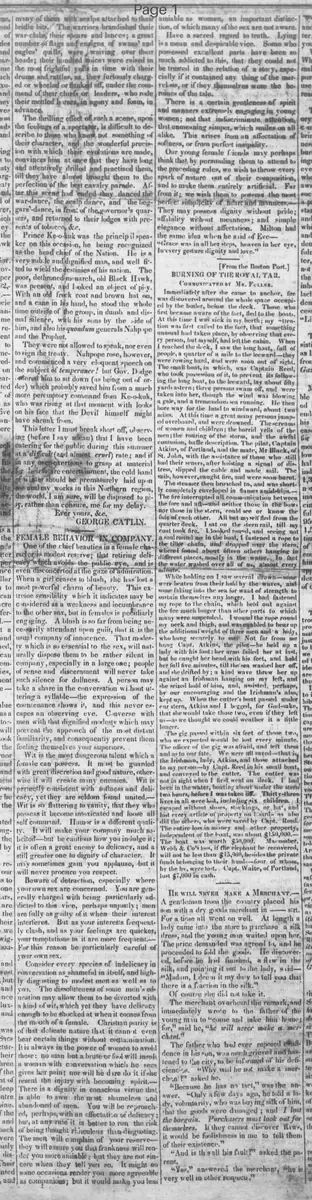
FEMALE BEHAVIOR IN COMPANY.
One of the chief beauties in a female character is modest reserve; that retiring delicacy which avoids the public eye, and is even disconcerted at the gaze of admiration. When a girl ceases to blush, she has lost a most powerful charm of beauty. This extreme sensibility which it indicates may be considered as a weakness and incumbrance to the other sex, but in females is peculiarly engaging. A blush is so far from being necessarily attendant upon guilt, that it is the usual company of innocence. That modesty which is so essential to the sex, will naturally dispose them to be rather silent in company, especially in a large one; people of sense and discernment will never take such silence for dullness. A person may take a share in the conversation without uttering a syllable—the expression of the countenance shows it, and this never escapes an observing eye. Converse with men with that dignified modesty which may prevent the approach of the most distant familiarity, and consequently prevent them feeling themselves your superiors.
Wit is the most dangerous talent which a female can possess. It must be guarded with great discretion and good nature, otherwise it will create many enemies. Wit is perfectly consistent with softness and delicacy, yet they are seldom found united. Wit is so flattering to vanity, that they who possess it become intoxicated and lose all self command. Humor is a different quality. It will make your company much solicited—but be cautious how you indulge it: it is often a great enemy to delicacy, and a still greater one to dignity of character. It may sometimes gain you applause, but it will never procure you respect.
Beware of detraction, especially where your own sex are concerned. You are generally charged with being particularly addicted to this vice, perhaps unjustly; men are fully as guilty of it when their interest interferes. But as your interests frequently clash, and as your feelings are quicker, your temptations to it are more frequent. For this reason be particularly careful of your own sex.
Consider every species of indelicacy in conversation as shameful in itself, and highly disgusting to modest men as well as to you. The dissoluteness of some men's education may allow them to be diverted with a kind of wit, which yet they have delicacy enough to be shocked at when it comes from the mouth of a female. Christian purity is of that delicate nature that it cannot even bear certain things without contamination. It is always in the power of women to avoid these: no man but a brute or fool will insult a woman with conversation which he sees gives her pain; nor will he dare do it if she resent the injury with becoming spirit.—There is a dignity in conscious virtue that is able to awe the most shameless and abandoned of men. You will be reproached, perhaps, with an affectation of delicacy; but, at any rate it is better to run the risk of being thought ridiculous than disgusting. The men will complain of your reserve—they will assure you that frankness will render you more amiable: but they are not sincere when they tell you so. It might on some occasions render you more agreeable as companions; but it would make you less amiable as women, an important distinction, of which many of the sex are not aware.
Have a sacred regard to truth. Lying is a mean and despicable vice. Some who possessed excellent parts have been so much addicted to this, that they could not be trusted in the relation of a story, especially if it contained any thing of the marvellous, or if they themselves were the heroines of the tale.
There is a certain gentleness of spirit and manners extremely engaging in young women; not that indiscriminate attention, that unmeaning simper, which smiles on all alike. This arises from an affectation of softness, or from perfect insipidity.
Our young female friends may perhaps think that by persuading them to attend to the preceding rules, we wish to throw every spark of nature out of their composition, and to make them entirely artificial. Far from it: we wish them to possess the most perfect simplicity of heart and manners.—They may possess dignity without pride; affability without meanness; and simple elegance without affectation. Milton had the same idea when he said of Eve—
"Grace was in all her steps, Heaven in her eye,
In every gesture dignity and love."
One of the chief beauties in a female character is modest reserve; that retiring delicacy which avoids the public eye, and is even disconcerted at the gaze of admiration. When a girl ceases to blush, she has lost a most powerful charm of beauty. This extreme sensibility which it indicates may be considered as a weakness and incumbrance to the other sex, but in females is peculiarly engaging. A blush is so far from being necessarily attendant upon guilt, that it is the usual company of innocence. That modesty which is so essential to the sex, will naturally dispose them to be rather silent in company, especially in a large one; people of sense and discernment will never take such silence for dullness. A person may take a share in the conversation without uttering a syllable—the expression of the countenance shows it, and this never escapes an observing eye. Converse with men with that dignified modesty which may prevent the approach of the most distant familiarity, and consequently prevent them feeling themselves your superiors.
Wit is the most dangerous talent which a female can possess. It must be guarded with great discretion and good nature, otherwise it will create many enemies. Wit is perfectly consistent with softness and delicacy, yet they are seldom found united. Wit is so flattering to vanity, that they who possess it become intoxicated and lose all self command. Humor is a different quality. It will make your company much solicited—but be cautious how you indulge it: it is often a great enemy to delicacy, and a still greater one to dignity of character. It may sometimes gain you applause, but it will never procure you respect.
Beware of detraction, especially where your own sex are concerned. You are generally charged with being particularly addicted to this vice, perhaps unjustly; men are fully as guilty of it when their interest interferes. But as your interests frequently clash, and as your feelings are quicker, your temptations to it are more frequent. For this reason be particularly careful of your own sex.
Consider every species of indelicacy in conversation as shameful in itself, and highly disgusting to modest men as well as to you. The dissoluteness of some men's education may allow them to be diverted with a kind of wit, which yet they have delicacy enough to be shocked at when it comes from the mouth of a female. Christian purity is of that delicate nature that it cannot even bear certain things without contamination. It is always in the power of women to avoid these: no man but a brute or fool will insult a woman with conversation which he sees gives her pain; nor will he dare do it if she resent the injury with becoming spirit.—There is a dignity in conscious virtue that is able to awe the most shameless and abandoned of men. You will be reproached, perhaps, with an affectation of delicacy; but, at any rate it is better to run the risk of being thought ridiculous than disgusting. The men will complain of your reserve—they will assure you that frankness will render you more amiable: but they are not sincere when they tell you so. It might on some occasions render you more agreeable as companions; but it would make you less amiable as women, an important distinction, of which many of the sex are not aware.
Have a sacred regard to truth. Lying is a mean and despicable vice. Some who possessed excellent parts have been so much addicted to this, that they could not be trusted in the relation of a story, especially if it contained any thing of the marvellous, or if they themselves were the heroines of the tale.
There is a certain gentleness of spirit and manners extremely engaging in young women; not that indiscriminate attention, that unmeaning simper, which smiles on all alike. This arises from an affectation of softness, or from perfect insipidity.
Our young female friends may perhaps think that by persuading them to attend to the preceding rules, we wish to throw every spark of nature out of their composition, and to make them entirely artificial. Far from it: we wish them to possess the most perfect simplicity of heart and manners.—They may possess dignity without pride; affability without meanness; and simple elegance without affectation. Milton had the same idea when he said of Eve—
"Grace was in all her steps, Heaven in her eye,
In every gesture dignity and love."
What sub-type of article is it?
Essay
What themes does it cover?
Moral Virtue
Social Manners
What keywords are associated?
Female Modesty
Social Behavior
Wit Dangers
Moral Conduct
Dignity Virtue
Literary Details
Title
Female Behavior In Company.
Subject
Advice On Female Modesty And Conduct In Society
Key Lines
When A Girl Ceases To Blush, She Has Lost A Most Powerful Charm Of Beauty.
Wit Is The Most Dangerous Talent Which A Female Can Possess.
There Is A Dignity In Conscious Virtue That Is Able To Awe The Most Shameless And Abandoned Of Men.
Have A Sacred Regard To Truth. Lying Is A Mean And Despicable Vice.
"Grace Was In All Her Steps, Heaven In Her Eye, In Every Gesture Dignity And Love."