Thank you for visiting SNEWPapers!
Sign up free
Story
July 31, 1844
The Arkansas Banner
Little Rock, Pulaski County, Arkansas
What is this article about?
Mr. Hume describes George Whitefield's dramatic pulpit eloquence in a sermon, where Whitefield pleads with the angel Gabriel to await news of a sinner's conversion, profoundly affecting the audience with tears.
Clipping
OCR Quality
98%
Excellent
Full Text
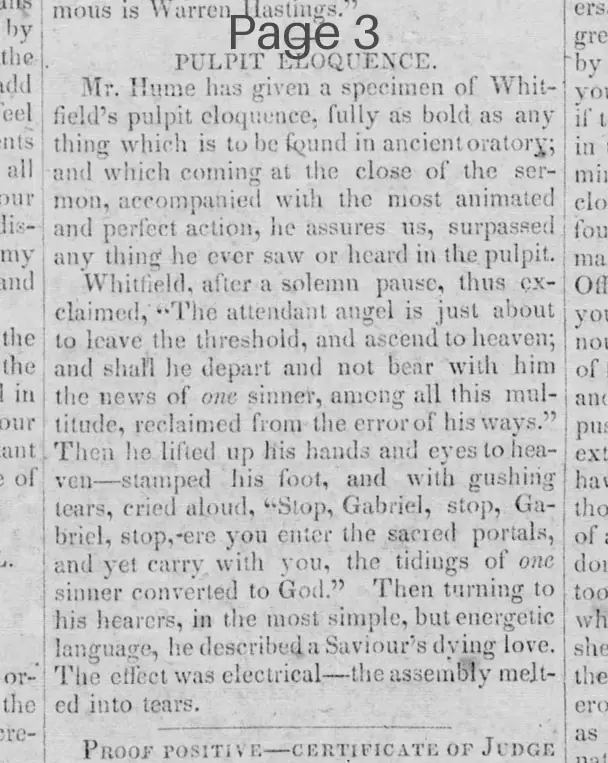
PULPIT ELOQUENCE.
Mr. Hume has given a specimen of Whitefield's pulpit eloquence, fully as bold as any thing which is to be found in ancient oratory; and which coming at the close of the sermon, accompanied with the most animated and perfect action, he assures us, surpassed any thing he ever saw or heard in the pulpit.
Whitefield, after a solemn pause, thus exclaimed, "The attendant angel is just about to leave the threshold, and ascend to heaven; and shall he depart and not bear with him the news of one sinner, among all this multitude, reclaimed from the error of his ways." Then he lifted up his hands and eyes to heaven—stamped his foot, and with gushing tears, cried aloud, "Stop, Gabriel, stop, Gabriel, stop, ere you enter the sacred portals, and yet carry with you, the tidings of one sinner converted to God." Then turning to his hearers, in the most simple, but energetic language, he described a Saviour's dying love. The effect was electrical—the assembly melted into tears.
Mr. Hume has given a specimen of Whitefield's pulpit eloquence, fully as bold as any thing which is to be found in ancient oratory; and which coming at the close of the sermon, accompanied with the most animated and perfect action, he assures us, surpassed any thing he ever saw or heard in the pulpit.
Whitefield, after a solemn pause, thus exclaimed, "The attendant angel is just about to leave the threshold, and ascend to heaven; and shall he depart and not bear with him the news of one sinner, among all this multitude, reclaimed from the error of his ways." Then he lifted up his hands and eyes to heaven—stamped his foot, and with gushing tears, cried aloud, "Stop, Gabriel, stop, Gabriel, stop, ere you enter the sacred portals, and yet carry with you, the tidings of one sinner converted to God." Then turning to his hearers, in the most simple, but energetic language, he described a Saviour's dying love. The effect was electrical—the assembly melted into tears.
What sub-type of article is it?
Biography
Historical Event
What themes does it cover?
Moral Virtue
Providence Divine
What keywords are associated?
Pulpit Eloquence
Whitefield Sermon
Angel Gabriel
Sinner Conversion
Religious Oratory
What entities or persons were involved?
Mr. Hume
Whitefield
Gabriel
Story Details
Key Persons
Mr. Hume
Whitefield
Gabriel
Story Details
Mr. Hume recounts Whitefield's bold and animated sermon climax, dramatically addressing the angel Gabriel to pause for news of a sinner's conversion, then describing the Saviour's love, resulting in the audience's emotional response of tears.