Thank you for visiting SNEWPapers!
Sign up free
Virginia Argus
Richmond, Virginia
What is this article about?
Account of U.S. diplomats Robert Livingston and James Monroe's negotiations in Paris leading to the Louisiana Purchase from France on April 30, 1803, highlighting Livingston's bold initiatives and the resolution of territorial and debt issues.
Clipping
OCR Quality
Full Text
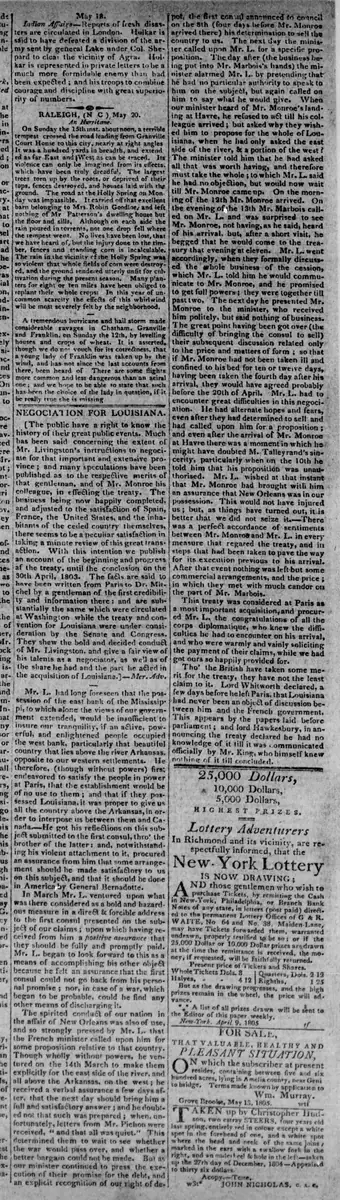
(The public have a right to know the history of their great public events. Much has been said concerning the extent of Mr. Livingston's instructions to negociate for that important and extensive province; and many speculations have been published as to the respective merits of that gentleman, and of Mr. Monroe his colleague, in effecting the treaty. The business being now happily completed, and adjusted to the satisfaction of Spain, France, the United States, and the inhabitants of the ceded country themselves, there seems to be a peculiar satisfaction in taking a minute review of this great transaction. With this intention we publish an account of the beginning and progress of the treaty, until the conclusion on the 30th April, 1803. The facts are said to have been written from Paris to Dr. Mitchell by a gentleman of the first credibility and information there: and are substantially the same which were circulated at Washington while the treaty and convention for Louisiana were under consideration by the Senate and Congress. They shew the bold and decided conduct of Mr. Livingston, and give a fair view of his talents as a negociator, as well as of the share he had and the part he acted in the acquisition of Louisiana.) —Mer. Adv.
Mr. L. had long foreseen that the possession of the east bank of the Mississippi, to which alone the views of our government extended, would be insufficient to insure our tranquility, if an active, powerful, and enlightened people occupied the west bank, particularly that beautiful country that lies above the river Arkansas, opposite to our western settlements. He therefore, (though without powers) first endeavored to satisfy the people in power at Paris, that the establishment would be of no use to them; and that if they possessed Louisiana, it was proper to give us all the country above the Arkansas, in order to interpose us between them and Canada. He got his reflections on this subject submitted to the first consul, thro' the brother of the latter: and, notwithstanding his violent attachment to it, procured an assurance from him that some arrangement should be made satisfactory to us on this subject, and that it should be done in America by General Bernadotte.
In March Mr. L. ventured upon what was there considered as a bold and hazardous measure in a direct & forcible address to the first consul presented on the subject of our claims; upon which having received from him a positive assurance that they should be fully and promptly paid. Mr. L. began to look forward to this as a means of accomplishing his other object because he felt an assurance that the first consul could not go back from his personal promise; nor, in case of a war, which began to be probable, could he find any other means of discharging it.
The spirited conduct of our nation in the affair of New Orleans was also of use, and so strongly pressed by Mr. L. that the French minister called upon him for some proposition relative to that country. Though wholly without powers, he ventured on the 14th March to make them explicitly for the east side of the river, and all above the Arkansas, on the west; he received a verbal assurance a few days after, that the next day should bring him a full and satisfactory answer; and he doubted not that such was prepared; when, unfortunately, letters from Mr. Pichon were received, and that all was quiet." This determined them to wait to see whether the war would pass over, and whether a better bargain could not be made. But as our minister continued to press the execution of their promise for the debt, and an explicit recognition of our right of deposit, the first consul announced to council on the 8th (four days before Mr. Monroe arrived there) his determination to sell the country to us. The next day the minister called upon Mr. L. for a specific proposition. The day after (the business being put into Mr. Marbois's hands) the minister alarmed Mr. L. by pretending that he had no particular authority to speak to him on the subject, but again called on him to say what he would give. When our minister heard of Mr. Monroe's landing at Havre, he refused to act till his colleague arrived; but asked why they wished him to propose for the whole of Louisiana, when he had only asked the east side of the river, & a portion of the west? The minister told him that he had asked all that was worth having, and therefore must take the whole; to which Mr. L. said he had no objection, but would now wait till Mr. Monroe came up. On the morning of the 12th Mr. Monroe arrived. On the evening of the 13th Mr. Marbois called on Mr. L. and was surprised to see Mr. Monroe, not having, as he said, heard of his arrival, but, after a short visit, he begged that he would come to the treasury that evening at eleven. Mr. L. went accordingly, when they formally discussed the whole business of the cession, which Mr. L. told him he would communicate to Mr. Monroe, and he promised to get full powers; they were together till past two. The next day he presented Mr. Monroe to the minister, who received him politely, but said nothing of business.
The great point having been got over (the difficulty of bringing the consul to sell) their subsequent discussion related only to the price and matters of form; so that if Mr. Monroe had not been taken ill and confined to his bed for ten or twelve days, having been taken the fourth day after his arrival, they would have agreed probably before the 20th of April. Mr. L. had to encounter great difficulties in this negociation. He had alternate hopes and fears, even after they had determined to sell and had called upon him for a proposition; and even after the arrival of Mr. Monroe at Havre there was a moment in which he might have doubted M. Talleyrand's sincerity, particularly when on the 10th he told him that his proposition was unauthorised. Mr. L. wished at that instant that Mr. Monroe had brought with him an assurance that New Orleans was in our possession. This would not have injured us; but, as things have turned out, it is better that we did not seize it. There was a perfect accordance of sentiments between Mr. Monroe and Mr. L. in every measure that regarded the treaty, and in steps that had been taken to pave the way for its execution previous to his arrival. After that event nothing was left but some commercial arrangements, and the price; in which they met with much candor on the part of Mr. Marbois.
This treaty was considered at Paris as a most important acquisition, and procured Mr. L. the congratulations of all the corps diplomatique, who knew the difficulties he had to encounter on his arrival, and who were warmly and vainly soliciting the payment of their claims, while we had got ours so happily provided for.
Tho' the British have taken some merit for the treaty, they have not the least claim to it. Lord Whitworth declared, a few days before he left Paris, that Louisiana had never been an object of discussion between him and the French government. This appears by the papers laid before parliament; and lord Hawkesbury, in announcing the treaty declared he had no knowledge of it till it was communicated officially by Mr. King, who himself knew nothing of it till concluded.
What sub-type of article is it?
What themes does it cover?
What keywords are associated?
What entities or persons were involved?
Where did it happen?
Story Details
Key Persons
Location
Paris
Event Date
30th April, 1803
Story Details
Robert Livingston, without full powers, boldly negotiates with French officials in Paris for U.S. territorial rights along the Mississippi, leveraging debt claims and the threat of war to secure assurances from Napoleon. James Monroe arrives to join, and together they finalize the purchase of all Louisiana territory, overcoming delays and illnesses, concluding the treaty on April 30, 1803.