Thank you for visiting SNEWPapers!
Sign up free
Editorial
December 18, 1823
Richmond Enquirer
Richmond, Richmond County, Virginia
What is this article about?
Editorial from Richmond, Dec. 18, 1823, warns of potential strife in 1824 presidential election with multiple candidates, citing 1800 and 1821 precedents. Urges Republicans to nominate one via congressional caucus to avoid divisive House vote by states.
Clipping
OCR Quality
95%
Excellent
Full Text
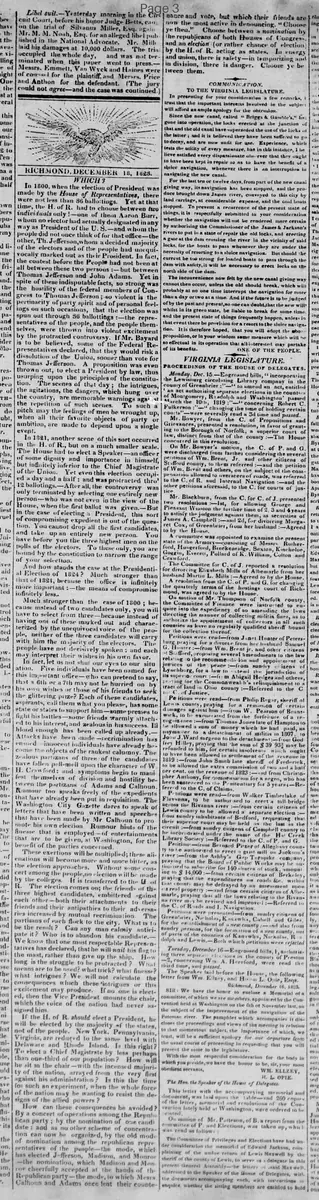
RICHMOND, DECEMBER 18, 1823.
WHICH?
In 1800, when the election of President was made by the House of Representatives, there were not less than 36 ballotings. Yet at that time, the H. of R. had to choose between two individuals only!—one of them Aaron Burr, whom no elector had actually designated in any way as President of the U. S.—and whom the people did not once think of for that office—the other, Th. Jefferson, whom a decided majority of the electors and of the people had unequivocally marked out as their President. In fact, the contest before the People had not been at all between these two persons:—but between Thomas Jefferson and John Adams. Yet in spite of these indisputable facts, so strong was the hostility of the federal members of Congress to Thomas Jefferson; so violent is the pertinacity of party spirit and of personal feelings on such occasions, that the election was spun out through 36 ballotings:—the representatives of the people, and the people themselves, were thrown into violent excitement by the protracted controversy. If Mr. Bayard is to be believed, some of the Federal Representatives declared, that they would risk a dissolution of the Union, sooner than vote for Thomas Jefferson. A proposition was even thrown out, to elect a President by law, thus usurping upon the principles of the constitution. The scenes of that day; the intrigues the agitations, the dangers, which hung over the country, are memorable warnings against the repetition of such scenes. To such a pitch may the feelings of men be wrought up, when all their favorite objects of party or ambition, are made to depend upon a single event.
In 1821, another scene of this sort occurred in the H. of R., but on a much smaller scale. The House had to elect a Speaker—an officer of some dignity and importance in himself, but infinitely inferior to the Chief Magistrate of the Union. Yet even this election occupied a day and a half : and was protracted through 12 ballotings.—After all, the controversy was only terminated by selecting one entirely new person—who was not even in the view of the House, when the first ballot was given.—But in the case of electing a President, this sort of compromising expedient is out of the question. You cannot drop all the first candidates, and take up an entirely new person. You have before you the three highest men on the polls of the electors. To these only, you are bound by the constitution to narrow the range of your selection.
And how stands the case at the Presidential Election of 1824? Much stronger than that of 1821, because the office is infinitely more important:—the means of compromise infinitely less.
Much stronger than the case of 1800; because instead of two candidates only, you will have to select from three—because instead of having one of these marked out and characterized by the unequivocal voice of the people, neither of the three candidates will carry with him the majority of the electors. The people have not decisively spoken : and each may interpret their wishes in his own favor.
In fact, let us not shut our eyes to our situation. Five individuals have been named for this important office—who can pretend to say, that a 6th or a 7th may not be hurried on by his own wishes or those of his friends to seek the glittering prize? Each of these candidates, aspirants, call them what you please, has some state or states to support him—some presses to fight his battles—some friends warmly attached to his interest, and zealous in his success. Ill blood enough has been called up already.—Attacks have been made—recrimination has ensued—innocent individuals have already become the objects of the rankest calumny. The zealous partisans of three of the candidates have fallen pell-mell upon the character of W. H. Crawford: and symptoms begin to manifest themselves of division and hostility between the partisans of Adams and Calhoun.
Rumour too speaks freely of the expedients that have already been put in requisition. The Washington City Gazette dares to speak of letters that have been written and speeches that have been made by Mr. Calhoun to promote his own election. Rumour hints of the finesse that is employed—of entertainments that are to be given, at Washington, for the benefit of the parties concerned.
These exertions will be multiplied; these alienations will become more and more bitter, as the election approaches. Without some concert among the people, no election will be made by the colleges. It is transferred to the H. of R. The election comes up; the friends of the three highest candidates, embittered against each other—both their attachments to their friends and their antipathies to their adversaries increased by mutual recrimination. The partisans of each flock to the city. What is to be the result? Can any man calmly anticipate it? Who is to abandon his candidate.—We know that one most respectable Representative has declared, that he will nail his flag to the mast, rather than give up the ship. How long is the struggle to be protracted? What means are to be used? what trick? what finesse? what intrigues? We will not calculate the consequences which these intrigues or this excitement may produce. If no one is elected, then the Vice President mounts the chair which the voice of the nation had never assigned him.
If the H. of R. should elect a President, he will be elected by the majority of the states, not of the people. New York, Pennsylvania, Virginia, are reduced to the same level with Delaware and Rhode Island. Is this right? To elect a Chief Magistrate by less perhaps than one-third of our population? How will he sit in the chair—with the incensed majority of the nation, arrayed from the very first against his administration? Is this the time for such an experiment, when the whole force of the nation may be wanting to resist the designs of the allied powers?
How can these consequences be avoided? By a concert of operations among the Republican party ; by the nomination of one candidate : and as no other scheme of concentration can now be organized, by the old mode of nomination among the republican representatives of the people—the mode, which has elected Jefferson, Madison, and Monroe—the nomination, which Madison and Monroe cheerfully accepted at the hands of the Republican party—the mode, to which Messrs. Calhoun and Adams once lent their countenance and vote, but which their friends are now the most active in denouncing. "Choose ye then." Choose between a nomination by the republicans of both Houses of Congress, and an election (or rather chance of election) by the H. of R. acting as states. In energy and union, there is safety—in temporizing and in division, there is danger. Choose ye between them.
WHICH?
In 1800, when the election of President was made by the House of Representatives, there were not less than 36 ballotings. Yet at that time, the H. of R. had to choose between two individuals only!—one of them Aaron Burr, whom no elector had actually designated in any way as President of the U. S.—and whom the people did not once think of for that office—the other, Th. Jefferson, whom a decided majority of the electors and of the people had unequivocally marked out as their President. In fact, the contest before the People had not been at all between these two persons:—but between Thomas Jefferson and John Adams. Yet in spite of these indisputable facts, so strong was the hostility of the federal members of Congress to Thomas Jefferson; so violent is the pertinacity of party spirit and of personal feelings on such occasions, that the election was spun out through 36 ballotings:—the representatives of the people, and the people themselves, were thrown into violent excitement by the protracted controversy. If Mr. Bayard is to be believed, some of the Federal Representatives declared, that they would risk a dissolution of the Union, sooner than vote for Thomas Jefferson. A proposition was even thrown out, to elect a President by law, thus usurping upon the principles of the constitution. The scenes of that day; the intrigues the agitations, the dangers, which hung over the country, are memorable warnings against the repetition of such scenes. To such a pitch may the feelings of men be wrought up, when all their favorite objects of party or ambition, are made to depend upon a single event.
In 1821, another scene of this sort occurred in the H. of R., but on a much smaller scale. The House had to elect a Speaker—an officer of some dignity and importance in himself, but infinitely inferior to the Chief Magistrate of the Union. Yet even this election occupied a day and a half : and was protracted through 12 ballotings.—After all, the controversy was only terminated by selecting one entirely new person—who was not even in the view of the House, when the first ballot was given.—But in the case of electing a President, this sort of compromising expedient is out of the question. You cannot drop all the first candidates, and take up an entirely new person. You have before you the three highest men on the polls of the electors. To these only, you are bound by the constitution to narrow the range of your selection.
And how stands the case at the Presidential Election of 1824? Much stronger than that of 1821, because the office is infinitely more important:—the means of compromise infinitely less.
Much stronger than the case of 1800; because instead of two candidates only, you will have to select from three—because instead of having one of these marked out and characterized by the unequivocal voice of the people, neither of the three candidates will carry with him the majority of the electors. The people have not decisively spoken : and each may interpret their wishes in his own favor.
In fact, let us not shut our eyes to our situation. Five individuals have been named for this important office—who can pretend to say, that a 6th or a 7th may not be hurried on by his own wishes or those of his friends to seek the glittering prize? Each of these candidates, aspirants, call them what you please, has some state or states to support him—some presses to fight his battles—some friends warmly attached to his interest, and zealous in his success. Ill blood enough has been called up already.—Attacks have been made—recrimination has ensued—innocent individuals have already become the objects of the rankest calumny. The zealous partisans of three of the candidates have fallen pell-mell upon the character of W. H. Crawford: and symptoms begin to manifest themselves of division and hostility between the partisans of Adams and Calhoun.
Rumour too speaks freely of the expedients that have already been put in requisition. The Washington City Gazette dares to speak of letters that have been written and speeches that have been made by Mr. Calhoun to promote his own election. Rumour hints of the finesse that is employed—of entertainments that are to be given, at Washington, for the benefit of the parties concerned.
These exertions will be multiplied; these alienations will become more and more bitter, as the election approaches. Without some concert among the people, no election will be made by the colleges. It is transferred to the H. of R. The election comes up; the friends of the three highest candidates, embittered against each other—both their attachments to their friends and their antipathies to their adversaries increased by mutual recrimination. The partisans of each flock to the city. What is to be the result? Can any man calmly anticipate it? Who is to abandon his candidate.—We know that one most respectable Representative has declared, that he will nail his flag to the mast, rather than give up the ship. How long is the struggle to be protracted? What means are to be used? what trick? what finesse? what intrigues? We will not calculate the consequences which these intrigues or this excitement may produce. If no one is elected, then the Vice President mounts the chair which the voice of the nation had never assigned him.
If the H. of R. should elect a President, he will be elected by the majority of the states, not of the people. New York, Pennsylvania, Virginia, are reduced to the same level with Delaware and Rhode Island. Is this right? To elect a Chief Magistrate by less perhaps than one-third of our population? How will he sit in the chair—with the incensed majority of the nation, arrayed from the very first against his administration? Is this the time for such an experiment, when the whole force of the nation may be wanting to resist the designs of the allied powers?
How can these consequences be avoided? By a concert of operations among the Republican party ; by the nomination of one candidate : and as no other scheme of concentration can now be organized, by the old mode of nomination among the republican representatives of the people—the mode, which has elected Jefferson, Madison, and Monroe—the nomination, which Madison and Monroe cheerfully accepted at the hands of the Republican party—the mode, to which Messrs. Calhoun and Adams once lent their countenance and vote, but which their friends are now the most active in denouncing. "Choose ye then." Choose between a nomination by the republicans of both Houses of Congress, and an election (or rather chance of election) by the H. of R. acting as states. In energy and union, there is safety—in temporizing and in division, there is danger. Choose ye between them.
What sub-type of article is it?
Partisan Politics
Constitutional
What keywords are associated?
1824 Presidential Election
Republican Unity
House Of Representatives
Congressional Caucus
Party Division
Election Intrigue
What entities or persons were involved?
Thomas Jefferson
Aaron Burr
John Adams
Mr. Bayard
W. H. Crawford
John Quincy Adams
John C. Calhoun
James Madison
James Monroe
Editorial Details
Primary Topic
Warning Against Chaos In 1824 Presidential Election
Stance / Tone
Urging Republican Party Unity Via Congressional Nomination
Key Figures
Thomas Jefferson
Aaron Burr
John Adams
Mr. Bayard
W. H. Crawford
John Quincy Adams
John C. Calhoun
James Madison
James Monroe
Key Arguments
Historical Precedent Of 1800 Election Showed 36 Ballots Due To Federalist Opposition To Jefferson, Risking Union Dissolution.
1821 Speaker Election Took 12 Ballots, Resolved By New Candidate, But Impossible For President.
1824 Election Involves Three Candidates Without Majority, Increasing Division Risks.
Multiple Aspirants And Partisans Already Causing Calumny And Intrigues.
House Election By States Diminishes Large States' Influence, Potentially Electing President Opposed By Majority.
Solution: Republican Congressional Nomination As In Past For Jefferson, Madison, Monroe.