Thank you for visiting SNEWPapers!
Sign up free
Story
December 1, 1877
American Citizen
Canton, Madison County, Mississippi
What is this article about?
Account of Confederate hardships during the Civil War, including medicine shortages, failed opium cultivation, alcohol restrictions, herbal remedies, and women's sacrifices like making bandages and sand-bags during the Seven Days' Battles around Richmond.
Clipping
OCR Quality
98%
Excellent
Full Text
Mrs. M. P. Handy writes in the Philadelphia Times :
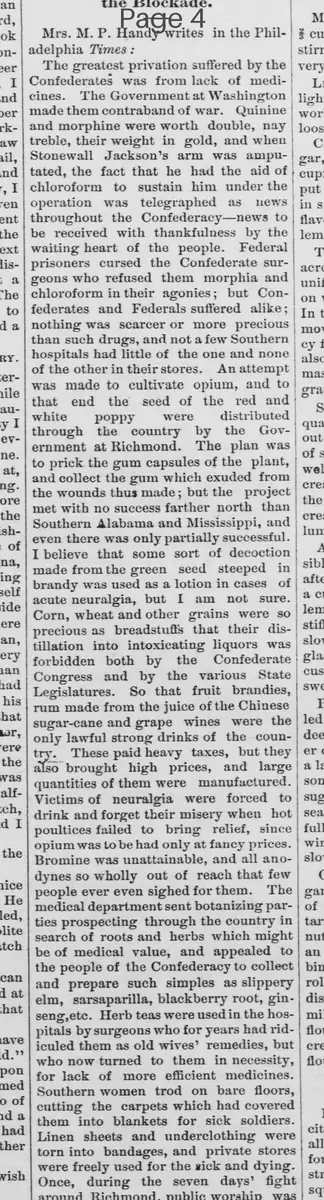
The greatest privation suffered by the Confederates was from lack of medicines. The Government at Washington made them contraband of war. Quinine and morphine were worth double, nay treble, their weight in gold, and when Stonewall Jackson's arm was amputated, the fact that he had the aid of chloroform to sustain him under the operation was telegraphed as news throughout the Confederacy-news to be received with thankfulness by the waiting heart of the people. Federal prisoners cursed the Confederate surgeons who refused them morphia and chloroform in their agonies; but Confederates and Federals suffered alike; nothing was scarcer or more precious than such drugs, and not a few Southern hospitals had little of the one and none of the other in their stores. An attempt was made to cultivate opium, and to that end the seed of the red and white poppy were distributed through the country by the Government at Richmond. The plan was to prick the gum capsules of the plant, and collect the gum which exuded from the wounds thus made; but the project met with no success farther north than Southern Alabama and Mississippi, and even there was only partially successful. I believe that some sort of decoction made from the green seed steeped in brandy was used as a lotion in cases of acute neuralgia, but I am not sure.
Corn, wheat and other grains were so precious as breadstuffs that their distillation into intoxicating liquors was forbidden both by the Confederate Congress and by the various State Legislatures. So that fruit brandies, rum made from the juice of the Chinese sugar-cane and grape wines were the only lawful strong drinks of the country. These paid heavy taxes, but they also brought high prices, and large quantities of them were manufactured.
Victims of neuralgia were forced to drink and forget their misery when hot poultices failed to bring relief, since opium was to be had only at fancy prices. Bromine was unattainable, and all anodynes so wholly out of reach that few people ever even sighed for them. The medical department sent botanizing parties prospecting through the country in search of roots and herbs which might be of medical value, and appealed to the people of the Confederacy to collect and prepare such simples as slippery elm, sarsaparilla, blackberry root, ginseng, etc. Herb teas were used in the hospitals by surgeons who for years had ridiculed them as old wives' remedies, but who now turned to them in necessity, for lack of more efficient medicines.
Southern women trod on bare floors, cutting the carpets which had covered them into blankets for sick soldiers. Linen sheets and underclothing were torn into bandages, and private stores were freely used for the sick and dying. Once, during the seven days' fight around Richmond, public worship was suspended on Sunday and the members of the churches worked all day long in their lecture-rooms making sand-bags for the fortifications and rolling bandages and scraping lint for the wounded.
The greatest privation suffered by the Confederates was from lack of medicines. The Government at Washington made them contraband of war. Quinine and morphine were worth double, nay treble, their weight in gold, and when Stonewall Jackson's arm was amputated, the fact that he had the aid of chloroform to sustain him under the operation was telegraphed as news throughout the Confederacy-news to be received with thankfulness by the waiting heart of the people. Federal prisoners cursed the Confederate surgeons who refused them morphia and chloroform in their agonies; but Confederates and Federals suffered alike; nothing was scarcer or more precious than such drugs, and not a few Southern hospitals had little of the one and none of the other in their stores. An attempt was made to cultivate opium, and to that end the seed of the red and white poppy were distributed through the country by the Government at Richmond. The plan was to prick the gum capsules of the plant, and collect the gum which exuded from the wounds thus made; but the project met with no success farther north than Southern Alabama and Mississippi, and even there was only partially successful. I believe that some sort of decoction made from the green seed steeped in brandy was used as a lotion in cases of acute neuralgia, but I am not sure.
Corn, wheat and other grains were so precious as breadstuffs that their distillation into intoxicating liquors was forbidden both by the Confederate Congress and by the various State Legislatures. So that fruit brandies, rum made from the juice of the Chinese sugar-cane and grape wines were the only lawful strong drinks of the country. These paid heavy taxes, but they also brought high prices, and large quantities of them were manufactured.
Victims of neuralgia were forced to drink and forget their misery when hot poultices failed to bring relief, since opium was to be had only at fancy prices. Bromine was unattainable, and all anodynes so wholly out of reach that few people ever even sighed for them. The medical department sent botanizing parties prospecting through the country in search of roots and herbs which might be of medical value, and appealed to the people of the Confederacy to collect and prepare such simples as slippery elm, sarsaparilla, blackberry root, ginseng, etc. Herb teas were used in the hospitals by surgeons who for years had ridiculed them as old wives' remedies, but who now turned to them in necessity, for lack of more efficient medicines.
Southern women trod on bare floors, cutting the carpets which had covered them into blankets for sick soldiers. Linen sheets and underclothing were torn into bandages, and private stores were freely used for the sick and dying. Once, during the seven days' fight around Richmond, public worship was suspended on Sunday and the members of the churches worked all day long in their lecture-rooms making sand-bags for the fortifications and rolling bandages and scraping lint for the wounded.
What sub-type of article is it?
Historical Event
Medical Curiosity
Curiosity
What themes does it cover?
Misfortune
Survival
Bravery Heroism
What keywords are associated?
Confederate Hardships
Medicine Shortage
Opium Cultivation
Herbal Remedies
Women S Sacrifices
Civil War
Seven Days Battles
What entities or persons were involved?
Mrs. M. P. Handy
Stonewall Jackson
Where did it happen?
Confederacy, Southern Alabama, Mississippi, Richmond
Story Details
Key Persons
Mrs. M. P. Handy
Stonewall Jackson
Location
Confederacy, Southern Alabama, Mississippi, Richmond
Event Date
Civil War Era
Story Details
Description of Confederate privations including medicine shortages like quinine and morphine, failed opium cultivation, alcohol restrictions, use of herbal remedies, and women's contributions such as sacrificing household items for soldiers and aiding during the Seven Days' Battles around Richmond.