Thank you for visiting SNEWPapers!
Sign up free
Alexandria Daily Advertiser
Alexandria, Virginia
What is this article about?
Paris report on France-Austria relations since Peace of Luneville, detailing French efforts for peace, English perfidy, Austrian treaty violations and war preparations, culminating in Austrian invasion of Bavaria and inevitable war.
Merged-components note: Direct textual continuation across pages 2 and 3 of the French minister's exposition on relations with Austria and England.
Clippings
1 of 2
OCR Quality
Full Text
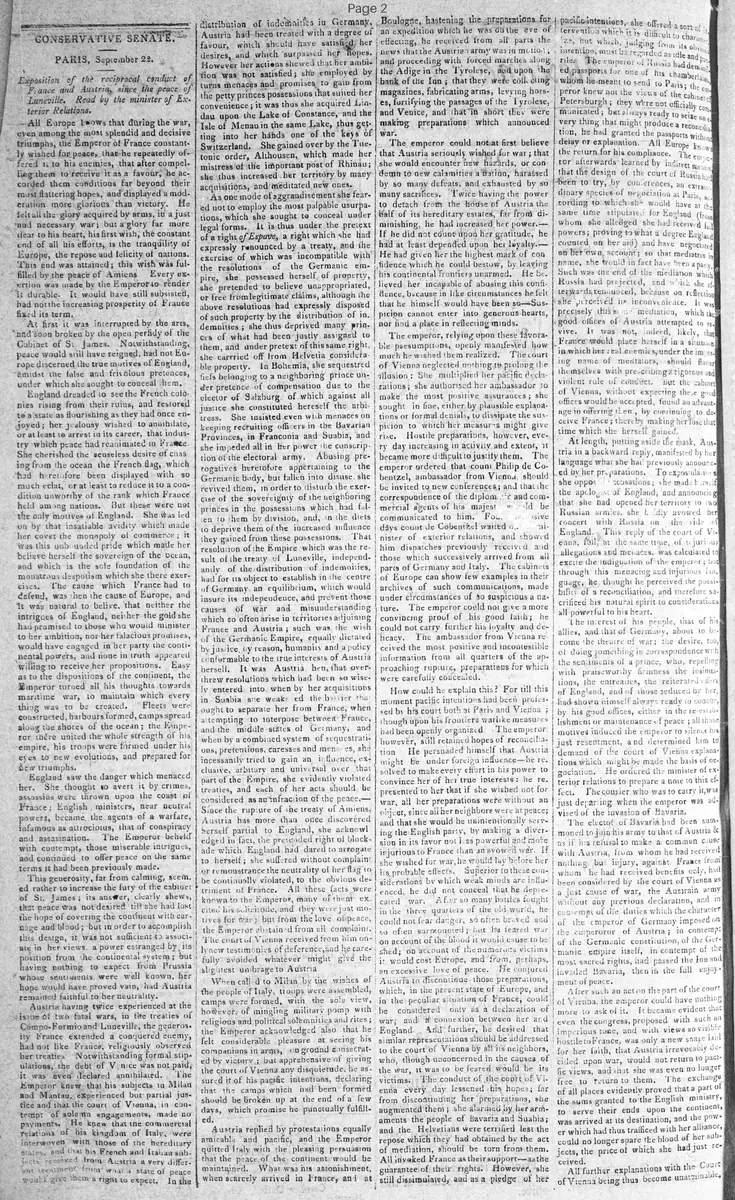
PARIS, September 28.
Exposition of the reciprocal conduct of France and Austria, since the peace of Luneville. Read by the minister of Exterior Relations.
All Europe knows that during the war, even among the most splendid and decisive triumphs, the Emperor of France constantly wished for peace, that he repeatedly offered it to his enemies, that after compelling them to receive it as a favour, he accorded them conditions far beyond their most flattering hopes, and displayed a moderation more glorious than victory. He felt all the glory acquired by arms, in a just and necessary war; but a glory far more dear to his heart, his first wish, the constant end of all his efforts, is the tranquility of Europe, the repose and felicity of nations.
This end was attained; this wish was fulfilled by the peace of Amiens. Every exertion was made by the Emperor to render it durable. It would have still subsisted, had not the increasing prosperity of France fixed its term.
At first it was interrupted by the arms, and soon broken by the open perfidy of the Cabinet of St. James. Notwithstanding, peace would still have reigned, had not Europe discerned the true motives of England, amidst the false and frivolous pretences, under which she sought to conceal them.
England dreaded to see the French colonies rising from their ruins, and restored to a state as flourishing as they had once enjoyed; her jealousy wished to annihilate, or at least to arrest in its career, that industry which peace had reanimated in France.
She cherished the senseless desire of chasing from the ocean the French flag, which had heretofore been displayed with so much eclat, or at least to reduce it to a condition unworthy of the rank which France held among nations. But these were not the only motives of England. She was led on by that insatiable avidity which made her covet the monopoly of commerce; it was this unbounded pride which made her believe herself the sovereign of the Ocean, and which is the sole foundation of the monstrous despotism which she there exercises. The cause which France had to defend, was then the cause of Europe, and it was natural to believe, that neither the intrigues of England, neither the gold she had promised to those who would minister to her ambition, nor her fallacious promises, would have engaged in her party the continental powers, and none in truth appeared willing to receive her propositions. Easy as to the dispositions of the continent, the Emperor turned all his thoughts towards maritime war, to maintain which every thing was to be created. Fleets were constructed, harbours formed, camps spread along the shores of the ocean; the Emperor there united the whole strength of his empire, his troops were formed under his eyes to new evolutions, and prepared for new triumphs.
England saw the danger which menaced her. She thought to avert it by crimes, assassins were thrown upon the coast of France; English ministers, near neutral powers, became the agents of a warfare infamous as atrocious, that of conspiracy and assassination. The Emperor beheld with contempt, those miserable intrigues, and continued to offer peace on the same terms it had been previously made.
This generosity, far from calming, seemed rather to increase the fury of the cabinet of St. James; its answer, clearly shews, that peace was not desired till she had lost the hope of covering the continent with carnage and blood; but in order to accomplish this design, it was not sufficient to associate in her views a power estranged by its position from the continental system; but having nothing to expect from Prussia whose sentiments were well known, her hope would have proved vain, had Austria remained faithful to her neutrality.
Austria having twice experienced at the issue of two fatal wars, in the treaties of Campo-Formio and Luneville, the generosity France extended a conquered enemy, had not like France, religiously observed her treaties. Notwithstanding formal stipulations, the debt of Venice was not paid, it was even declared annihilated. The Emperor knew that his subjects in Milan and Mantua, experienced but partial justice and that the court of Vienna, in contempt of solemn engagements, made no payments. He knew that the commercial relations of his kingdom of Italy, were interwoven with those of the hereditary states, and that his French and Italian subjects received from Austria a very different treatment from what a state of peace would give them a right to expect. In the distribution of indemnities in Germany,
austria had been treated with a degree of favour, which should have satisfied her desires, and which surpassed her hopes. However her actions shewed that her ambition was not satisfied; she employed by turns menaces and promises to gain from the petty princes possessions that suited her convenience; it was thus she acquired Lindau upon the Lake of Constance, and the Isle of Mainau in the same Lake, thus getting into her hands one of the keys of Switzerland. She gained over by the Teutonic order, Althausen, which made her mistress of the important post of Rhinau; she thus increased her territory by many acquisitions, and meditated new ones.
As one mode of aggrandisement she feared not to employ the most palpable usurpations, which she sought to conceal under legal forms. It is thus under the pretext of a right of Espave, a right which she had expressly renounced by a treaty, and the exercise of which was incompatible with the resolutions of the Germanic empire, she possessed herself of property, she pretended to believe unappropriated, or free from legitimate claims, although the above resolutions had expressly disposed of such property by the distribution of indemnities; she thus deprived many princes of what had been justly assigned to them, and under pretext of this same right, she carried off from Helvetia considerable property. In Bohemia, she sequestred fiefs belonging to a neighboring prince under pretence of compensation due to the elector of Salzburg, of which against all justice she constituted herself the arbitress. She insisted even with menaces on keeping recruiting officers in the Bavarian Provinces, in Franconia and Suabia, and she impeded all in her power the conscription of the electoral army. Abusing prerogatives heretofore appertaining to the Germanic body, but fallen into disuse, she revived them, in order to disturb the exercise of the sovereignty of the neighboring princes in the possessions which had fallen to them by division, and, in the diets to deprive them of the increased influence they gained from these possessions. That resolution of the Empire which was the result of the treaty of Luneville, independently of the distribution of indemnities, had for its object to establish in the centre of Germany an equilibrium, which would insure its independence, and prevent those causes of war and misunderstanding which so often arise in territories adjoining France and Austria; such was the wish of the Germanic Empire, equally dictated by justice, by reason, humanity and a policy conformable to the true interests of Austria herself. It was Austria then, that overthrew resolutions which had been so wisely entered into, when by her acquisitions in Suabia she weakened the barrier that ought to separate her from France, when attempting to interpose between France, and the middle states of Germany, and when by a combined system of sequestrations, pretensions, caresses and menaces, she incessantly tried to gain an influence, exclusive, arbitrary and universal over that part of the Empire, she evidently violated treaties, and each of her acts should be considered as an infraction of the peace.
Since the rupture of the treaty of Amiens, Austria has more than once discovered herself partial to England, she acknowledged in fact, the pretended right of blockade which England had dared to arrogate to herself; she suffered without complaint or remonstrance the neutrality of her flag to be continually violated, to the obvious detriment of France. All these facts were known to the Emperor, many of them excited his solicitude, and they were just motives for war; but from the love of peace, the Emperor abstained from all complaint.
The court of Vienna received from him only new testimonies of deference, and he carefully avoided whatever might give the slightest umbrage to Austria. When called to Milan by the wishes of the people of Italy, troops were assembled, camps were formed, with the sole view, however, of mingling military pomp with religious and political solemnities and rites; the Emperor acknowledged also that he felt considerable pleasure at seeing his companions in arms, on ground consecrated by victory; but apprehensive of giving the court of Vienna any disquietude, he assured it of his pacific intentions, declaring that the camps which had been formed should be broken up at the end of a few days, which promise he punctually fulfilled.
Austria replied by protestations equally amicable and pacific, and the Emperor quitted Italy with the pleasing persuasion that the peace of the continent would be maintained. What was his astonishment when scarcely arrived in France, and at
Boulogne, hastening the preparations for an expedition which he was on the eve of effecting, he received from all parts the news that the Austrian army was in motion; and proceeding with forced marches along the Adige in the Tyrolese, and upon the bank of the Inn; that they were collecting magazines, fabricating arms, levying horses, fortifying the passages of the Tyrolese, and Venice, and that in short they were making preparations which announced war.
The emperor could not at first believe that Austria seriously wished for war; that she would encounter new hazards, or condemn to new calamities a nation, harassed by so many defeats, and exhausted by so many sacrifices. Twice having the power to detach from the house of Austria the half of its hereditary estates, far from diminishing, he had increased her power. If he did not count upon her gratitude, he had at least depended upon her loyalty. He had given her the highest mark of confidence which he could bestow, by leaving his continental frontiers unarmed. He believed her incapable of abusing this confidence, because in like circumstances he felt that he himself would have been so. Suspicion cannot enter into generous hearts, nor find a place in reflecting minds.
The emperor, relying upon these favorable presumptions, openly manifested how much he wished them realized. The court of Vienna neglected nothing to prolong the illusion: She multiplied her pacific declarations; she authorised her ambassador to make the most positive assurances; she sought in fine, either by plausible explanations or formal denials, to dissipate the suspicion to which her measures might give rise. Hostile preparations, however, every day increasing in activity and extent, it became more difficult to justify them. The emperor ordered that count Philip de Cobentzel, ambassador from Vienna, should be invited to new conferences; and that the correspondence of the diplomatic and commercial agents of his majesty should be communicated to him. Four successive days count de Cobentzel waited on the minister of exterior relations, and showed him dispatches previously received and those which successively arrived from all parts of Germany and Italy. The cabinets of Europe can show few examples in their archives of such communications, made under circumstances of so suspicious a nature. The emperor could not give a more convincing proof of his good faith; he could not carry further his loyalty and delicacy. The ambassador from Vienna received the most positive and incontestable information from all quarters of the approaching rupture, preparations for which were carefully concealed.
How could he explain this? For till this moment pacific intentions had been professed by his court both at Paris and Vienna; though upon his frontiers warlike measures had been openly organized. The emperor, however, still retained hopes of reconciliation. He persuaded himself that Austria might be under foreign influence--he resolved to make every effort in his power to convince her of her true interests: he represented to her that if she wished not for war, all her preparations were without an object, since all her neighbors were at peace; and that she would be unintentionally serving the English party, by making a diversion in its favor not less powerful and more injurious to France than an avowed war. If she wished for war, he would lay before her its probable effects. Superior to these considerations by which weak minds are influenced, he did not conceal that he deprecated war. After so many battles fought in the three quarters of the old world, he could not fear danger, so often braved and so often surmounted; but he feared war on account of the blood it would cause to be shed; on account of the numerous victims it would cost Europe, and from, perhaps, an excessive love of peace. He conjured Austria to discontinue those preparations, which, in the present state of Europe, and in the peculiar situation of France, could be considered only as a declaration of war; and of connexion between her and England. And further, he desired that similar representations should be addressed to the court of Vienna by all its neighbors, who, though unconcerned in the causes of the war, it was to be feared would be its victims. The conduct of the court of Vienna every day lessened his hopes; far from discontinuing her preparations, she augmented them; she alarmed by her armaments the people of Bavaria and Suabia; and the Helvetians were terrified lest the repose which they had obtained by the act of mediation, should be torn from them.
All invoked France as their support--as the guarantee of their rights. However, she still dissimulated,-- and as a pledge of her pacific intentions, she offered a sort of intervention which it is difficult to characterize, but which, judging from its obvious intention, must be regarded as idle and puerile. The emperor of Russia had demanded passports for one of his chamberlains, whom he meant to send to Paris; the emperor knew not the views of the cabinet of Petersburgh; they were not officially communicated; but always ready to seize on every thing that might produce a reconciliation, he had granted the passports without delay or explanation. All Europe knows the return for his compliance. The emperor afterwards learned by indirect means, that the design of the court of Russia had been to try, by conferences, an extraordinary species of negociation at Paris, according to which she would have at the same time stipulated for England (from whom she alleged she had received full powers; proving to what a degree England counted on her aid) and have negociated on her own account; so that mediatrix in name, she would in fact have been a party.
Such was the end of the mediation which Russia had projected, and which she afterwards renounced, because on reflection she perceived its inconvenience. It was precisely this same mediation, which the good offices of Austria attempted to revive. It was not, indeed, likely, that France would place herself in a situation in which her real enemies, under the imposing name of mediators, should flatter themselves with prescribing a rigorous and violent rule of conduct. But the cabinet of Vienna, without expecting these good offices would be accepted, found an advantage in offering them, by continuing to deceive France; thereby making her lose that time which she herself gained.
At length, putting aside the mask, Austria in a backward reply, manifested by her language what she had previously announced by her preparations. To expostulators she opposed accusations; she made herself the apologist of England, and announcing that she had opened her territory to two Russian armies, she avowed her concert with Russia on the side of England. This reply of the court of Vienna, full at the same time, of injurious suspicions and menaces, was calculated to excite the indignation of the emperor; but through this menacing and injurious language, he thought he perceived the possibility of a reconciliation. and therefore sacrificed his natural spirit to considerations all powerful to his heart.
The interest of his people, that of his allies, and that of Germany, about to become the theatre of war: the desire, too, of doing something in correspondence with the sentiments of a prince, who, repelling with praiseworthy firmness the insinuations, the entreaties, the reiterated offers of England, and of those seduced by her, had shown himself always ready to concur, by his good offices, either in the re-establishment or maintenance of peace; all those motives induced the emperor to silence his just resentment, and determined him to demand of the court of Vienna explanations which might be made the basis of negociation. He ordered the minister of exterior relations to prepare a note to this effect. The courier who was to carry it, was just departing when the emperor was advised of the invasion of Bavaria.
The elector of Bavaria had been summoned to join his army to that of Austria & as if his refusal to make a common cause with Austria, from whom he had received nothing but injury, against France from whom he had received benefits only, had been considered by the court of Vienna as a just cause of war, the Austrian army without any previous declaration, and in contempt of the duties which the character of the emperor of Germany imposed on the emperor of Austria: in contempt of the Germanic constitution, of the Germanic empire itself, in contempt of the most sacred rights, had passed the Inn and invaded Bavaria, then in the full enjoyment of peace.
After such an act on the part of the court of Vienna, the emperor could have nothing more to ask of it. It became evident that even the congress, proposed with such an imperious tone, and with views so visibly hostile to France, was only a new snare laid for her faith, that Austria irrevocably decided upon war, would not return to pacific views, and that she was even no longer free to return to them. The exchange of all places evidently proved that a part of the sums granted to the English ministry, to serve their ends upon the continent was arrived at its destination, and the power which had thus trafficked with her alliance, could no longer spare the blood of her subjects, the price of which she had just received.
All further explanations with the Court of Vienna being thus become unattainable,
the way of arms is henceforward the only one compatible with honor.
Let England applaud herself upon having at length found allies; let her rejoice that blood is about to flow upon the continent; let her flatter herself that her own will be spared; let her hope to find her safety in the discord of other states; her joy will be of short duration, her hopes will be vain, and the day is not far distant when the rights of nations will be at length avenged.
The emperor obliged to repel an unjust aggression, which he has in vain endeavoured to prevent, has been constrained to suspend the execution of his first designs. He has withdrawn from the shores of the ocean those veteran bands so often victorious, at whose head he marches. He will not lay down his arms before he has obtained full and entire satisfaction; and complete security as well for his own states as for those of his allies.
What sub-type of article is it?
What keywords are associated?
What entities or persons were involved?
Where did it happen?
Foreign News Details
Primary Location
Austria
Event Date
September 28
Key Persons
Outcome
austrian invasion of bavaria without declaration of war, leading to french commitment to repel aggression and obtain full satisfaction through arms.
Event Details
Exposition details French peace efforts post-Luneville and Amiens, English perfidy, Austrian treaty violations including unpaid debts, territorial usurpations in Germany and Switzerland, partiality to England, war preparations despite assurances, failed negotiations via ambassador Cobentzel, Russian mediation attempts, and culminating Austrian invasion of Bavaria, forcing France to war.