Thank you for visiting SNEWPapers!
Sign up free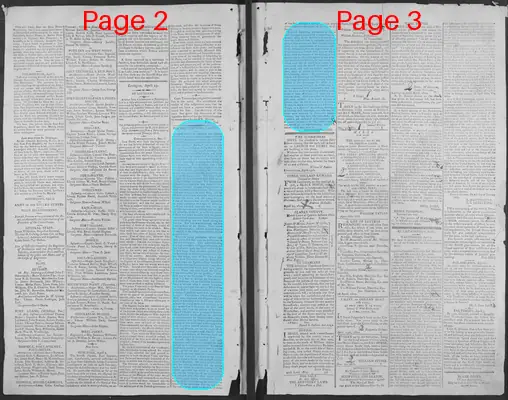
The Kentucky Gazette
Lexington, Fayette County, Kentucky
What is this article about?
A letter criticizing 'Philanthropist' for opposing classical languages and human literature without proper study, illustrated by a parable of deists converted through Bible examination. Argues for the value of Latin, Greek, and Hebrew in preserving knowledge, language unity, and scriptural understanding.
Merged-components note: This reader letter responding to the Philanthropist spans across pages 2 and 3, with text continuing directly.
Clippings
1 of 2
OCR Quality
Full Text
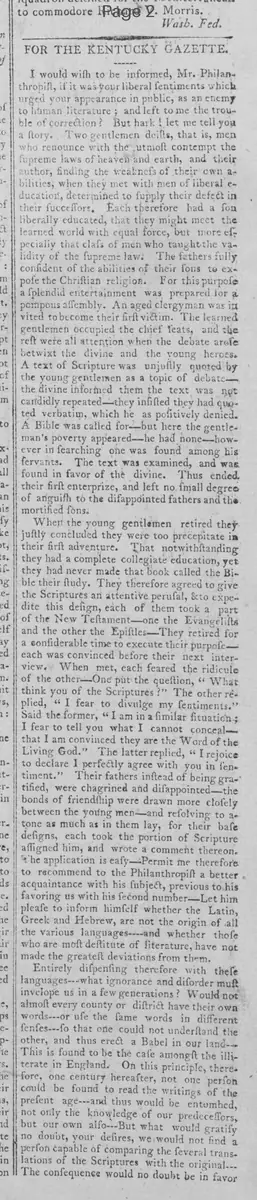
FOR THE KENTUCKY GAZETTE.
I would wish to be informed, Mr. Philanthropist, if it was your liberal sentiments which urged your appearance in public, as an enemy to human literature: and left to me the trouble of correction? But hark! let me tell you a story. Two gentlemen deists, that is, men who renounce with the utmost contempt the supreme laws of heaven and earth, and their author, finding the weakness of their own abilities, when they met with men of liberal education, determined to supply their defect in their successors. Each therefore had a son liberally educated, that they might meet the learned world with equal force, but more especially that class of men who taught the validity of the supreme law: The fathers fully confident of the abilities of their sons to expose the Christian religion. For this purpose a splendid entertainment was prepared for a pompous assembly. An aged clergyman was invited to become their first victim. The learned gentlemen occupied the chief seats, and the rest were all attention when the debate arose betwixt the divine and the young heroes.
A text of Scripture was unjustly quoted by the young gentlemen as a topic of debate- the divine informed them the text was not candidly repeated—they insisted they had quoted verbatim, which he as positively denied. A Bible was called for-but here the gentleman's poverty appeared he had none however in searching one was found among his servants. The text was examined, and was found in favor of the divine. Thus ended their first enterprize, and left no small degree of anguish to the disappointed fathers and the mortified sons.
When the young gentlemen retired they justly concluded they were too precipitate in their first adventure. That notwithstanding they had a complete collegiate education, yet they had never made that book called the Bible their study. They therefore agreed to give the Scriptures an attentive perusal, &to expedite this design, each of them took a part of the New Testament-one the Evangelists and the other the Epistles They retired for a considerable time to execute their purpose- each was convinced before their next interview. When met, each feared the ridicule of the other One put the question, " What think you of the Scriptures?" The other replied, " I fear to divulge my sentiments." Said the former, " I am in a similar situation.; I fear to tell you what I cannot conceal that I am convinced they are the Word of the Living God." The latter replied, " I rejoice to declare I perfectly agree with you in sentiment." Their fathers instead of being gratified, were chagrined and disappointed the bonds of friendship were drawn more closely between the young men -and resolving to atone as much as in them lay, for their base designs, each took the portion of Scripture assigned him, and wrote a comment thereon.
the application is easy-Permit me therefore to recommend to the Philanthropist a better acquaintance with his subject, previous to his favoring us with his second number—Let him please to inform himself whether the Latin, Greek and Hebrew, are not the origin of all the various languages----and whether those who are most destitute of literature, have not made the greatest deviations from them.
Entirely dispensing therefore with the languages---what ignorance and disorder must invelope us in a few generations? Would not almost every county or district have their own words---or use the same words in different senses---so that one could not understand the other, and thus erect a Babel in our land-- This is found to be the case amongst the illiterate in England. On this principle, therefore, one century hereafter, not one person could be found to read the writings of the present age---and thus would be entombed, not only the knowledge of our predecessors, but our own also---But what would gratify no doubt, your desires, we would not find a person capable of comparing the several translations of the Scriptures with the original... The consequence would no doubt be in favor
of the Philanthropist's sentiments---but very
contradictory to the import of the title he assumes.
Is it not something uncommon to find a
man thoroughly acquainted with the dead lan-
guages, using all the abilities with which na-
ture has endowed him, to extirpate those lan-
guages from having any share in polite litera-
ture, or the improvement of humanity-But
if the Philanthropist is not a gentleman of li-
beral education, (which some may be led to
doubt from the manner of his diction) it will
not, (it may be admitted) appear by any means
uncommon or inconsistent, for him to cast con-
tempt upon that of which'he is utterly igno-
rant--and with the firmest persuasion of his
own mind, and with the highest, magisterial
tone, may, in perfect consistency. pronounce
such learning useless. No gentleman it is
hoped, will discourage the Philanthropist from
continuing through several numbers, to make
visible in the news-paper the inside of his
pate-as it may be hoped, the better they be-
come acquainted with its contents, they will
see the more evident necessity of filling up the
heads of their offspring, with some just and
rational ideas. And where shall we find more
just, more rational, more honest painters of
nature, than the Greek and Latin writers--
Do you sir, know any who exceed a Homer, a
Virgil, or a Horace? &c.--Boys, therefore,
in learning these languages, not only may be-
come more accurate in their own mother
tongue; but they here also learn ideas, and
acquire a just method of thinking-they here
see nature painted to the life, and are thereby
enamoured of the representation, and led to
imitate those who gave it.
ANTHROPOPATHOS.
What sub-type of article is it?
What themes does it cover?
What keywords are associated?
What entities or persons were involved?
Letter to Editor Details
Author
Anthropopathos
Recipient
Kentucky Gazette
Main Argument
the philanthropist should study classical languages and scriptures before criticizing them, as they are essential for linguistic preservation, rational thinking, and understanding divine truth, illustrated by a story of deists converted through bible study.
Notable Details