Thank you for visiting SNEWPapers!
Sign up free
Editorial
June 16, 1828
The Virginian
Lynchburg, Virginia
What is this article about?
Editorial critiques Mr. Rives's reply to Mr. Bartlett on government retrenchment, condemning its ridicule and inconsistencies; defends increased federal expenses under Adams administration due to national growth in population, commerce, military, and diplomacy; attacks partisan bias of Retrenchment Committee; includes letter from Postmaster General McLean defending Mr. Cook's appointment; notes Judge Savage's declination of Treasury post for private reasons.
Clipping
OCR Quality
95%
Excellent
Full Text
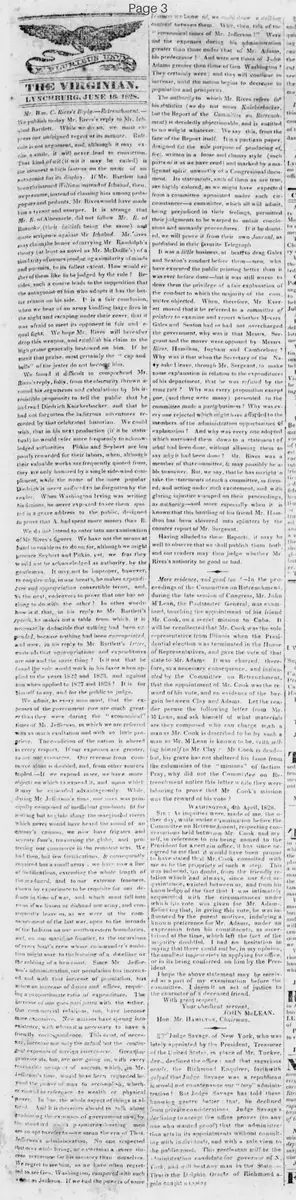
Mr. Wm. C. Rives's Reply.—Retrenchment.—
We publish to-day Mr. Rives's reply to Mr. Ichabod Bartlett. While we do so, we must express our unfeigned regret at its manner. Ridicule is not argument, and, although it may excite a smile, it will never lead to conviction. That kind of wit (if wit it may be called) is the meanest which fastens on the name of an antagonist for its display. If Mr. Bartlett had been christened William instead of Ichabod, then, we presume, instead of classing him among pedagogues and pedants, Mr. Rives would have made him a tyrant and usurper. It is strange that Mr. R. of Albemarle, did not follow Mr. R. of Roanoke (their initials being the same) and quote scripture against Mr. Ichabod. Mr. Rives may claim the honor of carrying Mr. Randolph's theory (at least as novel as Mr. McDuffie's) of a similarity of names producing a similarity of minds and pursuits, to its fullest extent. How would either of them like to be judged by the rule? Besides, such a course leads to the supposition that the antagonist of him who adopts it has the better reason on his side. It is a fair conclusion, when we hear of an army kindling large fires in the night and escaping under their cover, that it was afraid to meet its opponent in fair and equal fight. We hope Mr. Rives will hereafter drop this weapon, and establish his claim to the high praise generally bestowed on him. If he merits that praise, most certainly the "cap and bells" of the jester do not become him.
We found it difficult to comprehend Mr. Rives's reply, fully, from the obscurity thrown around his arguments and calculations by his irresistible propensity to tell the public that he had read Diedrich Knickerbocker, and that he had not forgotten the ludicrous adventures recorded by that celebrated historian. We could wish, that in his next production (if it be statistical) he would refer more frequently to acknowledged authorities. Pitkin and Seybert are but poorly rewarded for their labors, when, although their valuable works are frequently quoted from, they are only honored by a single side-wind compliment, while the name of the more popular Diedrich is never suffered to be forgotten by the reader. When Washington Irving was writing his fictions, he never expected to see them quoted in a grave address to the public, designed to prove that A. had spent more money than B.
We do not intend to enter into an examination of Mr. Rives's figures. We have not the means at hand to enable us to do so; for, although we might procure Seybert and Pitkin, yet we fear they would not be acknowledged as authority, by the gentleman. It may not be improper, however, to inquire why, in one breath, he makes expenditure and appropriation convertible terms, and, in the next, endeavors to prove that one has nothing to do with the other? In other words, how is it, that, in his reply to Mr. Bartlett's speech, he makes out a table from which, it is necessarily deducible that nothing had been expended, because nothing had been appropriated; and now, in his reply to Mr. Bartlett's letter, contends that appropriations and expenditures are one and the same thing? Is it not that he found the rule would work in his favor when applied to the years 1822 and 1823, and against him when applied to 1827 and 1828? It is for himself to say, and for the public to judge.
We admit, as every man must, that the expenses of the government now are much greater than they were during the "economical" times of Mr. Jefferson, to which we are referred with so much exultation and with so little propriety. The condition of the nation is altered in every respect. If our expenses are greater, so are our resources. Our revenue from commerce alone is doubled, and, from other sources tripled. If we expend more, we have more objects on which to expend it, and upon which it may be expended advantageously. While, during Mr. Jefferson's time, our navy was principally composed of inefficient gun-boats fit for nothing but to glide along the margins of rivers which never would have heard the sound of an enemy's cannon, we now have frigates and seventy-fours, traversing the globe, and protecting our commerce in the remotest seas. We had then, but few fortifications, & consequently required but a small army: we have now a line of fortifications, extending the whole length of the sea-board, and to our extreme frontiers, shown by experience to be requisite for our defence in time of war, and which must fall into ruins if we lessen or disband our army, and consequently leave us, as we were at the commencement of the last war, open to the inroads of the Indians on our south-western boundaries, and, on our maritime frontier, to the incursions of every boat's crew whose commander's ambition might soar to the burning of a dwelling or the robbing of a hen-roost. Since Mr. Jefferson's administration, our population has increased, and, with that increase of population, has arisen an increase of dues and offices, requiring a proportionate ratio of expenditure. The increase of one goes pari passu with the other. Our commercial relations, too, have become more extensive. New nations have sprung into existence, with whom it is necessary to have a friendly correspondence. This must, of necessity, increase not only the actual but the contingent expenses of foreign intercourse. Great improvements, too, are now going on, with every reasonable prospect of success, which, in Mr. Jefferson's time, would have been regarded beyond the power of man to accomplish, whether viewed in reference to wealth or physical power. In fine, the whole aspect of things is altered. And it is therefore absurd to talk about graduating the expenses of government now, by the standard which popularity-hunting men are so apt to refer to—we mean the era of Thos. Jefferson's administration. No one respected that man while living, or cherishes a more sincere reverence for his memory than ourselves. We regret to see him, as we have often regretted to see Gen. Washington, compared with such a pun as Jackson. If we had the powers of some limners we know of, we could draw a striking contrast between them. Why, then, talk of the "economical times of Mr. Jefferson?" Were not the expenses during his administration greater than those under that of Mr. Adams, his predecessor? And were not those of John Adams greater than those of Gen. Washington? They certainly were; and they will continue to increase, until the nation begins to decrease in population and prosperity.
The authority to which Mr. Rives refers for his statistics (we do not mean Knickerbocker, but the Report of the Committee on Retrenchment) is decidedly objectionable, and is entitled to no weight whatever. We say this, from the face of the Report itself. It is a partizan paper, designed for the sole purpose of producing effect, written in a loose and clumsy style (such parts of it as we have read) and marked by a malignant spirit, unworthy of a Congressional document. Its statements, such of them as are true, are highly colored, as we might have expected from a committee appointed under such circumstances—a committee, which all will admit, being prejudiced in their feelings, permitted their judgments to be warped to unfair conclusions and unmanly procedures. If it be doubted, we will prove it from their own Journal, as published in their favorite Telegraph. It was a little business, at best, to drag Gales and Seaton's conduct before them—who have executed the public printing better than it was ever before done—but it was still worse to deny them the privilege of a fair explanation of the conduct to which the majority of the committee objected. When, therefore, Mr. Everett moved that it be referred to a committee of printers to examine and report whether Messrs. Gales and Seaton had or had not overcharged the government, why was it that Messrs. Sergeant and the mover were opposed by Messrs. Rives, Hamilton, Ingham and Cambreleng? Why was it that when the Secretary of the Navy asked leave, through Mr. Sergeant, to make some explanation in relation to the expenditures of his department, that he was refused by the same vote? Why was every proposition except one, (and there were many presented to the committee) made a party business? Why was every one rejected which might have afforded to the members of the administration opportunities of explanation? And why was every one adopted which narrowed them down to a statement of what had been done, without allowing them to say why it had been done? Mr. Rives was a member of that committee, & may possibly be able to answer. But, we say, that he has no right to take the statements of such a committee, so formed, and acting under such excitement, and with glaring injustice stamped on their proceedings, as authority—and more especially when it is known that this bantling of his friend Mr. Hamilton has been shivered into splinters by the counter report of Mr. Sergeant.
Having alluded to these Reports, it may be well to observe that we shall publish them both and our readers may then judge whether Mr. Rives's authority be good or bad.
More evidence, and good too.—In the proceedings of the Committee on Retrenchment during the late session of Congress, Mr. John M'Lean, the Postmaster General, was examined, touching the appointment of his friend Mr. Cook, on a secret mission to Cuba. It will be recollected that Mr. Cook was the sole representative from Illinois when the Presidential election was terminated in the House of Representatives, and gave the vote of that state to Mr. Adams. It was charged, therefore, as a necessary consequence, and insinuated by the Committee on Retrenchment, that the appointment of Mr. Cook was the reward of his vote, and an evidence of the bargain between Clay and Adams. Let the reader peruse the following letter from Mr. M'Lean, and ask himself of what materials are they composed who can charge such a man as Mr. Cook is described to be by such a man as Mr. M'Lean is known to be, with selling himself to Mr. Clay: Mr. Cook is dead—but, his grave has not sheltered his fame from the calumnies of the "minions" of faction. Pray, why did not the Committee on Retrenchment notice this letter while they were laboring to prove that Mr. Cook's mission was the reward of his vote?
WASHINGTON, 4th April, 1828.
Sir: As inquiries were made of me, the other day, while under examination before the Committee on Retrenchment, respecting conversations held between Mr. Cook and myself, in reference to his being named to the President for a certain office, it has since occurred to me that it would have been proper to have stated that Mr. Cook consulted with me as to the propriety of such a step. This was induced, no doubt, from the friendly relation which had always, since our first acquaintance, existed between us, and from his knowledge of the fact that I was intimately acquainted with the circumstances under which his vote was given for Mr. Adams. Believing that, in giving this vote, he was influenced by the purest motives, indulging a known preference for Mr. Adams, under an expression from his constituents, as ascertained at the time, which left the fact of the majority doubtful, I had no hesitation in saying that there could not be, in my opinion, the smallest impropriety in applying for office, or in its being conferred on him by the President.
I hope the above statement may be received as a part of my examination before the committee. I deem it an act of justice to the character of a deceased friend.
With great respect,
Your obedient servant,
JOHN McLEAN.
Hon. Mr. Hamilton, Chairman.
Judge Savage, of New York, who was lately appointed by the President, Treasurer of the United States, in place of Mr. Tucker, dec., declined the office: and that sagacious oracle, the Richmond Enquirer, forthwith yelped that Judge Savage was a republican & would not countenance our "tory" administration! But Judge Savage has told these knowing gentry better: that he declined from private considerations. Judge Savage's declining to accept the office proves (to any one who wanted proof) that the administration acts in its appointments without consulting with individuals, and with a sole view to the public good. This gentleman will be the Administration candidate for governor of N. York, and will beat any man in the State.
Thus is the Delphic Oracle of Richmond again caught tripping.
We publish to-day Mr. Rives's reply to Mr. Ichabod Bartlett. While we do so, we must express our unfeigned regret at its manner. Ridicule is not argument, and, although it may excite a smile, it will never lead to conviction. That kind of wit (if wit it may be called) is the meanest which fastens on the name of an antagonist for its display. If Mr. Bartlett had been christened William instead of Ichabod, then, we presume, instead of classing him among pedagogues and pedants, Mr. Rives would have made him a tyrant and usurper. It is strange that Mr. R. of Albemarle, did not follow Mr. R. of Roanoke (their initials being the same) and quote scripture against Mr. Ichabod. Mr. Rives may claim the honor of carrying Mr. Randolph's theory (at least as novel as Mr. McDuffie's) of a similarity of names producing a similarity of minds and pursuits, to its fullest extent. How would either of them like to be judged by the rule? Besides, such a course leads to the supposition that the antagonist of him who adopts it has the better reason on his side. It is a fair conclusion, when we hear of an army kindling large fires in the night and escaping under their cover, that it was afraid to meet its opponent in fair and equal fight. We hope Mr. Rives will hereafter drop this weapon, and establish his claim to the high praise generally bestowed on him. If he merits that praise, most certainly the "cap and bells" of the jester do not become him.
We found it difficult to comprehend Mr. Rives's reply, fully, from the obscurity thrown around his arguments and calculations by his irresistible propensity to tell the public that he had read Diedrich Knickerbocker, and that he had not forgotten the ludicrous adventures recorded by that celebrated historian. We could wish, that in his next production (if it be statistical) he would refer more frequently to acknowledged authorities. Pitkin and Seybert are but poorly rewarded for their labors, when, although their valuable works are frequently quoted from, they are only honored by a single side-wind compliment, while the name of the more popular Diedrich is never suffered to be forgotten by the reader. When Washington Irving was writing his fictions, he never expected to see them quoted in a grave address to the public, designed to prove that A. had spent more money than B.
We do not intend to enter into an examination of Mr. Rives's figures. We have not the means at hand to enable us to do so; for, although we might procure Seybert and Pitkin, yet we fear they would not be acknowledged as authority, by the gentleman. It may not be improper, however, to inquire why, in one breath, he makes expenditure and appropriation convertible terms, and, in the next, endeavors to prove that one has nothing to do with the other? In other words, how is it, that, in his reply to Mr. Bartlett's speech, he makes out a table from which, it is necessarily deducible that nothing had been expended, because nothing had been appropriated; and now, in his reply to Mr. Bartlett's letter, contends that appropriations and expenditures are one and the same thing? Is it not that he found the rule would work in his favor when applied to the years 1822 and 1823, and against him when applied to 1827 and 1828? It is for himself to say, and for the public to judge.
We admit, as every man must, that the expenses of the government now are much greater than they were during the "economical" times of Mr. Jefferson, to which we are referred with so much exultation and with so little propriety. The condition of the nation is altered in every respect. If our expenses are greater, so are our resources. Our revenue from commerce alone is doubled, and, from other sources tripled. If we expend more, we have more objects on which to expend it, and upon which it may be expended advantageously. While, during Mr. Jefferson's time, our navy was principally composed of inefficient gun-boats fit for nothing but to glide along the margins of rivers which never would have heard the sound of an enemy's cannon, we now have frigates and seventy-fours, traversing the globe, and protecting our commerce in the remotest seas. We had then, but few fortifications, & consequently required but a small army: we have now a line of fortifications, extending the whole length of the sea-board, and to our extreme frontiers, shown by experience to be requisite for our defence in time of war, and which must fall into ruins if we lessen or disband our army, and consequently leave us, as we were at the commencement of the last war, open to the inroads of the Indians on our south-western boundaries, and, on our maritime frontier, to the incursions of every boat's crew whose commander's ambition might soar to the burning of a dwelling or the robbing of a hen-roost. Since Mr. Jefferson's administration, our population has increased, and, with that increase of population, has arisen an increase of dues and offices, requiring a proportionate ratio of expenditure. The increase of one goes pari passu with the other. Our commercial relations, too, have become more extensive. New nations have sprung into existence, with whom it is necessary to have a friendly correspondence. This must, of necessity, increase not only the actual but the contingent expenses of foreign intercourse. Great improvements, too, are now going on, with every reasonable prospect of success, which, in Mr. Jefferson's time, would have been regarded beyond the power of man to accomplish, whether viewed in reference to wealth or physical power. In fine, the whole aspect of things is altered. And it is therefore absurd to talk about graduating the expenses of government now, by the standard which popularity-hunting men are so apt to refer to—we mean the era of Thos. Jefferson's administration. No one respected that man while living, or cherishes a more sincere reverence for his memory than ourselves. We regret to see him, as we have often regretted to see Gen. Washington, compared with such a pun as Jackson. If we had the powers of some limners we know of, we could draw a striking contrast between them. Why, then, talk of the "economical times of Mr. Jefferson?" Were not the expenses during his administration greater than those under that of Mr. Adams, his predecessor? And were not those of John Adams greater than those of Gen. Washington? They certainly were; and they will continue to increase, until the nation begins to decrease in population and prosperity.
The authority to which Mr. Rives refers for his statistics (we do not mean Knickerbocker, but the Report of the Committee on Retrenchment) is decidedly objectionable, and is entitled to no weight whatever. We say this, from the face of the Report itself. It is a partizan paper, designed for the sole purpose of producing effect, written in a loose and clumsy style (such parts of it as we have read) and marked by a malignant spirit, unworthy of a Congressional document. Its statements, such of them as are true, are highly colored, as we might have expected from a committee appointed under such circumstances—a committee, which all will admit, being prejudiced in their feelings, permitted their judgments to be warped to unfair conclusions and unmanly procedures. If it be doubted, we will prove it from their own Journal, as published in their favorite Telegraph. It was a little business, at best, to drag Gales and Seaton's conduct before them—who have executed the public printing better than it was ever before done—but it was still worse to deny them the privilege of a fair explanation of the conduct to which the majority of the committee objected. When, therefore, Mr. Everett moved that it be referred to a committee of printers to examine and report whether Messrs. Gales and Seaton had or had not overcharged the government, why was it that Messrs. Sergeant and the mover were opposed by Messrs. Rives, Hamilton, Ingham and Cambreleng? Why was it that when the Secretary of the Navy asked leave, through Mr. Sergeant, to make some explanation in relation to the expenditures of his department, that he was refused by the same vote? Why was every proposition except one, (and there were many presented to the committee) made a party business? Why was every one rejected which might have afforded to the members of the administration opportunities of explanation? And why was every one adopted which narrowed them down to a statement of what had been done, without allowing them to say why it had been done? Mr. Rives was a member of that committee, & may possibly be able to answer. But, we say, that he has no right to take the statements of such a committee, so formed, and acting under such excitement, and with glaring injustice stamped on their proceedings, as authority—and more especially when it is known that this bantling of his friend Mr. Hamilton has been shivered into splinters by the counter report of Mr. Sergeant.
Having alluded to these Reports, it may be well to observe that we shall publish them both and our readers may then judge whether Mr. Rives's authority be good or bad.
More evidence, and good too.—In the proceedings of the Committee on Retrenchment during the late session of Congress, Mr. John M'Lean, the Postmaster General, was examined, touching the appointment of his friend Mr. Cook, on a secret mission to Cuba. It will be recollected that Mr. Cook was the sole representative from Illinois when the Presidential election was terminated in the House of Representatives, and gave the vote of that state to Mr. Adams. It was charged, therefore, as a necessary consequence, and insinuated by the Committee on Retrenchment, that the appointment of Mr. Cook was the reward of his vote, and an evidence of the bargain between Clay and Adams. Let the reader peruse the following letter from Mr. M'Lean, and ask himself of what materials are they composed who can charge such a man as Mr. Cook is described to be by such a man as Mr. M'Lean is known to be, with selling himself to Mr. Clay: Mr. Cook is dead—but, his grave has not sheltered his fame from the calumnies of the "minions" of faction. Pray, why did not the Committee on Retrenchment notice this letter while they were laboring to prove that Mr. Cook's mission was the reward of his vote?
WASHINGTON, 4th April, 1828.
Sir: As inquiries were made of me, the other day, while under examination before the Committee on Retrenchment, respecting conversations held between Mr. Cook and myself, in reference to his being named to the President for a certain office, it has since occurred to me that it would have been proper to have stated that Mr. Cook consulted with me as to the propriety of such a step. This was induced, no doubt, from the friendly relation which had always, since our first acquaintance, existed between us, and from his knowledge of the fact that I was intimately acquainted with the circumstances under which his vote was given for Mr. Adams. Believing that, in giving this vote, he was influenced by the purest motives, indulging a known preference for Mr. Adams, under an expression from his constituents, as ascertained at the time, which left the fact of the majority doubtful, I had no hesitation in saying that there could not be, in my opinion, the smallest impropriety in applying for office, or in its being conferred on him by the President.
I hope the above statement may be received as a part of my examination before the committee. I deem it an act of justice to the character of a deceased friend.
With great respect,
Your obedient servant,
JOHN McLEAN.
Hon. Mr. Hamilton, Chairman.
Judge Savage, of New York, who was lately appointed by the President, Treasurer of the United States, in place of Mr. Tucker, dec., declined the office: and that sagacious oracle, the Richmond Enquirer, forthwith yelped that Judge Savage was a republican & would not countenance our "tory" administration! But Judge Savage has told these knowing gentry better: that he declined from private considerations. Judge Savage's declining to accept the office proves (to any one who wanted proof) that the administration acts in its appointments without consulting with individuals, and with a sole view to the public good. This gentleman will be the Administration candidate for governor of N. York, and will beat any man in the State.
Thus is the Delphic Oracle of Richmond again caught tripping.
What sub-type of article is it?
Partisan Politics
Economic Policy
Military Affairs
What keywords are associated?
Retrenchment
Government Expenses
Rives Reply
Partisan Committee
Adams Administration
Military Expansion
Presidential Election
Cook Appointment
What entities or persons were involved?
Mr. Wm. C. Rives
Mr. Ichabod Bartlett
Mr. Jefferson
Mr. Adams
Gen. Washington
Jackson
Mr. Randolph
Mr. Mcduffie
Mr. Everett
Mr. Sergeant
Mr. Hamilton
Mr. Ingham
Mr. Cambreleng
Gales And Seaton
Mr. John M'lean
Mr. Cook
Judge Savage
Richmond Enquirer
Committee On Retrenchment
Editorial Details
Primary Topic
Critique Of Rives's Reply On Government Retrenchment And Defense Of Adams Administration
Stance / Tone
Critical Of Opposition, Supportive Of Administration
Key Figures
Mr. Wm. C. Rives
Mr. Ichabod Bartlett
Mr. Jefferson
Mr. Adams
Gen. Washington
Jackson
Mr. Randolph
Mr. Mcduffie
Mr. Everett
Mr. Sergeant
Mr. Hamilton
Mr. Ingham
Mr. Cambreleng
Gales And Seaton
Mr. John M'lean
Mr. Cook
Judge Savage
Richmond Enquirer
Committee On Retrenchment
Key Arguments
Ridicule In Rives's Reply Undermines Argument
Inconsistent Use Of Expenditure Vs. Appropriation Terms By Rives
Government Expenses Increased Due To National Growth In Population, Commerce, Military, And Diplomacy
Comparison To Jefferson's Era Inappropriate Given Changed Circumstances
Retrenchment Committee Report Partisan And Unjust
Mclean's Letter Defends Cook's Appointment As Non Partisan
Savage's Declination Due To Private Reasons, Not Political Opposition