Thank you for visiting SNEWPapers!
Sign up free
The Enquirer
Richmond, Henrico County, Virginia
What is this article about?
The HMS Apollo frigate, convoying 69 West Indies merchant ships from Cork, wrecked on Portugal's coast near Cape Mondego on April 2 after striking an unknown shoal. 61 crew died; multiple merchant vessels also lost with significant casualties.
Merged-components note: Continuation of the narrative about the Apollo frigate shipwreck across pages.
Clippings
1 of 2
OCR Quality
Full Text
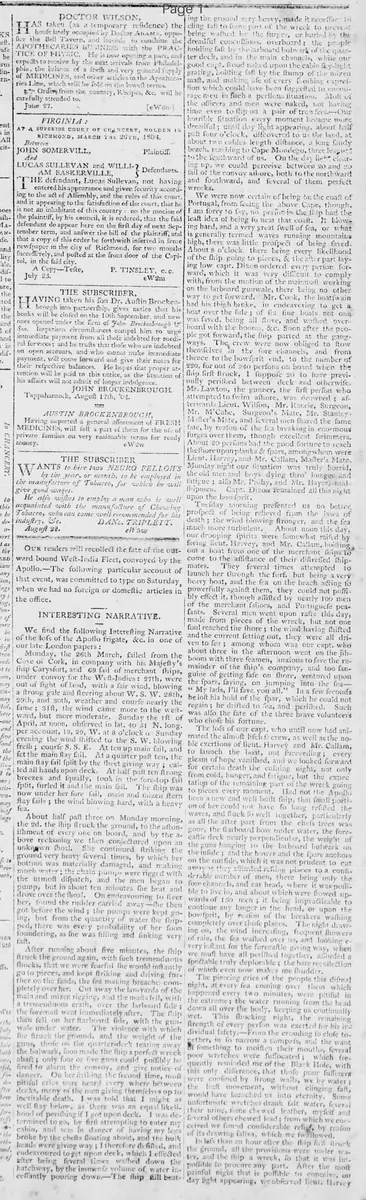
INTERESTING NARRATIVE.
We find the following Interesting Narrative of the loss of the Apollo frigate, &c. in one of our late London papers:
Monday, the 26th March, sailed from the Cove of Cork, in company with his Majesty's ship Carysfort, and 69 sail of merchant ships, under convoy for the West-Indies: 27th, were out of sight of land, with a fair wind, blowing a strong gale and steering about W. S. W. 28th, 29th, and 30th, weather and course nearly the same; 31st, the wind came more to the westward, but more moderate. Sunday the 1st of April, at noon, observed in lat. 40 51 N. long. per account, 12, 29, W. at 8 o'clock o Sunday evening the wind shifted to the S. W. blowing fresh; course S. S. E. At ten up main sail, and set the main stay sail. At a quarter past ten, the main stay sail split by the sheet giving way; called all hands upon deck. At half past ten strong breezes and squally, took in the fore-top sail split, furled it and the main sail. The ship was now under her fore sail, main and mizen stern stay sails; the wind blowing hard, with a heavy sea.
About half past three on Monday morning, the 2d. the ship struck the ground, to the astonishment of every one on board, and by the above reckoning we then conjectured upon an unknown shoal. She continued striking the ground very heavy several times, by which her bottom was materially damaged, and making much water; the chain pumps were rigged with the utmost dispatch, and the men began to pump, but in about ten minutes she beat and drove over the shoal. On endeavouring to steer her, found the rudder carried away—she then got before the wind; the pumps were kept going, but from the quantity of water she shipped, there was every probability of her soon foundering, as she was filling and sinking very fast.
After running about five minutes, the ship struck the ground again, with such tremendous shocks, that we were fearful she would instantly go to pieces, and kept striking and driving further on the sands, the sea making breaches completely over her. Cut away the lanyards of the main and mizen rigging, and the masts fell, with a tremendous crash, over the larboard side; the foremast went immediately after. The ship then fell on her starboard side, with the gunwale under water. The violence with which she struck the ground, and the weight of the guns, those on the quarter-deck tearing away the bulwark, soon made the ship a perfect wreck abaft; only four or five guns could possibly be fired to alarm the convoy, and give notice of danger. On her striking the second time, most pitiful cries were heard every where between decks, many of the men giving themselves up to inevitable death. I was told that I might as well stay below, as there was an equal likelihood of perishing if I got upon deck. I was determined to go, by first attempting to enter my cabin, and was in danger of having my legs broke by the chests floating about, and the bulk heads were giving way; I therefore desisted, and endeavoured to get upon deck, which I effected after being several times washed down the hatchway, by the immense volume of water incessantly pouring down.—The ship still beating the ground very heavy, made it necessary to cling fast to some part of the wreck to prevent being washed by the surges, or hurled by the dreadful concussions. overboard; the people holding fast by the larboard bulwark of the quarter deck, and in the main channels, while our good capt. stood nailed upon the cabin sky-light grating, holding fast by the stump of the mizen mast, and making use of every soothing expression which could have been suggested to encourage men in such a perilous situation. Most of the officers and men were naked, not having time even to slip on a pair of trousers.—Our horrible situation every moment became more dreadful; until day light appearing, about half past four o'clock. 'discovered to us the land, at about two cables length distance, a long sandy beach. reaching to Cape Mondego, three leagues to the southward of us. On the day light clearing up, we could perceive between 20 and 30 sail of the convoy ashore, both to the northward and southward, and several of them perfect wrecks.
We were now certain of being on the coast of Portugal, from seeing the above Cape, though, I am sorry to say, no person in the ship had the least idea of being so near that coast. It blowing hard, and a very great swell of sea, or what is generally termed waves running mountains high, there was little prospect of being saved.
About 8 o'clock there being every likelihood of the ship going to pieces, & the after part laying low capt. Dixon ordered every person forward, which it was very difficult to comply with, from the motion of the mainmast working on the larboard gunwale, there being no other way to get forward. Mr. Cook, the boatswain had his thigh broke, in endeavoring to get a boat over the side: of six fine boats not one was saved. being all stove, and washed overboard with the booms, &c. Soon after the people got forward, the ship parted at the gang-ways. The crew were now obliged to stow themselves in the fore channels, and from thence to the bowsprit end, to the number of 220, for out of 240 persons on board when the ship first struck, I suppose 20 to have previously perished between deck and otherwise.
Mr. Lawton, the gunner, the first person who attempted to swim ashore, was drowned; afterwards Lieut. Wilson, Mr. Rennie, Surgeon, Mr. M'Cabe, Surgeon's Mate, Mr. Stanley-Master's Mate, and several men shared the same fate, by reason of the sea breaking in enormous surges over them, though excellent swimmers.
About 20 persons had the good fortune to reach the shore upon planks & spars, among whom were Lieut. Harvey, and Mr. Callam, Master's Mate, Monday night our Situation was truly horrid, the old men and boys dying thro' hunger and fatigue; also Mr. Proby, and Mr. Hayes, mid-shipmen. Capt. Dixon remained all this night upon the bowsprit.
Tuesday morning presented us no better prospect of being relieved from the jaws of death; the wind blowing stronger, and the sea much more turbulent. , About noon this day, our drooping spirits were somewhat raised by seeing Lieut. Harvey, and Mr. Callam, hoisting out a boat from one of the merchant ships to come to the assistance of their distressed ship-mates. They several times attempted to launch her through the surf, but being a very heavy boat, and the sea on the beach acting so powerfully against them, they could not possibly effect it, though assisted by nearly 100 men of the merchant sailors, and Portuguese peasants. Several men went upon rafts this day; made from pieces of the wreck, but not one soul reached the shore; the wind having shifted and the current setting out, they were all driven to sea; among whom was our capt. who about three in the afternoon went on the jib-boom with three seamen, anxious to save the remainder of the ship's company, and too sanguine of getting safe on shore, ventured upon the spars, saying, on jumping into the sea— "My lads, I'll save you all." In a few seconds he lost his hold of the spar, which he could not regain; he drifted to sea, and perished. Such was also the fate of the three brave volunteers who chose his fortune.
The loss of our capt. who until now had animated the almost lifeless crew, as well as the no-ble exertions of lieut. Harvey and Mr. Callam, to launch the boat, not succeeding; every gleam of hope vanished, and we looked forward for certain death the ensuing night, not only from cold, hunger, and fatigue, but the expec-tation of the remaining part of the wreck going to pieces every moment. Had not the Apollo been a new and well built ship, that small por-tion of her could not have so long resisted the waves, and stuck so well together, particularly as all the after part from the chess trees was gone, the starboard bow under water, the fore-castle deck nearly perpendicular, the weight of the guns hanging to the larboard bulwark on the inside; and the bower and the spare anchors on the outside, which it was not prudent to cut away as they afforded resting places to a consi-derable number of men, there being only the fore channels, and cat head, where it was possi-ble to live in, and about which were stowed up-wards of 150 men; it being impracticable to continue any longer in the head, or upon the bowsprit, by reason of the breakers washing completely over those places. The night draw-ing on, the wind increasing, frequent showers of rain, the sea washed over us, and looking e-very instant for the forecastle giving way, when we must have all perished together, afforded a spectacle truly deplorable; the bare recollection of which even now makes me shudder.
The piercing cries of the people this dismal night, at every sea coming over them which happened every two minutes, were pitiful in the extreme; the water running from the head down all over the body, keeping us continually wet. This shocking night, the remaining strength of every person was exerted for his in-dividual safety.—From the crowding so close to-gether, in so narrow a compass, and the want of something to moisten their mouths, several poor wretches were suffocated; which fre-quently reminded me of the Black Hole, with this only difference, that those poor sufferers were confined by strong walls, we by water; the least movement, without clinging fast, would have launched us into eternity. Some unfortunate wretches drank salt water, several their urine, some chewed leather, myself and several others chewed lead; from which we cor-ceived we found considerable relief, by reason of its drawing saliva, which we swallowed.
In less than an hour after the ship first struck the ground, all the provisions were under wa-ter, and the ship a wreck, so that it was im-possible to procure any part. After the most painful night that is possible to conceive, on day light appearing, we observed Lieut. Harvey
and Mr. Callam again strove to launch the boat.
Several attempts were made without success, a number of men belonging to the merchant ships being much bruised and hurt in assisting—alternate hopes and fears now pervaded our wretched minds: fifteen men got safe on shore this morning on pieces of the wreck. About three in the afternoon of Wednesday the 4th, we had the inexpressible happiness of seeing the boat launched through the surf, by the indefatigable exertions of the above officers, assisted by the masters of the ships, with numbers of Portuguese peasants, who were encouraged by Mr. Whitney, the British consul from Figueira. All the crew then remaining on the wreck were brought safe on shore, praising God for a happy deliverance from a shipwreck which had never had its parallel. As soon as I stepped out of the boat, I found several persons whose humanity prompted them to offer me sustenance, though improperly in spirits, which I avoided as much as possible. Our weak state may be conceived, when it is considered we received no nourishment from Sunday to Wednesday afternoon, and continually exposed to the fury of the watery element. After eating and drinking a little, I found myself weaker than before, occasioned, I apprehend, from having been so long without either. Some men died soon after getting on shore, from imprudently drinking too large a quantity of spirits. All the crew were in a very weak and exhausted state, the greater part being badly bruised and wounded.
About four sail of merchant ships were wrecked at the same time on this dreadful beach. Some ships sunk with all their crews, and almost every ship lost from two to twelve men each; yet the situation of the remainder was not equal to that of the frigate's company; as the merchant ships drawing a less draught of water, were mostly driven close on shore, and no person remaining on board them after the first morning. The masters of the merchant ships had tents on the beach, and some provisions they had saved from the wrecks, which they very generously distributed, and gave every assistance to the Apollo's ship's company. Thus was lost one of the finest frigates in the British navy with 61 of her crew. The number of souls lost in the merchant ships, was also very considerable. Dead bodies were every day floating ashore, and pieces of wreck covered the beach upwards of ten miles in extent.
What sub-type of article is it?
What keywords are associated?
What entities or persons were involved?
Where did it happen?
Foreign News Details
Primary Location
Coast Of Portugal Near Cape Mondego
Event Date
Sailed 26th March, Wrecked 2nd April
Key Persons
Outcome
61 crew lost from apollo out of 240; multiple merchant ships wrecked with significant casualties, total souls lost considerable
Event Details
HMS Apollo, convoying 69 West Indies merchant ships from Cork, struck unknown shoal off Portugal on April 2, lost masts and rudder, wrecked on beach. Crew endured days on wreck amid storms; Captain Dixon drowned attempting rescue. Remaining 179 saved on April 4 via boat launched by Lieut. Harvey and Mr. Callam with local aid.