Thank you for visiting SNEWPapers!
Sign up free
Editorial
May 15, 1909
The Sun
New York, New York County, New York
What is this article about?
Editorial defends anthracite carriers' integrated role in coal production transportation and distribution arguing it ensures steady supply employment and fair prices against commodities clause reforms that might disrupt this benefiting middlemen and causing instability. Discusses historical practices storage and future price increases.
Clipping
OCR Quality
98%
Excellent
Full Text
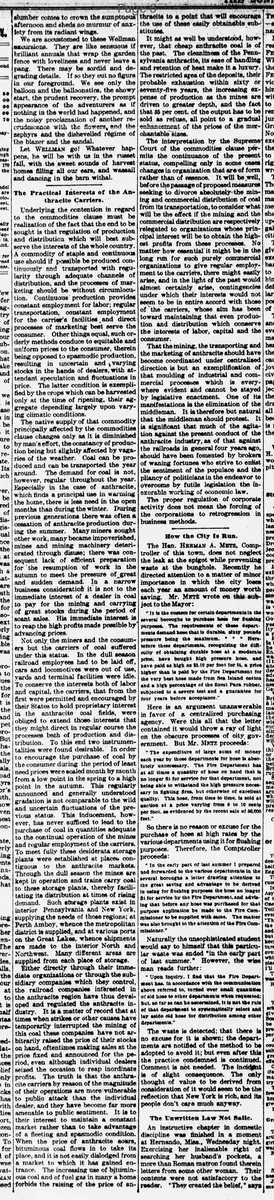
The Practical Interests of the Anthracite Carriers.
Underlying the contention in regard to the commodities clause must be realization of the fact that the end to be sought is that regulation of production and distribution which will best subserve the interests of the whole country. A commodity of staple and continuous use should, if possible, be produced continuously and transported with regularity through adequate channels of distribution, and the processes of marketing should be without circumlocution. Continuous production provides constant employment for labor; regular transportation, constant employment for the carrier's facilities, and direct processes of marketing best serve the consumer. Other things equal, such orderly methods conduce to equitable and uniform prices to the consumer, therein being opposed to spasmodic production, resulting in uncertain and varying stocks in the hands of dealers, with attendant speculation and fluctuations in price. The latter condition is exemplified by the crops which can be harvested only at the time of ripening, their aggregate depending largely upon varying climatic conditions.
The native supply of that commodity principally affected by the commodities clause changes only as it is diminished by man's effort, the constancy of production being but slightly affected by vagaries of the weather. Coal can be produced and can be transported the year around. The demand for coal is not, however, regular throughout the year. Especially in the case of anthracite, which finds a principal use in warming the home, there is less need in the open months than during the winter. During previous generations there was often a cessation of anthracite production during the summer. Many miners sought other work, many became impoverished, mines and mining machinery deteriorated through disuse; there was consequent lack of efficient preparation for the resumption of work in the autumn to meet the pressure of great and sudden demand. In a narrow business consideration it is not to the immediate interest of a dealer in coal to pay for the mining and carrying of great stocks during the period of scant sales. His immediate interest is to reap the high profits made possible by advancing prices.
Not only the miners and the consumers but the carriers of coal suffered under this status. In the dull season railroad employees had to be laid off, cars and locomotives were out of use, yards and terminal facilities were idle. To conserve the interests both of labor and capital, the carriers, that from the first were permitted and encouraged by their States to hold proprietary interest in the anthracite coal fields, were obliged to extend those interests that they might direct in regular course the processes both of production and distribution. To this end two instrumentalities were found desirable. In order to encourage the purchase of coal by the consumer during the period of least need prices were scaled month by month from a low point in the spring to a high point in the autumn. This regularly announced and generally understood gradation is not comparable to the wild and uncertain fluctuations of the previous status. This inducement, however, has never sufficed to lead to the purchase of coal in quantities adequate to the continual operation of the mines and regular employment of the carriers. To meet fully these desiderata storage plants were established at places contiguous to the anthracite markets. Through the dull season the mines are kept in operation and trains carry coal to these storage plants, thereby facilitating its distribution at times of rising demand. Such storage plants exist in interior Pennsylvania and New York, supplying the needs of those regions; at Perth Amboy, whence the metropolitan district is supplied, and at various ports on the Great Lakes, whence shipments are made to the interior North and Northwest. Many different areas are supplied from each place of storage.
Either directly through their immediate organizations or through the subsidiary companies which they control, the railroad companies interested in the anthracite region have thus developed and regulated the anthracite industry. It is a matter of record that at times when strikes or other causes have temporarily interrupted the mining of this coal these companies have not arbitrarily raised the price of their stocks on hand, oftentimes making sales at the price fixed and announced for the period, even although individual dealers seized the occasion to reap inordinate profits. The truth is that the anthracite carriers by reason of the magnitude of their operations are more vulnerable to public attack than the individual dealer, and they have become far more amenable to public sentiment. It is to their interest to maintain a constant market rather than to take advantage of a fleeting and spasmodic condition. When the price of anthracite soars, bituminous coal flows in to take its place, and it is not easily dislodged from a market to which it has gained entrance. The increasing use of bituminous coal and of fuel gas in many a home forbids the raising of the price of anthracite to a point that will encourage the use of these easily obtainable substitutes.
It might as well be understood, however, that cheap anthracite coal is of the past. The cleanliness of the Pennsylvania anthracite, its ease of handling and retention of heat make it a luxury. The restricted area of the deposits, their probable exhaustion within sixty or seventy-five years, the increasing expense of production as the mines are driven to greater depth, and the fact that 35 per cent. of the output has to be sold as refuse, all point to a gradual enhancement of the prices of the merchantable sizes.
The interpretation by the Supreme Court of the commodities clause permits the continuance of the present status, compelling only in some cases changes in organization that are of form rather than of essence. It will be well, before the passage of proposed measures seeking to divorce absolutely the mining and commercial distribution of coal from its transportation, to consider what will be the effect if the mining and the commercial distribution are respectively relegated to organizations whose principal interest will be to obtain the highest profits from these processes. No matter how essential it might be in the long run for such purely commercial organizations to give regular employment to the carriers, there might easily arise, and in the light of the past would almost certainly arise, contingencies under which their interests would not seem to be in entire accord with those of the carriers, whose aim has been toward maintaining that even production and distribution which conserve the interests of labor, capital and the consumer.
That the mining, the transporting and the marketing of anthracite should have become coordinated under centralized direction is but an exemplification of that moulding of industrial and commercial processes which is everywhere evident and cannot be stayed by legislative enactment. One of its manifestations is the elimination of the middleman. It is therefore but natural that the middleman should protest. It is significant that much of the agitation against the present conduct of the anthracite industry, as of that against the railroads in general four years ago, should have been fomented by brokers of waning fortunes who strive to enlist the sentiment of the populace and the pliancy of politicians in the endeavor to overcome by futile legislation the inexorable working of economic law.
The proper regulation of corporate activity does not mean the forcing of the corporations to retrogression in business methods.
Underlying the contention in regard to the commodities clause must be realization of the fact that the end to be sought is that regulation of production and distribution which will best subserve the interests of the whole country. A commodity of staple and continuous use should, if possible, be produced continuously and transported with regularity through adequate channels of distribution, and the processes of marketing should be without circumlocution. Continuous production provides constant employment for labor; regular transportation, constant employment for the carrier's facilities, and direct processes of marketing best serve the consumer. Other things equal, such orderly methods conduce to equitable and uniform prices to the consumer, therein being opposed to spasmodic production, resulting in uncertain and varying stocks in the hands of dealers, with attendant speculation and fluctuations in price. The latter condition is exemplified by the crops which can be harvested only at the time of ripening, their aggregate depending largely upon varying climatic conditions.
The native supply of that commodity principally affected by the commodities clause changes only as it is diminished by man's effort, the constancy of production being but slightly affected by vagaries of the weather. Coal can be produced and can be transported the year around. The demand for coal is not, however, regular throughout the year. Especially in the case of anthracite, which finds a principal use in warming the home, there is less need in the open months than during the winter. During previous generations there was often a cessation of anthracite production during the summer. Many miners sought other work, many became impoverished, mines and mining machinery deteriorated through disuse; there was consequent lack of efficient preparation for the resumption of work in the autumn to meet the pressure of great and sudden demand. In a narrow business consideration it is not to the immediate interest of a dealer in coal to pay for the mining and carrying of great stocks during the period of scant sales. His immediate interest is to reap the high profits made possible by advancing prices.
Not only the miners and the consumers but the carriers of coal suffered under this status. In the dull season railroad employees had to be laid off, cars and locomotives were out of use, yards and terminal facilities were idle. To conserve the interests both of labor and capital, the carriers, that from the first were permitted and encouraged by their States to hold proprietary interest in the anthracite coal fields, were obliged to extend those interests that they might direct in regular course the processes both of production and distribution. To this end two instrumentalities were found desirable. In order to encourage the purchase of coal by the consumer during the period of least need prices were scaled month by month from a low point in the spring to a high point in the autumn. This regularly announced and generally understood gradation is not comparable to the wild and uncertain fluctuations of the previous status. This inducement, however, has never sufficed to lead to the purchase of coal in quantities adequate to the continual operation of the mines and regular employment of the carriers. To meet fully these desiderata storage plants were established at places contiguous to the anthracite markets. Through the dull season the mines are kept in operation and trains carry coal to these storage plants, thereby facilitating its distribution at times of rising demand. Such storage plants exist in interior Pennsylvania and New York, supplying the needs of those regions; at Perth Amboy, whence the metropolitan district is supplied, and at various ports on the Great Lakes, whence shipments are made to the interior North and Northwest. Many different areas are supplied from each place of storage.
Either directly through their immediate organizations or through the subsidiary companies which they control, the railroad companies interested in the anthracite region have thus developed and regulated the anthracite industry. It is a matter of record that at times when strikes or other causes have temporarily interrupted the mining of this coal these companies have not arbitrarily raised the price of their stocks on hand, oftentimes making sales at the price fixed and announced for the period, even although individual dealers seized the occasion to reap inordinate profits. The truth is that the anthracite carriers by reason of the magnitude of their operations are more vulnerable to public attack than the individual dealer, and they have become far more amenable to public sentiment. It is to their interest to maintain a constant market rather than to take advantage of a fleeting and spasmodic condition. When the price of anthracite soars, bituminous coal flows in to take its place, and it is not easily dislodged from a market to which it has gained entrance. The increasing use of bituminous coal and of fuel gas in many a home forbids the raising of the price of anthracite to a point that will encourage the use of these easily obtainable substitutes.
It might as well be understood, however, that cheap anthracite coal is of the past. The cleanliness of the Pennsylvania anthracite, its ease of handling and retention of heat make it a luxury. The restricted area of the deposits, their probable exhaustion within sixty or seventy-five years, the increasing expense of production as the mines are driven to greater depth, and the fact that 35 per cent. of the output has to be sold as refuse, all point to a gradual enhancement of the prices of the merchantable sizes.
The interpretation by the Supreme Court of the commodities clause permits the continuance of the present status, compelling only in some cases changes in organization that are of form rather than of essence. It will be well, before the passage of proposed measures seeking to divorce absolutely the mining and commercial distribution of coal from its transportation, to consider what will be the effect if the mining and the commercial distribution are respectively relegated to organizations whose principal interest will be to obtain the highest profits from these processes. No matter how essential it might be in the long run for such purely commercial organizations to give regular employment to the carriers, there might easily arise, and in the light of the past would almost certainly arise, contingencies under which their interests would not seem to be in entire accord with those of the carriers, whose aim has been toward maintaining that even production and distribution which conserve the interests of labor, capital and the consumer.
That the mining, the transporting and the marketing of anthracite should have become coordinated under centralized direction is but an exemplification of that moulding of industrial and commercial processes which is everywhere evident and cannot be stayed by legislative enactment. One of its manifestations is the elimination of the middleman. It is therefore but natural that the middleman should protest. It is significant that much of the agitation against the present conduct of the anthracite industry, as of that against the railroads in general four years ago, should have been fomented by brokers of waning fortunes who strive to enlist the sentiment of the populace and the pliancy of politicians in the endeavor to overcome by futile legislation the inexorable working of economic law.
The proper regulation of corporate activity does not mean the forcing of the corporations to retrogression in business methods.
What sub-type of article is it?
Economic Policy
Trade Or Commerce
Labor
What keywords are associated?
Anthracite Coal
Commodities Clause
Railroad Carriers
Production Regulation
Storage Plants
Price Stability
Economic Coordination
Labor Employment
Consumer Interests
Industrial Integration
What entities or persons were involved?
Anthracite Carriers
Railroad Companies
Supreme Court
Miners
Consumers
Individual Dealers
Brokers
Editorial Details
Primary Topic
Defense Of Integrated Anthracite Coal Production Transportation And Distribution By Carriers Against Commodities Clause Changes
Stance / Tone
Supportive Of Current Coordinated System And Critical Of Proposals To Separate Mining Distribution From Transportation
Key Figures
Anthracite Carriers
Railroad Companies
Supreme Court
Miners
Consumers
Individual Dealers
Brokers
Key Arguments
Continuous Production And Regular Transportation Benefit Labor Carriers And Consumers With Stable Prices
Past Irregular Production Led To Unemployment Deterioration And Price Fluctuations
Carriers Developed Storage Plants And Scaled Pricing To Ensure Steady Supply
Integrated Control Prevents Arbitrary Price Hikes During Shortages
Future Prices Will Rise Due To Limited Deposits And Increasing Costs
Separating Interests Could Lead To Conflicts Harming Overall Interests
Coordination Exemplifies Inevitable Industrial Integration Eliminating Middlemen