Thank you for visiting SNEWPapers!
Sign up free
Editorial
October 21, 1890
The Anaconda Standard
Anaconda, Deer Lodge County, Montana
What is this article about?
Satirical editorial from the Philadelphia Times mocks Major McKinley's tariff bill, arguing its free list (e.g., acorns, rags, low-grade sugars) provides no real compensation for higher duties on life's necessities, benefiting trusts more than workers.
Clipping
OCR Quality
95%
Excellent
Full Text
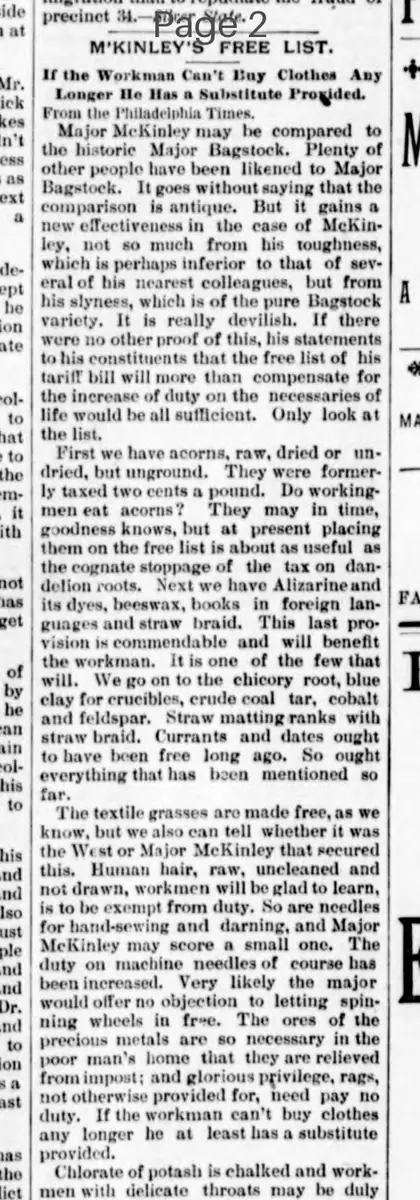
M'KINLEY'S FREE LIST.
If the Workman Can't Buy Clothes Any Longer He Has a Substitute Provided.
From the Philadelphia Times,
Major McKinley may be compared to the historic Major Bagstock. Plenty of other people have been likened to Major Bagstock. It goes without saying that the comparison is antique. But it gains a new effectiveness in the case of McKinley, not so much from his toughness, which is perhaps inferior to that of several of his nearest colleagues, but from his slyness, which is of the pure Bagstock variety. It is really devilish. If there were no other proof of this, his statements to his constituents that the free list of his tariff bill will more than compensate for the increase of duty on the necessaries of life would be all sufficient. Only look at the list.
First we have acorns, raw, dried or undried, but unground. They were formerly taxed two cents a pound. Do working men eat acorns? They may in time, goodness knows, but at present placing them on the free list is about as useful as the cognate stoppage of the tax on dandelion roots. Next we have alizarine and its dyes, beeswax, books in foreign languages and straw braid. This last provision is commendable and will benefit the workman. It is one of the few that will. We go on to the chicory root, blue clay for crucibles, crude coal tar, cobalt and feldspar. Straw matting ranks with straw braid. Currants and dates ought to have been free long ago. So ought everything that has been mentioned so far.
The textile grasses are made free, as we know, but we also can tell whether it was the West or Major McKinley that secured this. Human hair, raw, uncleaned and not drawn, workmen will be glad to learn, is to be exempt from duty. So are needles for hand-sewing and darning, and Major McKinley may score a small one. The duty on machine needles of course has been increased. Very likely the major would offer no objection to letting spinning wheels in free. The ores of the precious metals are so necessary in the poor man's home that they are relieved from impost; and glorious privilege, rags, not otherwise provided for, need pay no duty. If the workman can't buy clothes any longer he at least has a substitute provided.
Chlorate of potash is chalked and workmen with delicate throats may be duly grateful. Flower and grass seeds are deadheaded. Think of a tax of 20 per cent having been retained until now on flower and grass seeds. Shotgun barrels, forged and rough bored, nitrate of soda, sulphur, tar, tinsel, turpentine, uranium and unmedicated wafers are not exactly in constant use in workmen's homes, but it will be pleasant to get them cheaper whenever we are able to afford such luxuries. And in fine we have the sugars below No. 16 Dutch standard. We all welcome those sugars and the sugar drainings, and so, by the way, does the sugar trust; but notwithstanding we shall confess Mr. McKinley's right to make oratorical icing out of them for his congressional cake. But there we stop.
That is all. That is the workman's free list. That is to recompense him for the taxes on the necessaries of his life.
If the Workman Can't Buy Clothes Any Longer He Has a Substitute Provided.
From the Philadelphia Times,
Major McKinley may be compared to the historic Major Bagstock. Plenty of other people have been likened to Major Bagstock. It goes without saying that the comparison is antique. But it gains a new effectiveness in the case of McKinley, not so much from his toughness, which is perhaps inferior to that of several of his nearest colleagues, but from his slyness, which is of the pure Bagstock variety. It is really devilish. If there were no other proof of this, his statements to his constituents that the free list of his tariff bill will more than compensate for the increase of duty on the necessaries of life would be all sufficient. Only look at the list.
First we have acorns, raw, dried or undried, but unground. They were formerly taxed two cents a pound. Do working men eat acorns? They may in time, goodness knows, but at present placing them on the free list is about as useful as the cognate stoppage of the tax on dandelion roots. Next we have alizarine and its dyes, beeswax, books in foreign languages and straw braid. This last provision is commendable and will benefit the workman. It is one of the few that will. We go on to the chicory root, blue clay for crucibles, crude coal tar, cobalt and feldspar. Straw matting ranks with straw braid. Currants and dates ought to have been free long ago. So ought everything that has been mentioned so far.
The textile grasses are made free, as we know, but we also can tell whether it was the West or Major McKinley that secured this. Human hair, raw, uncleaned and not drawn, workmen will be glad to learn, is to be exempt from duty. So are needles for hand-sewing and darning, and Major McKinley may score a small one. The duty on machine needles of course has been increased. Very likely the major would offer no objection to letting spinning wheels in free. The ores of the precious metals are so necessary in the poor man's home that they are relieved from impost; and glorious privilege, rags, not otherwise provided for, need pay no duty. If the workman can't buy clothes any longer he at least has a substitute provided.
Chlorate of potash is chalked and workmen with delicate throats may be duly grateful. Flower and grass seeds are deadheaded. Think of a tax of 20 per cent having been retained until now on flower and grass seeds. Shotgun barrels, forged and rough bored, nitrate of soda, sulphur, tar, tinsel, turpentine, uranium and unmedicated wafers are not exactly in constant use in workmen's homes, but it will be pleasant to get them cheaper whenever we are able to afford such luxuries. And in fine we have the sugars below No. 16 Dutch standard. We all welcome those sugars and the sugar drainings, and so, by the way, does the sugar trust; but notwithstanding we shall confess Mr. McKinley's right to make oratorical icing out of them for his congressional cake. But there we stop.
That is all. That is the workman's free list. That is to recompense him for the taxes on the necessaries of his life.
What sub-type of article is it?
Economic Policy
Taxation
What keywords are associated?
Mckinley Tariff
Free List
Working Men
Tariff Duties
Sugar Trust
What entities or persons were involved?
Major Mckinley
Philadelphia Times
Sugar Trust
Editorial Details
Primary Topic
Critique Of Mckinley Tariff Free List
Stance / Tone
Satirical Criticism
Key Figures
Major Mckinley
Philadelphia Times
Sugar Trust
Key Arguments
Free List Items Like Acorns And Dandelion Roots Are Useless To Working Men
Straw Braid Benefits Workman But Few Others Do
Human Hair And Rags As Substitutes For Clothes
Sugars Benefit Sugar Trust More Than Consumers
Free List Fails To Compensate For Taxes On Necessities