Thank you for visiting SNEWPapers!
Sign up free
The Age Herald
Birmingham, Jefferson County, Alabama
What is this article about?
Article profiles Western millionaires relocating to New York and building opulent homes on Fifth Avenue, including Senator William A. Clark's $10M palace, Charles T. Yerkes' mansion with theater, John D. Rockefeller's residence, David H. Moffatt's properties, George Crocker's house, and Clarence Mackay's plans.
Clipping
OCR Quality
Full Text
A Glimpse Into Some of the Magnificent Homes of the Mecca of Millionaires.
New York, March 10—New York is the Metropolis of America. It is also the Mecca of millionaires, for within the past five years more than five hundred millions have been brought into the city by money monarchs who have accumulated their fortunes in the west, but prefer to spend them amid the luxury and splendor which has made New York famous.
The social advantages of this city as well as the opportunities afforded for studying the arts and sciences are the finest in America; and it is doubtful if they are at all second to those of leading European cities. No class of men appreciate these facts more than the millionaires who have recently taken up their homes in New York, and each of whom has done or is about to do something startling in the way of building palatial homes.
Since fashion has shifted its quarters above Fifty-ninth street, property has taken a tremendous jump and a plot on upper Fifth avenue facing Central park is worth as many gold dollars as can be spread over its area, if not more.
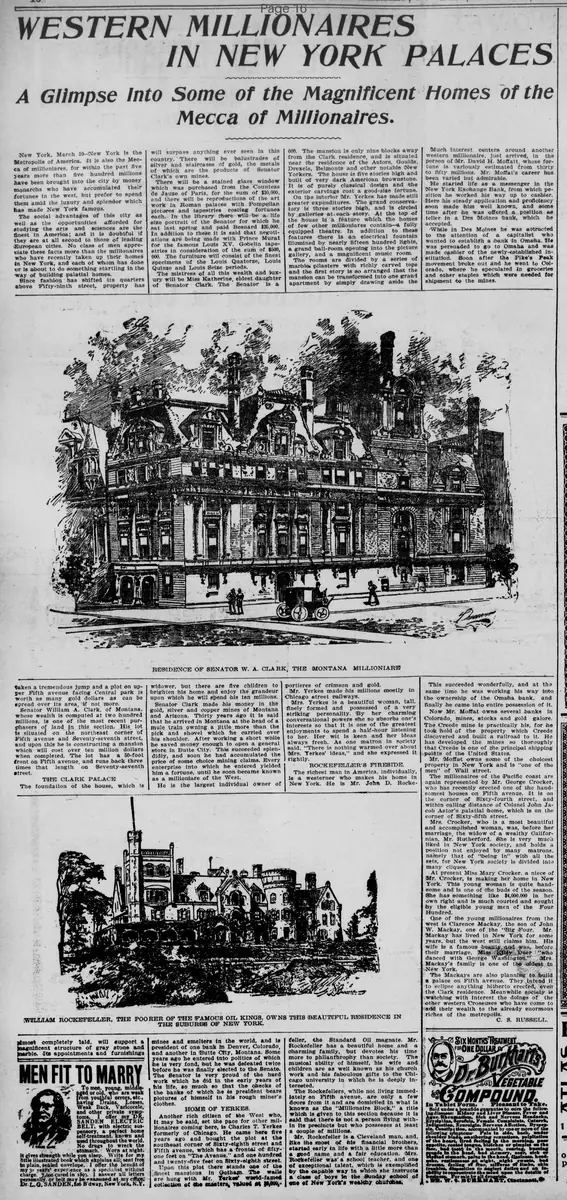
Senator William A. Clark, of Montana, whose wealth is computed at two hundred millions, is one of the most recent purchasers of land in this section. His lot is situated on the northeast corner of Fifth avenue and Seventy-seventh street, and upon this he is constructing a mansion which will cost over ten million dollars when completed. The lot has a 50-foot front on Fifth avenue, and runs back three times that length on Seventy-seventh street.
THE CLARK PALACE
The foundation of the house, which is most completely laid, will support a magnificent structure of gray stone and marble. Its appointments and furnishings will surpass anything ever seen in this country. There will be balustrades of silver and staircases of gold, the metals of which are the products of Senator Clark's own mines.
There will be a stained glass window which was purchased from the Countess de Jauze of Paris, for the sum of $30,000, and there will be reproductions of the art work in Roman palaces with Pompeiian pictures and tapestries costing fortunes each. In the library there will be a life size portrait of the Senator for which he sat last spring and paid Besnard $25,000.
In addition to these it is said that negotiations are being made with Prince Murat for the famous Louis XV. Gobelin tapestries in consideration of the sum of $500,000. The furniture will consist of the finest specimens of the Louis Quatorze, Louis Quinze and Louis Seize periods.
The mistress of all this wealth and luxury will be Miss Katherine, eldest daughter of Senator Clark. The Senator is a widower, but there are five children to brighten his home and enjoy the grandeur upon which he will spend his ten millions.
Senator Clark made his money in the gold, silver and copper mines of Montana and Arizona. Thirty years ago it is said that he arrived in Montana at the head of a mule train owning a little more than the pick and shovel which he carried over his shoulder. After working a short while he saved money enough to open a general store in Butte City. This succeeded splendidly, and soon he had accumulated the price of some choice mining claims. Every enterprise into which he entered yielded him a fortune, until he soon became known as a millionaire of the West.
He is the largest individual owner of mines and smelters in the world, and is president of one bank in Denver, Colorado, and another in Butte City, Montana. Some years ago he entered into politics of which he is very fond, but he was defeated twice before he was finally elected to the Senate.
The Senator is very proud of the hard work which he did in the early years of his life, so much so that the checks of the banks of which he is president bears pictures of himself in his rough miner's clothes.
HOME OF YERKES.
Another rich citizen of the West who, it may be said, set the pace for other millionaires coming here, is Charles T. Yerkes formerly of Chicago. He came here five years ago and bought the plot at the southeast corner of Sixty-eighth street and Fifth avenue, which has a frontage of fifty-one feet on 'The Avenue,' and one hundred and twenty-five feet on Sixty-eighth street.
Upon this plot there stands one of the finest mansions in Gotham. The walls are hung with Mr. Yerkes' world-famed collection of the masters, valued at $500,000. The mansion is only nine blocks away from the Clark residence, and is situated near the residence of the Astors, Goulds, Drexels, Belmonts and other notable New Yorkers. The house is five stories high and built of very dark American brownstone.
It is of purely classical design and the exterior carvings cost a good-size fortune. On the interior Mr. Yerkes has made still greater expenditures. The grand conservatory is three stories high, and is circled by galleries at each story. At the top of the house is a feature which the homes of few other millionaires contain—a fully equipped theatre. In addition to these features there is an electrical fountain illumined by nearly fifteen hundred lights, a grand ball-room opening into the picture gallery, and a magnificent music room.
The rooms are divided by a series of marble pilasters with richly carved tops and the first story is so arranged that the mansion can be transformed into one grand apartment by simply drawing aside the portieres of crimson and gold.
Mr. Yerkes made his millions mostly in Chicago street railways.
Mrs. Yerkes is a beautiful woman, tall, finely formed and possessed of a very striking personality. By her charming conversational powers she so absorbs one's interests so that it is one of the greatest enjoyments to spend a half-hour listening to her. Her wit is keen and her ideas always fresh. As one matron in Society said, 'There is nothing warmed over about Mrs. Yerkes' ideas,' and she expressed it rightly.
ROCKEFELLER'S FIRESIDE.
The richest man in America, individually, is a westerner who makes his home in New York. He is Mr. John D. Rockefeller, the Standard Oil magnate. Mr. Rockefeller has a beautiful home and a charming family, but devotes his time more to philanthropy than society. The musical ability of himself, his wife and children are as well known as his church work and his fabulous gifts to the Chicago university in which he is deeply interested.
The Rockefellers, while not living immediately on Fifth avenue, are only a few doors from it and are domiciled in what is known as the 'Millionaire Block,' a title which is given to this section because it is said that there is not a person living within its precincts but who possesses at least a couple of millions.
Mr. Rockefeller is a Cleveland man, and, like the most of his financial brothers, started early in life with a little more than a good name and a fair education. Mrs. Rockefeller was a school teacher, and one of exceptional talent, which is exemplified by the capable way in which she instructs a class of boys in the Sunday school of one of New York's wealthy churches.
Much interest centers around another western millionaire, just arrived, in the person of Mr. David H. Moffatt, whose fortune is variously estimated from thirty to fifty millions. Mr. Moffatt's career has been varied but admirable.
He started life as a messenger in the New York Exchange Bank, from which position he worked his way up to cashier. Here his steady application and proficiency soon made him well known, and some time after he was offered a position as teller in a Des Moines bank, which he accepted.
While in Des Moines he was attracted to the attention of a capitalist who wanted to establish a bank in Omaha. He was persuaded to go to Omaha and was made cashier of the newly-established institution. Soon after the Pike's Peak movement broke out and he went to Colorado, where he speculated in groceries and other staples which were needed for shipment to the mines.
This succeeded wonderfully, and at the same time he was working his way into the ownership of the Omaha bank, and finally he came into entire possession of it.
Now Mr. Moffatt owns several banks in Colorado, mines, stocks and gold galore. The Creede mine is practically his, for he took hold of the property which Creede discovered and built a railroad to it. He has developed the mines so thoroughly that Creede is one of the principal shipping points of the United States.
Mr. Moffatt owns some of the choicest property in New York and is 'one of the men' of Wall street.
The millionaires of the Pacific coast are again represented by Mr. George Crocker, who has recently erected one of the handsomest houses on Fifth avenue. It is on the corner of Sixty-fourth street, and within calling distance of Colonel John Jacob Astor's palatial home, which is on the corner of Sixty-fifth street.
Mrs. Crocker, who is a most beautiful and accomplished woman, was, before her marriage, the widow of a wealthy Californian, Mr. Rutherford. She is very much liked in New York society, and holds a position not enjoyed by many matrons, namely that of being 'in' with all the sets, for New York society is divided into many cliques.
At present Miss Mary Crocker, a niece of Mr. Crocker, is making her home in New York. This young woman is quite handsome and is one of the buds of the season. She has something like $4,000,000 in her own right and is much courted and sought by the eligible young men of the Four Hundred.
One of the young millionaires from the west is Clarence Mackay, the son of John W. Mackay, one of the Big Four. Mr. Mackay has lived in New York for some years, but the west still claims him. His wife is a famous beauty and was, before their marriage, Miss Kitty Duer, 'who danced with George Washington.' Mrs. Mackay's family is one of the oldest in New York.
The Mackays are also planning to build a palace on Fifth avenue. They intend to eclipse anything hitherto erected, even the Clark residence. Meanwhile society is watching with interest the doings of the other western Croesuses who have come to add their wealth to the already enormous riches of the metropolis.
What sub-type of article is it?
What themes does it cover?
What keywords are associated?
What entities or persons were involved?
Where did it happen?
Story Details
Key Persons
Location
New York, Fifth Avenue
Event Date
March 10
Story Details
Profiles of Western millionaires building luxurious mansions in New York, detailing Senator Clark's opulent palace with gold staircases and costly art, Yerkes' classical home with theater and conservatory, Rockefeller's philanthropic life in the Millionaire Block, Moffatt's banking and mining success, Crocker's society connections, and Mackay's planned palace.