Thank you for visiting SNEWPapers!
Sign up free
Story
May 30, 1892
The Helena Independent
Helena, Lewis And Clark County, Montana
What is this article about?
A. Alonzo Stagg's article for The Helena Independent reminisces about boyhood baseball and offers boys practical hints on forming a club, electing officers, buying gear, assigning positions, and catching safely. Emphasizes teamwork and play to win.
Clipping
OCR Quality
95%
Excellent
Full Text
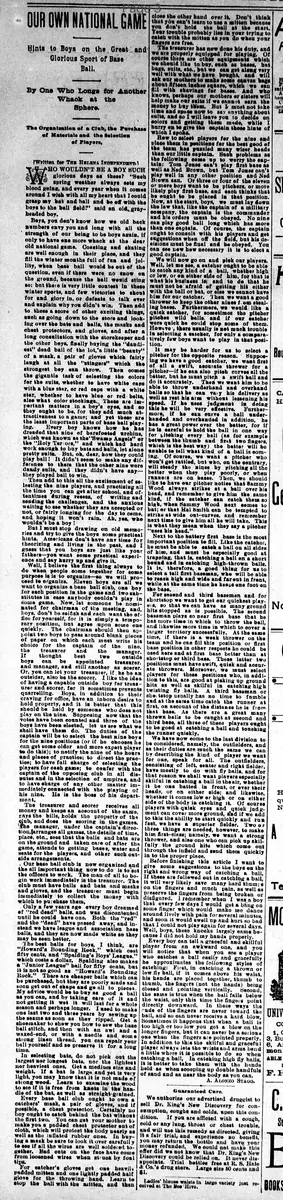
Hints to Boys on the Great and Glorious Sport of Base Ball,
By One Who Longs for Another Whack at the Sphere.
[Written for The Helena Independent.]
Who wouldn't be a boy such glorious days as these? "Such spring weather always sets my blood going, and every year when it comes around I wish with all my heart that I could grasp my bat and ball and be off with the boys to the ball field!" said an old, gray-headed boy.
Boys, you don't know how we old bachelors envy you and long with all the strength of our being to be boys again, if only to have one more whack at the dear old national game. Coasting and skating are well enough in their place, and they fill the winter months full of fun and jollity, when base ball would be out of the question, even if there were no snow on the ground, because the ball would sting so; but there is very little contest in these winter sports, and few victories to shout for and glory in, or defeats to talk over and explain why you didn't win. Then add to these a score of other exciting things, such as going down to the store and looking over the bats and balls, the masks and chest protectors, and gloves, and after a long consultation with the storekeeper and the other boys, finally buying the "dandiest" dead ball of the lot, a little "beauty" of a mask, a pair of gloves which fairly laugh at all the stingers which the strongest boy can throw. Then comes the gigantic task of selecting the colors for the suits, whether to have white caps with a blue star, or red caps with a white star, whether to have blue or red belts, also what color stockings. These are important matters in a boy's eyes, and so they ought to be, for they add much attractiveness to a game; and yet those are the least important parts of base ball playing.
Every boy knows how he has dreaded that nine of barefooted urchins, which was known as the "Swamp Angels" or the "Holy Terrors," and which had hard enough work to buy bats and balls, let alone pretty suits. But, oh, dear, how they could play ball! It didn't seem to make any difference to them that the other nine wore dandy suits, and they didn't have any--they played ball to win.
Then add to this all the excitement of selecting the nine players, and practising all the time you can get after school, and oftentimes during recess, of writing and sending the challenges, and the anxious waiting to see whether they are accepted or not, or fairly longing for the day to come, and hoping it won't rain. Ah, yes, who wouldn't be a boy!
But I must stop drawing on old memories and try to give the boys some practical hints. Americans don't have any time for theorizing and living in the past, and I guess that you boys are just like your fathers--you want some practical experience and say hurry up and give it.
Well, I believe the first thing always to do when people come together for some purpose is to organize--so we will proceed to organize. Eleven boys are all we want to organize a base ball club, one boy for each position in the game and two substitutes in case anybody couldn't play in some game. Now, let someone be nominated for chairman of the meeting, and, boys, don't be selfish and each want the office for yourself, for it is simply a temporary position, but agree upon some one quickly. The chairman should then appoint two boys to pass around blank pieces of paper on which each must write his choice for the captain of the nine, the treasurer and the manager.
If thought best two outside boys can be appointed treasurer and manager, and still another as scorer. Or, you can let your treasurer, if he be an outsider, also be the scorer. I like the idea of having a capable outside boy for treasurer and scorer, for it sometimes prevents quarrelling. Boys, in addition to their craving for office, have an inborn desire to hold property, and it is better that this should be held by someone who does not play on the nine. Supposing now that the votes have been counted and three of the boys have been elected, let us see what we shall have them do. The duties of the captain will be to select the best nine boys for the nine positions (or if he chooses he can get some older and more expert player to do this); to notify the nine of the hours and places of practice; to direct the practice; to have full charge of selecting the players for each game; to confer with the captain of the opposing club in all disputes and in the selection of umpires, and to have charge of any other matter immediately connected with the playing of his nine. He is the boss of his department.
The treasurer and scorer receives all money and keeps an account of the same, pays the bills, holds the property of the club, and does the scoring in the games. The manager, under the captain's direction, arranges all games, the details of time, place, etc., sees that the balls and bats are on the ground and taken care of after the game, attends to getting bases, water and seats for the players, and other such outside arrangements.
Our base ball club is now organized and the all important thing now to do is to set the officers to work. The man of all to begin work immediately is the treasurer. The club must have balls and bats, and masks and gloves, and the treasurer must begin immediately to collect the money with which to purchase them.
Only a few years ago every boy dreamed of "red dead" balls, and was discontented until he could have one. Both the "red" and the "dead" have passed away, and instead we have league and association base balls, and they are now made white so they may be seen better.
The best balls for boys, I think, are "Howard's Bounding Rook," which cost fifty cents, and "Spalding's Boys' League," which costs a dollar. Spalding also makes "Junior League" ball for fifty cents, but it is not so good as "Howard's Bounding Rook." There are cheaper balls which can be purchased, but they are poorly made and soon get out of shape and go all to pieces.
My advice would be to buy as good a ball as you can, and by taking care of it and not getting it wet it will last for a whole season and perhaps longer. I used to make one last two and three years by sewing up the seams as soon as they ripped. Get a shoemaker to show you how to sew the base ball stitch, and then with an awl and waxed-end, or with a needle and some strong linen thread, you can repair your ball yourself and so preserve it for a long time.
In selecting bats, do not pick out the largest nor longest bats, nor the lightest nor heaviest ones. Get a medium size and weight. If a bat is large and yet is very light, you may know that it is not made of strong wood. Learn to examine the wood to see if it is free from knots in the handle of the bat, as well as straight-grained.
Every base ball club ought to own a catcher's mask, a pair of gloves, and if possible, a chest protector. Certainly no boy ought to catch behind the bat without the first two. You can get your mother to make you a padded chest protector cut of cloth, which will protect the body nearly as well as the inflated rubber ones. In buying a mask be sure to look it over carefully to see if all the wires are well soldered together. Bad cuts on the face have come from loosened wires when struck by foul tips.
For catcher's gloves get one heavily padded mitten and one lightly padded half glove for the throwing hand. Learn to stop the ball with the mitten, and then close the other hand over it. Don't think that you can't learn to use a mitten because you don't hold the ball at the start. Your trouble probably lies in your trying to catch with the mitten as you use your free hand.
The treasurer has now done his duty, and we are properly equipped for playing, of course there are other equipments which we should like to buy, and as bases, bags, suits, etc., but you can let your mothers make suits about fifteen inches square, which will fit with twine your bases, and, I know, perhaps our mothers or sisters will help make our suits if we cannot earn money to buy them. But I must not take time or space now to say anything about suits, and so I will leave you to decide on colors and trimmings (home made), and hurry on to give the Captain those which I know.
How to select players for the nine and place them in positions for the best good of the team has puzzled many wiser heads than our little captain. Such problems as the following come up to worry the captain: Tom Jones can't play first base as well as Ned Brown, but Tom Jones can't play well in any other position and Ned Brown can. Or three or four of the eleven or more boys want to be pitchers, or more likely play first base, and each thinks that he ought to be placed in that position.
Now, at the start, boys, we must lay down the law that, like the captain of a military company, the captain is the commander and his orders must be obeyed. No nine can play good ball long which has more than one captain. Of course, the captain ought to consult with his players and get suggestions when on the field, but his decisions must be final and be obeyed. You can see now how necessary to elect a good captain.
We will now go on and pick our players. Well, let me see, a catcher ought to be able to catch any kind of a ball, whether high or low, or on either side of him, for that is his business; and to do that he must not be afraid of getting hit either with the ball or bat, or else we cannot have him for our catcher. Then we want a good thrower to keep the other nines from stealing bases. Furthermore, we would like a quick catcher, for sometimes the pitcher pitches wild balls, and if our catcher were quick he could stop some of them. However, there usually is not much trouble in selecting a catcher, for only a comparatively few boys want to play in that position.
It may be harder for us to select a pitcher for the opposite reason. Supposing we have a good catcher, we want first of all a swift, accurate thrower for a pitcher--if he can also pitch curves all the better, but he must pitch a swift ball and do it accurately. Then we want him to be able to throw underhand and overhand balls so that he can vary his delivery as well as rest his arm without lessening his speed. If he uses judgment in doing this he will be very effective. Furthermore, if he can curve a ball underhanded and overhanded in addition, he has a great power over the batter, for if he is careful to hold the ball in one way for pitching every ball (as for example between the thumb and first two fingers, which is the best way) the batter will be unable to tell what kind of a ball is coming. Of course, we want a pitcher who won't get rattled, but who, on the contrary, will steady the men by pitching all the better when they play poorly, or when runners are on bases. Then, we should like to have our pitcher notice that Sammy Wood always strikes at a ball over his head, and remember to give him the same kind, if the catcher can catch them so high, when Sammy Wood next comes to bat; or that Hal Smith can be tempted to strike at wide out-curves, and remember next time to give him all he will take. This is what they mean when they say a pitcher "uses his head."
Next to the battery first base is the most important position to fill. Like the catcher, he must be able to catch a ball on all sides of him, and must be especially good at trapping, that is, catching a ball on a short bound and in catching high-thrown balls. It is, therefore, a good thing for us to select a tall first baseman, who will be able to reach high and wide and far out in front, while at the same time he keeps one foot on the base.
For second and third basemen and for shortstop we want to get our quickest players, so that we can have as many ground hits stopped as is possible. The second baseman plays so near first base that he has more time in which to throw the ball, and likewise more time in which to cover a larger territory successfully. At the same time, if there is a weak thrower on the team and he can fill this position or first base position in other respects he could be used here and at first base better than at shortstop or third base. These latter two positions must have swift, quick and accurate throwers. Moreover, we must select players for those positions who, in addition to this, are good at picking up ground hits as well as skillful in catching high twisting fly balls. A third baseman or shortstop usually has no time to fumble and at the same time catch the runner at first, on account of the distance he is from that base. As there are a great many thrown balls to be caught at second and third base, all three of these players ought to be good at catching a ball and touching the runner quickly.
We have now come to the last division to be considered, namely, the outfielders, and as their duties are much the same we can by describing the kind of player we want for one, speak for all. The outfielders, consisting of left, center and right fielder, have mostly to do with fly balls, and for that reason we shall want players especially skillful in catching a ball in the air, whether it be one batted in front, or over their heads, or on either side; and likewise, whether it comes low or high or on either side of the body in catching it. Of course players with quick eyes and quick judgment can cover more ground, and if we add to this the ability to start quickly and run fast, we have a superior fielder. Two or three things are needed, however, to make him first-class; namely, we want a strong thrower, and also one who can pick up skillfully the ground hits which come out through the infield and send them quickly in to the proper place.
Before finishing this article I want to give some suggestions to the boys on the right and wrong way of catching a ball. If these are followed out in catching a ball, it will very likely save many hard thumps on the fingers and much pain, as well as preserve the fingers from being broken or disfigured. I remember when I was a boy that every few days I would get a bung on some finger which would make me dance around lively with pain for several minutes, and soon it would swell up and hurt so bad that I could not play again for several days.
Well, boys, these knocks largely came because I did not hold my hands properly. Every boy can tell a graceful and skillful player from an awkward one, and you will notice that when you see a player who catches a ball easily and gracefully he approximates the following styles of catching: First, in catching a thrown or low fly ball, if it comes above his waist, his hands are placed together, thumb to thumb, the fingers (not the hands) being closed and pointing vertically. Second, the same is true when the ball falls below the waist, only this time the fingers point directly downward. In these ways the ends of the fingers are never toward the ball, and so can never receive a hard blow. Sometimes it happens that when a ball is too high or too low you get a blow on the longer fingers, but it can never be a serious one when the fingers are pointed properly.
In addition to this the skillful and graceful player always lets the wrists and arms bend a little where it is possible to do so when catching a ball. In catching high fly balls, it is better to take them with the hands held as when scooping up double handfuls of sand and as near the body as you can.
A. ALONZO STAGG.
By One Who Longs for Another Whack at the Sphere.
[Written for The Helena Independent.]
Who wouldn't be a boy such glorious days as these? "Such spring weather always sets my blood going, and every year when it comes around I wish with all my heart that I could grasp my bat and ball and be off with the boys to the ball field!" said an old, gray-headed boy.
Boys, you don't know how we old bachelors envy you and long with all the strength of our being to be boys again, if only to have one more whack at the dear old national game. Coasting and skating are well enough in their place, and they fill the winter months full of fun and jollity, when base ball would be out of the question, even if there were no snow on the ground, because the ball would sting so; but there is very little contest in these winter sports, and few victories to shout for and glory in, or defeats to talk over and explain why you didn't win. Then add to these a score of other exciting things, such as going down to the store and looking over the bats and balls, the masks and chest protectors, and gloves, and after a long consultation with the storekeeper and the other boys, finally buying the "dandiest" dead ball of the lot, a little "beauty" of a mask, a pair of gloves which fairly laugh at all the stingers which the strongest boy can throw. Then comes the gigantic task of selecting the colors for the suits, whether to have white caps with a blue star, or red caps with a white star, whether to have blue or red belts, also what color stockings. These are important matters in a boy's eyes, and so they ought to be, for they add much attractiveness to a game; and yet those are the least important parts of base ball playing.
Every boy knows how he has dreaded that nine of barefooted urchins, which was known as the "Swamp Angels" or the "Holy Terrors," and which had hard enough work to buy bats and balls, let alone pretty suits. But, oh, dear, how they could play ball! It didn't seem to make any difference to them that the other nine wore dandy suits, and they didn't have any--they played ball to win.
Then add to this all the excitement of selecting the nine players, and practising all the time you can get after school, and oftentimes during recess, of writing and sending the challenges, and the anxious waiting to see whether they are accepted or not, or fairly longing for the day to come, and hoping it won't rain. Ah, yes, who wouldn't be a boy!
But I must stop drawing on old memories and try to give the boys some practical hints. Americans don't have any time for theorizing and living in the past, and I guess that you boys are just like your fathers--you want some practical experience and say hurry up and give it.
Well, I believe the first thing always to do when people come together for some purpose is to organize--so we will proceed to organize. Eleven boys are all we want to organize a base ball club, one boy for each position in the game and two substitutes in case anybody couldn't play in some game. Now, let someone be nominated for chairman of the meeting, and, boys, don't be selfish and each want the office for yourself, for it is simply a temporary position, but agree upon some one quickly. The chairman should then appoint two boys to pass around blank pieces of paper on which each must write his choice for the captain of the nine, the treasurer and the manager.
If thought best two outside boys can be appointed treasurer and manager, and still another as scorer. Or, you can let your treasurer, if he be an outsider, also be the scorer. I like the idea of having a capable outside boy for treasurer and scorer, for it sometimes prevents quarrelling. Boys, in addition to their craving for office, have an inborn desire to hold property, and it is better that this should be held by someone who does not play on the nine. Supposing now that the votes have been counted and three of the boys have been elected, let us see what we shall have them do. The duties of the captain will be to select the best nine boys for the nine positions (or if he chooses he can get some older and more expert player to do this); to notify the nine of the hours and places of practice; to direct the practice; to have full charge of selecting the players for each game; to confer with the captain of the opposing club in all disputes and in the selection of umpires, and to have charge of any other matter immediately connected with the playing of his nine. He is the boss of his department.
The treasurer and scorer receives all money and keeps an account of the same, pays the bills, holds the property of the club, and does the scoring in the games. The manager, under the captain's direction, arranges all games, the details of time, place, etc., sees that the balls and bats are on the ground and taken care of after the game, attends to getting bases, water and seats for the players, and other such outside arrangements.
Our base ball club is now organized and the all important thing now to do is to set the officers to work. The man of all to begin work immediately is the treasurer. The club must have balls and bats, and masks and gloves, and the treasurer must begin immediately to collect the money with which to purchase them.
Only a few years ago every boy dreamed of "red dead" balls, and was discontented until he could have one. Both the "red" and the "dead" have passed away, and instead we have league and association base balls, and they are now made white so they may be seen better.
The best balls for boys, I think, are "Howard's Bounding Rook," which cost fifty cents, and "Spalding's Boys' League," which costs a dollar. Spalding also makes "Junior League" ball for fifty cents, but it is not so good as "Howard's Bounding Rook." There are cheaper balls which can be purchased, but they are poorly made and soon get out of shape and go all to pieces.
My advice would be to buy as good a ball as you can, and by taking care of it and not getting it wet it will last for a whole season and perhaps longer. I used to make one last two and three years by sewing up the seams as soon as they ripped. Get a shoemaker to show you how to sew the base ball stitch, and then with an awl and waxed-end, or with a needle and some strong linen thread, you can repair your ball yourself and so preserve it for a long time.
In selecting bats, do not pick out the largest nor longest bats, nor the lightest nor heaviest ones. Get a medium size and weight. If a bat is large and yet is very light, you may know that it is not made of strong wood. Learn to examine the wood to see if it is free from knots in the handle of the bat, as well as straight-grained.
Every base ball club ought to own a catcher's mask, a pair of gloves, and if possible, a chest protector. Certainly no boy ought to catch behind the bat without the first two. You can get your mother to make you a padded chest protector cut of cloth, which will protect the body nearly as well as the inflated rubber ones. In buying a mask be sure to look it over carefully to see if all the wires are well soldered together. Bad cuts on the face have come from loosened wires when struck by foul tips.
For catcher's gloves get one heavily padded mitten and one lightly padded half glove for the throwing hand. Learn to stop the ball with the mitten, and then close the other hand over it. Don't think that you can't learn to use a mitten because you don't hold the ball at the start. Your trouble probably lies in your trying to catch with the mitten as you use your free hand.
The treasurer has now done his duty, and we are properly equipped for playing, of course there are other equipments which we should like to buy, and as bases, bags, suits, etc., but you can let your mothers make suits about fifteen inches square, which will fit with twine your bases, and, I know, perhaps our mothers or sisters will help make our suits if we cannot earn money to buy them. But I must not take time or space now to say anything about suits, and so I will leave you to decide on colors and trimmings (home made), and hurry on to give the Captain those which I know.
How to select players for the nine and place them in positions for the best good of the team has puzzled many wiser heads than our little captain. Such problems as the following come up to worry the captain: Tom Jones can't play first base as well as Ned Brown, but Tom Jones can't play well in any other position and Ned Brown can. Or three or four of the eleven or more boys want to be pitchers, or more likely play first base, and each thinks that he ought to be placed in that position.
Now, at the start, boys, we must lay down the law that, like the captain of a military company, the captain is the commander and his orders must be obeyed. No nine can play good ball long which has more than one captain. Of course, the captain ought to consult with his players and get suggestions when on the field, but his decisions must be final and be obeyed. You can see now how necessary to elect a good captain.
We will now go on and pick our players. Well, let me see, a catcher ought to be able to catch any kind of a ball, whether high or low, or on either side of him, for that is his business; and to do that he must not be afraid of getting hit either with the ball or bat, or else we cannot have him for our catcher. Then we want a good thrower to keep the other nines from stealing bases. Furthermore, we would like a quick catcher, for sometimes the pitcher pitches wild balls, and if our catcher were quick he could stop some of them. However, there usually is not much trouble in selecting a catcher, for only a comparatively few boys want to play in that position.
It may be harder for us to select a pitcher for the opposite reason. Supposing we have a good catcher, we want first of all a swift, accurate thrower for a pitcher--if he can also pitch curves all the better, but he must pitch a swift ball and do it accurately. Then we want him to be able to throw underhand and overhand balls so that he can vary his delivery as well as rest his arm without lessening his speed. If he uses judgment in doing this he will be very effective. Furthermore, if he can curve a ball underhanded and overhanded in addition, he has a great power over the batter, for if he is careful to hold the ball in one way for pitching every ball (as for example between the thumb and first two fingers, which is the best way) the batter will be unable to tell what kind of a ball is coming. Of course, we want a pitcher who won't get rattled, but who, on the contrary, will steady the men by pitching all the better when they play poorly, or when runners are on bases. Then, we should like to have our pitcher notice that Sammy Wood always strikes at a ball over his head, and remember to give him the same kind, if the catcher can catch them so high, when Sammy Wood next comes to bat; or that Hal Smith can be tempted to strike at wide out-curves, and remember next time to give him all he will take. This is what they mean when they say a pitcher "uses his head."
Next to the battery first base is the most important position to fill. Like the catcher, he must be able to catch a ball on all sides of him, and must be especially good at trapping, that is, catching a ball on a short bound and in catching high-thrown balls. It is, therefore, a good thing for us to select a tall first baseman, who will be able to reach high and wide and far out in front, while at the same time he keeps one foot on the base.
For second and third basemen and for shortstop we want to get our quickest players, so that we can have as many ground hits stopped as is possible. The second baseman plays so near first base that he has more time in which to throw the ball, and likewise more time in which to cover a larger territory successfully. At the same time, if there is a weak thrower on the team and he can fill this position or first base position in other respects he could be used here and at first base better than at shortstop or third base. These latter two positions must have swift, quick and accurate throwers. Moreover, we must select players for those positions who, in addition to this, are good at picking up ground hits as well as skillful in catching high twisting fly balls. A third baseman or shortstop usually has no time to fumble and at the same time catch the runner at first, on account of the distance he is from that base. As there are a great many thrown balls to be caught at second and third base, all three of these players ought to be good at catching a ball and touching the runner quickly.
We have now come to the last division to be considered, namely, the outfielders, and as their duties are much the same we can by describing the kind of player we want for one, speak for all. The outfielders, consisting of left, center and right fielder, have mostly to do with fly balls, and for that reason we shall want players especially skillful in catching a ball in the air, whether it be one batted in front, or over their heads, or on either side; and likewise, whether it comes low or high or on either side of the body in catching it. Of course players with quick eyes and quick judgment can cover more ground, and if we add to this the ability to start quickly and run fast, we have a superior fielder. Two or three things are needed, however, to make him first-class; namely, we want a strong thrower, and also one who can pick up skillfully the ground hits which come out through the infield and send them quickly in to the proper place.
Before finishing this article I want to give some suggestions to the boys on the right and wrong way of catching a ball. If these are followed out in catching a ball, it will very likely save many hard thumps on the fingers and much pain, as well as preserve the fingers from being broken or disfigured. I remember when I was a boy that every few days I would get a bung on some finger which would make me dance around lively with pain for several minutes, and soon it would swell up and hurt so bad that I could not play again for several days.
Well, boys, these knocks largely came because I did not hold my hands properly. Every boy can tell a graceful and skillful player from an awkward one, and you will notice that when you see a player who catches a ball easily and gracefully he approximates the following styles of catching: First, in catching a thrown or low fly ball, if it comes above his waist, his hands are placed together, thumb to thumb, the fingers (not the hands) being closed and pointing vertically. Second, the same is true when the ball falls below the waist, only this time the fingers point directly downward. In these ways the ends of the fingers are never toward the ball, and so can never receive a hard blow. Sometimes it happens that when a ball is too high or too low you get a blow on the longer fingers, but it can never be a serious one when the fingers are pointed properly.
In addition to this the skillful and graceful player always lets the wrists and arms bend a little where it is possible to do so when catching a ball. In catching high fly balls, it is better to take them with the hands held as when scooping up double handfuls of sand and as near the body as you can.
A. ALONZO STAGG.
What sub-type of article is it?
Instructional Guide
Sports Advice
What themes does it cover?
Moral Virtue
What keywords are associated?
Baseball Organization
Boys Club
Equipment Selection
Player Positions
Catching Techniques
What entities or persons were involved?
A. Alonzo Stagg
Tom Jones
Ned Brown
Sammy Wood
Hal Smith
Where did it happen?
Helena
Story Details
Key Persons
A. Alonzo Stagg
Tom Jones
Ned Brown
Sammy Wood
Hal Smith
Location
Helena
Story Details
An experienced player shares memories of youth baseball and provides practical advice on organizing a boys' baseball club, electing officers, purchasing equipment like balls, bats, masks, and gloves, selecting and positioning players for catcher, pitcher, infield, and outfield roles, and proper techniques for catching balls to avoid injury.