Thank you for visiting SNEWPapers!
Sign up free
Editorial
February 5, 1846
The Hillsborough Recorder
Hillsboro, Orange County, North Carolina
What is this article about?
An editorial from the Greensborough Patriot advocates for establishing a penitentiary in North Carolina, as voted on in the upcoming election. The author, Lorenzo, supports the system based on successes in other states like New York and Tennessee, critiques alternatives like whipping vagrants, and responds to opposing views by Sylvanus, emphasizing penal reform over moral causes of crime.
Clipping
OCR Quality
95%
Excellent
Full Text
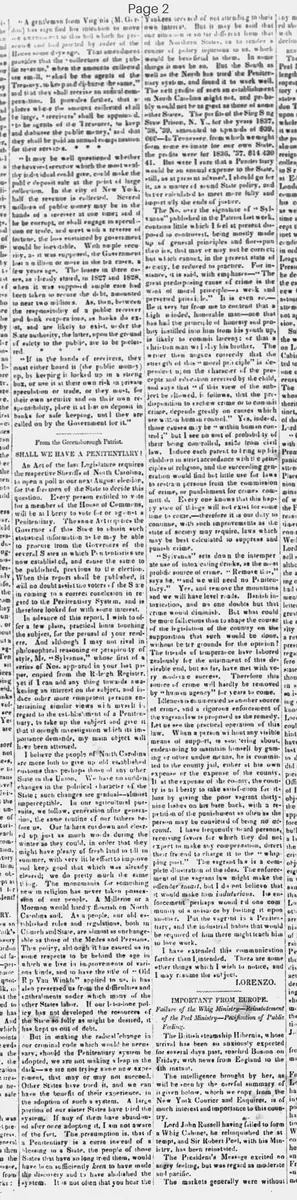
From the Greensborough Patriot.
SHALL WE HAVE A PENITENTIARY!
An Act of the last Legislature requires the respective Sheriffs of North Carolina, to open a poll at our next August election, for the free men of the State to decide this question. Every person entitled to vote for a member of the House of Commons, will be at liberty to vote for or against a Penitentiary. The act requires the Governor of this State to obtain such statistical information as he may be able to procure from the Governors of the several States in which Penitentiaries are now established, and cause the same to be published, previous to the election. When this report shall be published, it will no doubt assist the voters of the State in coming to a correct conclusion in regard to the Penitentiary System, and is therefore looked for with some interest.
In advance of this report, I wish to offer a few plain, practical hints touching the subject, for the perusal of your readers. And although I may not rival in philosophical reasoning or perspicuity of style, Mr. "Sylvanus," whose first of a series of Nos. appeared in your last paper, copied from the Raleigh Register, yet if I can add anything towards awakening an interest on the subject, and induce other more competent persons entertaining similar views with myself, in regard to the establishment of a Penitentiary, to take up the subject and give it that thorough investigation which its importance demands, my main object will have been attained.
I believe the people of North Carolina are more loth to give up old established customs than perhaps those of any other State in the Union. We have no sudden changes in the political character of the State; such changes are gradual—almost imperceptible. In our agricultural pursuits, we follow, generation after generation, the same routine of our fathers before us. Our fathers cut down and cleared up just as much woods during the winter as they could, in order that they might have plenty of fresh land to till in summer, with very little effort to improve and keep good that which was already cleared; we do pretty much the same thing. The monomania for something new in religion has never taken possession of our people. A Millerite or a Mormon would hardly flourish on North Carolina soil. As a people, our old established rules and regulations, both in Church and State, are almost as unchangeable as those of the Medes and Persians. This policy, although it has caused us in some respects to be behind the age in which we live in improvements of various kinds, and to have the title of "Old Rip Van Winkle" applied to us, it has also preserved us from the difficulties and enthrallments under which many of the other States labor. If our legislation policy has not developed the resources of the State so fully as might be desired, it has kept us out of debt.
But in making the radical change in our criminal code which would be necessary, should the Penitentiary system be adopted, we are not making a leap in the dark—we are not trying some new experiment, that may or may not succeed. Other States have tried it, and we can have the benefit of their experience, in the adoption of such a system. A large portion of our sister States have tried the system. If any of them have abandoned it after once adopting it, I am not aware of the fact. The presumption is, that if a Penitentiary is a curse instead of a blessing to a State, the people of those States that have so long tried them, would have been sufficiently keen to have made the discovery and to have abolished the system. It is not often that you hear the Yankees once or twice of not attending to their own interest. But it may be good that our citizens of the South as well as the North has tried the Penitentiary system, and found it to work well. The net profits of such an establishment in North Carolina might not be as great as those of some other States. The profit of the Sing Sing Prison, N. Y., for the years 1837, '38, '39, amounted to upward of $39,000. On the Tennessee, from which we might form some estimate for our own State, the profits were for 1836, '37, $14,430. But were I sure that a Penitentiary would be an annual expense to the State, still, as at present advised, I should go for it, as a matter of sound State policy, and better calculated to meet more fully and impartially the ends of justice.
The No. over the signature of "Sylvanus" published in the Patriot last week, contains little which I feel at present disposed to controvert, being mostly made up of general principles and for-opinions on the issue, that may or may not be correct; but which cannot, in the present state of society, be reduced to practice. For instance, it is said, with emphasis "The great predisposing cause of crime is the want of moral principles—weak and perverted principles." It is even so. But it is very far from me to contend that a light-minded, honorable man—one that has had the principle of honesty and probity instilled into him from his youth up, is likely to commit larceny; or that a Christian man will rob his brother. The writer then argues correctly that the strength of this "moral principle" is dependent upon the character of the precepts and education received by the child, and says that "if this view of the subject be allowed, it follows, that the predisposition to eschew crime or to commit crime, depends greatly on causes which are within human control." Yes, indeed, those causes may be "within human control;" but I see no sort of probability of their being controlled, as suggested from child law. Induce each parent to bring up his children in strict accordance with the principles of religion, and the succeeding generation would find but little use for laws to restrain persons from the commission of crime, or punishment for crimes committed. Every one knows that this happy state of things will not exist for some time to come, therefore it is our duty to continue, with such improvements as the state of society may require, laws which may be best calculated to suppress and punish crime.
"Sylvanus" sets down the intemperate use of intoxicating drinks, as the most prolific source of crime. "Remove this," says he, "and we will need no Penitentiary." Yes, and remove the mountains and we will have level roads. Banish intoxication, and no one doubts but that crime would diminish. But what could be more fallacious than to shape the course of the legislation of the country on the supposition that such would be done, without better grounds for the opinion? The friends of temperance have labored zealously for the attainment of this desirable end, but so far, have met with very moderate success. Therefore this source of crime will hardly be removed by "human agency" for years to come.
Idleness is enumerated as another source of crime, and a rigorous enforcement of the vagrant law is proposed as the remedy. Let us see the practical operation of this law. When a person without any visible means of support, is sauntering about, endeavoring to maintain himself by gaming or other undue means, he is committed to the county jail, either at his own expense or the expense of the county. If at the expense of the county, the county is at liberty to take out-of-pocket for it, loss by giving the poor vagrant thirty-nine lashes on his bare back, with repetition of the punishment as often as the person may be convicted of being no account. I have frequently heard persons, receiving favors for which they did not expect to make any compensation, direct their friend to charge it to the "whipping post." The vagrant law is a complete illustration of the idea. The enforcement of the vagrant law might make the offender smart, but I do not believe that it would make him industrious. Its enforcement perhaps would rid one county of a nuisance by foisting it upon another. Put the vagrant in a Penitentiary, and the industrial habits that would be required of him there might teach him to love work.
I have extended this communication farther than I intended. There are some other things which I wish to notice, and I may resume the subject.
LORENZO.
SHALL WE HAVE A PENITENTIARY!
An Act of the last Legislature requires the respective Sheriffs of North Carolina, to open a poll at our next August election, for the free men of the State to decide this question. Every person entitled to vote for a member of the House of Commons, will be at liberty to vote for or against a Penitentiary. The act requires the Governor of this State to obtain such statistical information as he may be able to procure from the Governors of the several States in which Penitentiaries are now established, and cause the same to be published, previous to the election. When this report shall be published, it will no doubt assist the voters of the State in coming to a correct conclusion in regard to the Penitentiary System, and is therefore looked for with some interest.
In advance of this report, I wish to offer a few plain, practical hints touching the subject, for the perusal of your readers. And although I may not rival in philosophical reasoning or perspicuity of style, Mr. "Sylvanus," whose first of a series of Nos. appeared in your last paper, copied from the Raleigh Register, yet if I can add anything towards awakening an interest on the subject, and induce other more competent persons entertaining similar views with myself, in regard to the establishment of a Penitentiary, to take up the subject and give it that thorough investigation which its importance demands, my main object will have been attained.
I believe the people of North Carolina are more loth to give up old established customs than perhaps those of any other State in the Union. We have no sudden changes in the political character of the State; such changes are gradual—almost imperceptible. In our agricultural pursuits, we follow, generation after generation, the same routine of our fathers before us. Our fathers cut down and cleared up just as much woods during the winter as they could, in order that they might have plenty of fresh land to till in summer, with very little effort to improve and keep good that which was already cleared; we do pretty much the same thing. The monomania for something new in religion has never taken possession of our people. A Millerite or a Mormon would hardly flourish on North Carolina soil. As a people, our old established rules and regulations, both in Church and State, are almost as unchangeable as those of the Medes and Persians. This policy, although it has caused us in some respects to be behind the age in which we live in improvements of various kinds, and to have the title of "Old Rip Van Winkle" applied to us, it has also preserved us from the difficulties and enthrallments under which many of the other States labor. If our legislation policy has not developed the resources of the State so fully as might be desired, it has kept us out of debt.
But in making the radical change in our criminal code which would be necessary, should the Penitentiary system be adopted, we are not making a leap in the dark—we are not trying some new experiment, that may or may not succeed. Other States have tried it, and we can have the benefit of their experience, in the adoption of such a system. A large portion of our sister States have tried the system. If any of them have abandoned it after once adopting it, I am not aware of the fact. The presumption is, that if a Penitentiary is a curse instead of a blessing to a State, the people of those States that have so long tried them, would have been sufficiently keen to have made the discovery and to have abolished the system. It is not often that you hear the Yankees once or twice of not attending to their own interest. But it may be good that our citizens of the South as well as the North has tried the Penitentiary system, and found it to work well. The net profits of such an establishment in North Carolina might not be as great as those of some other States. The profit of the Sing Sing Prison, N. Y., for the years 1837, '38, '39, amounted to upward of $39,000. On the Tennessee, from which we might form some estimate for our own State, the profits were for 1836, '37, $14,430. But were I sure that a Penitentiary would be an annual expense to the State, still, as at present advised, I should go for it, as a matter of sound State policy, and better calculated to meet more fully and impartially the ends of justice.
The No. over the signature of "Sylvanus" published in the Patriot last week, contains little which I feel at present disposed to controvert, being mostly made up of general principles and for-opinions on the issue, that may or may not be correct; but which cannot, in the present state of society, be reduced to practice. For instance, it is said, with emphasis "The great predisposing cause of crime is the want of moral principles—weak and perverted principles." It is even so. But it is very far from me to contend that a light-minded, honorable man—one that has had the principle of honesty and probity instilled into him from his youth up, is likely to commit larceny; or that a Christian man will rob his brother. The writer then argues correctly that the strength of this "moral principle" is dependent upon the character of the precepts and education received by the child, and says that "if this view of the subject be allowed, it follows, that the predisposition to eschew crime or to commit crime, depends greatly on causes which are within human control." Yes, indeed, those causes may be "within human control;" but I see no sort of probability of their being controlled, as suggested from child law. Induce each parent to bring up his children in strict accordance with the principles of religion, and the succeeding generation would find but little use for laws to restrain persons from the commission of crime, or punishment for crimes committed. Every one knows that this happy state of things will not exist for some time to come, therefore it is our duty to continue, with such improvements as the state of society may require, laws which may be best calculated to suppress and punish crime.
"Sylvanus" sets down the intemperate use of intoxicating drinks, as the most prolific source of crime. "Remove this," says he, "and we will need no Penitentiary." Yes, and remove the mountains and we will have level roads. Banish intoxication, and no one doubts but that crime would diminish. But what could be more fallacious than to shape the course of the legislation of the country on the supposition that such would be done, without better grounds for the opinion? The friends of temperance have labored zealously for the attainment of this desirable end, but so far, have met with very moderate success. Therefore this source of crime will hardly be removed by "human agency" for years to come.
Idleness is enumerated as another source of crime, and a rigorous enforcement of the vagrant law is proposed as the remedy. Let us see the practical operation of this law. When a person without any visible means of support, is sauntering about, endeavoring to maintain himself by gaming or other undue means, he is committed to the county jail, either at his own expense or the expense of the county. If at the expense of the county, the county is at liberty to take out-of-pocket for it, loss by giving the poor vagrant thirty-nine lashes on his bare back, with repetition of the punishment as often as the person may be convicted of being no account. I have frequently heard persons, receiving favors for which they did not expect to make any compensation, direct their friend to charge it to the "whipping post." The vagrant law is a complete illustration of the idea. The enforcement of the vagrant law might make the offender smart, but I do not believe that it would make him industrious. Its enforcement perhaps would rid one county of a nuisance by foisting it upon another. Put the vagrant in a Penitentiary, and the industrial habits that would be required of him there might teach him to love work.
I have extended this communication farther than I intended. There are some other things which I wish to notice, and I may resume the subject.
LORENZO.
What sub-type of article is it?
Crime Or Punishment
Legal Reform
What keywords are associated?
Penitentiary System
Penal Reform
North Carolina Election
Crime Causes
Vagrant Law
What entities or persons were involved?
North Carolina Legislature
Governor Of North Carolina
Sylvanus
Sing Sing Prison
Tennessee Penitentiary
Editorial Details
Primary Topic
Advocacy For Establishing A Penitentiary In North Carolina
Stance / Tone
Supportive Of The Penitentiary System And Penal Reform
Key Figures
North Carolina Legislature
Governor Of North Carolina
Sylvanus
Sing Sing Prison
Tennessee Penitentiary
Key Arguments
Other States Have Successfully Adopted Penitentiaries Without Abandoning Them
Penitentiaries Can Generate Profits, As Seen In New York ($39,000) And Tennessee ($14,430)
Even If Costly, Penitentiaries Serve Sound State Policy And Justice Better Than Current Methods
Moral Education And Temperance Reforms Are Unrealistic Short Term Solutions To Crime
Vagrant Laws And Whipping Fail To Reform Offenders And Merely Shift Problems