Thank you for visiting SNEWPapers!
Sign up free
The National Intelligencer And Washington Advertiser
Washington, District Of Columbia
What is this article about?
Transcript of witness testimonies in the 1805 impeachment trial of U.S. Supreme Court Justice Samuel Chase, focusing on his alleged bias and improper conduct during the 1800 sedition trial of James T. Callender in Richmond, VA, and charges to grand juries in New Castle, DE (1800) and Baltimore, MD (1803).
Merged-components note: These components form a single continued narrative article on the impeachment trial of Judge Chase, spanning multiple pages with sequential reading order and coherent text flow.
Clippings
1 of 3
OCR Quality
Full Text
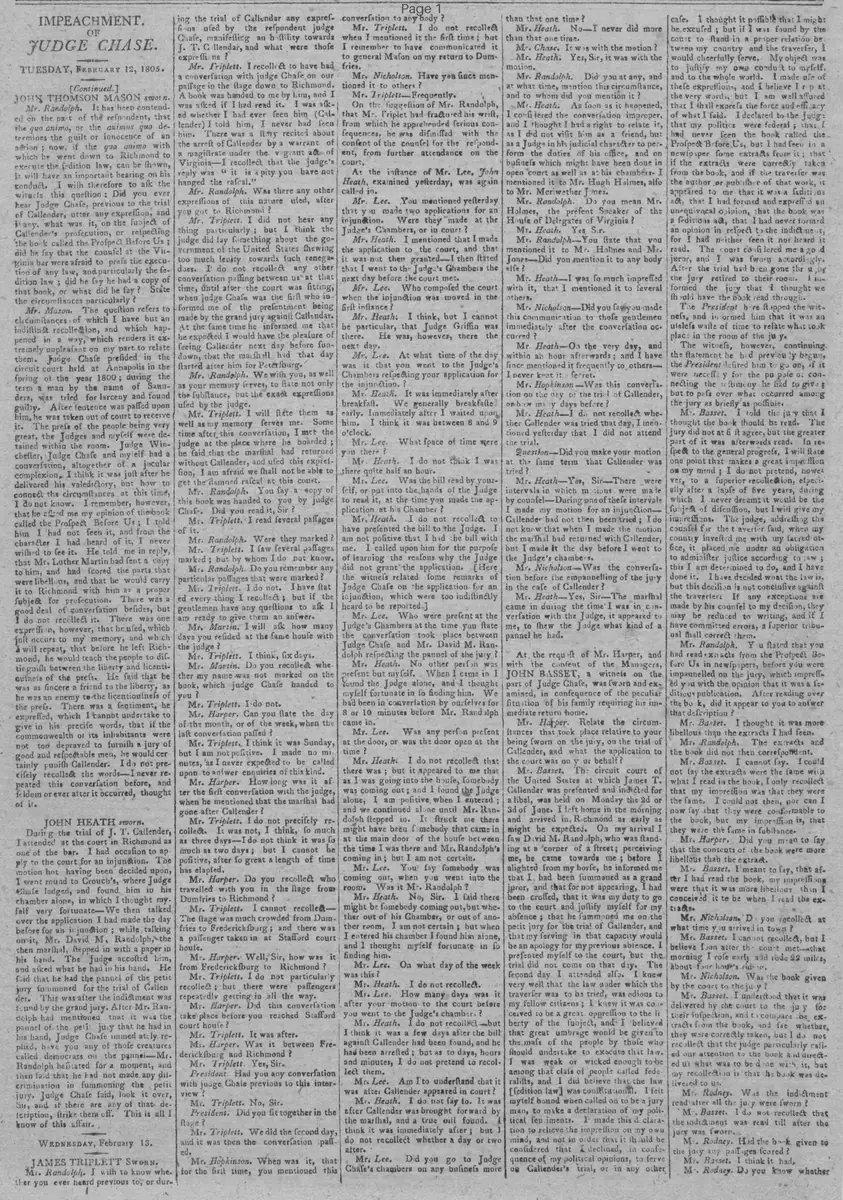
OF
JUDGE CHASE.
TUESDAY, FEBRUARY 12, 1805.
[Continued.]
JOHN THOMSON MASON SWORN.
Mr. Randolph. It has been contended on the part of the respondent, that the quo animo, or the animus quo determines the guilt or innocence of an action; now, if the quo animo with which he went down to Richmond to execute the sedition law, can be shown, it will have an important bearing on his conduct. I wish therefore to ask the witness this question: Did you ever hear Judge Chase, previous to the trial of Callender, utter any expression, and if any, what was it, on the subject of Callender's prosecution, or respecting the book called the Prospect Before Us; did he say that the counsel at the Virginia bar were afraid to press the execution of any law, and particularly the sedition law; did he say he had a copy of that book, or what did he say? State the circumstances particularly?
Mr. Mason. The question refers to circumstances of which I have but an indistinct recollection, and which happened in a way, which renders it extremely unpleasant on my part to relate them. Judge Chase presided in the circuit court held at Annapolis in the spring of the year 1800; during the term a man by the name of Saunders, was tried for larceny and found guilty. After sentence was passed upon him, he was taken out of court to receive it. The press of the people being very great, the Judges and myself were detained within the room. Judge Winchester, Judge Chase and myself had a conversation, altogether of a jocular complexion, I think it was just after he delivered his valedictory, but how to connect the circumstances at this time, I do not know. I remember, however, that he asked me my opinion of the book called the Prospect Before Us: I told him I had not seen it, and from the character I had heard of it, I never wished to see it. He told me in reply, that Mr. Luther Martin had sent a Copy to him, and had scored the parts that were libellous, and that he would carry it to Richmond with him as a proper subject for prosecution. There was a good deal of conversation besides, but I do not recollect it. There was one expression, however, that he used, which just occurs to my memory, and which I will repeat. that before he left Richmond, he would teach the people to distinguish between the liberty and licentiousness of the press. He said that he was as sincere a friend to the liberty, as he was an enemy to the licentiousness of the press. There was a sentiment. he expressed, which I cannot undertake to give in his precise words, that if the commonwealth or its inhabitants were not too depraved to furnish a jury of good and respectable men, he would certainly punish Callender. I do not precisely recollect the words-I never repeated this conversation before. and seldom or ever after it occurred, thought of it.
JOHN HEATH sworn.
During the trial of J. T. Callender, I attended at the court in Richmond as one of the bar. I had occasion to apply to the court for an injunction. The motion not having been decided upon, I went round to Crouch's, where Judge Chase lodged, and found him in his chamber alone, in which I thought myself very fortunate-We then talked over the application I had made the day before for an injunction; while talking on it, Mr. David M. Randolph, the then marshal, stepped in with a paper in his hand. The Judge accosted him, and asked what he had in his hand. He said that he had the pannel of the petit jury summoned for the trial of Callender. This was after the indictment was found by the grand jury. After Mr. Randolph had mentioned that it was the pannel of the petit jury that he had in his hand, Judge Chase immediately replied, have you any of those creatures called democrats on the pannel? Mr. Randolph hesitated for a moment, and then said that he had not made any discrimination in summoning the petit jury. Judge Chase said, look it over, Sir, and if there are any of that description, strike them off. This is all I know of this affair.
WEDNESDAY, February 13.
JAMES TRIPLETT SWORN.
Mr. Randolph. I wish to know whether you ever heard previous to, or during the trial of Callender any expressions used by the respondent judge Chase, manifesting a hostility towards J. T. Callender, and what were those expressions?
Mr. Triplett. I recollect it to have had a conversation with judge Chase on our passage in the stage down to Richmond. A book was handed to me by him, and I was asked if I had read it. I was asked whether I had ever seen him (Callender) I told him. I never had seen him. There was a story recited about the arrest of Callender by a warrant of a magistrate under the vagrant act of Virginia I recollect that the judge's reply was "it is a pity you have not hanged the rascal."
Mr. Randolph. Was there any other expressions of this nature used, after you got to Richmond?
Mr. Triplett. I did not hear any thing particularly; but I think the judge did say something about the government of the United States Shewing too much lenity towards such renegades. I do not recollect any other conversation passing between us at that time, until after the court was sitting. when judge Chase was the first who informed me of the presentment being made by the grand jury against Callender. At the same time he informed me that he expected I would have the pleasure of seeing Callender next day before sun-down, that the marshal had that day started after him for Petersburg-
Mr. Randolph. We wish you, as well as your memory serves, to state not only the substance, but the exact expressions used by the judge.
Mr. Triplett. I will state them as well as my memory serves me. Some time after this conversation, I met the judge at the place where he boarded; he said that the marshal had returned without Callender, and used this expression, I am afraid we shall not be able to get the damned rascal at this court.
Mr. Randolph. You say a copy of this book was handed to you by judge Chase. Did you read it, Sir?
Mr. Triplett. I read several passages of it.
Mr. Randolph. Were they marked?
Mr. Triplett. I saw several passages marked; but by whom I do not know.
Mr. Randolph. Do you remember any particular passages that were marked?
Mr. Triplett. I do not. I have stated every thing I recollect: but if the gentlemen have any questions to ask I am ready to give them an answer.
Mr. Martin. I will ask how many days you resided at the same house with the judge?
Mr. Triplett. I think, six days.
Mr. Martin. Do you recollect whether my name was not marked on the book, which judge Chase handed to you?
Mr. Triplett. I do not.
Mr. Harper. Can you state the day of the month, or of the week, when the last conversation passed?
Mr. Triplett. I think it was Sunday. but I am not positive. I made no minutes, 'as I never expected to be called upon to answer enquiries of this kind.
Mr. Harper. How long was it after the first conversation with the judge, when he mentioned that the marshal had gone after Callender?
Mr. Triplett. I do not precisely recollect. It was not, I think, so much as three days-I do not think it was so much as two days: but I cannot be positive, after so great a length of time has elapsed.
Mr. Harper. Do you recollect who travelled with you in the stage from Dumfries to Richmond?
Mr. Triplett. I cannot recollect- The stage was much crowded from Dumfries to Fredericksburg; and there was a passenger taken in at Stafford court house.
Mr. Harper.' Well, Sir, how was it from Fredericksburg to Richmond?
Mr. Triplett. I do not particularly recollect; but there were passengers repeatedly getting in all the way.
Mr. Harper. Did this conversation take place before you reached Stafford Court house?
Mr. Triplett. It was after.
Mr. Harper. Was it between Fredericksburg and Richmond?
Mr. Triplett. Yes, Sir.
President. Had you any conversation with judge Chase previous to this interview?
Mr. Triplett. No. Sir.
President. Did you sit together in the stage?
Mr. Triplett. We did the second day. and it was then the conversation passed.
Mr. Hopkinson. When was it. that for the first time, you mentioned this conversation to any body?
Mr. Triplett. I do not recollect when I mentioned it the first time ; but I remember to have communicated it to general Mason on my return to Dumfries.
Mr. Nicholson. Have you since mentioned it to others?
Mr. Triplett-Frequently.
On the suggestion of Mr. Randolph, that Mr. Triplett had fractured his wrist, from which he apprehended serious consequences. he was dismissed with the consent of the counsel for the respondent, from further attendance on the court.
At the instance of Mr. Lee. John Heath, examined yesterday, was again called in.
Mr. Lee. You mentioned yesterday that you made two applications for an injunction. Were they made at the Judge's Chambers, or in court?
Mr. Heath. I mentioned that I made the application to the court. and that it was not then granted I then stated that I went to the Judge's Chambers the next day before the court met.
Mr. Lee. Who composed the court when the injunction was moved in the first instance?
Mr. Heath: I think, but I cannot be particular, that Judge Griffin was there. He was, however, there the next day.
Mr. Lee. At what time of the day was it that you went to the Judge's Chambers respecting your application for the injunction. ?
Mr. Heathi. It was immediately after breakfast. We generally breakfast early. Immediately after I waited upon him. I think it was between 8 and 9 o'clock,
Mr. Lee. What space of time were you there?
Mr. Heath. I do not think I was there quite half an hour.
Mr. Lee. Was the bill read by yourself. or put into the hands of the Judge to read it, at the time you made the application at his Chamber?
Mr. Heath. I do not recollect to have presented the bill to the Judge. I am not positive that I had the bill with me. I called upon him for the purpose of learning the reasons why the Judge did not grant the application. [Here the witness related some remarks of Judge Chase on the application for an injunction, which were too indistinctly heard to be reported.]
Mr. Lee. Who were present at the Judge's Chambers at the time you state the conversation took place between Judge Chase and Mr. David M. Randolph repeating the pannel of the jury?
Mr. Heath. No other person was present but myself. When I came in I found the Judge alone, and I thought myself fortunate in so finding him. We had been in conversation by ourselves for 8 or 10 minutes before Mr. Randolph came in.
Mr. Lee.
Was any person present at the door, or was the door open at the time?
Mr. Heath. I do not recollect that there was ; but it appeared to me that as I was going into the house, somebody was coming out ; and I found the Judge alone, I am positive, when I entered : and we continued alone until Mr. Randolph stepped in. It struck me there might have been somebody that came in at the main door of the house between the time I was there and Mr. Randolph's coming in; but I am not certain.
Mr. Lee. You say somebody was coming out, when you went into the room. Was it Mr. Randolph?
Mr. Heath. No, Sir. I said there might be somebody coming out, but whether out of his Chamber, or out of another room, I am not certain ; but when I entered his chamber I found him alone, and I thought myself fortunate in so finding him.
Mr. Lee. On what day of the week was this?
Mr. Heath. I do not recollect.
Mr. Lee. How many days was it after your motion to the court before you went to the Judge's chamber.?
Mr. Heath. I do not recollect but I think it was a few days after the bill against Callender had been found, and he had been arrested ; but as to days, hours and minutes, I do not pretend to recollect them.
Mr. Lee. Am I to understand that it was after Callender appeared in Court?
Mr. Heath. I do not say so. It was after Callender was brought forward by the marshal, and a true bill found. I think it was immediately after; but I do not recollect whether a day or two after.'
Mr. Lee. Did you go to Judge Chase's chambers on any business more
Mr. Heath. No-I never did more than that one time.
Mr. Chase. It was with the motion?
Mr. Heath. Yes. Sir, it was with the motion.
Mr. Randolph. Did you at any, and at what time, mention this circumstance, and to whom did you mention it?
Mr. Heath. As soon as it happened. I considered the conversation improper, and I thought I had a right to relate it. as I did not visit him as a friend, but as a Judge in his judicial character to perform the duties of his office. and on business which might have been done in open court as well as at his chambers- I mentioned it to Mr. Hugh Holmes, also to Mr. Meriwether Jones.
Mr. Randolph. Do you mean Mr. Holmes, the present Speaker of the House of Delegates of Virginia?
Mr. Heath. Yes Sir.
Mr. Randolph--You State that you mentioned it to Mr. Holmes and Mr. Jones--Did you mention it to any body else?
Mr. Heath I was so much impressed with it, that I mentioned it to several others.
Mr. Nicholson-Did you say you-made this communication to those gentlemen immediately after the conversation occurred?
Mr. Heath-On the very day, and within an hour afterwards; and I have since mentioned it frequently to others-- I never kept it secret.
Mr. Hopkinson -Was this conversation on the day of the trial of Callender. or how many days before?
Mr. Heath-I do not recollect whether Callender was tried that day, I mentioned yesterday that I did not attend the trial.
Question--Did you make your motion at the same term that Callender was tried?
Mr. Heath-Yes, Sir-There were intervals in which motions were made by counsel-During one of these intervals I made my motion for an injunction-- Callender had not then been tried : I do not know that when I made the motion the marshal had returned with Callender, but I made it the day before I went to the Judge's chambers
Mr. Nicholson-Was the conversation before the empannelling of the jury in the case of Callender?
Mr. Heath-Yes, Sir-The marshal came in during the time I was in conversation with the Judge, it appeared to me, to shew the Judge what kind of a pannel he had.
At. the request of Mr. Harper, and with the Consent of the Managers, JOHN BASSET. a witness on the part of Judge Chase, was sworn and examined, in consequence of the peculiar situation of his family requiring his immediate return home.
Mr. Harper. Relate the circumstances that took place relative to your being sworn on the jury, on the trial of Callender, and what the application to the court was on your behalf?
Mr. Basset. The circuit court of the United States at which James T. Callender was presented and indicted for a libel. was held on Monday the 2d or 3d of June. I left home in the morning and arrived in, Richmond as early as might be expected. On my arrival I saw David M. Randolph, who was standing at a corner of a street; perceiving me, he came towards me ; before alighted from my horse, he informed me that I. had been summoned as a grand juror, and that for not appearing, I had been crossed, that it was my duty to go to the court and justify myself for my absence ; that he summoned me on the petit jury for the trial of Callender, and that my serving in that capacity would be an apology for my previous absence. I presented myself to the court, but the trial did not come on that day. The second day I attended also. I knew very well that the law under which the traverser was to be tried, was odious to my fellow citizens; I knew it was conceived to be a great oppression to the liberty of the subject, and- I believed that great umbrage would be given to the,mass of the people by those who should undertake to execute that law. I was weak or wicked enough to be among that class of people called federalists. and I did believe that the law [sedition law] was constitutional. I felt myself bound when called on to be a juryman, to make a declaration of my political sentiments. I' made this declaration to relieve the impression on my own mind, and not in order that it should be considered that I declined, in consequence
Mr. Basset. case. I thought it possible that I might be excused ; but if I was found by the court to stand in a proper relation between my country and the traverser, would cheerfully serve. My object was to justify my own conduct to myself. and to the whole world. I made use of these expressions, and I believe I repeat the very words, but I am well assured that I shall express the force and efficacy of what I said. I declared to the Judge- that my politics were federal : that I had never seen the book called the Prospect Before Us. but I had seen in a newspaper some extracts from it : that if the extracts were correctly taken from the book, and if the traverser was the author or publisher of that work, it appeared to me that it was a seditious act, that I had formed and expressed an unequivocal opinion, that the book was a seditious act. that I had never formed an opinion in respect to the indictment. for I had neither seen it nor heard it read. The court considered me a good juror, and I was sworn accordingly.
After the trial had been gone through the jury retired to their room. I informed the jury that I thought we should have the book read through.
The President here stopped the witness. and informed him that it was an useless waste of time to relate what took place in the room of the jury.
The witness, however, continuing the statement he had previously begun, the President desired him to go on, if it were necessary for the purpose of connecting the testimony he had to give: z but to pass over what occurred among the jury as briefly as possible.
Mr. Basset. I told the jury that I thought the book should be read. The jury did not at first agree, but the greater part of it was afterwards read. In respect to the general progress, I will state one point that makes a great impression on my mind : I do not pretend, however, to a superior recollection, especially after a lapse of five years, during which I never dreamt it would be the subject of discussion, but I will give my impressions. The judge, addressing the counsel for the traverser said, when my country invested me with my sacred office, it placed me under an obligation to administer justice according to law ; this I am determined to do. and I have done it. I have decided what the law is. but this decision is not conclusive against the traverser: If any exceptions are made by his counsel to my decision, they may be reduced to writing, and if I have committed errors, a superior tribunal shall correct them.
Mr. Randolph. You Stated that you had read extracts from the Prospect Before Us in newspapers, before you were impanelled on the jury, which impressed you with the opinion that it was a seditious publication. After reading over the book, did it appear to you to answer that description?
Mr. Basset. I thought it was more libellous than the extracts I had seen-
Mr. Randolph. The extracts and the book did not then correspondent.
Mr. Basset. I cannot say. I could not say the extracts were the same which what I read in the book, I only recollect that my impression was that they were the same. I could not then, nor can I now say that they were conformable to the book, but my impression is, that they were the same in substance-
Mr. Harper. Did you mean to say that the contents of the book were more libellous than the extracts.
Mr. Basset. I meant to say. that after I had read the book, my impressions were that it was more libellous than I conceived it to be when I read the extracts so
Mr. Nicholson. Do you recollect at what time you arrived in town?
Mr. Basset. I cannot recollect, but I believe soon after the court met-that morning I rose early and rode 22 miles, about four hours ride.
Mr. Nicholson. Was the book given by the court to the jury
Mr. Basset. I understood that it was delivered by the court to the jury for their inspection, and to compare .the extracts from the book, and see whether, they were correctly taken, but I do not recollect that the judge particularly called our attention to the book and directed us what was to be done with it, but my recollection is'that the book was delivered to us.
Mr. Rodney. Was the indictment read after all the jury were sworn?
Mr. Basset. I do not recollect that the indictment was read till after the jury was sworn.
Mr. Rodney. Had the book given to the jury any passages scored?
Mr. Basset. I think it had,
Mr. Rodney. Do you know whether
the pages marked formed any part of
the indictment?
Mr. Basset. I cannot say that I re-
collect.
Mr. Campbell. When you were sworn
did you understand that the charges in
the indictment were taken from the book
called the Prospect Before Us?
Mr. Basset. It was a subject of gene-
ral notoriety, that the indictment was
drawn from the Prospect Before Us.
Mr. Campbell. What authority had
you for supposing that the extracts you
had read were taken from the Prospect
Before Us?
Mr. Basset. I had no authority but
the newspapers, they reported that the
extracts were taken from the book called
the Prospect Before Us.
Mr. Randolph. Have you any reason
to believe that the extracts in the new-
papers were not taken from the book?
Mr. Basset. I firmly believe they
were taken from it.
Mr. Hopkinson. Was the book
which you took out that which was
given in evidence during the trial?
Mr. Basset. Whether it was the
book which was furnished by the prose-
cutor and handed to us by the agent of
the court. I cannot tell.
Mr. Hopkinson. At what hour did
the court meet?
Mr. Basset. I believe about 10
o'clock.
The President. I understand you as
saying that you never saw the book, un-
til you saw it in court.
Mr. Basset. I am clearly and fully of
impressed
The President. When you were ques-
tioned as a juror, I understand you to
have said, that if the extracts you had
read were correctly given, the mat-
ter was libellous; did you say that you
had formed an opinion?
Mr. Basset. No Sir, nor that I had
delivered an opinion, but I said that if
the traverser was the author of those ex-
tracts, he was guilty of a breach of the
sedition law. I repeat every expression
that is now remaining on my memory.
I answered so far as to the fact. The
enquiries extended no farther than to
taking up my opinion on the extracts
contained in the newspapers. It had no
connection whatever with the book. I
do not know that I stated to the court
that I had expressed an opinion.
Mr. Harper. Did you make an ap-
plication to the court to be excused, or
did your observations arise from motives
of delicacy?
Mr. Basset. If my memory does not
fail me I did not solicit the judge to
excuse me; the office of a juryman is
no doubt always an unpleasant one, but
when I am called upon to perform a du-
ty, I do not shrink from the task. I had
some doubts whether my mind was in a
proper state to pass between my Country
and the traverser. It was to remove
these doubts that I made the declaration
and for no other purpose.
Mr. Lee. On what day of the week
was Callender tried?
Mr. Basset. I arrived about 10
o'clock on Monday, and the next day
the jury were sworn at the usual time.
Mr. Bayard. What was the general
conduct of the judge to the counsel,
and of the counsel to the court:
Mr. Basset. The different colouring
through which the same things are seen
makes you men see things differently
through others. My own opinion is that the
judge conducted himself with decision
unmixed with severity, and that he was
witty without being sarcastic. It was
my impression that the Judge wished the
prisoner to have a full hearing, that he
might be acquitted, if innocent, and
found guilty, if really guilty. It appear-
ed to me, that the only point on which
the counsel hoped to save their client was
by proving the unconstitutionality of the
sedition law, and it appeared to me that
they could not form a reasonable expec-
tation of acquitting him on any other
ground. I believe his counsel believed
the law unconstitutional, and thought
they had eloquence and argument enough
to convince the jury of it. I believe
they thought the Judge deprived them
of their right to address the jury on that
point; and that having the cause very
much at heart, they were vastly mortified
that the Court did not permit them to
take the course they wished. They ap-
peared to consider themselves as advocat-
ing the cause of an oppressed citizen,
and they felt hurt at not being allowed
the mode of defence which in their opi-
nion the law authorized. In all their
arguments they travelled but little way
before they came to the point that went
to prove the law unconstitutional, and
the Judge declared, at every such time,
that they had no right to address the
jury on that point; that the constitution
had made the court the sole Judges of
a law as far as it respected its constitu-
tionality. From these circumstances, it
is my impression that the altercation be-
tween the bar and the court arose solely
from the sensibility of the counsel to this
particular subject, and from being de-
prived, as they supposed, of their rights.
The President. What were the par-
ticular causes of irritation between the
Judge and the counsel?
Mr. Basset. I have stated what I
considered the causes. They arose from
the counsel adverting to that particular
point, and their so frequently doing it
occasioned the Judge to elevate his voice,
and to pronounce over and over again
what he conceived to be the law.
Mr. Rodney. Was the question put
by the court, whether you had formed
and delivered an opinion on the charges
contained in the indictment?
Mr. Basset. My memory on the
particular form of the question is imper-
fect, but I will state my idea of it. I
at first thought the question had been
put in the disjunctive, or—but I am now
persuaded that I was mistaken, so many
gentlemen concurring in recollecting
that the word and was used, I must be-
lieve I was mistaken.
Mr. Rodney. When the question was
put, did you not say that you had form-
ed an opinion on the extracts, and did
you not express the very opinion which
you had formed?
Mr. Basset. I did, and I said that if
the book answered to the extracts, I had
formed an unequivocal opinion that it
was libellous.
Mr. Rodney. And this before you
was sworn?
Mr. Basset. Yes, Sir.
The witness was then, from the pecu-
liar circumstances already stated, excused
with the consent of the parties from any
further attendance on the court: the
President observing that although the
indulgence was granted in this instance.
he hoped it would not be made a pre-
cedent for a general practice.
THURSDAY, Feb. 14,
On the request of Mr. Harper, and
with the consent of the managers, ED-
MUND RANDOLPH a witness on be-
half of the respondent, was sworn.
Mr. Hopkinson. Were you present at
the trial of Callender?
Mr. Randolph. I was present during
a short part of the time.
Mr. Harper. What was the general
conduct and demeanor of the court to-
wards the counsel. Was it harsh, rough
and irritating; or was it mild and face-
tious?
Mr. J. Randolph. I wish to submit
to the court, whether it is proper to put
this question in the form proposed. I
wish the witness may in stating the con-
duct of the court, confine himself to spe-
cific facts, as much as possible.
Mr. Harper. The general conduct of
the court is a matter of fact, and the
particular acts of the court go to show
what that was.
The President here desired the answer
to be reduced to writing, when Mr.
Harper said that he had no objection
to withdrawing the question. Mr. J.
Randolph, however, waiving any ob-
jection to the question, the President de-
sired Mr. Randolph to proceed.
Mr. Randolph. The answer I have
to make is very short. Having been
absent the greater part of the time, I
do not consider myself competent to say
what the general conduct of the court
was. I recollect that shortly after the
trial commenced, I came into court, and
sat very near the bench on which the
judges sat. I continued there some
time, while a portion of the very lengthy
indictment was reading. I then went
out, and returned to my own house,
where I continued until the time when I
supposed the reading of the indictment
would be finished. But on my entrance
into the lobby of the court, I saw the
counsel for the traverser folding up their
papers, and retiring from the bar.
Mr. Harper. Were you in court dur-
ing the time when the previous motions
were made?
Mr. Randolph. Shortly after the in-
dictment was found against Callender, I
was in court. The only incident,
which I recollect to have taken place at
that time, was seeing the clerk or the
attorney of the district hand up to judge
Chase a paper about which I made en-
quiry of somebody near me, and learnt
that it was a warrant or process for
apprehending Callender. This is all I
recollect previous to the arrest of Callen-
der. When Callender was brought into
the court, I stood outside of the crowd, at
some distance from the court. I heard a
great deal said, but I do not recollect
what I did hear. I am, therefore, satis-
hed that I am incapable of giving a con-
nected statement of what passed at
that time. On the succeeding day the
trial commenced; but I was not present
when the motion was made for a conti-
nuance. I have stated already how far
I was a witness from that time to the
conclusion of the trial.
Mr. Harper. What was the demea-
ner of the court when you saw the coun-
el folding up their papers?
Mr. Randolph. I do not recollect any
specific facts.
Mr. Harper. What was their general
demeanor during the trial?
Mr. Randolph. From the causes I
have stated I am not able to answer this
question.
Mr. Harper. Have you no general
impression?
Mr. Randolph. I cannot say I
have.
Mr. Harper. Was there any thing,
which struck you as remarkable, impro-
per, or otherwise?
Mr. Randolph. I have no hesitation
in saying that I saw nothing that con-
veyed the idea of corruption.
Mr. Harper. What do you mean by
corruption?
Mr. Randolph. I mean an evil in-
tention to oppress the traverser. I speak
only of those parts of the trial which I
witnessed myself, and I must be under-
stood as knowing little of what passed
from my own observation.
Mr. Harper. You say you perceived
no evil intent to oppress the party?
Mr. Randolph. I had no idea of the
sort.
Mr. Lee. Do you recollect nothing
that was said by the court to the coun-
el, when they were putting up their pa-
pers and retiring.
The introduction of Mr. Randolph's
testimony was delivered in so low a
voice as not to be heard by the reporter.
But it is understood that, in the part not
heard, nothing relevant to the charges
in the articles of impeachment, was
said.
Mr. Randolph. No. Sir, I was at a
considerable distance, at the door of the
lobby at the time. I have no further
answers to make to the questions propo-
sed; I do not think it incumbent on me
to relate matters that are irrelevant, or
to go into conjectures.
Mr. Harper. We are ready to hear
any thing from a gentleman so well skill-
ed,
Mr. Randolph. The reason of my
remark is my having understood that I
was summoned in relation to opinions de-
livered by me at the time of the trial.
Mr. Harper. We are sensible that
we cannot require them.
Mr. Randolph was, by consent of both
parties, excused from further attendance
as a witness.
GEORGE READ SWORN.
Mr. Randolph. The witness will
please to state what he knows in relation
to certain proceedings at a circuit court
of the United States held at New
Castle, in the state of Delaware, in the
month of June, 1800
Mr. Read. It is incumbent on me
to state that several years have elapsed
since the transaction, which I am now
about to relate, occurred, of course I
cannot pretend to say that the language
I shall use to convey the sentiments de-
livered by Mr. Chase is precisely accord-
ing to what occurred at the time; but
the substance of what I relate will be
correct. The transactions, to which I
presume I am called to testify, took
place at a session of the circuit court,
held in New Castle, for Delaware dis-
trict, in June 1800. The court sat
two days, viz. on the 27th and 28th
day of the month. At that court, Sa-
muel Chase, one of the associate justices
presided, and Gunning Bedford, district
judge, was associated with him. Judge
Chase, as usual, delivered a charge to
the grand jury on the first day of the
term. The grand jury, after hearing
the charge, retired to their chamber;
after remaining there for some time,
they returned into court, and on being
asked whether they had found any bills.
or had any presentments to make; they
answered they had found no bills of in-
dictment, and had no presentments to
make. After receiving this answer,
Judge Chase proceeded to observe, as
nearly as I can recollect, addressing him-
self to the grand jury, that he had been
informed, or heard, a highly seditious
temper had manifested itself in the state
of Delaware, among a certain class of
people, especially in New Castle county,
and more especially in the town of Wil-
mington, where lived a most seditious
printer, unrestrained by any principle of
virtue, and regardless of social order;
that the name of this printer was—
the judge here paused and said, perhaps
it might be assuming, or taking upon
himself too much to mention the name
of this person, but, gentlemen, it be-
comes your special duty, and you must
enquire diligently into this matter. Se-
veral of the jurors, I believe, made a
request to the court to dismiss them, and
assigned as the reasons for their request,
that some of them were farmers, and
as it was about the time of harvest.
they were anxious to be on their farms.
The Judge observed that the business to
which he had called their attention was
of a very urgent and pressing nature,
and must be attended to; that he could
not therefore discharge them before the
next day, when further information
should be communicated to them on the
subject he had referred to. The Judge
then addressing himself to me as district
attorney, asked me, as I believe is usual
on such occasions, whether I had any
criminal charges to submit to the grand
jury. I said that none such had yet oc-
curred, and I believed none were likely
to occur during that term. Judge Chase
continuing his address to me, observed,
you might, by prosecuting proper re-
searches, make some discoveries. Have
you not heard of some persons in this
state, who have been guilty of libelling
the government, or the administration
of the government of the United States.
I am told, and the general circulation
of the report induces me to believe it,
that there is a certain printer in the
town of Wilmington, who publishes a
most scandalous newspaper; but it will
not do to mention names. Have you
not two printers in that town? I an-
swered that I believed there were. Judge
Chase observed that one of them was a
seditious printer, adding, he shall be
taken notice of, and it is your duty,
Mr. Attorney, to examine unregard-
lessly and minutely into affairs of this na-
ture; times like these require that this
seditious temper or spirit which pervades
too many of our press should be dis-
couraged or repressed. Can you not had
a file of these newspapers between this
time and to-morrow morning. and ex-
amine them, and discover whether this
printer is not guilty of libelling the go.
vernment of the United States? This
I say, Sir, must be done; I think it is
your duty. I observed, as this subject
was pressed by the honorable judge. I
believed I was acquainted with the duties
of my office, and was willing to dis-
charge them. I mentioned that I had
not in my possession the papers alluded
to by the judge, nor had read them.
But that if a file of them were procur-
ed, and handed to me, I had no objec-
tion to examine them, and communicate
with the grand jury on the subject. The
Judge then said he was satisfied, and
turning to the grand jury, observed,
that he could not discharge them, howe-
ver inconvenient their stay; they must
attend the ensuing day. at the usual
hour. The Judge then directed that a
file of the papers should be procured for
me; I understood him to mean the pa-
per called the Mirror of the Times and
General Advertiser, though I do not re-
collect to have heard the title of the pa-
per mentioned during this procedure. A
file of those papers was brought to me
in the afternoon after the adjournment
of the court, by whom they were
brought I do not recollect. I examined
them, but in a cursory manner, as I
was very much interrupted by persons
calling upon me. I did not discover dur-
ing the course of this examination, any
libellous matter coming within the pro-
visions of the sedition act. According
to what I understood to be the wish of
the Judge, I sent this file of papers to
the grand jury. Soon after the meet-
ing of the court on the second day, and
at the request of the grand jury I at-
tended them in their room. On enter-
ing, the foreman of the jury addressed
me, and directed my attention to a pa-
paragraph in a publication contained in
the Mirror of the 21st June, 1800, re-
published from the Aurora, reflecting
perhaps in strong and pointed language.
on the former Conduct of Judge Chase.
He observed that there was a difference
of opinion among the jurors as to the
nature of the paragraph—some doubted
whether it was a libel or not, and if li-
bellous, whether they had a right to
present it to the circuit court. I ob-
served that it was not necessary for me
to be very particular in my opinion of
the publication, as I did not consider it
as coming under the sedition law, though
it might be considered as an offence at
common law, because Judge Chase had
decided that the circuit court could not
take cognizance of cases arising at com-
mon law. I returned into court, after
some time the file was placed before the
Judge. Judge Chase asked me what
had been done, and whether the grand
jury had made any discoveries of libel-
lous matter. I answered none, unless it
were the paragraph which related to
Judge Chase, which I showed him, ob-
Mr. Read. I do recollect that Judge Chase, in a conversation with me, previous to the court, observed that there was a seditious printer in Wilmington, who published a paper called the Mirror of the Times and the General Advertiser; that he was in the habit of libelling the government of the United States; that it was our duty to enquire if any seditious publications had been made; that he would not discharge us that day, nor until we had made the enquiry. Several of the jurors addressed the Judge for leave to return home, stating that they were farmers, and were extremely anxious to be on their farms as it was harvest time. Some conversation passed between Judge Chase and the Attorney of the district, after which he said he could not discharge us until the next day. We returned the next day into court, and after sitting some time in our box we retired to the jury room. A file of newspapers was produced by some persons, and we examined them. We found nothing in them of a libellous nature in our opinion, excepting something relative to Judge Chase; which one of the jury thought came under the sedition law. We sent for the Attorney of the district, to inform us, as to the nature of that paragraph. He told us it did not come under the sedition law. We went into the jury box; when a conversation of some length took place between Judge Chase and the Attorney of the district, after which we were discharged.
Mr. Martin—What time did you come down on the first day?
Mr. Lea—We were up a very short time; perhaps an hour.
Mr. Martin—What time the second day?
Mr. Lea—A good while.
Mr. Martin—What time is the harvest in Delaware?
Mr. Lea—It was the time of hay harvest.
Mr. Randolph—I will ask you, whether you recollect the Judge to have quoted the title of the paper?
Mr. Lea—I recollect that he did.
Mr. Randolph—Was it the same paper that was sent you by the attorney?
Mr. Lea—It was.
JOHN CROW, SWORN.
Mr. Rodney. Please to state what occurred in the circuit court held at New-Castle.
Mr. Crow. I was not in the court house the first day. On the second day, I went into court just after it was opened. I recollect there was some conversation that took place between Judge Chase and the district attorney. The Judge asked the attorney of the district if there were any presentments likely to be made that day. The attorney answered, there were none; that on examining the file of newspapers, there was nothing found libellous, unless it were some strictures on the Judge himself. If that is all, the Judge replied, we will take no notice of it. I recollect nothing further. The Judge shortly after discharged the grand jury.
JOHN MONTGOMERY SWORN.
Mr. Randolph. The subject on which it is understood you are capable of giving some information to the court, is the conduct of Judge Chase at a circuit court of the United States held for the district of Maryland, at Baltimore, in May, 1803, or about that time.
Mr. Montgomery. The point I presume, on which I am called to give testimony, relates to a charge to a grand jury delivered by Judge Chase, at a circuit court where he presided, and Judge Winchester was associated with him. It will not, from the nature of the subject, be expected that I shall be able to detail in the precise language of the Judge,—the whole of the charge which was delivered in 1803, at the May term. Though not one of the bar, I was present at the court, and took a chair among the gentlemen of the bar. After the grand jury were impanelled, Judge Chase addressed them. He appeared to address them from a written paper that lay before him. He proceeded in the usual manner to charge the jury as to the duties expected to be performed by them. After he had thus far proceeded in his charge, he mentioned that before the jury retired to their chamber, he would make some observations, and that they would be considered as flowing from a wish for the happiness or welfare of the community. He stated that it was important that the people should be fully informed, particularly at such a crisis: that falsehood was more easily disseminated than truth; and that the latter was reluctantly attended to, when opposed to popular prejudice. I cannot pretend to state the sentiments delivered by the Judge in the order in which they were delivered. I can undertake to state from my recollection, the substance of those he delivered. To the best of my recollection the Judge stated that the administration was weak, relaxed, and inadequate to the duties devolved on it, and that its acts proceeded not from a view to promote the general happiness, but from a desire for the continuance of unfairly acquired power. The language, 'unfairly acquired' power, made a strong impression on my mind at the time, and when the Judge called the attention of the jury to the observations he was about to make, I was prepared to expect something extraordinary from him, as I was at Annapolis, when he pronounced the valedictory address, which Mr. Mason in his testimony took occasion to mention. The Judge stated the violation of the constitution that had taken place by the act of Congress repealing the judiciary act of 1800, and the consequent removal of sixteen judges; that it had made a violent attack on the independency of the judiciary. He also found fault with a law passed by the legislature of Maryland in 1801, the effect of which was the removal of all the judges on the county court establishment: he stated that those acts were a severe blow against the independence of the judiciary; he stated that since the year 1776 he had been an advocate for a representative or republican form of government; that it was his wish that freemen should be governed by representatives chosen by that class of citizens who had a property in, a common interest with, and an attachment to the community: the language might have been in the words of our constitution: he found fault with the law passed by the legislature of Maryland, which he styled the universal suffrage law. He stated, that that also affected the independence of the judiciary, and to the best of my recollection, he explained his ideas in this manner. That every free white male citizen, in the language of the constitution, having the qualification of age and residence, tho' he had not a property in, an interest with, and an attachment to the community, being suffered to choose those who constituted the legislature, and the judiciary being dependent on the legislature for their support and continuance in office, few characters of integrity and ability, who are competent to discharge the duties of judges, would be found to accept of appointments held on such a tenure. He stated that these measures were destructive of the happiness and welfare of the Community; that they would have a tendency to sink our republican government into what he called a mobocracy, the worst of all possible governments. When on the subject of the alteration of the state constitution, he stated that the framers of that constitution were men of ability and patriotism; the names of some of whom were honorably enrolled on the journals of Congress, and also, I think he said on the journals of the convention of Maryland; that he had to observe, that the sons of some of those characters which he regretted, were the chief supporters of these destructive measures. He stated that where there were equal laws and equal rights, viz. laws equally administered, between the rich and the poor, in that country there was freedom. But where the administration of the laws was partial and uncertain, the people were not free, and he was apprehensive we were fast approaching to that state of things. He stated that there was but one act remaining to be done, mentioning the act passed by the legislature of Maryland, for the trial of facts and for abolishing the general and appellate Court—if that should be adopted, the constitution would not be worthy of further care or preservation. At the close of the judge's charge, he, in an impressive manner, called on the jury to pause, to reflect and when they returned to their homes, to use their endeavors to prevent these impending evils, and save their country. He said that the people had been misled by misrepresentation, falsehood, art and cunning; that by correcting these errors, the threatened evils might be prevented, or words to that effect. With regard to a part of the answer of Judge Chase which has been published, and which I have read, perhaps it will not be improper for, and may be expected of me, to mention a fact contradictory to what is stated therein. It is stated in the answer, "The next opinion is, that the independence of the judges of the state of Maryland, would be entirely destroyed if the bill for abolishing the two supreme courts should be ratified by the next general assembly." This opinion, however incorrect it may be, seems to have been adopted by the people of Maryland, to whom this argument against the bill in question was addressed: for at the next session of the legislature this bill, which went to change entirely the Constitutional tenure of judicial office in the state, and to render the subsistence of the judges dependent on the legislature, and their continuance in office on the executive, was abandoned by common consent. It is true it was abandoned by common consent, but not for the reasons assigned by the Judge in this part of his answer.
Mr. Nicholson—Was the provision for establishing universal suffrage a part of the constitution, at the time Judge Chase delivered the charge?
Mr. Montgomery—It was.
Mr. Randolph—You state that the charge appeared to have been delivered from a written paper which lay before the Judge. Do you mean to be understood, that after going through the first part of the charge on the ordinary duties of a grand jury, the latter part appeared to be delivered from a written paper?
Mr. Montgomery. It appeared to me that the latter, as well as the former part, was delivered in the same manner; the Judge keeping his eyes on the paper before him.
Mr. Nicholson. Do you recollect whether the very last part of the charge, when he desired the jury to pause and reflect, &c. was delivered from the written paper?
Mr. Montgomery. It appeared to me as if he confined himself throughout to the written paper.
(To be continued.)
What sub-type of article is it?
What themes does it cover?
What keywords are associated?
What entities or persons were involved?
Where did it happen?
Story Details
Key Persons
Location
Richmond, Virginia; New Castle, Delaware; Baltimore, Maryland; Annapolis, Maryland
Event Date
1805 02 12 To 1805 02 14 (Impeachment); 1800 06 (Callender Trial And New Castle); 1803 05 (Baltimore)
Story Details
Witnesses testify in Chase's impeachment trial about his pre-trial hostility toward Callender, instructions to exclude Democrats from the jury, biased grand jury charges urging sedition prosecutions in Delaware, and a politically charged charge in Maryland criticizing the administration, judiciary repeals, and universal suffrage.