Thank you for visiting SNEWPapers!
Sign up free
Gazette Of The United States, & Philadelphia Daily Advertiser
Philadelphia, Philadelphia County, Pennsylvania
What is this article about?
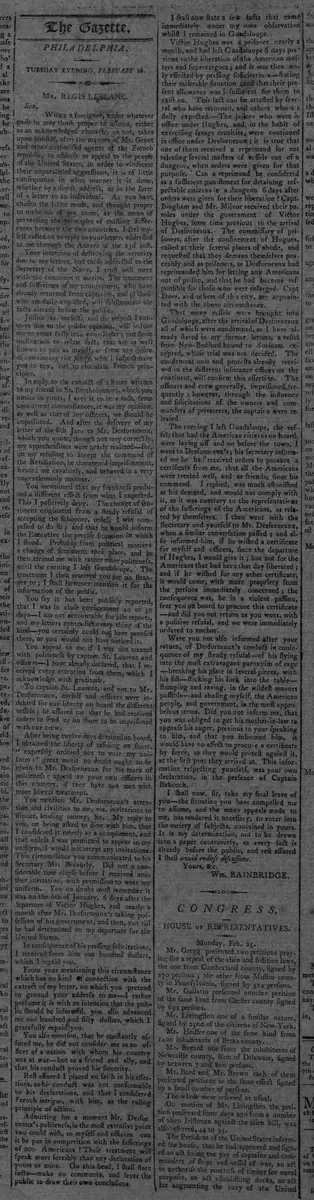
Captain William Bainbridge replies to Regis LeBlanc's letter in the Aurora, defending his veracity regarding French mistreatment of American prisoners in Guadeloupe during the Quasi-War. He details threats, imprisonments, and rude behavior by Victor Hugues and Pierre Desforneaux, emphasizing the sufferings of over 200 Americans despite claims of politeness.
Clipping
OCR Quality
Full Text
PHILADELPHIA,
TUESDAY EVENING, FEBRUARY 26.
MR. REGIS LEBLANC.
SIR,
When a foreigner, under whatever garb he may think proper to assume, either as an acknowledged character or not, takes upon himself, after the manner of Mr. Genet and other authorised agents of the French republic, to address or appeal to the people of the United States, in order to vindicate their unparalleled aggressions, it is of little consequence in what manner it is done, whether by a direct address, or in the form of a letter to an individual. As you have chosen the latter mode, and thought proper to make use of my name, as the means of perverting the principles of existing differences between the two countries, I feel myself called on to reply to your letter, addressed to me through the Aurora of the 23d inst.
Your intention of destroying the veracity due to my letters, and those addressed to the Secretary of the Navy, I trust will meet with the contempt it merits. The treatment and sufferings of my countrymen, who have already returned from captivity, and of those who are daily expected, will substantiate the facts already before the public.
Justice to myself, and the respect I conceive due to the public opinion, will induce me to enter fully into your letter; not from inclination to relate facts that are as well known to you as myself, or from any desire of convincing the party, who I suspect have you in tow, but to elucidate French principles.
In reply to the extract of a letter written to my friend in St. Bartholomews, which you notice in yours, I aver it to be a fact, from concurrent circumstances, it was my opinion, as well as that of my officers, we should be imprisoned. And after the delivery of my letter of the 6th Jan. to Mr. Desforneaux, which you quote, though not very correctly, my apprehensions were nearly realized—for, on my refusing to accept the command of the Retaliation, he threatened imprisonment, treated me cavalierly, and behaved in a very ungentlemanly manner.
You mentioned that my frankness produced a different effect from what I expected. This I positively deny. The change of sentiment originated from a steady refusal of accepting the schooner, unless I was compelled to do so; and that he would inform the Executive the precise situation in which I stood. Probably from political motives a change of sentiment took place, and he then treated me with rather more politeness, until the evening I left Guadaloupe. The treatment I then received you are no stranger to; I shall however mention it for the information of the public.
You say it has been publicly reported, that I was in close confinement 40 or 50 days—I am not accountable for idle reports, and my letters contradict every thing of the kind—you certainly could not have perused them, or you would not have noticed it.
You appeal to me if I was not treated with politeness by captain St. Laurent and officers—I have already declared, that I received every attention from them, which I acknowledge with gratitude.
To captain St. Laurent, and not to Mr. Desforneaux, myself and officers were indebted for our liberty on board the different vessels; he assured me that he had received orders to send us on shore to be imprisoned with our crew.
After being twelve days detained on board, I obtained the liberty of residing on shore, "expressly ordered—not to wear my uniform:" great merit no doubt ought to be given to Mr. Desforneaux for his mark of politeness: appeal to your own officers in this country, if they have not met with more liberal treatment.
You mention Mr. Desforneaux's attention and civilities to me, viz. invitations to dinner, lending money, &c. My reply to you, on being asked to dine with him, that I considered it merely as a compliment, and that unless I was permitted to appear in my uniform, I would not accept any invitations. This circumstance you communicated to his Secretary Mr. Bevaurly. Did not a considerable time elapse before I received another invitation, with permission to wear my uniform. You no doubt must remember it was on the 6th of January, 6 days after the departure of Victor Hughes, and nearly a month after Mr. Desforneaux's taking possession of his government, and then, not till he had determined on my departure for the United States.
In consequence of his pressing solicitations, I received from him one hundred dollars, which I repaid you.
From your mentioning this circumstance which has no kind of connection with the extract of my letter, on which you pretend to ground your address to me—I rather presume it is with an intention that the public should be informed, you also advanced me one hundred and fifty dollars, which I gratefully repaid you.
You also mention, that he constantly assured me, he did not consider me as an officer of a nation with whom his country was at war—but as a friend and ally, and that his conduct proved his sincerity. Rest assured I placed no faith in his assertions, as his conduct was not conformable to his declarations, and that I considered French intrigue, with him, as the ruling principle of action.
Admitting for a moment Mr. Desforneaux's politeness, in the most extensive point you could wish, to myself and officers, can it be put in competition with the sufferings of 200 Americans? Their treatment will speak more forcibly than any declaration of yours or mine. On this head, I shall state facts—make no comments, and leave the public to draw their own conclusions.
I shall now state a few facts that came immediately under my own observation whilst I remained in Guadaloupe.
Victor Hughes was a prisoner nearly a month, and had left Guadaloupe 6 days previous to the liberation of the American masters and supercargoes; and it was then only effected by pressing solicitations—stating their miserable situation and that their present allowance was insufficient for them to exist on. This fact can be attested by several who have returned, and others who are daily expected. The jailors who were in office under Hughes, and in the habit of exercising savage cruelties; were continued in office under Desforneaux; it is true that one of them received a reprimand for not releasing several masters of vessels out of a dungeon, when orders were given for that purpose. Can a reprimand be considered as a sufficient punishment for detaining respectable citizens in a dungeon 6 days after orders were given for their liberation? Capt. Bingham and Mr. Milnor received their passports under the government of Victor Hughes, some time previous to the arrival of Desforneaux. The commissary of prisoners, after the confinement of Hugues, called at their several places of abode, and requested that they demean themselves peaceably and as prisoners, as Desforneaux had reprimanded him for letting any Americans out of prison, and that he had become responsible for those who were enlarged. Capt. Duer, and others of this city, are acquainted with the above circumstance.
That many vessels were brought into Guadaloupe, after the arrival of Desforneaux all of which were condemned, as I have already stated in my former letters, a vessel from New-Bedford bound to Surinam excepted, whose trial was not decided. The condemnations and protests already received in the different insurance offices on the continent, will confirm this assertion. The officers and crew generally, imprisoned frequently: however, through the influence and solicitations of the owners and commanders of privateers, the captains were released.
The evening I left Guadaloupe, the vessels that had the American citizens on board, were laying off and on before the town, I went to Desforneaux's; his secretary informed me he had received orders to procure a certificate from me, that all the Americans were treated well, and as friends, since his command. I replied, was much astonished at his demand, and would not comply with it, as it was contrary to the representations of the sufferings of the Americans, as related by themselves. I then went with the Secretary and yourself to Mr. Desforneaux, when a similar conversation passed; and also informed him, if he wished a certificate for myself and officers, since the departure of Hughes, I would give it; but not for the Americans that had been that day liberated; and if he wished for any other certificate, it would come, with more propriety from the persons immediately concerned; the consequence was, he in a violent passion, sent you on board to procure this certificate—and did you not return as you went, with a positive refusal, and we were immediately ordered to anchor.
Were you not also informed after your return, of Desforneaux's conduct in consequence of my steady refusal—of his flying into the most extravagant paroxysm of rage—breaking his plate in several pieces, with his fist—sticking his fork into the table—stamping and raving, in the wildest manner possible—and abusing myself, the American people, and government, in the most opprobrious terms. Did you not inform me, that you was obliged to get his mother-in-law to appease his anger, previous to your speaking to him, and that you informed him, it would have no effect to procure a certificate by force, as they would protest against it, at the first port they arrived at. This information respecting yourself, was your own declaration, in the presence of Captain Babcock.
I shall now, sir, take my final leave of you—the situation you have compelled me to assume, and the many appeals made to me, has rendered it necessary, to enter into the variety of subjects, contained in yours. It is my determination, not to be drawn into a paper controversy, as every fact is already before the public, and rest assured I shall avoid endless discussions.
Yours, &c.
Wm. BAINBRIDGE.
What sub-type of article is it?
What themes does it cover?
What keywords are associated?
What entities or persons were involved?
Letter to Editor Details
Author
Wm. Bainbridge
Recipient
Mr. Regis Leblanc
Main Argument
captain bainbridge refutes leblanc's attempts to discredit his accounts of french mistreatment in guadeloupe, detailing threats, imprisonments, and cruelties to american prisoners under desforneaux, arguing that such actions reveal french principles despite claims of politeness.
Notable Details