Thank you for visiting SNEWPapers!
Sign up free
The Daily State Register
Carson City, Ormsby County, Carson City County, Nevada
What is this article about?
Newspaper article from December 1871 details the arrival of newly elected Piute Chief George Curry in Carson City, Nevada, including an interview, his background, the succession from the Winnemucca family, Piute tribal history spanning 2000 years with wars and conquests, and current reservation conditions.
Clipping
OCR Quality
Full Text
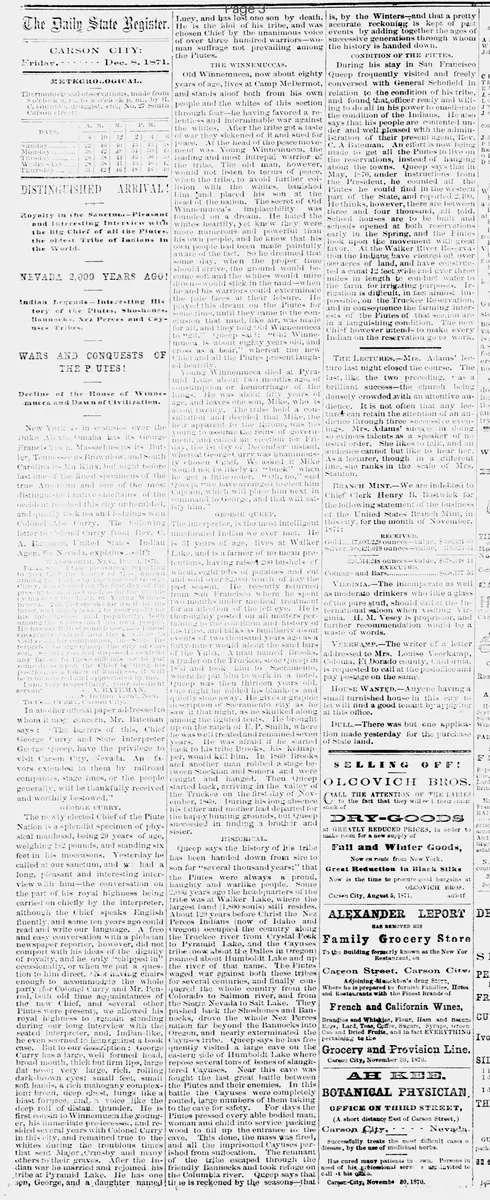
Royalty in the Sanctum—Pleasant and interesting Interview with the Big Chief of all the Piutes, the oldest Tribe of Indians in the World.
NEVADA 2,000 YEARS AGO!
Indian Legends—Interesting History of the Piutes, Shoshones, Bannocks, Nez Perces and Cayuse Tribes.
WARS AND CONQUESTS OF THE PIUTES!
Decline of the House of Winnemucca and Dawn of Civilization.
New York is in ecstasies over the Duke Alexis, Omaha boosts its George Francis Train, Massachusetts its Butler, Tennessee its Brownlow, and South Carolina its Ku Klux, but last night before one of the finest specimens of the true American and one of the most distinguished native chieftains of the occident reached this city, uproarious and gaudy took tea and lodgings with Colonel A. H. Curry. The following letter to Colonel Curry from Rev. G. A. Bateman, United States Indian Agent Nevada, explains itself:
WASHOE, NEV., Dec. 1st, 1871.
To No. 1,
I take pleasure in introducing to your notice Chief George Curry and State Interpreter George Queep, who are known among the Indians as Captain Winnemucca and Numaga. They are on their way to Carson to present themselves to the people and to have an interview with his Excellency the Governor of the State on the Indian question. They are both men of influence and popularity among their people, and their visit will be appreciated by everyone.
I am very respectfully your obedient servant,
C. A. BATEMAN,
U. S. Indian Agt., Nev.
To Col. A. H. Curry, Carson City.
In another official paper addressed to whom it may concern, Mr. Bateman says: The bearers of this, Chief George Curry and State Interpreter George Queep, have the privilege to visit Carson City, Nevada. Any favors extended to them by railroad companies, stage lines, or the people generally, will be thankfully received and worthily bestowed."
GEORGE CURRY.
The newly elected Chief of the Piute Nation is a splendid specimen of physical manhood, being 29 years of age, weighing 182 pounds, and standing six feet in his moccasins. Yesterday he called at our sanctum, and we had a long, pleasant and interesting interview with him—the conversation on the part of his royal highness being carried on chiefly by the interpreter, although the Chief speaks English fluently, and some ten years ago could read and write our language. A free and easy conversation with a plebeian newspaper reporter, however, did not comport with his ideas of the dignity of royalty, and he only "chipped in" occasionally, or when we put a question to him direct. Not having chairs enough to accommodate the whole party (for Colonel Curry and Mr. Penrod, both old time acquaintances of the new Chief, and several other Piutes were present), we allowed his royal highness to remain standing during our long interview with the seated interpreter, and, Indian-like, he even scorned to lean against a book case. But to our description: George Curry has a large, well formed head, broad mouth, thick but firm lips, large flat nose, very large, rich, rolling dark-brown eyes; small feet, small soft hands, a rich mahogany complexion; broad, deep chest, lungs like a blast furnace, and a voice like the deep roll of distant thunder. He is first cousin to Winnemucca the younger, his immediate predecessor, and resided several years with Colonel Curry in this city, and remained true to the whites during the troublous times that sent Major Ormsby and many others to their graves. After the Indian war he married and rejoined his tribe at Pyramid Lake. He has one son, George, and a daughter named Lucy, and has lost one son by death.
He is the idol of his tribe, and was chosen Chief by the unanimous voice of over three hundred warriors—woman suffrage not prevailing among the Piutes.
THE WINNEMUCCAS.
Old Winnemucca, now about eighty years of age, lives at Camp McDermit, and stands aloof both from his own people and the whites of this section through fear—he having favored a relentless and interminable war against the whites. After the tribe got a taste of war they sickened of it and sued for peace. At the head of the peace movement was Young Winnemucca, the leading and most intrepid warrior of the tribe. The old man, however, would not listen to terms of peace, when the tribe, to avoid further collision with the whites, banished him and placed his son at the head of the nation. The secret of Old Winnemucca's implacability was founded on a dream. He hated the whites heartily, yet knew they were more numerous and powerful than his own people, and he knew that his own people had been made painfully aware of the fact. So he dreamed that some day, when the proper time should arrive, the ground would become soft and the whites would mire down—would stick in the mud—when he and his warriors could exterminate the pale faces at their leisure. He played this dream on the Piutes for some time, until they came to the conclusion that mud, like air, was made for all, and they told old Winnemucca to "git." Queep said: "Old Winnemucca is about eighty years old, and cross as a bear," whereat the new Chief and all the Piutes present laughed heartily.
Young Winnemucca died at Pyramid Lake about two months ago, of consumption or hemorrhage of the lungs. He was about fifty years of age, and leaves one son, Mike, who is about twenty. The tribe held a consultation and decided that Mike, the heir apparent to the throne, was too young to assume the reins of government, and called an election for Friday, the 1st day of December instant, whereat George Curry was unanimously chosen Chief. We asked if Mike would not be likely to "buck" when he got a little older. "Oh, no," said Queep, "we have arranged to elect him Captain, which will place him next in command to George, and that will satisfy him."
The interpreter is the most intelligent uneducated Indian we ever met. He is 31 years of age, lives at Walker Lake, and is a farmer of no mean pretensions, having raised 200 bushels of wheat, eight tons of potatoes and cut and sold over $200 worth of hay the past season. He recently returned from San Francisco where he spent two months under medical treatment for an affection of the left eye. He is thoroughly posted on all matters pertaining to the condition and history of his tribe, and talks as familiarly about events of two thousand years ago as a forty-niner would about the sand bars of the Yuba. A man named Brooks, a trader on the Truckee, stole Queep in his infancy and took him to Sacramento, where he put him to work in a hotel. Queep was then thirteen years old. One night he folded his blankets and quietly stole away. He gives a graphic description of Sacramento city as he saw it that night, as he skulked along among the lighted tents. He brought up on the ranch of E. P. Smith, where he was well treated and remained seven years. He was afraid if he started back to his tribe Brooks, his kidnapper, would kill him. In 1850 Brooks and another man robbed a stage between Stockton and Sonora and were caught and hanged. Then Queep started back, arriving in the valley of the Truckee on the first day of November, 1850. During his long absence his father and mother had departed for the happy hunting grounds, but Queep succeeded in finding a brother and sister.
HISTORICAL.
Queep says the history of his tribe has been handed down from sire to son for "several thousand years;" that the Piutes were always a proud, haughty and warlike people. Some 2,000 years ago the headquarters of the tribe was at Walker Lake, where the largest band (1,500 souls) still resides. About 129 years before Christ the Nez Perces Indians (now of Idaho and Oregon) occupied the country along the Truckee river from Crystal Peak to Pyramid Lake, and the Cayuses tribe (now about the Dalles in Oregon) roamed about Humboldt Lake and up the river of that name. The Piutes waged war against both these tribes for several centuries, and finally conquered the whole country from the Colorado to Salmon river, and from the Sierra Nevada to Salt Lake. They pushed back the Shoshones and Bannocks, drove the whole Nez Perces nation far beyond the Bannocks into Oregon, and nearly exterminated the Cayuses tribe. Queep says he has frequently visited a large cave on the eastern side of Humboldt Lake where repose several tons of bones of slaughtered Cayuses. Near this cave was fought the last great battle between the Piutes and their enemies. In this battle the Cayuses were completely routed, large numbers of them taking to the cave for safety. For days the Piutes pressed every able bodied man, woman and child into service packing wood to fill up the entrance to the cave. This done, the mass was fired, and all the imprisoned Cayuses perished from suffocation. The remnant of the tribe escaped through the friendly Bannocks and took refuge on the Columbia river. Queep says that time is reckoned by the seasons—that is, by the Winters—and that a pretty accurate reckoning is kept of past events by adding together the ages of successive generations through whom the history is handed down.
CONDITION OF THE PIUTES.
During his stay in San Francisco Queep frequently visited and freely conversed with General Schofield in relation to the condition of his tribe, and found that officer ready and willing to do all in his power to ameliorate the condition of the Indians. He also says that his people are contented under and well pleased with the administration of their present agent, Rev. C. A. Bateman. An effort is now being made to get all the Piutes to live on the reservations, instead of hanging about the towns. Queep says that in May, 1870, under instructions from the President, he counted all the Piutes he could find in the western part of the State, and reported 2,500. He thinks, however, there are between three and four thousand, all told. School houses are to be built and schools opened at both reservations early in the Spring, and the Piutes look upon the movement with great favor. "At the Walker River Reservation the Indians have cleared off over 100 acres of land, and have constructed a canal 12 feet wide and over three miles in length to conduct water to the farm for irrigating purposes. Irrigation is difficult, in fact almost impossible, on the Truckee Reservation, and in consequence the farming interests of the Piutes of that section are in a languishing condition. The new Chief however intends to make every Indian on the reservation go to work."
What sub-type of article is it?
What themes does it cover?
What keywords are associated?
What entities or persons were involved?
Where did it happen?
Story Details
Key Persons
Location
Carson City, Nevada; Pyramid Lake; Walker Lake; Humboldt Lake
Event Date
December 1, 1871
Story Details
Newly elected Piute Chief George Curry arrives in Carson City for an interview with the governor; detailed account of his background, physical description, family ties to Winnemucca, election after predecessor's death; interpreter Queep shares personal history and ancient Piute tribal legends of wars, conquests over Nez Perces and Cayuses 2000 years ago, and current reservation improvements and population.