Thank you for visiting SNEWPapers!
Sign up free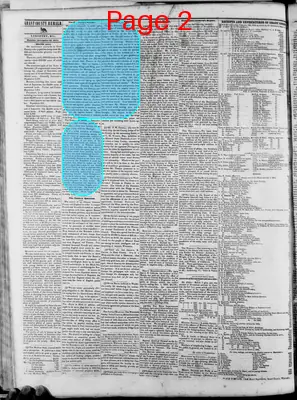
Story
December 26, 1853
Grant County Herald
Lancaster, Grant County, Wisconsin
What is this article about?
Editorial critique of President Pierce's message, lamenting its brevity and length, indecision on national issues, and evasive style, contrasting with bolder predecessors like Adams, Jackson, and Fillmore. Quotes harsh review from Democratic Bulletin accusing it of dilution and concealment.
Clipping
OCR Quality
95%
Excellent
Full Text
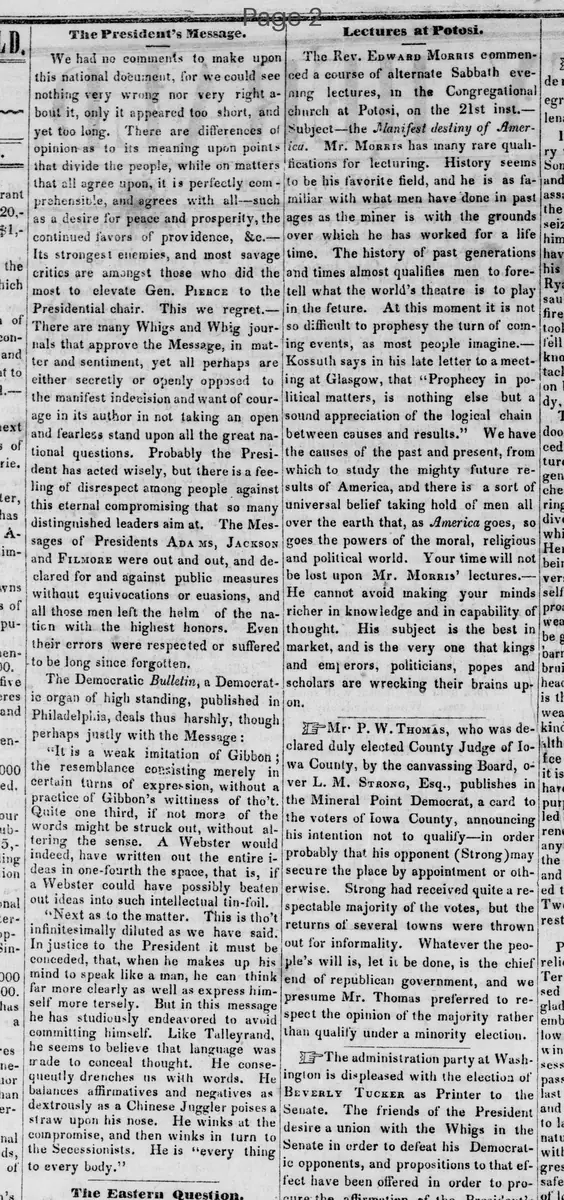
The President's Message.
We had no comments to make upon this national document, for we could see nothing very wrong nor very right about it, only it appeared too short, and yet too long. There are differences of opinion as to its meaning upon points that divide the people, while on matters that all agree upon, it is perfectly comprehensible, and agrees with all--such as a desire for peace and prosperity, the continued favors of providence, &c.
Its strongest enemies, and most savage critics are amongst those who did the most to elevate Gen. Pierce to the Presidential chair. This we regret.
There are many Whigs and Whig journals that approve the Message, in matter and sentiment, yet all perhaps are either secretly or openly opposed to the manifest indecision and want of courage in its author in not taking an open and fearless stand upon all the great national questions. Probably the President has acted wisely, but there is a feeling of disrespect among people against this eternal compromising that so many distinguished leaders aim at. The Messages of Presidents Adams, Jackson and Fillmore were out and out, and declared for and against public measures without equivocations or evasions, and all those men let the helm of the nation with the highest honors. Even their errors were respected or suffered to be long since forgotten.
The Democratic Bulletin, a Democratic organ of high standing, published in Philadelphia, deals thus harshly, though perhaps justly with the Message:
"It is a weak imitation of Gibbon; the resemblance consisting merely in certain turns of expression, without a particle of Gibbon's wittiness of thought. Quite one third, if not more of the words might be struck out, without altering the sense. A Webster would indeed, have written out the entire ideas in one-fourth the space, that is, if a Webster could have possibly beaten out ideas into such intellectual tin-foil."
"Next as to the matter. This is thought infinitesimally diluted as we have said. In justice to the President it must be conceded, that, when he makes up his mind to speak like a man, he can think far more clearly as well as express himself more tersely. But in this message he has studiously endeavored to avoid committing himself. Like Talleyrand, he seems to believe that language was made to conceal thought. He consequently drenches us with words. He balances affirmatives and negatives as dextrously as a Chinese Juggler poises a straw upon his nose. He winks at the compromise, and then winks in turn to the Secessionists. He is "every thing to every body."
We had no comments to make upon this national document, for we could see nothing very wrong nor very right about it, only it appeared too short, and yet too long. There are differences of opinion as to its meaning upon points that divide the people, while on matters that all agree upon, it is perfectly comprehensible, and agrees with all--such as a desire for peace and prosperity, the continued favors of providence, &c.
Its strongest enemies, and most savage critics are amongst those who did the most to elevate Gen. Pierce to the Presidential chair. This we regret.
There are many Whigs and Whig journals that approve the Message, in matter and sentiment, yet all perhaps are either secretly or openly opposed to the manifest indecision and want of courage in its author in not taking an open and fearless stand upon all the great national questions. Probably the President has acted wisely, but there is a feeling of disrespect among people against this eternal compromising that so many distinguished leaders aim at. The Messages of Presidents Adams, Jackson and Fillmore were out and out, and declared for and against public measures without equivocations or evasions, and all those men let the helm of the nation with the highest honors. Even their errors were respected or suffered to be long since forgotten.
The Democratic Bulletin, a Democratic organ of high standing, published in Philadelphia, deals thus harshly, though perhaps justly with the Message:
"It is a weak imitation of Gibbon; the resemblance consisting merely in certain turns of expression, without a particle of Gibbon's wittiness of thought. Quite one third, if not more of the words might be struck out, without altering the sense. A Webster would indeed, have written out the entire ideas in one-fourth the space, that is, if a Webster could have possibly beaten out ideas into such intellectual tin-foil."
"Next as to the matter. This is thought infinitesimally diluted as we have said. In justice to the President it must be conceded, that, when he makes up his mind to speak like a man, he can think far more clearly as well as express himself more tersely. But in this message he has studiously endeavored to avoid committing himself. Like Talleyrand, he seems to believe that language was made to conceal thought. He consequently drenches us with words. He balances affirmatives and negatives as dextrously as a Chinese Juggler poises a straw upon his nose. He winks at the compromise, and then winks in turn to the Secessionists. He is "every thing to every body."
What sub-type of article is it?
Historical Event
What themes does it cover?
Deception
Justice
What keywords are associated?
Presidential Message
Political Compromise
Franklin Pierce
Democratic Bulletin
Indecision
Historical Critique
What entities or persons were involved?
Gen. Pierce
Presidents Adams
Jackson
Fillmore
Talleyrand
Gibbon
Webster
Where did it happen?
Philadelphia
Story Details
Key Persons
Gen. Pierce
Presidents Adams
Jackson
Fillmore
Talleyrand
Gibbon
Webster
Location
Philadelphia
Story Details
Critique of President Pierce's message for its ambiguous and compromising tone on divisive issues, praised for universal sentiments but criticized for lack of decisiveness compared to past presidents; Democratic Bulletin calls it verbose, diluted, and evasive.