Thank you for visiting SNEWPapers!
Sign up free
Letter to Editor
September 2, 1852
Herald Of The Times
Newport, Newport County, Rhode Island
What is this article about?
Mrs. H. Marion Stephenson writes from Newport, R.I., on Aug. 2, 1852, describing her delightful social experiences, including sea bathing mishaps, flirting, and observations of fashionable crowds, contrasting with last year's hectic season.
Clipping
OCR Quality
95%
Excellent
Full Text
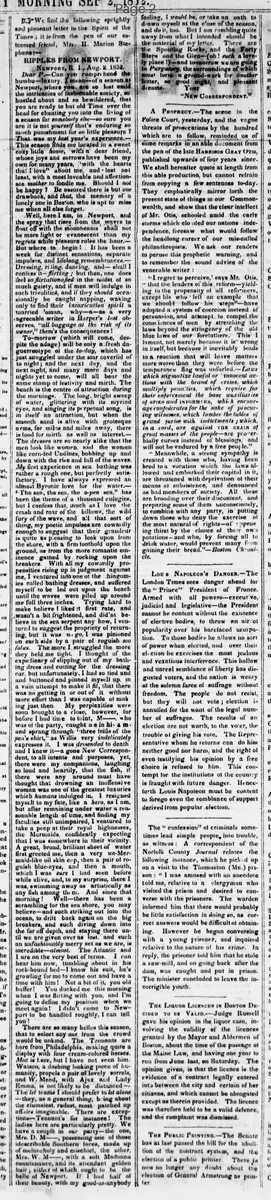
We find the following sprightly and pleasant letter in the Spirit of the Times; it is from the pen of our esteemed friend, Mrs. H. Marion Stephenson:-
RIPPLES FROM NEWPORT.
Newport, R. I., Aug. 2, 1852.
Dear P.—Can you comprehend the humbug luxury, I mean—of a season at Newport, where you are so lost amid the intricacies of fashionable society, so hustled about and so bewildered, that you are ready to bat old Time over the head for cheating you into the living of a season for somebody else—so sure you are it is not yourself that's enduring so much punishment for so little pleasure? That was my last year's experience. This season finds me located in a sweet cozy little home, with a dear friend, whose joys and sorrows have been my own for many years, with the hearts that I love about me, and—last not least, with a most loveable and affectionate mother to coddle me. Should I not be happy? Be assured there is but one drawback, and that, the memory of a lonely one in Boston, who is apt to miss me when all else forget.
Well, here I am, in Newport, and the spray that rises from the waves to float off with the moonbeams shall not be more light or evanescent than my regrets while pleasure rules the hour. But where to begin! It has been a week for distinct sensations, separate impulses, and lifelong remembrances. Dressing, riding, dancing, and—shall I confess it—flirting; but then, one does feel so flirtationafied in the midst of so much gaiety, and if men will indulge in such frivolities, and if they should occasionally be caught napping, waking only to find their intoxication spirit a married woman, why—a—as a very agreeable writer in Harper's last observes, "all baggage at the risk of its owner," them's the consequences!
To-morrow (which will come, despite the adage) will be only a fresh daguerreotype of the to-day, which has just snuggled under the star coverlid of to-night; and the next day, and the next night, and many more days and nights yet to come, will all bear the same stamp of festivity and mirth. The beach is the centre of attraction during the mornings. The long, bright sweep of water, glittering with its myriad eyes, and singing its perpetual song, is in itself an attraction, but when the smooth sand is alive with grotesque forms, for miles and miles away, there is food for mirth as well as interest. The dresses are so nearly alike that the men look like women, and the women like corn-fed Undines, bobbing up and down with the rise and fall of the waves.
My first experience in sea bathing was rather a rough one, but perfectly satisfactory. I have always expressed an almost Byronic love for the water. "The sea, the sea, the open sea," has been the theme of a thousand eulogies, but I confess that, much as I love the crash and roar of the billows, the wild fury of the wave, and all that sort of thing, my poetic impulses are cowardly enough to suggest that their grandeur is quite as pleasing to look upon from the shore, with a firm foothold upon the ground, as from the more romantic eminence gained by rocking upon the breakers. With all my cowardly propensities rising up in judgment against me, I ventured into one of the thingumies called bathing dresses, and suffered myself to be led out upon the beach until the waves were piled up around me full three inches. Trying hard to make believe I liked it first rate, and wasn't a bit frightened, and didn't believe in the sea serpent any how, I ventured to suggest the propriety of returning, but it was no go, I was pinioned on each side by a pair of roguish sea nymphs. The more I struggled the more they held me tight. I thought of the expediency of slipping out of my bathing dress and cutting for the dressing car, but unfortunately, I had so tied and buttoned and pinned myself up, in a vain attempt to make it fit, that there was no getting in or out of it without more effort than I was capable of making just then. My perplexities were soon brought to a close, however, for before I had time to faint, M—, who was of the party, caught me in his arms and sprang through three frills of the sea's shirt," as Willis very indelicately expresses it. I was drowned to death and I knew it—a gone New Correspondent, to all intents and purposes, yet there were my companions, laughing so loud and heartily, that the fish, if there were any around must have thought that drowning an inoffensive woman was one of the greatest luxuries which humans indulged in. I resigned myself to my fate, like a hero, as I am, but after remaining under water a reasonable length of time, and finding my faculties still unimpaired, I ventured to take a peep at their royal highnesses, the Mermaids, confidently expecting that I was somewhere in their vicinity. A great, broad, brilliant sheet of water first greeted me, then a very un-Mermaid-like oil skin cap, then a pair of roguish blue-eyes, and then a mouth, which I was sure I had seen before while alive, and, to my surprise, there I was, swimming away as artistically as any fish among them. And since that morning! Well—there has been a scrambling for the sea shore, you may believe—and such striking out into the ocean, to drift back again on the big breakers, and such diving down into the far off depth, and staying there until we are given over as lost, and such an unfashionably merry set as we are, is incredible—almost. The Atlantic and I are on the very best of terms. I can hear him now, tumbling about in his rock-bound bed—I know his suit, he's growling for me to come out and have a time with him! Not a bit of it, you old buffer! You ducked me this morning when I was flirting with you, and I'm going to define my position when we meet again! I didn't come to Newport to be handled roughly, I can tell you!
There are so many belles this season, that to select any one from the crowd would be unkind. The Tennants are here from Philadelphia, making quite a display with four cream-colored horses. Mac is here, but I have not seen him. Watson, a dashing looking piece of humanity, propels a pair of lovely sorrels, and W. Mead, with Ajax and Lady Emma, is not likely to be distanced. The livery teams I should prefer to let alone—they, as a general thing, being about the clumsiest, rudest, most patched up affairs imaginable. There are exceptions—Tennant's for instance! The ladies here are particularly pretty. We have a couple in our party—the one, Mrs. D. M—, possessing one of those indescribable Southern faces, made up of melancholy and mischief, the other Mrs. W. M—, with a soft Madonna countenance, and its attendant golden hair; either of which ought to be the belle of Newport. If I had half of their beauty, with my good-as-anybody feeling, I would be, or take an oath to drown myself at the close of the season, and do it, too. But I am rambling quite away from what I intended should be the material of my letter. There are the Spouting Rocks, and the Forty Steps and the Glen—(oh! such a lovely place!)—and to-morrow we are going to Purgatory, the surroundings of which must form a ground-work for another letter, so good night, and pleasant dreams.
Your
"New Correspondent."
RIPPLES FROM NEWPORT.
Newport, R. I., Aug. 2, 1852.
Dear P.—Can you comprehend the humbug luxury, I mean—of a season at Newport, where you are so lost amid the intricacies of fashionable society, so hustled about and so bewildered, that you are ready to bat old Time over the head for cheating you into the living of a season for somebody else—so sure you are it is not yourself that's enduring so much punishment for so little pleasure? That was my last year's experience. This season finds me located in a sweet cozy little home, with a dear friend, whose joys and sorrows have been my own for many years, with the hearts that I love about me, and—last not least, with a most loveable and affectionate mother to coddle me. Should I not be happy? Be assured there is but one drawback, and that, the memory of a lonely one in Boston, who is apt to miss me when all else forget.
Well, here I am, in Newport, and the spray that rises from the waves to float off with the moonbeams shall not be more light or evanescent than my regrets while pleasure rules the hour. But where to begin! It has been a week for distinct sensations, separate impulses, and lifelong remembrances. Dressing, riding, dancing, and—shall I confess it—flirting; but then, one does feel so flirtationafied in the midst of so much gaiety, and if men will indulge in such frivolities, and if they should occasionally be caught napping, waking only to find their intoxication spirit a married woman, why—a—as a very agreeable writer in Harper's last observes, "all baggage at the risk of its owner," them's the consequences!
To-morrow (which will come, despite the adage) will be only a fresh daguerreotype of the to-day, which has just snuggled under the star coverlid of to-night; and the next day, and the next night, and many more days and nights yet to come, will all bear the same stamp of festivity and mirth. The beach is the centre of attraction during the mornings. The long, bright sweep of water, glittering with its myriad eyes, and singing its perpetual song, is in itself an attraction, but when the smooth sand is alive with grotesque forms, for miles and miles away, there is food for mirth as well as interest. The dresses are so nearly alike that the men look like women, and the women like corn-fed Undines, bobbing up and down with the rise and fall of the waves.
My first experience in sea bathing was rather a rough one, but perfectly satisfactory. I have always expressed an almost Byronic love for the water. "The sea, the sea, the open sea," has been the theme of a thousand eulogies, but I confess that, much as I love the crash and roar of the billows, the wild fury of the wave, and all that sort of thing, my poetic impulses are cowardly enough to suggest that their grandeur is quite as pleasing to look upon from the shore, with a firm foothold upon the ground, as from the more romantic eminence gained by rocking upon the breakers. With all my cowardly propensities rising up in judgment against me, I ventured into one of the thingumies called bathing dresses, and suffered myself to be led out upon the beach until the waves were piled up around me full three inches. Trying hard to make believe I liked it first rate, and wasn't a bit frightened, and didn't believe in the sea serpent any how, I ventured to suggest the propriety of returning, but it was no go, I was pinioned on each side by a pair of roguish sea nymphs. The more I struggled the more they held me tight. I thought of the expediency of slipping out of my bathing dress and cutting for the dressing car, but unfortunately, I had so tied and buttoned and pinned myself up, in a vain attempt to make it fit, that there was no getting in or out of it without more effort than I was capable of making just then. My perplexities were soon brought to a close, however, for before I had time to faint, M—, who was of the party, caught me in his arms and sprang through three frills of the sea's shirt," as Willis very indelicately expresses it. I was drowned to death and I knew it—a gone New Correspondent, to all intents and purposes, yet there were my companions, laughing so loud and heartily, that the fish, if there were any around must have thought that drowning an inoffensive woman was one of the greatest luxuries which humans indulged in. I resigned myself to my fate, like a hero, as I am, but after remaining under water a reasonable length of time, and finding my faculties still unimpaired, I ventured to take a peep at their royal highnesses, the Mermaids, confidently expecting that I was somewhere in their vicinity. A great, broad, brilliant sheet of water first greeted me, then a very un-Mermaid-like oil skin cap, then a pair of roguish blue-eyes, and then a mouth, which I was sure I had seen before while alive, and, to my surprise, there I was, swimming away as artistically as any fish among them. And since that morning! Well—there has been a scrambling for the sea shore, you may believe—and such striking out into the ocean, to drift back again on the big breakers, and such diving down into the far off depth, and staying there until we are given over as lost, and such an unfashionably merry set as we are, is incredible—almost. The Atlantic and I are on the very best of terms. I can hear him now, tumbling about in his rock-bound bed—I know his suit, he's growling for me to come out and have a time with him! Not a bit of it, you old buffer! You ducked me this morning when I was flirting with you, and I'm going to define my position when we meet again! I didn't come to Newport to be handled roughly, I can tell you!
There are so many belles this season, that to select any one from the crowd would be unkind. The Tennants are here from Philadelphia, making quite a display with four cream-colored horses. Mac is here, but I have not seen him. Watson, a dashing looking piece of humanity, propels a pair of lovely sorrels, and W. Mead, with Ajax and Lady Emma, is not likely to be distanced. The livery teams I should prefer to let alone—they, as a general thing, being about the clumsiest, rudest, most patched up affairs imaginable. There are exceptions—Tennant's for instance! The ladies here are particularly pretty. We have a couple in our party—the one, Mrs. D. M—, possessing one of those indescribable Southern faces, made up of melancholy and mischief, the other Mrs. W. M—, with a soft Madonna countenance, and its attendant golden hair; either of which ought to be the belle of Newport. If I had half of their beauty, with my good-as-anybody feeling, I would be, or take an oath to drown myself at the close of the season, and do it, too. But I am rambling quite away from what I intended should be the material of my letter. There are the Spouting Rocks, and the Forty Steps and the Glen—(oh! such a lovely place!)—and to-morrow we are going to Purgatory, the surroundings of which must form a ground-work for another letter, so good night, and pleasant dreams.
Your
"New Correspondent."
What sub-type of article is it?
Comedic
Reflective
Social Critique
What themes does it cover?
Social Issues
What keywords are associated?
Newport Season
Sea Bathing
Fashionable Society
Flirting
Social Gaiety
Newport Belles
What entities or persons were involved?
Mrs. H. Marion Stephenson
Dear P.
Letter to Editor Details
Author
Mrs. H. Marion Stephenson
Recipient
Dear P.
Main Argument
describes the joys and light-hearted adventures of the social season in newport, contrasting personal contentment with societal hustle.
Notable Details
Sea Bathing Experience
Flirting In Gaiety
References To Byronic Love For Water
Quote From Harper's
Mention Of Willis
Observations Of Belles And Horses