Thank you for visiting SNEWPapers!
Sign up free
Editorial
July 24, 1829
Virginia Advocate
Charlottesville, Virginia
What is this article about?
This 1829 editorial critiques excessive ambition for the U.S. presidency, argues that true power lies in guiding public opinion rather than office, praises the Federalists' historical contributions but faults their despondence, and urges dispassionate discourse to safeguard the Union from partisan strife.
Clipping
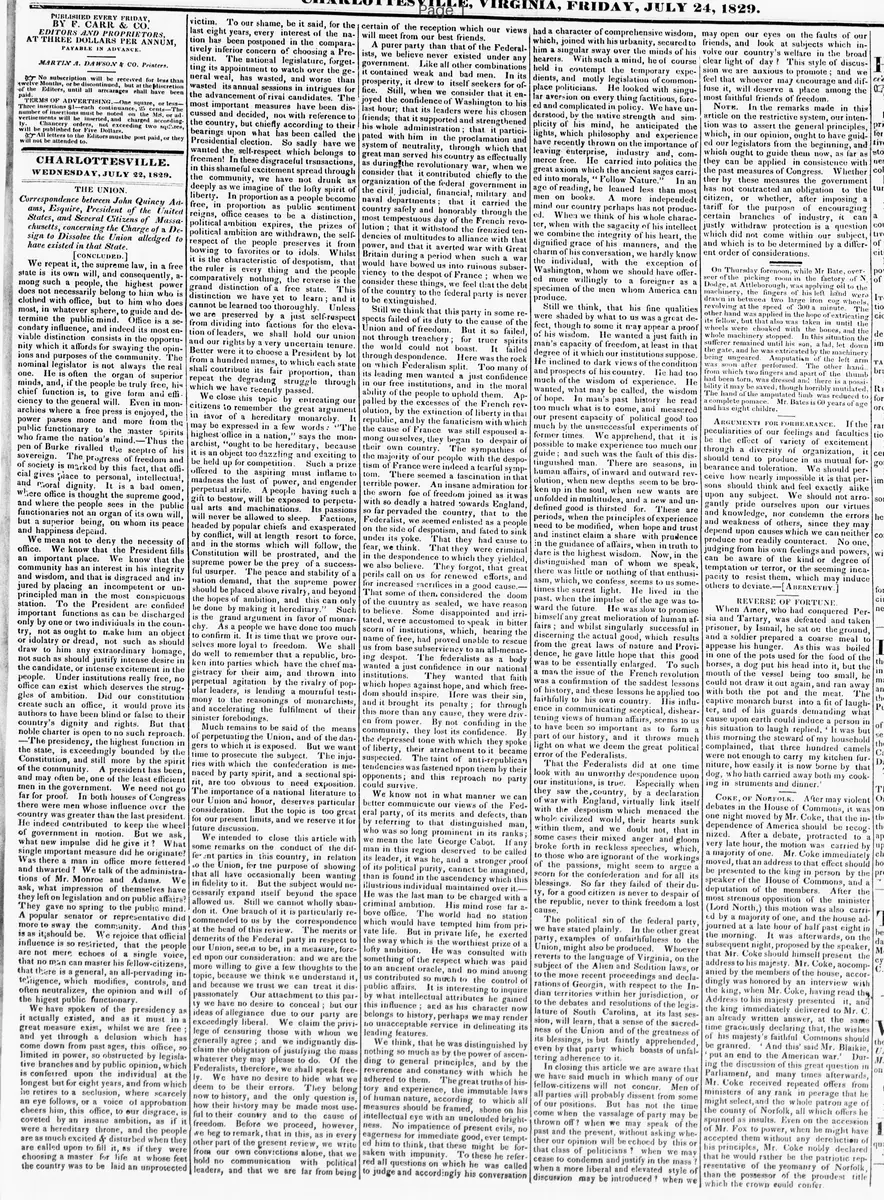
OCR Quality
98%
Excellent
Full Text
CHARLOTTESVILLE.
WEDNESDAY, JULY 22, 1829.
THE UNION.
Correspondence between John Quincy Adams, Esquire, President of the United States, and Several Citizens of Massachusetts, concerning the Charge of a Design to Dissolve the Union alledged to have existed in that State.
[CONCLUDED.]
We repeat it, the supreme law, in a free state is its own will, and consequently, among such a people, the highest power does not necessarily belong to him who is clothed with office, but to him who does most, in whatever sphere, to guide and determine the public mind. Office is a secondary influence, and indeed its most enviable distinction consists in the opportunity which it affords for swaying the opinions and purposes of the community. The nominal legislator is not always the real one. He is often the organ of superior minds, and, if the people be truly free, his chief function is, to give form and efficiency to the general will. Even in monarchies where a free press is enjoyed, the power passes more and more from the public functionary to the master Spirits who frame the nation's mind.—Thus the pen of Burke rivalled the sceptre of his sovereign. The progress of freedom and of society is marked by this fact, that official gives place to personal, intellectual, and moral dignity. It is a bad omen, where office is thought the supreme good, and where the people sees in the public functionaries not an organ of its own will, but a superior being, on whom its peace and happiness depend.
We mean not to deny the necessity of office. We know that the President fills an important place. We know that the community has an interest in his integrity and wisdom, and that it is disgraced and injured by placing an incompetent or unprincipled man in the most conspicuous station. To the President are confided important functions as can be discharged only by one or two individuals in the country, not as ought to make him an object of idolatry or dread, not such as should draw to him any extraordinary homage, not such as should justify intense desire in the candidate, or intense excitement in the people. Under institutions really free, no office can exist which deserves the struggles of ambition. Did our constitution create such an office, it would prove its authors to have been blind or false to their country's dignity and rights. But that noble charter is open to no such reproach.—The presidency, the highest function in the state, is exceedingly bounded by the Constitution, and still more by the spirit of the community. A president has been, and may often be, one of the least efficient men in the government. We need not go far for proof. In both houses of Congress there were men whose influence over the country was greater than the last president. He indeed contributed to keep the wheel of government in motion. But we ask, what new impulse did he give it? What single important measure did he originate? Was there a man in office more fettered and thwarted? We talk of the administrations of Mr. Monroe and Adams. We ask, what impression of themselves have they left on legislation and on public affairs? They gave no spring to the public mind. A popular senator or representative did more to sway the community. And this is as it should be. We rejoice that official influence is so restricted, that the people are not mere echoes of a single voice, that no man can master his fellow-citizens, that there is a general, an all-pervading intelligence, which modifies, controls, and often neutralizes, the opinion and will of the highest public functionary.
We have spoken of the presidency as it actually existed, and as it must in a great measure exist, whilst we are free; and yet through a delusion which has come down from past ages, this office, so limited in power, so obstructed by legislative branches and by public opinion, which is conferred upon the individual at the longest but for eight years, and from which he retires to a seclusion, where scarcely an eye follows, or a voice of approbation cheers him, this office, to our disgrace, is coveted by an insane ambition, as if it were a hereditary throne, and the people are as much excited and disturbed when they are called upon to fill it, as if they were choosing a master for life at whose feet the country was to be laid an unprotected victim. To our shame, be it said, for the last eight years, every interest of the nation has been postponed in the comparatively inferior concern of choosing a President. The national legislature, forgetting its appointment to watch over the general weal, has wasted, and worse than wasted its annual sessions in intrigues for the advancement of rival candidates. The most important measures have been discussed and decided, not with reference to the country, but chiefly according to their bearings upon what has been called the Presidential election. So sadly have we wanted the self-respect which belongs to freemen! In these disgraceful transactions, in this shameful excitement spread through the community, we have not drunk as deeply as we imagine of the lofty spirit of liberty. In proportion as a people become free, in proportion as public sentiment reigns, office ceases to be a distinction, political ambition expires, the prizes of political ambition are withdrawn, the self-respect of the people preserves it from bowing to favorites or to idols. Whilst it is the characteristic of despotism, that the ruler is every thing and the people comparatively nothing, the reverse is the grand distinction of a free state. This distinction we have yet to learn; and it cannot be learned too thoroughly. Unless we are preserved by a just self-respect from dividing into factions for the elevation of leaders, we shall hold our union and our rights by a very uncertain tenure. Better were it to choose a President by lot from a hundred names, to which each state shall contribute its fair proportion, than repeat the degrading struggle through which we have recently passed.
We close this topic by entreating our citizens to remember the great argument in favor of a hereditary monarchy. It may be expressed in a few words: "The highest office in a nation," says the monarchist, "ought to be hereditary, because it is an object too dazzling and exciting to be held up for competition. Such a prize offered to the aspiring must inflame to madness the lust of power, and engender perpetual strife. A people having such a gift to bestow, will be exposed to perpetual arts and machinations. Its passions will never be allowed to sleep. Factions, headed by popular chiefs and exasperated by conflict, will at length resort to force, and in the storms which will follow, the Constitution will be prostrated, and the supreme power be the prey of a successful usurper. The peace and stability of a nation demand, that the supreme power should be placed above rivalry, and beyond the hopes of ambition, and this can only be done by making it hereditary." Such is the grand argument in favor of monarchy. As a people we have done too much to confirm it. It is time that we prove ourselves more loyal to freedom. We shall do well to remember that a republic, broken into parties which have the chief magistracy for their aim, and thrown into perpetual agitation by the rivalry of popular leaders, is lending a mournful testimony to the reasonings of monarchists, and accelerating the fulfilment of their sinister forebodings.
Much remains to be said of the means of perpetuating the Union, and of the dangers to which it is exposed. But we want time to prosecute the subject. The injuries with which the confederation is menaced by party spirit, and a sectional spirit, are too obvious to need exposition. The importance of a national literature to our Union and honor, deserves particular consideration. But the topic is too great for our present limits, and we reserve it for future discussion.
We intended to close this article with some remarks on the conduct of the different parties in this country, in relation to the Union, for the purpose of showing that all have occasionally been wanting in fidelity to it. But the subject would necessarily expand itself beyond the space allowed us. Still we cannot wholly abandon it. One branch of it is particularly recommended to us by the correspondence at the head of this review. The merits or demerits of the Federal party in respect to our Union, seem to be, in a measure, forced upon our consideration: and we are the more willing to give a few thoughts to the topic, because we think we understand it, and because we trust we can treat it dispassionately. Our attachment to this party we have no desire to conceal; but our ideas of allegiance due to our party are exceedingly liberal. We claim the privilege of censuring those with whom we generally agree; and we indignantly disclaim the obligation of justifying the mass whatever they may please to do. Of the Federalists, therefore, we shall speak freely. We have no desire to hide what we deem to be their errors. They belong now to history, and the only question is, how their history may be made most useful to their country and to the cause of freedom. Before we proceed, however, we beg to remark, that in this, as in every other part of the present review, we write from our own convictions alone, that we hold no communication with political leaders, and that we are far from being certain of the reception which our views will meet from our best friends.
A purer party than that of the Federalists, we believe never existed under any government. Like all other combinations it contained weak and bad men. In its prosperity, it drew to itself seekers for office. Still, when we consider that it enjoyed the confidence of Washington to his last hour; that its leaders were his chosen friends; that it supported and strengthened his whole administration; that it participated with him in the proclamation and system of neutrality, through which that great man served his country as effectually as during the revolutionary war, when we consider that it contributed chiefly to the organization of the federal government in the civil, judicial, financial, military and naval departments; that it carried the country safely and honorably through the most tempestuous day of the French revolution; that it withstood the frenzied tendencies of multitudes to alliance with that power, and that it averted war with Great Britain during a period when such a war would have bowed us into ruinous subserviency to the despot of France; when we consider these things, we feel that the debt of the country to the federal party is never to be extinguished.
Still we think that this party in some respects failed of its duty to the cause of the Union and of freedom. But it so failed, not through treachery; for truer spirits the world could not boast. It failed through despondence. Here was the rock on which Federalism split. Too many of its leading men wanted a just confidence in our free institutions, and in the moral ability of the people to uphold them. Appalled by the excesses of the French revolution, by the extinction of liberty in that republic, and by the fanaticism with which the cause of France was still espoused among ourselves, they began to despair of their own country. The sympathies of the majority of our people with the despotism of France were indeed a fearful symptom. There seemed a fascination in that terrible power. An insane admiration for the sworn foe of freedom joined as it was with so deadly a hatred towards England, so far pervaded the country, that to the Federalist, we seemed enlisted as a people on the side of despotism, and fated to sink under its yoke. That they had cause to fear, we think. That they were criminal in the despondence to which they yielded, we also believe. They forgot, that great perils call on us for renewed efforts, and for increased sacrifices in a good cause. That some of them, considered the doom of the country as sealed, we have reason to believe. Some disappointed and irritated, were accustomed to speak in bitter scorn of institutions, which, bearing the name of free, had proved unable to rescue us from base subserviency to an all-menacing despot. The federalists as a body wanted a just confidence in our national institutions.
They wanted that faith which hopes against hope, and which freedom should inspire. Here was their sin, and it brought its penalty; for through this more than any cause, they were driven from power. By not confiding in the community, they lost its confidence. By the depressed tone with which they spoke of liberty, their attachment to it became suspected. The taint of anti-republican tendencies was fastened upon them by their opponents; and this reproach no party could survive.
We know not in what manner we can better communicate our views of the Federal party, of its merits and defects, than by referring to that distinguished man, who was so long prominent in its ranks; we mean the late George Cabot. If any man in this region deserved to be called its leader, it was he, and a stronger proof of its political purity, cannot be imagined, than is found in the ascendency which this illustrious individual maintained over it. He was the last man to be charged with a criminal ambition. His mind rose far above office. The world had no station which would have tempted him from private life. But in private life, he exerted the sway which is the worthiest prize of a lofty ambition. He was consulted with something of the respect which was paid to an ancient oracle, and no mind among us contributed so much to the control of public affairs. It is interesting to inquire by what intellectual attributes he gained this influence; and as his character now belongs to history, perhaps we may render no unacceptable service in delineating its leading features.
We think, that he was distinguished by nothing so much as by the power of ascending to general principles, and by the reverence and constancy with which he adhered to them. The great truths of history and experience, the immutable laws of human nature, according to which all measures should be framed, shone on his intellectual eye with an unclouded brightness. No impatience of present evils, no eagerness for immediate good, ever tempted him to think, that these might be forsaken with impunity. To these he referred all questions on which he was called to judge and accordingly his conversation had a character of comprehensive wisdom, which, joined with his urbanity, secured to him a singular sway over the minds of his hearers.
With such a mind, he of course held in contempt the temporary expedients, and motley legislation of common-place politicians. "He looked with singular aversion on every thing factitious, forced and complicated in policy. We have understood, by the native strength and simplicity of his mind, he anticipated the lights, which philosophy and experience have recently thrown on the importance of leaving enterprise, industry and commerce free. He carried into politics the great axiom which the ancient sages carried into morals, 'Follow Nature.'"
In an age of reading, he leaned less than most men on books. A more independent mind our country perhaps has not produced. When we think of his whole character, when with the sagacity of his intellect we combine the integrity of his heart, the dignified grace of his manners, and the charm of his conversation, we hardly know the individual, with the exception of Washington, whom we should have offered more willingly to a foreigner as a specimen of the men whom America can produce.
Still we think, that his fine qualities were shaded by what to us was a great defect, though to some it may appear a proof of his wisdom. He wanted a just faith in man's capacity of freedom, at least in that degree of it which our institutions suppose. He inclined to dark views of the condition and prospects of his country. He had too much of the wisdom of experience. He wanted, what may be called, the wisdom of hope. In man's past history he read too much what is to come, and measured our present capacity of political good too much by the unsuccessful experiments of former times. We apprehend, that it is possible to make experience too much our guide; and such was the fault of this distinguished man. There are seasons, in human affairs, of inward and outward revolution, when new depths seem to be broken up in the soul, when new wants are unfolded in multitudes, and a new and undefined good is thirsted for. These are periods, when the principles of experience need to be modified, when hope and trust and instinct claim a share with prudence in the guidance of affairs, when in truth to dare is the highest wisdom. Now, in the distinguished man of whom we speak, there was little or nothing of that enthusiasm, which, we confess, seems to us sometimes the surest light. He lived in the past, when the impulse of the age was toward the future. He was slow to promise himself any great melioration of human affairs; and whilst singularly successful in discerning the actual good, which results from the great laws of nature and Providence, he gave little hope that this good was to be essentially enlarged. To such a man the issue of the French revolution was a confirmation of the saddest lessons of history, and these lessons he applied too faithfully to his own country. His influence in communicating sceptical, disheartening views of human affairs, seems to us to have been so important as to form a part of our history, and it throws much light on what we deem the great political error of the Federalists.
That the Federalists did at one time look with an unworthy despondence upon our institutions, is true. Especially when they saw the country, by a declaration of war with England, virtually link itself with the despotism which menaced the whole civilized world, their hearts sunk within them, and we doubt not, that in some cases their mixed anger and gloom broke forth in reckless speeches, which, to those who are ignorant of the workings of the passions, might seem to argue a scorn for the confederation and for all its blessings. So far they failed of their duty, for a good citizen is never to despair of the republic, never to think freedom a lost cause.
The political sin of the federal party, we have stated plainly. In the other great party, examples of unfaithfulness to the Union, might also be produced. Whoever reverts to the language of Virginia, on the subject of the Alien and Sedition laws, or to the more recent proceedings and declarations of Georgia, with respect to the Indian territories within her jurisdiction, or to the debates and resolutions of the legislature of South Carolina, at its last session, will learn, that a sense of the sacredness of the Union and of the greatness of its blessings, is but faintly apprehended, even by that party which boasts of unfaltering adherence to it.
In closing this article we are aware that we have said much in which many of our fellow-citizens will not concur. Men of all parties will probably dissent from some of our positions. But has not the time come when the vassalage of party may be thrown off? when we may speak of the past and the present, without asking whether our opinion will be echoed by this or that class of politicians? when we may cease to condemn and justify in the mass? when a more liberal and elevated style of discussion may be introduced? when we may open our eyes on the faults of our friends, and look at subjects which involve our country's welfare in the broad clear light of day? This style of discussion we are anxious to promote; and we feel that whoever may encourage and diffuse it, will deserve a place among the most faithful friends of freedom.
Note. In the remarks made in this article on the restrictive system, our intention was to assert the general principles, which, in our opinion, ought to have guided our legislators from the beginning, and which ought to guide them now, as far as they can be applied in consistence with the past measures of Congress. Whether by these measures the government has not contracted an obligation to the citizen, or whether, after imposing a tariff for the purpose of encouraging certain branches of industry, it can justly withdraw protection is a question which did not come within our subject, and which is to be determined by a different order of considerations.
WEDNESDAY, JULY 22, 1829.
THE UNION.
Correspondence between John Quincy Adams, Esquire, President of the United States, and Several Citizens of Massachusetts, concerning the Charge of a Design to Dissolve the Union alledged to have existed in that State.
[CONCLUDED.]
We repeat it, the supreme law, in a free state is its own will, and consequently, among such a people, the highest power does not necessarily belong to him who is clothed with office, but to him who does most, in whatever sphere, to guide and determine the public mind. Office is a secondary influence, and indeed its most enviable distinction consists in the opportunity which it affords for swaying the opinions and purposes of the community. The nominal legislator is not always the real one. He is often the organ of superior minds, and, if the people be truly free, his chief function is, to give form and efficiency to the general will. Even in monarchies where a free press is enjoyed, the power passes more and more from the public functionary to the master Spirits who frame the nation's mind.—Thus the pen of Burke rivalled the sceptre of his sovereign. The progress of freedom and of society is marked by this fact, that official gives place to personal, intellectual, and moral dignity. It is a bad omen, where office is thought the supreme good, and where the people sees in the public functionaries not an organ of its own will, but a superior being, on whom its peace and happiness depend.
We mean not to deny the necessity of office. We know that the President fills an important place. We know that the community has an interest in his integrity and wisdom, and that it is disgraced and injured by placing an incompetent or unprincipled man in the most conspicuous station. To the President are confided important functions as can be discharged only by one or two individuals in the country, not as ought to make him an object of idolatry or dread, not such as should draw to him any extraordinary homage, not such as should justify intense desire in the candidate, or intense excitement in the people. Under institutions really free, no office can exist which deserves the struggles of ambition. Did our constitution create such an office, it would prove its authors to have been blind or false to their country's dignity and rights. But that noble charter is open to no such reproach.—The presidency, the highest function in the state, is exceedingly bounded by the Constitution, and still more by the spirit of the community. A president has been, and may often be, one of the least efficient men in the government. We need not go far for proof. In both houses of Congress there were men whose influence over the country was greater than the last president. He indeed contributed to keep the wheel of government in motion. But we ask, what new impulse did he give it? What single important measure did he originate? Was there a man in office more fettered and thwarted? We talk of the administrations of Mr. Monroe and Adams. We ask, what impression of themselves have they left on legislation and on public affairs? They gave no spring to the public mind. A popular senator or representative did more to sway the community. And this is as it should be. We rejoice that official influence is so restricted, that the people are not mere echoes of a single voice, that no man can master his fellow-citizens, that there is a general, an all-pervading intelligence, which modifies, controls, and often neutralizes, the opinion and will of the highest public functionary.
We have spoken of the presidency as it actually existed, and as it must in a great measure exist, whilst we are free; and yet through a delusion which has come down from past ages, this office, so limited in power, so obstructed by legislative branches and by public opinion, which is conferred upon the individual at the longest but for eight years, and from which he retires to a seclusion, where scarcely an eye follows, or a voice of approbation cheers him, this office, to our disgrace, is coveted by an insane ambition, as if it were a hereditary throne, and the people are as much excited and disturbed when they are called upon to fill it, as if they were choosing a master for life at whose feet the country was to be laid an unprotected victim. To our shame, be it said, for the last eight years, every interest of the nation has been postponed in the comparatively inferior concern of choosing a President. The national legislature, forgetting its appointment to watch over the general weal, has wasted, and worse than wasted its annual sessions in intrigues for the advancement of rival candidates. The most important measures have been discussed and decided, not with reference to the country, but chiefly according to their bearings upon what has been called the Presidential election. So sadly have we wanted the self-respect which belongs to freemen! In these disgraceful transactions, in this shameful excitement spread through the community, we have not drunk as deeply as we imagine of the lofty spirit of liberty. In proportion as a people become free, in proportion as public sentiment reigns, office ceases to be a distinction, political ambition expires, the prizes of political ambition are withdrawn, the self-respect of the people preserves it from bowing to favorites or to idols. Whilst it is the characteristic of despotism, that the ruler is every thing and the people comparatively nothing, the reverse is the grand distinction of a free state. This distinction we have yet to learn; and it cannot be learned too thoroughly. Unless we are preserved by a just self-respect from dividing into factions for the elevation of leaders, we shall hold our union and our rights by a very uncertain tenure. Better were it to choose a President by lot from a hundred names, to which each state shall contribute its fair proportion, than repeat the degrading struggle through which we have recently passed.
We close this topic by entreating our citizens to remember the great argument in favor of a hereditary monarchy. It may be expressed in a few words: "The highest office in a nation," says the monarchist, "ought to be hereditary, because it is an object too dazzling and exciting to be held up for competition. Such a prize offered to the aspiring must inflame to madness the lust of power, and engender perpetual strife. A people having such a gift to bestow, will be exposed to perpetual arts and machinations. Its passions will never be allowed to sleep. Factions, headed by popular chiefs and exasperated by conflict, will at length resort to force, and in the storms which will follow, the Constitution will be prostrated, and the supreme power be the prey of a successful usurper. The peace and stability of a nation demand, that the supreme power should be placed above rivalry, and beyond the hopes of ambition, and this can only be done by making it hereditary." Such is the grand argument in favor of monarchy. As a people we have done too much to confirm it. It is time that we prove ourselves more loyal to freedom. We shall do well to remember that a republic, broken into parties which have the chief magistracy for their aim, and thrown into perpetual agitation by the rivalry of popular leaders, is lending a mournful testimony to the reasonings of monarchists, and accelerating the fulfilment of their sinister forebodings.
Much remains to be said of the means of perpetuating the Union, and of the dangers to which it is exposed. But we want time to prosecute the subject. The injuries with which the confederation is menaced by party spirit, and a sectional spirit, are too obvious to need exposition. The importance of a national literature to our Union and honor, deserves particular consideration. But the topic is too great for our present limits, and we reserve it for future discussion.
We intended to close this article with some remarks on the conduct of the different parties in this country, in relation to the Union, for the purpose of showing that all have occasionally been wanting in fidelity to it. But the subject would necessarily expand itself beyond the space allowed us. Still we cannot wholly abandon it. One branch of it is particularly recommended to us by the correspondence at the head of this review. The merits or demerits of the Federal party in respect to our Union, seem to be, in a measure, forced upon our consideration: and we are the more willing to give a few thoughts to the topic, because we think we understand it, and because we trust we can treat it dispassionately. Our attachment to this party we have no desire to conceal; but our ideas of allegiance due to our party are exceedingly liberal. We claim the privilege of censuring those with whom we generally agree; and we indignantly disclaim the obligation of justifying the mass whatever they may please to do. Of the Federalists, therefore, we shall speak freely. We have no desire to hide what we deem to be their errors. They belong now to history, and the only question is, how their history may be made most useful to their country and to the cause of freedom. Before we proceed, however, we beg to remark, that in this, as in every other part of the present review, we write from our own convictions alone, that we hold no communication with political leaders, and that we are far from being certain of the reception which our views will meet from our best friends.
A purer party than that of the Federalists, we believe never existed under any government. Like all other combinations it contained weak and bad men. In its prosperity, it drew to itself seekers for office. Still, when we consider that it enjoyed the confidence of Washington to his last hour; that its leaders were his chosen friends; that it supported and strengthened his whole administration; that it participated with him in the proclamation and system of neutrality, through which that great man served his country as effectually as during the revolutionary war, when we consider that it contributed chiefly to the organization of the federal government in the civil, judicial, financial, military and naval departments; that it carried the country safely and honorably through the most tempestuous day of the French revolution; that it withstood the frenzied tendencies of multitudes to alliance with that power, and that it averted war with Great Britain during a period when such a war would have bowed us into ruinous subserviency to the despot of France; when we consider these things, we feel that the debt of the country to the federal party is never to be extinguished.
Still we think that this party in some respects failed of its duty to the cause of the Union and of freedom. But it so failed, not through treachery; for truer spirits the world could not boast. It failed through despondence. Here was the rock on which Federalism split. Too many of its leading men wanted a just confidence in our free institutions, and in the moral ability of the people to uphold them. Appalled by the excesses of the French revolution, by the extinction of liberty in that republic, and by the fanaticism with which the cause of France was still espoused among ourselves, they began to despair of their own country. The sympathies of the majority of our people with the despotism of France were indeed a fearful symptom. There seemed a fascination in that terrible power. An insane admiration for the sworn foe of freedom joined as it was with so deadly a hatred towards England, so far pervaded the country, that to the Federalist, we seemed enlisted as a people on the side of despotism, and fated to sink under its yoke. That they had cause to fear, we think. That they were criminal in the despondence to which they yielded, we also believe. They forgot, that great perils call on us for renewed efforts, and for increased sacrifices in a good cause. That some of them, considered the doom of the country as sealed, we have reason to believe. Some disappointed and irritated, were accustomed to speak in bitter scorn of institutions, which, bearing the name of free, had proved unable to rescue us from base subserviency to an all-menacing despot. The federalists as a body wanted a just confidence in our national institutions.
They wanted that faith which hopes against hope, and which freedom should inspire. Here was their sin, and it brought its penalty; for through this more than any cause, they were driven from power. By not confiding in the community, they lost its confidence. By the depressed tone with which they spoke of liberty, their attachment to it became suspected. The taint of anti-republican tendencies was fastened upon them by their opponents; and this reproach no party could survive.
We know not in what manner we can better communicate our views of the Federal party, of its merits and defects, than by referring to that distinguished man, who was so long prominent in its ranks; we mean the late George Cabot. If any man in this region deserved to be called its leader, it was he, and a stronger proof of its political purity, cannot be imagined, than is found in the ascendency which this illustrious individual maintained over it. He was the last man to be charged with a criminal ambition. His mind rose far above office. The world had no station which would have tempted him from private life. But in private life, he exerted the sway which is the worthiest prize of a lofty ambition. He was consulted with something of the respect which was paid to an ancient oracle, and no mind among us contributed so much to the control of public affairs. It is interesting to inquire by what intellectual attributes he gained this influence; and as his character now belongs to history, perhaps we may render no unacceptable service in delineating its leading features.
We think, that he was distinguished by nothing so much as by the power of ascending to general principles, and by the reverence and constancy with which he adhered to them. The great truths of history and experience, the immutable laws of human nature, according to which all measures should be framed, shone on his intellectual eye with an unclouded brightness. No impatience of present evils, no eagerness for immediate good, ever tempted him to think, that these might be forsaken with impunity. To these he referred all questions on which he was called to judge and accordingly his conversation had a character of comprehensive wisdom, which, joined with his urbanity, secured to him a singular sway over the minds of his hearers.
With such a mind, he of course held in contempt the temporary expedients, and motley legislation of common-place politicians. "He looked with singular aversion on every thing factitious, forced and complicated in policy. We have understood, by the native strength and simplicity of his mind, he anticipated the lights, which philosophy and experience have recently thrown on the importance of leaving enterprise, industry and commerce free. He carried into politics the great axiom which the ancient sages carried into morals, 'Follow Nature.'"
In an age of reading, he leaned less than most men on books. A more independent mind our country perhaps has not produced. When we think of his whole character, when with the sagacity of his intellect we combine the integrity of his heart, the dignified grace of his manners, and the charm of his conversation, we hardly know the individual, with the exception of Washington, whom we should have offered more willingly to a foreigner as a specimen of the men whom America can produce.
Still we think, that his fine qualities were shaded by what to us was a great defect, though to some it may appear a proof of his wisdom. He wanted a just faith in man's capacity of freedom, at least in that degree of it which our institutions suppose. He inclined to dark views of the condition and prospects of his country. He had too much of the wisdom of experience. He wanted, what may be called, the wisdom of hope. In man's past history he read too much what is to come, and measured our present capacity of political good too much by the unsuccessful experiments of former times. We apprehend, that it is possible to make experience too much our guide; and such was the fault of this distinguished man. There are seasons, in human affairs, of inward and outward revolution, when new depths seem to be broken up in the soul, when new wants are unfolded in multitudes, and a new and undefined good is thirsted for. These are periods, when the principles of experience need to be modified, when hope and trust and instinct claim a share with prudence in the guidance of affairs, when in truth to dare is the highest wisdom. Now, in the distinguished man of whom we speak, there was little or nothing of that enthusiasm, which, we confess, seems to us sometimes the surest light. He lived in the past, when the impulse of the age was toward the future. He was slow to promise himself any great melioration of human affairs; and whilst singularly successful in discerning the actual good, which results from the great laws of nature and Providence, he gave little hope that this good was to be essentially enlarged. To such a man the issue of the French revolution was a confirmation of the saddest lessons of history, and these lessons he applied too faithfully to his own country. His influence in communicating sceptical, disheartening views of human affairs, seems to us to have been so important as to form a part of our history, and it throws much light on what we deem the great political error of the Federalists.
That the Federalists did at one time look with an unworthy despondence upon our institutions, is true. Especially when they saw the country, by a declaration of war with England, virtually link itself with the despotism which menaced the whole civilized world, their hearts sunk within them, and we doubt not, that in some cases their mixed anger and gloom broke forth in reckless speeches, which, to those who are ignorant of the workings of the passions, might seem to argue a scorn for the confederation and for all its blessings. So far they failed of their duty, for a good citizen is never to despair of the republic, never to think freedom a lost cause.
The political sin of the federal party, we have stated plainly. In the other great party, examples of unfaithfulness to the Union, might also be produced. Whoever reverts to the language of Virginia, on the subject of the Alien and Sedition laws, or to the more recent proceedings and declarations of Georgia, with respect to the Indian territories within her jurisdiction, or to the debates and resolutions of the legislature of South Carolina, at its last session, will learn, that a sense of the sacredness of the Union and of the greatness of its blessings, is but faintly apprehended, even by that party which boasts of unfaltering adherence to it.
In closing this article we are aware that we have said much in which many of our fellow-citizens will not concur. Men of all parties will probably dissent from some of our positions. But has not the time come when the vassalage of party may be thrown off? when we may speak of the past and the present, without asking whether our opinion will be echoed by this or that class of politicians? when we may cease to condemn and justify in the mass? when a more liberal and elevated style of discussion may be introduced? when we may open our eyes on the faults of our friends, and look at subjects which involve our country's welfare in the broad clear light of day? This style of discussion we are anxious to promote; and we feel that whoever may encourage and diffuse it, will deserve a place among the most faithful friends of freedom.
Note. In the remarks made in this article on the restrictive system, our intention was to assert the general principles, which, in our opinion, ought to have guided our legislators from the beginning, and which ought to guide them now, as far as they can be applied in consistence with the past measures of Congress. Whether by these measures the government has not contracted an obligation to the citizen, or whether, after imposing a tariff for the purpose of encouraging certain branches of industry, it can justly withdraw protection is a question which did not come within our subject, and which is to be determined by a different order of considerations.
What sub-type of article is it?
Constitutional
Partisan Politics
What keywords are associated?
Union Preservation
Political Ambition
Federalist Party
Republican Principles
Presidential Elections
French Revolution Influence
George Cabot
What entities or persons were involved?
John Quincy Adams
Federalists
George Cabot
Washington
Burke
Monroe
Editorial Details
Primary Topic
Preservation Of The Union Through Reduced Political Ambition And Critique Of Federalist Despondence
Stance / Tone
Advocacy For Republican Self Respect And Dispassionate Political Discourse
Key Figures
John Quincy Adams
Federalists
George Cabot
Washington
Burke
Monroe
Key Arguments
Supreme Law In A Free State Is The People's Will, Not Office Holders
Presidency Is Limited By Constitution And Public Opinion, Not Deserving Of Intense Ambition
Excessive Focus On Presidential Elections Has Degraded National Politics For Eight Years
Federalists Failed Through Despondence Over French Revolution Influences, Lacking Faith In Free Institutions
George Cabot Exemplified Federalist Virtues But Erred In Overly Pessimistic Views Of Human Freedom
Both Parties Have Shown Unfaithfulness To The Union, Calling For Elevated Discussion Beyond Party Lines