Thank you for visiting SNEWPapers!
Sign up free
The Key West Citizen
Key West, Monroe County, Florida
What is this article about?
In Bolivia, the left-of-center National Revolutionary Movement (MNR) is heavily favored to win the national elections next Sunday, with Hernan Siles Zuazo poised to succeed President Victor Paz Estenssoro. Opposition includes Falange, Communist, and Trotskyite parties. First-time voting for women and illiterates amid economic challenges.
Clipping
OCR Quality
Full Text
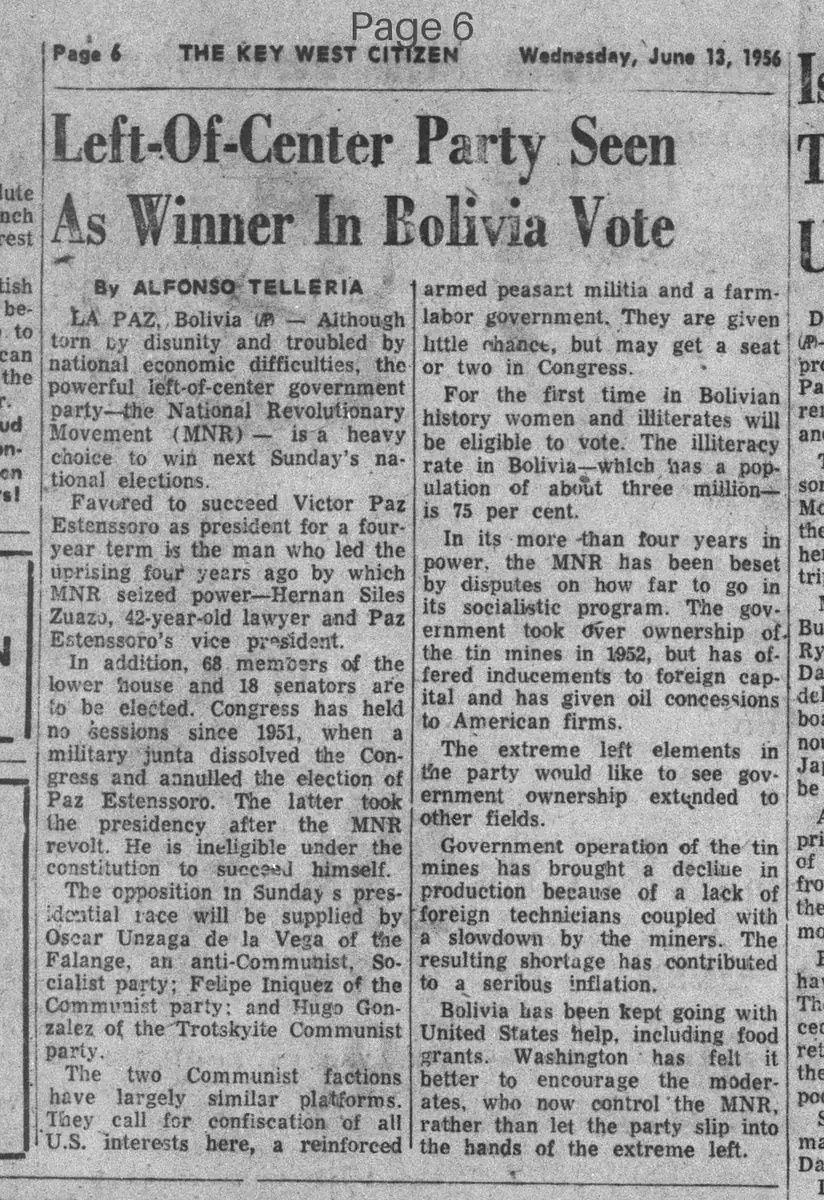
THE KEY WEST CITIZEN
Wednesday, June 13
Left-Of-Center Party Seen
As Winner In Bolivia Vote
By ALFONSO TELLERIA
LA PAZ, Bolivia ( ) - Although torn by disunity and troubled by national economic difficulties, the powerful left-of-center government party-the National Revolutionary Movement (MNR)-is a heavy choice to win next Sunday's national elections.
Favored to succeed Victor Paz Estenssoro as president for a four-year term is the man who led the uprising four years ago by which MNR seized power-Hernan Siles Zuazo, 42-year-old lawyer and Paz Estenssoro's vice president.
In addition, 68 members of the lower house and 18 senators are to be elected. Congress has held no sessions since 1951, when a military junta dissolved the Congress and annulled the election of Paz Estenssoro. The latter took the presidency after the MNR revolt. He is ineligible under the constitution to succeed himself.
The opposition in Sunday's presidential race will be supplied by Oscar Unzaga de la Vega of the Falange, an anti-Communist, Socialist party; Felipe Iniquez of the Communist party; and Hugo Gonzalez of the Trotskyite Communist party.
The two Communist factions have largely similar platforms. They call for confiscation of all U.S. interests here, a reinforced armed peasant militia and a farm-labor government. They are given little chance, but may get a seat or two in Congress.
For the first time in Bolivian history women and illiterates will be eligible to vote. The illiteracy rate in Bolivia -which has a population of about three million - is 75 per cent.
In its more-than four years in power, the MNR has been beset by disputes on how far to go in its socialistic program. The government took over ownership of the tin mines in 1952, but has offered inducements to foreign capital and has given oil concessions to American firms.
The extreme left elements in the party would like to see government ownership extended to other fields.
Government operation of the tin mines has brought a decline in production because of a lack of foreign technicians coupled with a slowdown by the miners. The resulting shortage has contributed to a serious inflation.
Bolivia has been kept going with United States help, including food grants. Washington has felt it better to encourage the moderates, who now control the MNR, rather than let the party slip into the hands of the extreme left.
What sub-type of article is it?
What keywords are associated?
What entities or persons were involved?
Where did it happen?
Foreign News Details
Primary Location
La Paz, Bolivia
Event Date
Next Sunday
Key Persons
Outcome
mnr heavily favored to win; first elections allowing women and illiterates to vote; congress to be elected after dissolution in 1951.
Event Details
The National Revolutionary Movement (MNR) is predicted to win Bolivia's national elections next Sunday despite internal disunity and economic issues. Hernan Siles Zuazo, current vice president, is favored to become president. Opposition from Falange, Communist, and Trotskyite parties. MNR has nationalized tin mines but faces production declines and inflation; supported by U.S. aid to moderates.