Thank you for visiting SNEWPapers!
Sign up free
The Aegis & Intelligencer
Bel Air, Harford County, Maryland
What is this article about?
The Baltimore and Ohio Railroad acquires majority interest in the Delaware Western Railroad to build a new direct route from Baltimore to Philadelphia, with funding secured. The Philadelphia, Wilmington and Baltimore Railroad opposes, citing track usage restrictions and demanding locomotive costs for through trains.
Clipping
OCR Quality
Full Text
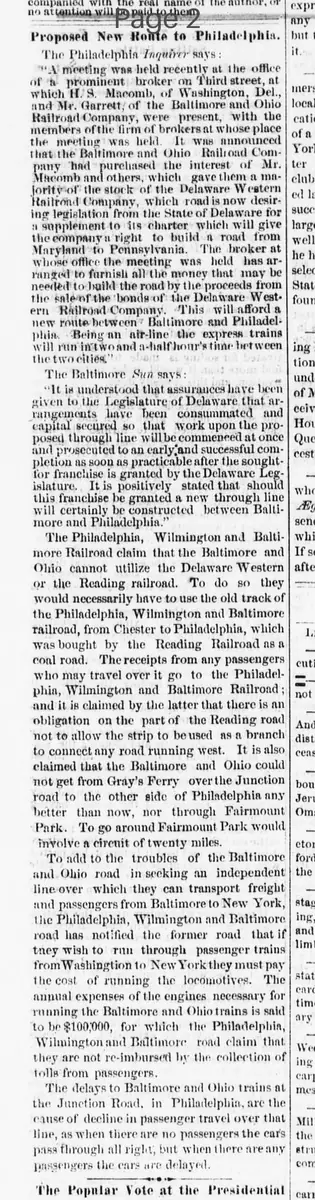
The Philadelphia Inquirer says:
"A meeting was held recently at the office of a prominent broker on Third street, at which H. S. McComb, of Wilmington, Del., and Mr. Garrett, of the Baltimore and Ohio Railroad Company, were present, with the members of the firm of brokers at whose place the meeting was held. It was announced that the Baltimore and Ohio Railroad Company had purchased the interest of Mr. McComb and others, which gave them a majority of the stock of the Delaware Western Railroad Company, which road is now desiring legislation from the State of Delaware for a supplement to its charter, which will give the company a right to build a road from Maryland to Pennsylvania. The broker at whose office the meeting was held has arranged to furnish all the money that may be needed to build the road by the proceeds from the sale of the bonds of the Delaware Western Railroad Company. This will afford a new route between Baltimore and Philadelphia. Being an air-line the express trains will run in two and a half hours time between the two cities."
The Baltimore Sun says:
"It is understood that assurances have been given to the Legislature of Delaware that arrangements have been consummated and capital secured so that work upon the proposed through line will be commenced at once and prosecuted to an early and successful completion as soon as practicable after the sought-for franchise is granted by the Delaware Legislature. It is positively stated that should this franchise be granted a new through line will certainly be constructed between Baltimore and Philadelphia."
The Philadelphia, Wilmington and Baltimore Railroad claim that the Baltimore and Ohio cannot utilize the Delaware Western or the Reading railroad. To do so they would necessarily have to use the old track of the Philadelphia, Wilmington and Baltimore railroad, from Chester to Philadelphia, which was bought by the Reading Railroad as a coal road. The receipts from any passengers who may travel over it go to the Philadelphia, Wilmington and Baltimore Railroad; and it is claimed by the latter that there is an obligation on the part of the Reading road not to allow the strip to be used as a branch to connect any road running west. It is also claimed that the Baltimore and Ohio could not get from Gray's Ferry over the Junction road to the other side of Philadelphia any better than now, nor through Fairmount Park. To go around Fairmount Park would involve a circuit of twenty miles.
To add to the troubles of the Baltimore and Ohio road in seeking an independent line over which they can transport freight and passengers from Baltimore to New York, the Philadelphia, Wilmington and Baltimore road has notified the former road that if they wish to run through passenger trains from Washington to New York they must pay the cost of running the locomotives. The annual expenses of the engines necessary for running the Baltimore and Ohio trains is said to be $100,000, for which the Philadelphia, Wilmington and Baltimore road claim that they are not reimbursed by the collection of tolls from passengers.
The delays to Baltimore and Ohio trains at the Junction Road, in Philadelphia, are the cause of decline in passenger travel over that line, as when there are no passengers the cars pass through all right, but when there are any passengers the cars are delayed.
What sub-type of article is it?
What keywords are associated?
What entities or persons were involved?
Where did it happen?
Story Details
Key Persons
Location
Baltimore To Philadelphia Via Delaware
Event Date
Recently
Story Details
Baltimore and Ohio Railroad purchases majority stock in Delaware Western Railroad to seek charter supplement for building a new line from Maryland to Pennsylvania, enabling a direct two-and-a-half-hour route to Philadelphia with secured funding. Philadelphia, Wilmington and Baltimore Railroad opposes utilization of existing tracks and demands payment for locomotive costs on through trains, contributing to delays and declining passengers.