Thank you for visiting SNEWPapers!
Sign up free
Portland Gazette, And Maine Advertiser
Portland, Cumberland County, Maine
What is this article about?
Captain Charles Morris reports on the USS Adams' 1814 cruise: evaded Jamaica convoy, captured and destroyed several British vessels off Ireland and Newfoundland, escaped two frigate chases, battled scurvy from harsh weather, and grounded on Isle of Haute near Maine after taking prizes.
Clipping
OCR Quality
Full Text
WASHINGTON, SEPT. 6.
Copy of a letter from Captain Charles Morris to the Secretary of the Navy
Hampden, D Maine, Aug 28, 1814
U S Ship Adams.
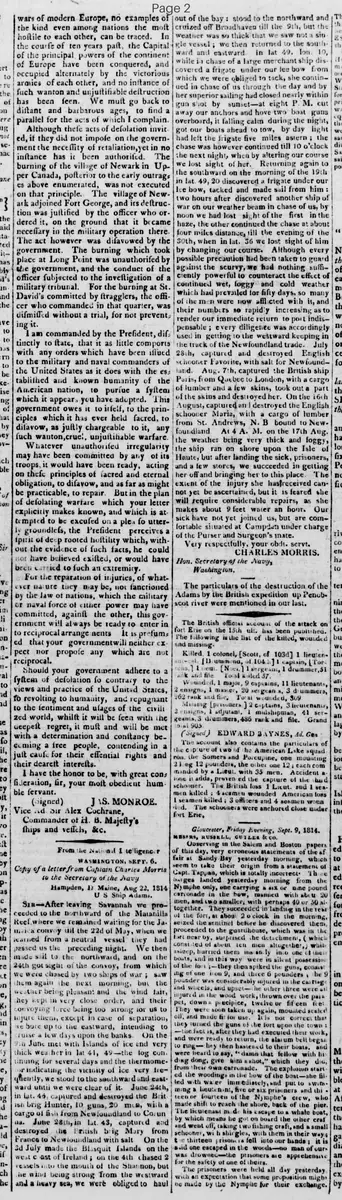
SIR--After leaving Savannah we proceeded to the northward of the Matanilla Reef, where we remained waiting for the Jamaica convoy until the 22d of May, when we learned from a neutral vessel they had passed us the preceding night. We then made sail to the northward, and on the 24th got sight of the convoy, from which we were chased by two ships of war; saw them again the next morning, but the weather being pleasant and the wind fair, they kept in very close order, and their convoying force being too strong for us to injure them, except in case of separation, we bore up to the eastward, intending to cruise a few days upon the banks. On the 9th June met with islands of ice and very thick weather in lat 41, 49--the fog continuing for several days and the thermometer indicating the vicinity of ice very frequently, we stood to the southward and eastward until we were clear of it. June 24th, in lat. 46, captured and destroyed the British brig Hunter, 10 guns, 20 men, with a cargo of fish from Newfoundland to Corunna. June 28th, in lat. 43, captured and destroyed the British brig Mary from France to Newfoundland with salt. On the 3d July made the Blaskets islands on the west coast of Ireland; on the 4th chased 2 vessels into the mouth of the Shannon, but the wind being strong from the westward and a heavy sea, we were obliged to haul out of the bay: stood to the northward and cruized off Broadhaven till the 9th, but the weather was so thick that we saw not a single vessel; we then returned to the southward and eastward. In lat 49. lon. 10, while in chase of a large merchant ship discovered a frigate under our lee bow from which we were obliged to tack, she continued in chase of us through the day and by her superior sailing had closed nearly within gun shot by sunset--at eight P. M. cut away our anchors and hove two boat guns overboard, it falling calm during the night, got our boats ahead to tow, by day light had left the frigate five miles astern; the chase was however continued till 10 o'clock the next night, when by altering our course we lost sight of her. Returning again to the southward on the morning of the 19th in lat, 49, 20 discovered a frigate under our lee bow, tacked and made sail from him: two hours after discovered another ship of war on our weather beam in chase of us, by noon we had lost sight of the first in the haze, the other continued the chase at about four miles distance, till the evening of the 30th, when in lat. 36 we lost sight of him by changing our course. Although every possible precaution had been taken to guard against the scurvy, we had nothing sufficiently powerful to counteract the effect of continued wet, foggy and cold weather which had prevailed for fifty days, so many of the men were now affected with it, and their numbers so rapidly increasing as to render our immediate return to port indispensable; every diligence was accordingly used in getting to the westward keeping in the track of the Newfoundland trade. July 28th, captured and destroyed English schooner Favorite, with salt for Newfoundland. Aug. 7th, captured the British ship Paris, from Quebec to London, with a cargo of lumber and a few skins, took out a part of the skins and destroyed her. On the 16th August, captured and destroyed the English schooner Maria, with a cargo of lumber from St. Andrews, N. B bound to Newfoundland. At 4 A.M. on the 17th Aug. the weather being very thick and foggy, the ship ran on shore upon the Isle of Haute, but after landing the sick, prisoners, and a few stores, we succeeded in getting her off and bringing her to this place. The extent of the injury she has received cannot yet be ascertained, but it is feared she will require considerable repairs, as she makes about 9 feet water an hour. Our sick have not yet joined us, but are comfortably situated at Campden under charge of the Purser and Surgeon's mate.
Very respectfully, your obdt. servt,
CHARLES MORRIS.
Hon. Secretary of the Navy, Washington.
The particulars of the destruction of the Adams by the British expedition up Penobscot river were mentioned in our last.
What sub-type of article is it?
What themes does it cover?
What keywords are associated?
What entities or persons were involved?
Where did it happen?
Story Details
Key Persons
Location
Atlantic Ocean, Off Ireland, Newfoundland Trade Track, Isle Of Haute, Hampden, Maine
Event Date
May 22, 1814 To August 17, 1814
Story Details
USS Adams under Capt. Morris cruises from Savannah, evades British convoy and frigates, captures and destroys British vessels including Hunter, Mary, Favorite, Paris, Maria; crew suffers scurvy from weather; ship grounds on Isle of Haute but is refloated with damage.