Thank you for visiting SNEWPapers!
Sign up free
Literary
June 1, 1816
Virginia Argus
Richmond, Virginia
What is this article about?
An essay praising American liberty, order, and the 'spirit of property' as foundations of the republic, contrasting with European systems. It reviews D.B. Warden's statistical description of the District of Columbia, highlighting its role as the federal capital, agricultural prosperity, and recovery from the 1814 British burning of Washington.
Clipping
OCR Quality
95%
Excellent
Full Text
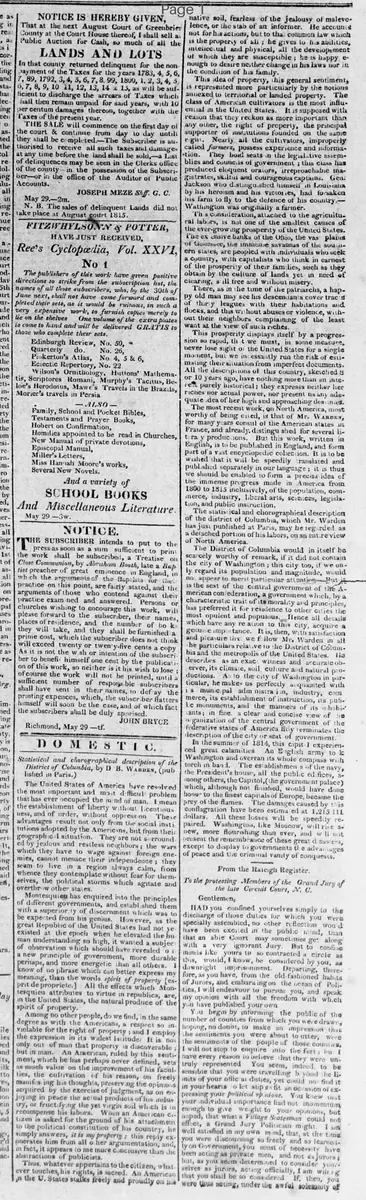
Statistical and chorographical description of the District of Columbia, by D B. Warden, (published in Paris.)
The United States of America have resolved the most important and most difficult problem that has ever occupied the mind of man. I mean the establishment of liberty without licentiousness, and of order, without oppression These advantages result not only from the social institutions adopted by the Americans, but from their geographic situation. They are not surrounded by jealous and restless neighbors; the wars which they have to wage against foreign enemies, cannot menace their independence; they seem to live in a region always calm, from whence they contemplate without fear for themselves, the political storms which agitate and overthrow other states.
Montesquieu has enquired into the principles of different governments, and established them with a superiority of discernment which was to be expected from his genius. However, as the great Republic of the United States had not yet existed at the epoch when he elevated the human understanding so high, it wanted a subject of observation which should have revealed to a new principle of government, more durable perhaps, and more energetic than all others. I know of no phrase which can better express my meaning, than the words spirit of property [esprit de propriété.] All the effects which Montesquieu attributes to virtue in republics, are, in the United States, the natural produce of the spirit of property.
Among no other people, do we find, in the same degree as with the Americans, a respect so invincible for the right of property; and I employ the expression in its widest latitude: It is not only out of man that property is discoverable; but in man. An American, ruled by this sentiment, which he has perhaps never defined, sets as much value on the improvement of his faculties, the cultivation of his reason, on freely manifesting his thoughts, preserving the opinions acquired by the exercise of judgment, as on enjoying in peace the actual products of his industry, or fructifying the yet virgin soil which is to recompense his labors. When an American Citizen is asked for the ground of his attachment to the political constitution of his country, he simply answers, it is my property; this reply exonerates him from all other argumentation, and, in fact, it appears to me more conclusive than the abstractions of publicists
Thus, whatever appertains to the citizen, whatever touches his rights, is sacred. An American in the U. States stalks freely and proudly on the native soil, fearless of the jealousy of malevolence, or the stab of an informer. He accounts not for his actions, but to that common law which is the property of all; he gives to his abilities, intellectual and physical, all the development of which they are susceptible; he is happy enough to desire neither change in his laws nor in the condition of his family.
This idea of property, this general sentiment, is represented more particularly by the notions annexed to territorial or landed property. The class of American cultivators is the most influential in the United States. It is supposed with reason that they reckon as more important than any other, the right of property, the principal supporter of institutions founded on the same right. Nearly all the cultivators, improperly called farmers, possess experience and information. They hold seats in the legislative assemblies and councils of government; this class has produced eloquent orators, irreproachable magistrates, skillful and courageous captains. Gen. Jackson who distinguished himself in Louisiana by his heroism and his victories, had forsaken his farm to fly to the defence of his country.—Washington was originally a farmer.
This consideration, attached to the agricultural labors, is not one of the smallest causes of the ever-growing prosperity of the United States. The extensive banks of the Ohio, the vast plains of Genessee, the immense savannas of the southern states, are peopled with individuals who seek a country, with capitalists who think in earnest of the prosperity of their families, such as they obtain by the culture of lands yet in need of clearing, still free and without misery.
There, as in the time of the patriarchs, a happy old man may see his descendants cover tracts of thirty leagues with their habitations and flocks, and this without abuses or violence, without their neighbors complaining of the least want at the view of such riches.
This prosperity displays itself by a progression so rapid, that we must, in some measure, never lose sight of the United States for a single moment, but we incessantly run the risk of estimating their situation from imperfect documents. All the descriptions of this country, sketched 8 or 10 years ago, have nothing more than an interest purely historical; they express neither her riches nor actual power, nor present us any adequate idea of her high and approaching destinies.
The most recent work, on North America, most worthy of being cited, is that of Mr. Warden, for many years consul of the American states in France, and already distinguished for several literary productions. But this work, written in English, is to be published in England, and form part of a vast encyclopedic collection. It is to be wished that it will be speedily translated and published separately in our language; it is thus we should be enabled to form a precise idea of the immense progress made in America from 1800 to 1815 inclusively, of the population, commerce, industry, liberal arts, sciences, legislation, and public instruction.
The statistical and chorographical description of the district of Columbia, which Mr. Warden has just published at Paris, may be regarded as a detached portion of his labors, on an entire view of North America.
The District of Columbia would in itself be scarcely worthy of remark, if it did not contain the city of Washington; this city too, if we only regard its population and magnitude, would no appear to merit particular attention—But is the seat of the Central government of the American confederation, a government which, by a characteristic trait of its morality and principles, has preferred it for residence to other cities the most opulent and populous. Hence all details which have any relation to this city, acquire a genuine importance. It is, then, with satisfaction and pleasure that we follow Mr. Warden in all the particulars relative to the District of Columbia and the metropolis of the United States. He describes as an exact witness and accurate observer, its climate, soil culture and natural productions. As to the city of Washington in particular, he makes us perfectly acquainted with its municipal administration, industry, commerce, its establishment of instruction, its public monuments, and the manners of its inhabitants; in fine, a clear and concise view of the organization of the central government of the federative states of America fitly terminates the description of the city or seat of government.
In the summer of 1814, this capital experienced great calamities An English army took Washington and overran its whole compass with torch in hand. The establishments of the navy, the President's house, all the public edifices, among others, the Capitol, (the government palace) which, although not finished, would have done honor to the finest capitals of Europe, became the prey of the flames. The damages caused by this conflagration have been estimated at 1,215,111 dollars. All these losses will be speedily repaired. Washington, like Moscow, will rise anew, more flourishing than ever, and will not present the remembrance of these great disasters, except to display to governments the advantages of peace and the criminal vanity of conquests.
The United States of America have resolved the most important and most difficult problem that has ever occupied the mind of man. I mean the establishment of liberty without licentiousness, and of order, without oppression These advantages result not only from the social institutions adopted by the Americans, but from their geographic situation. They are not surrounded by jealous and restless neighbors; the wars which they have to wage against foreign enemies, cannot menace their independence; they seem to live in a region always calm, from whence they contemplate without fear for themselves, the political storms which agitate and overthrow other states.
Montesquieu has enquired into the principles of different governments, and established them with a superiority of discernment which was to be expected from his genius. However, as the great Republic of the United States had not yet existed at the epoch when he elevated the human understanding so high, it wanted a subject of observation which should have revealed to a new principle of government, more durable perhaps, and more energetic than all others. I know of no phrase which can better express my meaning, than the words spirit of property [esprit de propriété.] All the effects which Montesquieu attributes to virtue in republics, are, in the United States, the natural produce of the spirit of property.
Among no other people, do we find, in the same degree as with the Americans, a respect so invincible for the right of property; and I employ the expression in its widest latitude: It is not only out of man that property is discoverable; but in man. An American, ruled by this sentiment, which he has perhaps never defined, sets as much value on the improvement of his faculties, the cultivation of his reason, on freely manifesting his thoughts, preserving the opinions acquired by the exercise of judgment, as on enjoying in peace the actual products of his industry, or fructifying the yet virgin soil which is to recompense his labors. When an American Citizen is asked for the ground of his attachment to the political constitution of his country, he simply answers, it is my property; this reply exonerates him from all other argumentation, and, in fact, it appears to me more conclusive than the abstractions of publicists
Thus, whatever appertains to the citizen, whatever touches his rights, is sacred. An American in the U. States stalks freely and proudly on the native soil, fearless of the jealousy of malevolence, or the stab of an informer. He accounts not for his actions, but to that common law which is the property of all; he gives to his abilities, intellectual and physical, all the development of which they are susceptible; he is happy enough to desire neither change in his laws nor in the condition of his family.
This idea of property, this general sentiment, is represented more particularly by the notions annexed to territorial or landed property. The class of American cultivators is the most influential in the United States. It is supposed with reason that they reckon as more important than any other, the right of property, the principal supporter of institutions founded on the same right. Nearly all the cultivators, improperly called farmers, possess experience and information. They hold seats in the legislative assemblies and councils of government; this class has produced eloquent orators, irreproachable magistrates, skillful and courageous captains. Gen. Jackson who distinguished himself in Louisiana by his heroism and his victories, had forsaken his farm to fly to the defence of his country.—Washington was originally a farmer.
This consideration, attached to the agricultural labors, is not one of the smallest causes of the ever-growing prosperity of the United States. The extensive banks of the Ohio, the vast plains of Genessee, the immense savannas of the southern states, are peopled with individuals who seek a country, with capitalists who think in earnest of the prosperity of their families, such as they obtain by the culture of lands yet in need of clearing, still free and without misery.
There, as in the time of the patriarchs, a happy old man may see his descendants cover tracts of thirty leagues with their habitations and flocks, and this without abuses or violence, without their neighbors complaining of the least want at the view of such riches.
This prosperity displays itself by a progression so rapid, that we must, in some measure, never lose sight of the United States for a single moment, but we incessantly run the risk of estimating their situation from imperfect documents. All the descriptions of this country, sketched 8 or 10 years ago, have nothing more than an interest purely historical; they express neither her riches nor actual power, nor present us any adequate idea of her high and approaching destinies.
The most recent work, on North America, most worthy of being cited, is that of Mr. Warden, for many years consul of the American states in France, and already distinguished for several literary productions. But this work, written in English, is to be published in England, and form part of a vast encyclopedic collection. It is to be wished that it will be speedily translated and published separately in our language; it is thus we should be enabled to form a precise idea of the immense progress made in America from 1800 to 1815 inclusively, of the population, commerce, industry, liberal arts, sciences, legislation, and public instruction.
The statistical and chorographical description of the district of Columbia, which Mr. Warden has just published at Paris, may be regarded as a detached portion of his labors, on an entire view of North America.
The District of Columbia would in itself be scarcely worthy of remark, if it did not contain the city of Washington; this city too, if we only regard its population and magnitude, would no appear to merit particular attention—But is the seat of the Central government of the American confederation, a government which, by a characteristic trait of its morality and principles, has preferred it for residence to other cities the most opulent and populous. Hence all details which have any relation to this city, acquire a genuine importance. It is, then, with satisfaction and pleasure that we follow Mr. Warden in all the particulars relative to the District of Columbia and the metropolis of the United States. He describes as an exact witness and accurate observer, its climate, soil culture and natural productions. As to the city of Washington in particular, he makes us perfectly acquainted with its municipal administration, industry, commerce, its establishment of instruction, its public monuments, and the manners of its inhabitants; in fine, a clear and concise view of the organization of the central government of the federative states of America fitly terminates the description of the city or seat of government.
In the summer of 1814, this capital experienced great calamities An English army took Washington and overran its whole compass with torch in hand. The establishments of the navy, the President's house, all the public edifices, among others, the Capitol, (the government palace) which, although not finished, would have done honor to the finest capitals of Europe, became the prey of the flames. The damages caused by this conflagration have been estimated at 1,215,111 dollars. All these losses will be speedily repaired. Washington, like Moscow, will rise anew, more flourishing than ever, and will not present the remembrance of these great disasters, except to display to governments the advantages of peace and the criminal vanity of conquests.
What sub-type of article is it?
Essay
What themes does it cover?
Liberty Freedom
Political
Agriculture Rural
What keywords are associated?
American Liberty
Spirit Of Property
District Of Columbia
Washington Dc
Agricultural Prosperity
Political Institutions
British Invasion 1814
Literary Details
Title
Statistical And Chorographical Description Of The District Of Columbia, By D B. Warden, (Published In Paris.)
Subject
On American Liberty, Property, And The District Of Columbia
Form / Style
Prose Essay On Political Philosophy And Geography
Key Lines
The Establishment Of Liberty Without Licentiousness, And Of Order, Without Oppression
I Know Of No Phrase Which Can Better Express My Meaning, Than The Words Spirit Of Property [Esprit De Propriété.]
When An American Citizen Is Asked For The Ground Of His Attachment To The Political Constitution Of His Country, He Simply Answers, It Is My Property
Washington, Like Moscow, Will Rise Anew, More Flourishing Than Ever