Thank you for visiting SNEWPapers!
Sign up free
The Sun
New York, New York County, New York
What is this article about?
Union forces under Admiral Farragut and General Granger captured Fort Morgan on August 23 after intense bombardment from land and sea batteries. The Confederate garrison of 600 surrendered, but spiked guns and destroyed property before evacuation to New Orleans.
Clipping
OCR Quality
Full Text
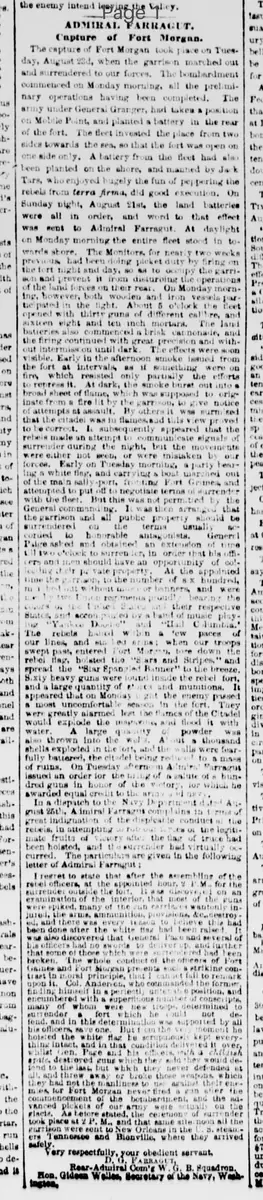
Capture of Fort Morgan.
The capture of Fort Morgan took place on Tuesday, August 23d, when the garrison marched out and surrendered to our forces. The bombardment commenced on Monday morning, all the preliminary operations having been completed. The army under General Granger, had taken a position on Mobile Point, and planted a battery in the rear of the fort. The fleet invested the place from two sides towards the sea, so that the fort was open on one side only. A battery from the fleet had also been planted on the shore, and manned by Jack Tars, who enjoyed hugely the fun of peppering the rebels from terra firma, did good execution. On Sunday night, August 21st, the land batteries were all in order, and word to that effect was sent to Admiral Farragut. At daylight on Monday morning the entire fleet stood in towards shore. The Monitor, for nearly two weeks previous, had been doing picket duty by firing on the fort night and day, so as to occupy the garrison and prevent it from disturbing the operations of the land forces on their rear. On Monday morning, however, both wooden and iron vessels participated in the fight. About 5 o'clock the fleet opened with thirty guns of different calibre, and sixteen eight and ten inch mortars. The land batteries also commenced a brisk cannonade, and the firing continued with great precision and without intermission until dark. The effects were soon visible. Early in the afternoon smoke issued from the fort at intervals, as if something were on fire, which resisted only partially the efforts to repress it. At dark, the smoke burst out into broad sheet of flame, which was supposed to originate from a fire lit by the garrison, to give notice of attempts at assault. By others it was conjectured that the citadel was in flames, and this view proved to be correct. It subsequently appeared that the rebels made an attempt to communicate signals of surrender during the night, but the movements were either not seen, or were mistaken by our forces. Early on Tuesday morning, a party bearing a white flag, and carrying a boat rowed out of the main sally-port, fronting Fort Gaines and attempted to put off to negotiate terms of surrender with the fleet. But this was not permitted by the General commanding. It was then arranged that the garrison and all public property should be surrendered on the terms usually accorded to honorable antagonists. General Page asked and obtained an extension of time till two o'clock to surrender, in order that his officers and men should have an opportunity of collecting their private property. At the appointed time the garrison, to the number of six hundred, marched out without colors and were escorted to their respective States, and accompanied by a band of music playing "Yankee Doodle" and "Hail Columbia."
The rebels halted within a few paces of our lines, and stacked arms; when our troops swept past, entered Fort Morgan, tore down the rebel flag, hoisted the "stars and Stripes," and spread the "Star Spangled Banner" to the breeze. Sixty heavy guns were found inside the rebel fort. and a large quantity of shot and munitions. It appeared that on Monday night the enemy passed a most uncomfortable season in the fort. They were greatly alarmed lest the flames of the Citadel would explode the magazine and flood it with water. A large quantity of powder was also thrown into the ditch. About a thousand shells exploded in the fort, and the walls were fearfully battered, the citadel being reduced to a mass of ruins. On Tuesday afternoon Adm'ral Farragut issued an order for the firing of a salute of a hundred guns in honor of the victory, for which he awarded equal credit to the army and navy.
In a dispatch to the Navy Department, dated August 25th, Admiral Farragut complains in terms of great indignation of the dastardly conduct of the rebels, in attempting to cut fuses of the legitimate fruits of victory after the flag of truce had been hoisted, and the surrender had virtually occurred. The particulars are given in the following letter of Admiral Farragut:
I regret to state that after the assembling of the rebel officers, at the appointed hour, 2 P.M. for the surrender outside the fort, it was discovered on an examination of the interior, that most of the guns were spiked, many of the gun carriages wantonly injured, the arms, ammunition, provisions, &c., destroyed, and there was every reason to believe this had been done after the white flag had been raised. It was also discovered that General Page and several of his officers had no swords to deliver up and further that some of those which were surrendered had been broken. The whole conduct of the officers of Fort Gaines and Fort Morgan presents a striking contrast in moral principle, that I cannot but fail to remark upon it. Col. Anderson, who commanded the former, finding himself in a perfectly untenable position, and encumbered with a superfluous number of conscripts, many of whom were new to the gun, determined to surrender fort which he could not defend, and in this determination was supported by all his officers, save one. But from the moment he hoisted the white flag he scrupulously kept everything intact and that condition delivered over whilst Gen. Page and his officers, with a churlish spite, destroyed guns which they said they would defend to the last, but which they never defended at all, and threw away or broke those weapons, which they had not the manliness to use against their enemy, for Fort Morgan never fired a gun after the commencement of the bombardment, and the advanced pickets of our army were still on the place. As before stated, the ceremony of surrender took place at 2 P. M., and that same afternoon all the garrison were sent to New Orleans in the U. S. steamers Tennessee and Bienville, where they arrived safely Fire respectfully, your obedient servant,
D. G. Farragut,
Rear-Admiral Commanding W. G. B. Squadron.
Hon. Gideon Welles,
Secretary of the Navy, Washington.
What sub-type of article is it?
What keywords are associated?
What entities or persons were involved?
Where did it happen?
Domestic News Details
Primary Location
Fort Morgan
Event Date
August 23d
Key Persons
Outcome
garrison of six hundred surrendered without colors; marched out and escorted; fort entered by union troops; sixty heavy guns found; property partially destroyed by rebels including spiked guns and broken swords; garrison sent to new orleans.
Event Details
Union army under General Granger positioned on Mobile Point with rear battery; fleet under Admiral Farragut invested from sea sides; bombardment began Monday morning August 22 with fleet guns and mortars plus land batteries; fire in citadel; signals of surrender attempted but missed; white flag party rowed out Tuesday morning; terms arranged; surrender at 2 P.M.; troops hoisted Union flags; Admiral Farragut's dispatch notes rebel destruction after truce.