Thank you for visiting SNEWPapers!
Sign up free
The New Hampshire Gazette
Portsmouth, Rockingham County, New Hampshire
What is this article about?
This letter critiques the ongoing baptism controversy between Baptists and their opponents, highlighting shared errors: neglecting the Kingdom of Heaven doctrine, misinterpreting baptism as a sign of privileges or principles rather than sin's washing in Christ's blood, using partisan and logical arguments instead of Scripture, and employing scornful rhetoric. It urges direct reliance on the New Testament.
Clipping
OCR Quality
Full Text
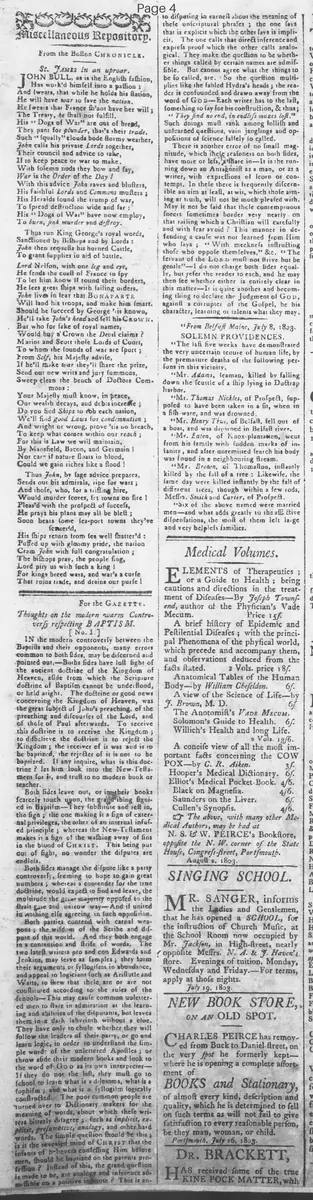
Thoughts on the modern warm Controversy respecting BAPTISM.
[No. 1.]
IN the modern controversy between the
Baptists and their opponents, many errors
common to both sides, may be discerned and
pointed out.--Both sides have lost sight of
the ancient doctrine of the Kingdom of
Heaven, aside from which the Scripture
doctrine of Baptism cannot be understood,
or held aright. The doctrine or good news
concerning the Kingdom of Heaven, was
the great subject of John's preaching. of the
preaching and discourses of the Lord, and
of those of Paul afterwards. To receive
this doctrine is to receive the Kingdom ;
to disbelieve the doctrine is to reject the
Kingdom ; the receiver of it was and is to
be baptized, the rejecter of it is not to be
baptized. If any inquire, what is this doc-
trine ? let him look into the New Testa-
ment for it, and trust to no modern book or
teacher.
Both sides leave out, or in their books
carecly touch upon, the grand thing sig-
ed in Baptism-They substitute and set in,
the sign ; the one making it a sign of exter-
nal privileges, the other of an internal infu-
sed principle ; whereas the New-Testament
makes it a sign of the washing away of sins
in the blood of Christ. This being put
out of sight, no wonder the disputes are
endless.
Both sides manage the dispute like a party
controversy, coming to hope to gain great
numbers; whereas a contender for the true
doctrine, would expect to find and leave, the
multitude the gross majority opposed to the
strait gate and narrow way-And if united
in nothing else agreeing in such opposition.
Both parties contend with carnal wea-
pens ; the wisdom of the Scribe and de-
pute of this world. And they both engage
in a contention and strife of words. The
two latest writers pro and con Edwards and
Jenkins, may serve as samples ; they form
their arguments or syllogisms in abundance,
and appeal to logicians such as Aristotle and
Watts, to shew that these are or are not
constituted according to the rules of the
schools--This may cause common unletter-
ed men to stare in admiration at the learn-
ing and abilities of the disputants, but leaves
them in a dark labyrinth without a clue.
They have only to chuse whether they will
follow the leaders of their party, or go and
learn logic, in order to understand the sim-
ple words of the unlettered Apostles ; or
throw aside their modern books and look to
the word of God as its own interpreter—
If they do not the last, they must go to
school to learn what is a dilemma, what is a
sophism ; and what is a syllogism logically
constituted. The poor common people are
Turned over to Dictionary makers for the
meaning of words, about which these wri-
ters bitterly disagree ; such as implicit, ex.
plicit, presumptive, analogy, and other hard
words. The simple question should be this;
is it the revealed mind of Christ that the
infants of believers coming Him before
fasion ? Instead of this, the grand question
is made to be, are analogy and inference ad-
missible on a positive institute ? This is an-
other error common to both sides, that of
disputing in earnest about the meaning of
these unscriptural phrases : the one says
that is explicit which the other says is impli-
cit. The one calls that direct inference and
express proof which the other calls analo-
gical. They make the question to be wheth-
er things called by certain names are admis-
sible. But cannot agree what the things to
be so called, are. So the question multi-
plies like the fabled Hydra's heads : the rea-
der is confounded and drawn away from the
word of GOD-Each writer has to the last,
something to say for his construction, & thus
"They find no end, in endless mazes lost."
Such doings must rank among foolish and
unlearned questions, vain janglings and op-
positions of science falsely so called.
There is another error of no small mag-
nitude, which these reasoners on both sides,
have more or less, a share in-It is the run-
ning down an Antagonist as a man, or as a
writer. with expressions of scorn or con-
tempt. In these there is frequently discern-
ible an aim at least. at wit, which those aim-
ing at truth. will not be much pleased with.
May it not be said that these contemptuous
sneers sometimes border very nearly on
that railing which a Christian will carefully
and with fear avoid ? This manner in de-
fending a cause was not learned from Him
who says ; " With meekness instructing
those who oppose themselves," &c. "The
servant of the Lord must not strive but be
gentle"-I do not charge both sides equal-
ly, but refer the reader to each, and he may
then see whether either is entirely clear in
this matter-It is quite another and becom-
ing thing to declare the Judgment of God,
against a corrupter of the Gospel, be his
character, learning or talents what they may.
What sub-type of article is it?
What themes does it cover?
What keywords are associated?
What entities or persons were involved?
Letter to Editor Details
Recipient
The Gazette
Main Argument
both baptists and opponents err in the baptism controversy by ignoring the kingdom of heaven doctrine central to scripture, misinterpreting baptism's sign, engaging in partisan logical debates rather than direct scriptural interpretation, and using scornful rhetoric; true understanding requires returning to the new testament alone.
Notable Details