Thank you for visiting SNEWPapers!
Sign up free
Editorial
April 6, 1844
Independent Democrat
Canton, Madison County, Mississippi
What is this article about?
Editorial in the New York Standard expressing alarm over opposition to Martin Van Buren's 1844 Democratic presidential candidacy, urging him to withdraw before the Baltimore Convention to avoid defeat and allow General Cass to lead the party to victory.
Clipping
OCR Quality
98%
Excellent
Full Text
From the New York Standard
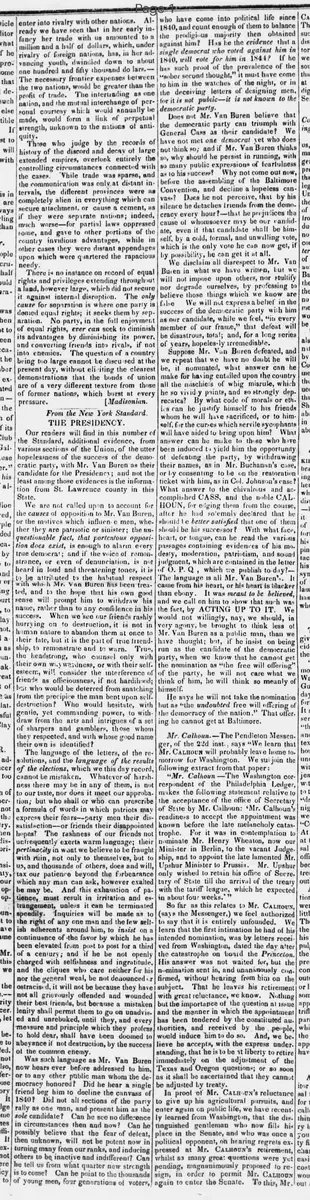
THE PRESIDENCY.
Our readers will find in this number of the Standard, additional evidence, from various sections of the Union, of the utter hopelessness of the success of the democratic party, with Mr. Van Buren as their candidate for the Presidency; and not the least among those evidences is the information from St. Lawrence county in this State.
We are not called upon to account for the causes of opposition to Mr. Van Buren, or the motives which influence men, whether they are patriotic or sinister; the unquestionable fact, that portentous opposition does exist, is enough to alarm every true democrat; and if the voice of remonstrance, or even of denunciation, is not heard in loud and threatening tones, it is to be attributed to the habitual respect with which Mr. Van Buren has been treated, and to the hope that his own good sense will prompt him to withdraw his name, rather than to any confidence in his success. When we see our friends rashly hurrying on to destruction, it is not in human nature to abandon them at once to their fate, but it is the part of true friendship, to remonstrate and to warn. True, the headstrong, who counsel only with their own waywardness, or with their self-esteem, will consider the interference of friends as officiousness, if not hardihood; but who would be deterred from snatching from the precipice the man bent upon self-destruction? Who would hesitate, with gentle, yet commanding power, to withdraw from the arts and intrigues of a set of sharpers and gamblers, those whom they respected, and with whose good name their own is identified?
The language of the letters, of the resolutions, and the language of the results of the elections, which we this day record, cannot be mistaken. Whatever of harshness there may be in any of them, is not to our taste, nor does it meet our approbation; but who shall or who can prescribe a formula of words in which patriots may express their fears--party men their dissatisfaction--or friends their disappointed hopes? The rashness of our friends not unfrequently excites warm language: their pertinacity in what we believe to be fraught with ruin, not only to themselves, but to us, and thousands of others, does and will tax our patience beyond the forbearance which any man can ask, however exalted he may be. And this exhaustion of patience, must result in irritation and estrangement, unless it can be terminated speedily. Inquiries will be made as to the right of any one man and the few selfish adherents around him, to insist on a continuance of the favor by which he has been elevated from post to post for a third of a century; and if he be not openly charged with selfishness and ingratitude, and the cliques who care neither for his nor the general weal, be not denounced, ostracised, it will not be because they have not all grievously offended and wounded their best friends, but because a mistaken lenity shall permit them to go on unadvised and unrebuked, until they, and every measure and principle which they profess to hold dear, shall have been doomed to abeyance if not destruction, by the success of the common enemy.
Was such language as Mr. Van Buren now hears ever before addressed to him, or to any other public man whom the democracy honored? Did he hear a single friend beg him to decline the canvass of 1840? Did not all sections of the party rally as one man, and present him as the sole candidate? Can he see no difference in circumstances then and now? Can he possibly believe that the fear of defeat, then unknown, will not be potent now in turning many from our ranks, and inducing others to be inactive and indifferent? Can he tell us from what quarter new strength is to come? Can he point to the thousands of young men, four generations of voters, who have come into political life since 1840, and count enough of them to balance the prodigious majority then obtained against him? Has he the evidence that a single democrat who voted against him in 1840, will vote for him in 1844? If he has such proof of the prevalence of the "sober second thought," it must have come to him in the watches of the night, or in the deceiving letters of designing men, for it is not public--it is not known to the democratic party.
Does not Mr. Van Buren believe that the democratic party can triumph with General Cass as their candidate? We have not met one democrat yet who does not think so; and if Mr. Van Buren thinks so, why should he persist in running, with so many public expressions of fearfulness as to his success? Why not come out now, before the assembling of the Baltimore Convention, and decline a hopeless canvass? Does he not perceive, that by his silence he detaches friends from the democracy every hour?--that he prejudices the cause of whomsoever may be our candidate, even if that candidate shall be himself, by a cold, formal, and unwilling vote, which is the only vote he can now get, if by possibility, he can get it at all.
We disclaim all disrespect to Mr. Van Buren in what we have written, but we will not impose upon others, nor stultify nor degrade ourselves, by professing to believe those things which we know are false. We will not express a belief in the success of the democratic party with him as our candidate, while we feel, "in every member of our frame," that defeat will be disastrous, total; and, for a long series of years, hopelessly irremediable.
Suppose Mr. Van Buren defeated, and we repeat that we have no doubt he will be, if nominated, what answer can he make for having entailed upon the country all the mischiefs of whig misrule, which he so vividly paints, and so strongly deprecates? By what code of morals or ethics can he justify himself to his friends whom he will have sacrificed, or to himself, for the curses which servile sycophants will have aided to bring upon him? What answer can he make to those who have been induced to yield him the opportunity of defeating the party, by withdrawing their names, as in Mr. Buchanan's case, or by consenting to be on the second place ticket with him, as in Col. Johnson's case? What answer to the chivalrous and accomplished CASS, and the noble CALHOUN, for edging them from the course, after he had solemnly declared that he should be better satisfied that one of them should be his successor? With what face, heart, or tongue, can he read the various passages containing evidences of his modesty, moderation, patriotism, and sound judgment, which are contained in the letter of O. P. Q., which we publish to-day? The language is all Mr. Van Buren's. It came from his heart, or his heart is blacker than ebony. It was meant to be believed, and we call on him to show that such was the fact, by ACTING UP TO IT. We would not willingly, nay, we should, in very agony, be brought to think less of Mr. Van Buren as a public man, than we have thought; but, if he insist on being run as the candidate of the democratic party, when we know that he cannot get the nomination as "the free will offering" of the party, he will not care what we think of him, he will think so meanly of himself.
He says he will not take the nomination but as "the undoubted free will offering of the democracy of the nation." That offering he cannot get at Baltimore.
THE PRESIDENCY.
Our readers will find in this number of the Standard, additional evidence, from various sections of the Union, of the utter hopelessness of the success of the democratic party, with Mr. Van Buren as their candidate for the Presidency; and not the least among those evidences is the information from St. Lawrence county in this State.
We are not called upon to account for the causes of opposition to Mr. Van Buren, or the motives which influence men, whether they are patriotic or sinister; the unquestionable fact, that portentous opposition does exist, is enough to alarm every true democrat; and if the voice of remonstrance, or even of denunciation, is not heard in loud and threatening tones, it is to be attributed to the habitual respect with which Mr. Van Buren has been treated, and to the hope that his own good sense will prompt him to withdraw his name, rather than to any confidence in his success. When we see our friends rashly hurrying on to destruction, it is not in human nature to abandon them at once to their fate, but it is the part of true friendship, to remonstrate and to warn. True, the headstrong, who counsel only with their own waywardness, or with their self-esteem, will consider the interference of friends as officiousness, if not hardihood; but who would be deterred from snatching from the precipice the man bent upon self-destruction? Who would hesitate, with gentle, yet commanding power, to withdraw from the arts and intrigues of a set of sharpers and gamblers, those whom they respected, and with whose good name their own is identified?
The language of the letters, of the resolutions, and the language of the results of the elections, which we this day record, cannot be mistaken. Whatever of harshness there may be in any of them, is not to our taste, nor does it meet our approbation; but who shall or who can prescribe a formula of words in which patriots may express their fears--party men their dissatisfaction--or friends their disappointed hopes? The rashness of our friends not unfrequently excites warm language: their pertinacity in what we believe to be fraught with ruin, not only to themselves, but to us, and thousands of others, does and will tax our patience beyond the forbearance which any man can ask, however exalted he may be. And this exhaustion of patience, must result in irritation and estrangement, unless it can be terminated speedily. Inquiries will be made as to the right of any one man and the few selfish adherents around him, to insist on a continuance of the favor by which he has been elevated from post to post for a third of a century; and if he be not openly charged with selfishness and ingratitude, and the cliques who care neither for his nor the general weal, be not denounced, ostracised, it will not be because they have not all grievously offended and wounded their best friends, but because a mistaken lenity shall permit them to go on unadvised and unrebuked, until they, and every measure and principle which they profess to hold dear, shall have been doomed to abeyance if not destruction, by the success of the common enemy.
Was such language as Mr. Van Buren now hears ever before addressed to him, or to any other public man whom the democracy honored? Did he hear a single friend beg him to decline the canvass of 1840? Did not all sections of the party rally as one man, and present him as the sole candidate? Can he see no difference in circumstances then and now? Can he possibly believe that the fear of defeat, then unknown, will not be potent now in turning many from our ranks, and inducing others to be inactive and indifferent? Can he tell us from what quarter new strength is to come? Can he point to the thousands of young men, four generations of voters, who have come into political life since 1840, and count enough of them to balance the prodigious majority then obtained against him? Has he the evidence that a single democrat who voted against him in 1840, will vote for him in 1844? If he has such proof of the prevalence of the "sober second thought," it must have come to him in the watches of the night, or in the deceiving letters of designing men, for it is not public--it is not known to the democratic party.
Does not Mr. Van Buren believe that the democratic party can triumph with General Cass as their candidate? We have not met one democrat yet who does not think so; and if Mr. Van Buren thinks so, why should he persist in running, with so many public expressions of fearfulness as to his success? Why not come out now, before the assembling of the Baltimore Convention, and decline a hopeless canvass? Does he not perceive, that by his silence he detaches friends from the democracy every hour?--that he prejudices the cause of whomsoever may be our candidate, even if that candidate shall be himself, by a cold, formal, and unwilling vote, which is the only vote he can now get, if by possibility, he can get it at all.
We disclaim all disrespect to Mr. Van Buren in what we have written, but we will not impose upon others, nor stultify nor degrade ourselves, by professing to believe those things which we know are false. We will not express a belief in the success of the democratic party with him as our candidate, while we feel, "in every member of our frame," that defeat will be disastrous, total; and, for a long series of years, hopelessly irremediable.
Suppose Mr. Van Buren defeated, and we repeat that we have no doubt he will be, if nominated, what answer can he make for having entailed upon the country all the mischiefs of whig misrule, which he so vividly paints, and so strongly deprecates? By what code of morals or ethics can he justify himself to his friends whom he will have sacrificed, or to himself, for the curses which servile sycophants will have aided to bring upon him? What answer can he make to those who have been induced to yield him the opportunity of defeating the party, by withdrawing their names, as in Mr. Buchanan's case, or by consenting to be on the second place ticket with him, as in Col. Johnson's case? What answer to the chivalrous and accomplished CASS, and the noble CALHOUN, for edging them from the course, after he had solemnly declared that he should be better satisfied that one of them should be his successor? With what face, heart, or tongue, can he read the various passages containing evidences of his modesty, moderation, patriotism, and sound judgment, which are contained in the letter of O. P. Q., which we publish to-day? The language is all Mr. Van Buren's. It came from his heart, or his heart is blacker than ebony. It was meant to be believed, and we call on him to show that such was the fact, by ACTING UP TO IT. We would not willingly, nay, we should, in very agony, be brought to think less of Mr. Van Buren as a public man, than we have thought; but, if he insist on being run as the candidate of the democratic party, when we know that he cannot get the nomination as "the free will offering" of the party, he will not care what we think of him, he will think so meanly of himself.
He says he will not take the nomination but as "the undoubted free will offering of the democracy of the nation." That offering he cannot get at Baltimore.
What sub-type of article is it?
Partisan Politics
What keywords are associated?
Van Buren Candidacy
Democratic Party Opposition
1844 Election
Presidential Nomination
Baltimore Convention
General Cass
What entities or persons were involved?
Mr. Van Buren
General Cass
Col. Johnson
Mr. Buchanan
Calhoun
Democratic Party
Whig Party
Baltimore Convention
Editorial Details
Primary Topic
Opposition To Martin Van Buren's 1844 Presidential Candidacy
Stance / Tone
Urgent Plea For Van Buren To Withdraw To Save The Democratic Party
Key Figures
Mr. Van Buren
General Cass
Col. Johnson
Mr. Buchanan
Calhoun
Democratic Party
Whig Party
Baltimore Convention
Key Arguments
Widespread Opposition Within The Democratic Party To Van Buren's Candidacy Signals Likely Defeat
Van Buren Should Withdraw To Allow A Stronger Candidate Like Cass To Lead
Past Support In 1840 Contrasts With Current Fears Of Loss Due To New Voters And Unchanged Opponents
Silence From Van Buren Is Alienating Supporters And Prejudicing The Party's Chances
Pursuing Nomination Against Party Will Would Damage Van Buren's Reputation And The Party's Principles