Thank you for visiting SNEWPapers!
Sign up free
Literary
August 31, 1805
Herald Of The United States
Warren, Bristol County, Rhode Island
What is this article about?
A narrative recounts a fatal quarrel between two Dublin shoe-blacks over a coin toss game, leading to a stabbing trial. The defendant's vivid slang testimony is dissected in a linguistic commentary, praising its metaphorical richness and comparing it to classical literature.
Clipping
OCR Quality
95%
Excellent
Full Text
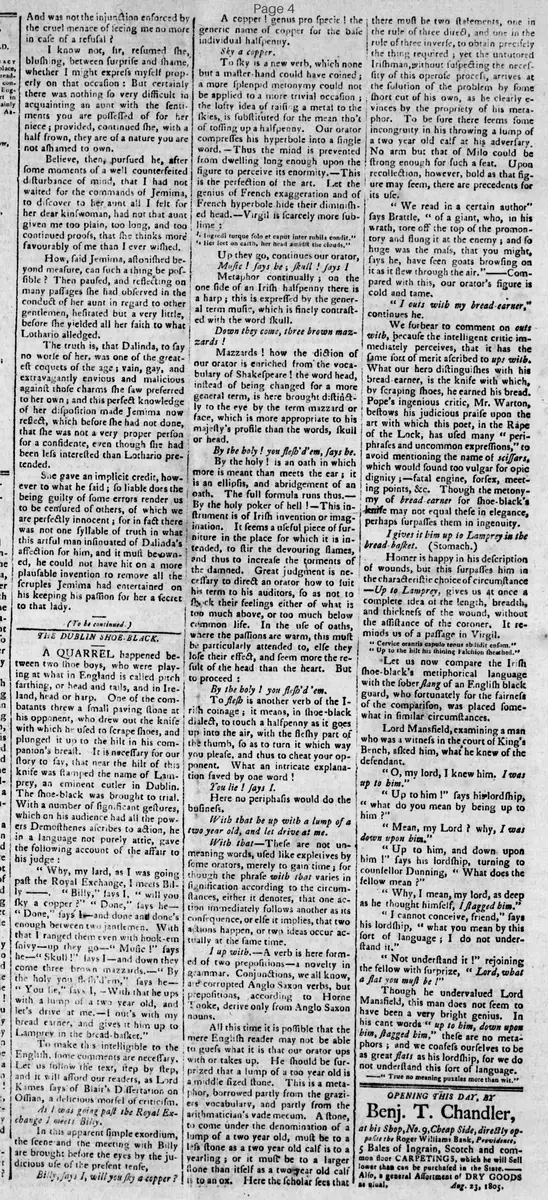
THE DUBLIN SHOE-BLACK.
A QUARREL happened between two shoe boys, who were playing at what in England is called pitch farthing, or head and tails, and in Ireland, head or harp. One of the combatants threw a large paving stone at his opponent, who drew out the knife with which he used to scrape shoes, and plunged it up to the hilt in his companion's breast. It is necessary for our story to say, that near the hilt of this knife was stamped the name of Lamprey, an eminent cutler in Dublin.
The shoe-black was brought to trial. With a number of significant gestures, which on his audience had all the powers Demosthenes ascribes to action, he in a language not purely attic, gave the following account of the affair to his judge:
"Why, my lord, as I was going past the Royal Exchange, I meets Billy—"Billy," says I, "will you sky a copper?" "Done," says he—"Done," says I—and done and done's enough between two gentlemen. With that I ranged them even with hook-em-snivy—up they go—"Music!" says he—"Skull!" says I—and down they come three brown mazzards.—"By the holy vou Ath'd'em," says he—"You lie," says I,—With that he ups with a lump of a two year old, and let's drive at me.—I out's with my bread earner, and gives it him up to Lamprey in the bread-basket."
To make this intelligible to the English, some comments are necessary. Let us follow the text, step by step, and it will afford our readers, as Lord Kames says of Blair's Dissertation on Ossian, a delicious morsel of criticism.
As I was going past the Royal Exchange I meets Billy.
In this apparent simple exordium, the scene and the meeting with Billy are brought before the eyes by the judicious use of the present tense,
Billy, says I, will you sky a copper?
A copper! genus pro specie! the generic name of copper for the base individual halfpenny.
Sky a copper.
To sky is a new verb, which none but a master-hand could have coined; a more pleopod metonymy could not be applied to a more trivial occasion; the lofty idea of raising a metal to the skies, is substituted for the mean thought of tossing up a halfpenny. Our orator compresses his hyperbole into a single word.—Thus the mind is prevented from dwelling long enough upon the figure to perceive its enormity.—This is the perfection of the art. Let the genius of French exaggeration and of French hyperbole hide their diminished head.—Virgil is scarcely more sublime:
"Ingredi turque solo et caput inter nubila condit."
"Her feet on earth, her head amidst the clouds."
Up they go, continues our orator, Music! Says he; Skull! says I
Metaphor continually; on the one side of an Irish halfpenny there is a harp; this is expressed by the general term music, which is finely contrasted with the word skull.
Down they come, three brown mazzards!
Mazzards! how the diction of our orator is enriched from the vocabulary of Shakespeare! the word head, instead of being changed for a more general term, is here brought distinctly to the eye by the term mazzard or face, which is more appropriate to his majesty's profile than the words, skull or head.
By the holy! you flesh'd'em, says he.
By the holy! is an oath in which more is meant than meets the ear; it is an ellipsis, and abridgement of an oath, The full formula runs thus.—By the holy poker of hell!—This instrument is of Irish invention or imagination.. It seems a useful piece of furniture in the place for which it is intended, to stir the devouring flames, and thus to increase the torments of the damned.. Great judgment is necessary to direct an orator how to suit his term to his auditors, so as not to shock their feelings either of what is too much above, or too much below common life. In the use of oaths, where the passions are warm, this must be particularly attended to, else they lose their effect, and seem more the result of the head than the heart. But to proceed:
By the holy! you flesh'd'em.
To flesh is another verb of the Irish coinage; it means, in shoe-black dialect, to touch a halfpenny as it goes up into the air, with the fleshy part of the thumb, so as to turn it which way you please, and thus to cheat your opponent.
What an intricate explanation saved by one word!
You lie! says I.
Here no periphrasis would do the business.
With that he up with a lump of a two year old, and let drive at me.
With that—These are not unmeaning words, used like expletives by some orators, merely to gain time; for though the phrase with that varies in signification according to the circumstances, either it denotes, that one action immediately follows another as its consequence, or else it implies, that two actions happen, or two ideas occur accidentally at the same time.
I up with.—A verb is here formed of two prepositions—a novelty in grammar. Conjunctions, we all know, are corrupted Anglo Saxon verbs, but prepositions, according to Horne Tooke, derive only from Anglo Saxon nouns.
All this time it is possible that the mere English reader may not be able to guess what it is that our orator ups with or takes up. He should be surprised that a lump of a two year old is a middle sized stone. This is a metaphor, borrowed partly from the grazier's vocabulary, and partly from the arithmetician's vade mecum. A stone, to come under the denomination of a lump of a two year old, must be to a Is tone as a two year old calf is to a yearling; or it must be to a larger stone than itself as a two year old calf is to an ox. Here the scholar sees that there must be two statements, one in the rule of three direct, and one in the rule of three inverse, to obtain precisely the thing required; yet the untutored Irishman, without suspecting the necessity of this operose process, arrives at the solution of the problem by some short cut of his own, as he clearly evinces by the propriety of his metaphor. To be sure there seems some incongruity in his throwing a lump of a two year old calf at his adversary. No arm but that of Milo could be strong enough for such a feat. Upon recollection, however, bold as that figure may seem, there are precedents for its use.
"We read in a certain author" says Brattle, "of a giant, who, in his wrath, tore off the top of the promontory and flung it at the enemy; and so huge was the mass, that you might" says he, "have seen goats browsing on it as it flew through the air."—Compared with this, our orator's figure is cold and tame.
"I outs with my bread-earner," continues he.
We forbear to comment on outs with, because the intelligent critic immediately perceives, that it has the same sort of merit ascribed to ups with.
What our hero distinguishes with his bread-earner, is the knife with which, by scraping shoes, he earned his bread.
Pope's ingenious critic, Mr. Warton, bestows his judicious praise upon the art with which this poet, in the Rape of the Lock, has used many "periphrases and uncommon expressions," to avoid mentioning the name of scissors, which would sound too vulgar for epic dignity;—fatal engine, forceps, meeting points, &c. Though the metonymy of bread-earner for Shoe-black's knife may not equal these in elegance, perhaps surpasses them in ingenuity.
I gives it him up to Lamprey in the bread-basket. (Stomach.)
Homer is happy in his description of wounds, but this surpasses him in the characteristic choice of circumstance—Up to Lamprey, gives us at once a complete idea of the length, breadth, and thickness of the wound, without the assistance of the coroner. It reminds us of a passage in Virgil.
"Cervice orantis capulo tenus abdidit ensem."
"Up to the hilt his shining Falchion Sheathed."
—Let us now compare the Irish Shoe-black's metaphorical language with the sober lang of an English black guard, who fortunately for the fairness of the comparison, was placed somewhat in similar circumstances.
Lord Mansfield, examining a man who was a witness in the court of King's Bench, asked him, what he knew of the defendant.
"O, my lord, I knew him. I was up to him."
"Up to him!" says his lordship, "what do you mean by being up to him?"
"Mean, my Lord? why, I was down upon him."
"Up to him, and down upon him!" says his lordship, turning to counsellor Dunning, "What does the fellow mean?"
"Why. I mean, my lord, as deep as he thought himself, I tagged him."
"I cannot conceive, friend," says his lordship. "what you mean by this sort of language; I do not understand it."
"Not understand it!" rejoining the fellow with surprise, "Lord, what a flat you must be!"
Though he undervalued Lord Mansfield, this man does not seem to have been a very bright genius. In his cant words "up to him, down upon him, tagged him," these are no metaphors; and we confess ourselves to be as great flats as his lordship, for we do not understand this sort of language.
"True no meaning puzzles more than wit."
A QUARREL happened between two shoe boys, who were playing at what in England is called pitch farthing, or head and tails, and in Ireland, head or harp. One of the combatants threw a large paving stone at his opponent, who drew out the knife with which he used to scrape shoes, and plunged it up to the hilt in his companion's breast. It is necessary for our story to say, that near the hilt of this knife was stamped the name of Lamprey, an eminent cutler in Dublin.
The shoe-black was brought to trial. With a number of significant gestures, which on his audience had all the powers Demosthenes ascribes to action, he in a language not purely attic, gave the following account of the affair to his judge:
"Why, my lord, as I was going past the Royal Exchange, I meets Billy—"Billy," says I, "will you sky a copper?" "Done," says he—"Done," says I—and done and done's enough between two gentlemen. With that I ranged them even with hook-em-snivy—up they go—"Music!" says he—"Skull!" says I—and down they come three brown mazzards.—"By the holy vou Ath'd'em," says he—"You lie," says I,—With that he ups with a lump of a two year old, and let's drive at me.—I out's with my bread earner, and gives it him up to Lamprey in the bread-basket."
To make this intelligible to the English, some comments are necessary. Let us follow the text, step by step, and it will afford our readers, as Lord Kames says of Blair's Dissertation on Ossian, a delicious morsel of criticism.
As I was going past the Royal Exchange I meets Billy.
In this apparent simple exordium, the scene and the meeting with Billy are brought before the eyes by the judicious use of the present tense,
Billy, says I, will you sky a copper?
A copper! genus pro specie! the generic name of copper for the base individual halfpenny.
Sky a copper.
To sky is a new verb, which none but a master-hand could have coined; a more pleopod metonymy could not be applied to a more trivial occasion; the lofty idea of raising a metal to the skies, is substituted for the mean thought of tossing up a halfpenny. Our orator compresses his hyperbole into a single word.—Thus the mind is prevented from dwelling long enough upon the figure to perceive its enormity.—This is the perfection of the art. Let the genius of French exaggeration and of French hyperbole hide their diminished head.—Virgil is scarcely more sublime:
"Ingredi turque solo et caput inter nubila condit."
"Her feet on earth, her head amidst the clouds."
Up they go, continues our orator, Music! Says he; Skull! says I
Metaphor continually; on the one side of an Irish halfpenny there is a harp; this is expressed by the general term music, which is finely contrasted with the word skull.
Down they come, three brown mazzards!
Mazzards! how the diction of our orator is enriched from the vocabulary of Shakespeare! the word head, instead of being changed for a more general term, is here brought distinctly to the eye by the term mazzard or face, which is more appropriate to his majesty's profile than the words, skull or head.
By the holy! you flesh'd'em, says he.
By the holy! is an oath in which more is meant than meets the ear; it is an ellipsis, and abridgement of an oath, The full formula runs thus.—By the holy poker of hell!—This instrument is of Irish invention or imagination.. It seems a useful piece of furniture in the place for which it is intended, to stir the devouring flames, and thus to increase the torments of the damned.. Great judgment is necessary to direct an orator how to suit his term to his auditors, so as not to shock their feelings either of what is too much above, or too much below common life. In the use of oaths, where the passions are warm, this must be particularly attended to, else they lose their effect, and seem more the result of the head than the heart. But to proceed:
By the holy! you flesh'd'em.
To flesh is another verb of the Irish coinage; it means, in shoe-black dialect, to touch a halfpenny as it goes up into the air, with the fleshy part of the thumb, so as to turn it which way you please, and thus to cheat your opponent.
What an intricate explanation saved by one word!
You lie! says I.
Here no periphrasis would do the business.
With that he up with a lump of a two year old, and let drive at me.
With that—These are not unmeaning words, used like expletives by some orators, merely to gain time; for though the phrase with that varies in signification according to the circumstances, either it denotes, that one action immediately follows another as its consequence, or else it implies, that two actions happen, or two ideas occur accidentally at the same time.
I up with.—A verb is here formed of two prepositions—a novelty in grammar. Conjunctions, we all know, are corrupted Anglo Saxon verbs, but prepositions, according to Horne Tooke, derive only from Anglo Saxon nouns.
All this time it is possible that the mere English reader may not be able to guess what it is that our orator ups with or takes up. He should be surprised that a lump of a two year old is a middle sized stone. This is a metaphor, borrowed partly from the grazier's vocabulary, and partly from the arithmetician's vade mecum. A stone, to come under the denomination of a lump of a two year old, must be to a Is tone as a two year old calf is to a yearling; or it must be to a larger stone than itself as a two year old calf is to an ox. Here the scholar sees that there must be two statements, one in the rule of three direct, and one in the rule of three inverse, to obtain precisely the thing required; yet the untutored Irishman, without suspecting the necessity of this operose process, arrives at the solution of the problem by some short cut of his own, as he clearly evinces by the propriety of his metaphor. To be sure there seems some incongruity in his throwing a lump of a two year old calf at his adversary. No arm but that of Milo could be strong enough for such a feat. Upon recollection, however, bold as that figure may seem, there are precedents for its use.
"We read in a certain author" says Brattle, "of a giant, who, in his wrath, tore off the top of the promontory and flung it at the enemy; and so huge was the mass, that you might" says he, "have seen goats browsing on it as it flew through the air."—Compared with this, our orator's figure is cold and tame.
"I outs with my bread-earner," continues he.
We forbear to comment on outs with, because the intelligent critic immediately perceives, that it has the same sort of merit ascribed to ups with.
What our hero distinguishes with his bread-earner, is the knife with which, by scraping shoes, he earned his bread.
Pope's ingenious critic, Mr. Warton, bestows his judicious praise upon the art with which this poet, in the Rape of the Lock, has used many "periphrases and uncommon expressions," to avoid mentioning the name of scissors, which would sound too vulgar for epic dignity;—fatal engine, forceps, meeting points, &c. Though the metonymy of bread-earner for Shoe-black's knife may not equal these in elegance, perhaps surpasses them in ingenuity.
I gives it him up to Lamprey in the bread-basket. (Stomach.)
Homer is happy in his description of wounds, but this surpasses him in the characteristic choice of circumstance—Up to Lamprey, gives us at once a complete idea of the length, breadth, and thickness of the wound, without the assistance of the coroner. It reminds us of a passage in Virgil.
"Cervice orantis capulo tenus abdidit ensem."
"Up to the hilt his shining Falchion Sheathed."
—Let us now compare the Irish Shoe-black's metaphorical language with the sober lang of an English black guard, who fortunately for the fairness of the comparison, was placed somewhat in similar circumstances.
Lord Mansfield, examining a man who was a witness in the court of King's Bench, asked him, what he knew of the defendant.
"O, my lord, I knew him. I was up to him."
"Up to him!" says his lordship, "what do you mean by being up to him?"
"Mean, my Lord? why, I was down upon him."
"Up to him, and down upon him!" says his lordship, turning to counsellor Dunning, "What does the fellow mean?"
"Why. I mean, my lord, as deep as he thought himself, I tagged him."
"I cannot conceive, friend," says his lordship. "what you mean by this sort of language; I do not understand it."
"Not understand it!" rejoining the fellow with surprise, "Lord, what a flat you must be!"
Though he undervalued Lord Mansfield, this man does not seem to have been a very bright genius. In his cant words "up to him, down upon him, tagged him," these are no metaphors; and we confess ourselves to be as great flats as his lordship, for we do not understand this sort of language.
"True no meaning puzzles more than wit."
What sub-type of article is it?
Prose Fiction
Satire
Essay
What themes does it cover?
Social Manners
Moral Virtue
Political
What keywords are associated?
Dublin Shoe Black
Irish Slang
Trial Testimony
Linguistic Analysis
Metaphorical Language
Coin Toss Quarrel
Stabbing Incident
Literary Details
Title
The Dublin Shoe Black.
Form / Style
Narrative Anecdote With Linguistic Commentary
Key Lines
"Why, My Lord, As I Was Going Past The Royal Exchange, I Meets Billy—"Billy," Says I, "Will You Sky A Copper?" "Done," Says He—"Done," Says I—And Done And Done's Enough Between Two Gentlemen. With That I Ranged Them Even With Hook Em Snivy—Up They Go—"Music!" Says He—"Skull!" Says I—And Down They Come Three Brown Mazzards.—"By The Holy Vou Ath'd'em," Says He—"You Lie," Says I,—With That He Ups With A Lump Of A Two Year Old, And Let's Drive At Me.—I Out's With My Bread Earner, And Gives It Him Up To Lamprey In The Bread Basket."