Thank you for visiting SNEWPapers!
Sign up free
The Jersey City News
Jersey City, Hudson County, New Jersey
What is this article about?
On Nov. 15, 1899, New Jersey Governor Voorhees appointed a commission headed by Maj. Gen. William J. Sewell to reorganize the National Guard, cutting officer numbers, consolidating brigades, and aligning ranks with the regular army to eliminate top-heaviness.
Clipping
OCR Quality
Full Text
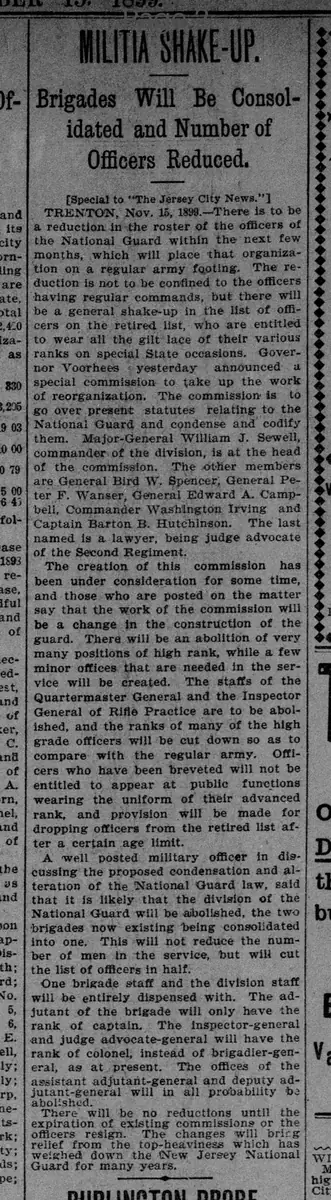
Brigades Will Be Consolidated and Number of Officers Reduced.
[SPECIAL TO "THE JERSEY CITY NEWS."]
TRENTON, Nov. 15, 1899.-There is to be a reduction in the roster of the officers of the National Guard within the next few months, which will place that organization on a regular army footing. The reduction is not to be confined to the officers having regular commands, but there will be a general shake-up in the list of officers on the retired list, who are entitled to wear all the gilt lace of their various ranks on special State occasions. Governor Voorhees yesterday announced a special commission to take up the work of reorganization. The commission is to go over present statutes relating to the National Guard and condense and codify them. Major-General William J. Sewell, commander of the division, is at the head of the commission. The other members are General Bird W. Spencer, General Peter F. Wanser, General Edward A. Campbell, Commander Washington Irving and Captain Barton B. Hutchinson. The last named is a lawyer, being judge advocate of the Second Regiment.
The creation of this commission has been under consideration for some time, and those who are posted on the matter say that the work of the commission will be a change in the construction of the guard. There will be an abolition of very many positions of high rank, while a few minor offices that are needed in the service will be created. The staffs of the Quartermaster General and the Inspector General of Rifle Practice are to be abolished, and the ranks of many of the high grade officers will be cut down so as to compare with the regular army. Officers who have been breveted will not be entitled to appear at public functions wearing the uniform of their advanced rank, and provision will be made for dropping officers from the retired list after a certain age limit.
A well posted military officer in discussing the proposed condensation and alteration of the National Guard law, said that it is likely that the division of the National Guard will be abolished, the two brigades now existing being consolidated into one. This will not reduce the number of men in the service, but will cut the list of officers in half.
One brigade staff and the division staff will be entirely dispensed with. The adjutant of the brigade will only have the rank of captain. The inspector-general and judge advocate-general will have the rank of colonel, instead of brigadier-general, as at present. The offices of the assistant adjutant-general and deputy adjutant-general will in all probability be abolished.
There will be no reductions until the expiration of existing commissions or the officers resign. The changes will bring relief from the top-heaviness which has weighed down the New Jersey National Guard for many years.
What sub-type of article is it?
What keywords are associated?
What entities or persons were involved?
Where did it happen?
Domestic News Details
Primary Location
Trenton, New Jersey
Event Date
Nov. 15, 1899
Key Persons
Outcome
reduction in officer roster, consolidation of two brigades into one, abolition of certain staffs and positions, ranks adjusted to match regular army, brevet officers restricted in uniform use, retired officers to be dropped after age limit; no immediate reductions until commissions expire or resignations occur
Event Details
Governor Voorhees announced a special commission to reorganize the New Jersey National Guard by condensing and codifying statutes, reducing high-ranking positions, abolishing staffs of Quartermaster General and Inspector General of Rifle Practice, consolidating brigades, adjusting ranks (e.g., adjutant to captain, inspector-general and judge advocate-general to colonel), and eliminating assistant and deputy adjutant-general offices to address top-heaviness