Thank you for visiting SNEWPapers!
Sign up free
Las Vegas Age
Las Vegas, Clark County, Lincoln County, Nevada
What is this article about?
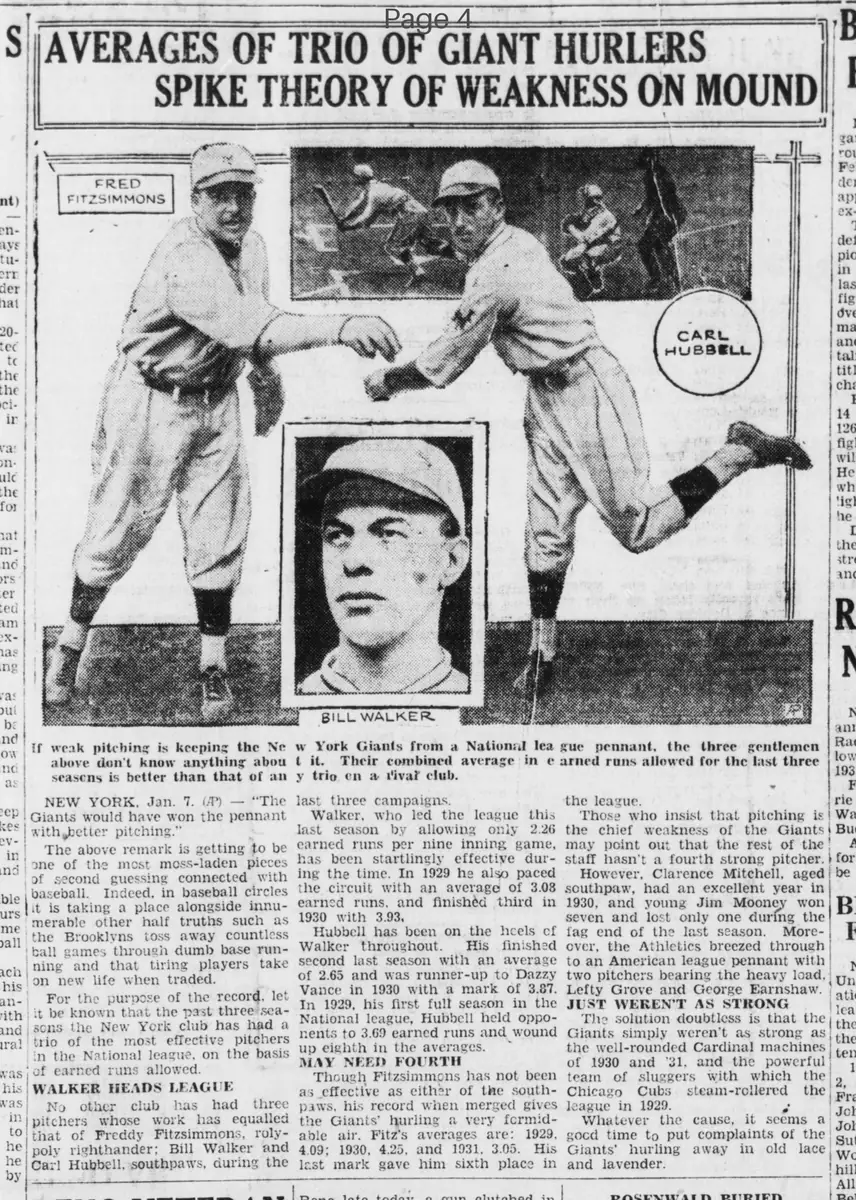
Article refutes claims of weak pitching for the New York Giants by showcasing the superior earned run averages of pitchers Bill Walker, Carl Hubbell, and Freddy Fitzsimmons from 1929-1931, better than any rival trio.
Merged-components note: Caption, image, and text about Giants pitchers form a single sports story component.
Clipping
OCR Quality
Full Text
GIANT
HURLERS
SPIKE THEORY OF WEAKNESS ON MOUND
If weak pitching is keeping the New York Giants from a National league pennant, the three gentlemen above don't know anything about it. Their combined average in earned runs allowed for the last three seasons is better than that of any trio on a rival club.
NEW YORK, Jan. 7. (A) - "The Giants would have won the pennant with better pitching."
The above remark is getting to be one of the most moss-laden pieces of second guessing connected with baseball. Indeed, in baseball circles it is taking a place alongside innumerable other half truths such as the Brooklyns toss away countless ball games through dumb base running and that tiring players take on new life when traded.
For the purpose of the record, let it be known that the past three seasons the New York club has had a trio of the most effective pitchers in the National league, on the basis of earned runs allowed.
WALKER HEADS LEAGUE
No other club has had three pitchers whose work has equalled that of Freddy Fitzsimmons, roly-poly righthander; Bill Walker and Carl Hubbell, southpaws, during the past three years.
Walker, who led the league this last season by allowing only 2.26 earned runs per nine inning game, has been startlingly effective during the time. In 1929 he also paced the circuit with an average of 3.08 earned runs, and finished third in 1930 with 3.93.
Hubbell has been on the heels of Walker throughout. He finished second last season with an average of 2.65 and was runner-up to Dazzy Vance in 1930 with a mark of 3.87.
In 1929, his first full season in the National league, Hubbell held opponents to 3.69 earned runs and wound up eighth in the averages.
MAY NEED FOURTH
Though Fitzsimmons has not been as effective as either of the southpaws, his record when merged gives the Giants' hurling a very formidable air. Fitz's averages are: 1929, 4.09; 1930, 4.25, and 1931, 3.05. His last mark gave him sixth place in the league.
Those who insist that pitching is the chief weakness of the Giants may point out that the rest of the staff hasn't a fourth strong pitcher.
However, Clarence Mitchell, aged southpaw, had an excellent year in 1930, and young Jim Mooney won seven and lost only one during the fag end of the last season. Moreover, the Athletics breezed through to an American league pennant with two pitchers bearing the heavy load, Lefty Grove and George Earnshaw.
JUST WEREN'T AS STRONG
The solution doubtless is that the Giants simply weren't as strong as the well-rounded Cardinal machines of 1930 and 31, and the powerful team of sluggers with which the Chicago Cubs steam-rollered the league in 1929.
Whatever the cause, it seems a good time to put complaints of the Giants' hurling away in old lace and lavender.
the league.
What sub-type of article is it?
What themes does it cover?
What keywords are associated?
What entities or persons were involved?
Where did it happen?
Story Details
Key Persons
Location
New York
Event Date
1929 1931
Story Details
The New York Giants' top pitchers, Freddy Fitzsimmons, Bill Walker, and Carl Hubbell, had the best combined earned run averages in the National League over the past three seasons, countering claims of weak pitching as the reason for not winning the pennant.