Thank you for visiting SNEWPapers!
Sign up free
Virginia Argus
Richmond, Virginia
What is this article about?
Detailed report of U.S. House of Representatives proceedings from December 19-23, covering petitions against Sabbath mail transport, relief bills, debates and passage of a direct tax bill for $6 million, militia draft bill conference, and committee discussions on a national bank bill. Includes Senate actions on resolutions and bills.
Merged-components note: These components form a single continuous report on congressional proceedings across pages 2 and 3.
Clippings
1 of 2
OCR Quality
Full Text
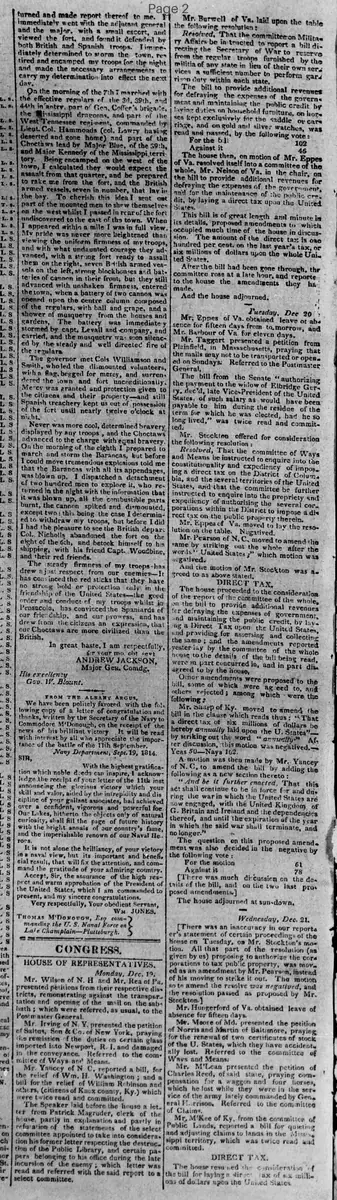
HOUSE OF REPRESENTATIVES.
Monday, Dec. 19;
Mr. Wilson of N. H and Mr. Rea of Pa. presented petitions from their respective districts, remonstrating against the transportation and opening of the mail on the sabbath; which were referred, as usual, to the Postmaster General.
Mr. Irving of N. Y. presented the petition of Saltus, Son & Co. of New York, praying the remission of the duties on certain glass imported into Newport, R. I. and damaged in the conveyance. Referred to the committee of Ways and Means.
Mr. Yancey of N C, reported a bill, for the relief of Wm. H. Washington; and a bill for the relief of William Robinson and others, (citizens of Knox county, Ky.) which were twice read and committed.
The Speaker laid before the house a letter from Patrick Magruder, clerk of the house, partly in explanation and partly in refutation of the statements of the select committee appointed to take into consideration his former letter respecting the destruction of the Public Library, and certain papers belonging to his office during the late incursion of the enemy; which letter was read and referred with the said report to a select committee.
Mr. Burwell of Va. laid upon the table the following resolution:
Resolved, That the committee on Military Affairs be instructed to report a bill directing the Secretary of War to reserve from the regular troops furnished by the militia of any state in lieu of their own services a sufficient number to perform garrison duty within each state,
The bill to provide additional revenues for defraying the expenses of the government and maintaining the public credit by laying duties on household furniture, on horses kept exclusively for the saddle or carriage, and on gold and silver watches, was read and passed, by the following vote:
For the bill 102
Against it 46
The house then, on motion of Mr. Eppes of Va. resolved itself into a committee of the whole, Mr. Nelson of Va. in the chair, on the bill to provide additional revenues for defraying the expenses of the government, and for the maintenance of the public credit, by laying a direct tax upon the United States.
This bill is of great length and minute in its details, proposed amendments to which occupied much time of the house in discussion. The amount of the direct tax is one hundred per cent. on the last year's tax, or six millions of dollars upon the whole United States.
After the bill had been gone through, the committee rose at a late hour, and reported to the house the amendments they had made.
And the house adjourned.
Tuesday. Dec. 20.
Mr. Eppes of Va. obtained leave of absence for fifteen days from to morrow, and Mr. Barbour of Va for eleven days.
Mr. Taggart presented a petition from Plainfield, in Massachusetts, praying that the mails may not to be transported or opened on Sundays: Referred to the Postmaster General,
The bill from the Senate "authorizing the payment to the widow of Elbridge Gerry, dec'd. late Vice-President of the United States, of such salary as would have been payable to him during the residue of the term for which he was elected, had he so long lived," was twice read and committed.
Mr. Stockton offered for consideration the following resolution:
Resolved, That the committee of Ways and Means be instructed to enquire into the constitutionality and expediency of imposing a direct tax on the District of Columbia, and the several territories of the United States, and that the committee be further instructed to enquire into the propriety and expediency of authorising the several corporations within the District to impose a direct tax on the public property therein.
Mr. Eppes of Va. moved to lay the resolution on the table. Negatived.
Mr. Pearson of N. C. moved to amend the same by striking out the whole after the words "United States;" which motion was negatived.
And the motion of Mr. Stockton was agreed to as above stated.
DIRECT TAX.
The house proceeded to the consideration of the report of the committee of the whole, on the bill to provide additional revenues for defraying the expenses of government, and maintaining the public credit, by laying a Direct Tax upon the United States, and providing for assessing and collecting the same; and the amendments reported yesterday by the committee of the whole house to the details of the bill being read, were in part concurred in, and in part disagreed to by the house,
Other amendments were proposed to the bill, some of which were agreed to, and others rejected; among which were the following:
Mr. Sharp of Ky. moved to amend the bill in the clause which reads thus: That a direct tax of six millions of dollars be hereby annually laid upon the U. States" by striking out the word "annually." After discussion, this motion was negatived.
Yeas 50—Nays 102.
A motion was then made by Mr. Yancey of N. C, to amend the bill by adding the following as a new section thereto:
"And be it further enacted, That this act shall continue to be in force for and during the war in which the United States are now engaged, with the United Kingdom of G. Britain and Ireland and the dependencies thereof, and until the expiration of the year in which the said war shall terminate, and no longer."
The question on this proposed amendment was also decided in the negative by the following vote:
For the motion 61
Against it 78
[There was much discussion on the details of the bill, and on the two last proposed amendments]
The house adjourned at sun-down.
Wednesday, Dec. 21.
[There was an inaccuracy in our reporter's statement of certain proceedings of the House on Tuesday. on Mr. Stockton's motion. All that part of the resolution (as given by us) proposing to authorize the corporations to tax public property, was moved as an amendment by Mr. Pearson, instead of his moving to strike it out. The motion so to amend the resolve was negatived, and the resolution passed as proposed by Mr. Stockton.]
Mr. Hungerford of Va. obtained leave of absence for fifteen days.
Mr. Moore of Md. presented the petition of Norris and Martin of Baltimore, praying for the renewal of two certificates of stock of the U. States, which they have accidentally lost. Referred to the committee of Ways and Means:
Mr. M'Lean presented the petition of Charles Reed, of said state, praying compensation for a waggon and four horses, which he lost while they were in the service of the army lately commanded by Gen. Harrison. Referred to the committee of Claims.
Mr. M'Kee of Ky. from the committee of Public Lands, reported a bill for quieting and adjusting claims to lands in the Mississippi territory, which was twice read and committed.
DIRECT TAX.
The house resumed the Consideration of the bill for laying a direct tax of six millions of dollars upon the United States
Mr. Yancey of N. C. moved to amend the bill by striking out therefrom the 41st section of the bill, which pledges the continuation in force of this bill, for the purpose of establishing an adequate revenue to pay the expenses of the government, the principal and interest of the public debt, &c. and to create an adequate sinking fund, &c. (in the same manner as all the internal duties enacted during the present session are proposed to be pledged.)
On this motion a very interesting but desultory debate arose, in which Messrs. Yancey, Calhoun, Rhees, Lowndes and Telfair advocated the motion, and Messrs. Eppes, Ingersoll, Potter, Duval, Findley, Grosvenor, Hawkins, Webster, Pickering, Newton and Nelson opposed it.
The advocates of the motion urged, that they had no wish to defeat the passage of this bill, but that the spirit of the constitution required that a direct tax should be laid only for one year, and continued no longer than imperious necessity required; that the Constitution having given to Congress the power to control the taxes—to part with it for a series of years, would be to surrender their constitutional power. inasmuch as they could not, after giving the proposed pledge, withhold the taxes without the consent of the two other branches of the government; that, whilst the pledge to be given might saddle the nation forever with a land tax, it was not necessary to the maintenance of the public credit, because a sufficient sum was pledged, by the acts already passed, for the annual payment of the interest and a portion of the principal of the public debt; that this discovery of supporting public credit by pledging an annual land tax, was of recent date, for, during the administrations of Washington and Adams, when the government would naturally be most solicitous for the establishment and invigoration of public credit, a direct tax had been imposed but one year, and was not then pledged, as now proposed; that it was flying too suddenly from one extreme to the other, after refusing to pledge any thing, to pledge all the resources of the government of every description to the public creditor. Various arguments were also urged against a pledge for the continuance of this tax, derived from its general character: it was a tax, it was said, unequal in its character on different sections of the union, and unequal in its operation frequently when not unequal in its amount, owing to the local advantages and disadvantages of different sections of the nation, and the disbursements of the government therein. It was, besides, argued that direct taxation was the principal resource of the state governments for revenue—because, from their nature and relative situation, they cannot resort to internal taxation—and therefore a direct tax ought not to be overcharged, nor too long persevered in.
The arguments in opposition to the motion were various, as they proceeded from one or the other side of the house. They were in general to this effect: The argument against parting with the power of taxation, it was said, would apply as well to the pledges contained in the internal tax bills (against which it had not been suggested) as to this; and was besides inconclusive if correct, inasmuch as the house, by withholding appropriations, over which it had an efficient check, could at any time coerce the other branches of the government to repeal or modify existing taxes. 'That, though in ordinary times, the pledges already given of the internal taxes might be sufficient to maintain public credit, it was necessary now to resuscitate that credit—in the words of one gentleman, "to dig it from the grave;" that this was a duty peculiarly devolving on those who had declared and supported the war, and on whom devolved the responsibility for its success or failure. That it would be highly unjust and partial, after pledging the taxes on the materials and labor of the artisan, mechanic, and poor retailer—after, in fact, pledging the taxes on the industry of the community—to refuse to pledge the tax on its solid wealth and landed property, &c. That this pledge of the land-tax, as a foundation for borrowing money, would be worth much more than all the internal taxes put together, because its product would be certain, whilst the products of the other taxes must be matter of estimate and conjecture. The argument that a sufficient amount of taxes was already pledged to sustain the public credit, was denied any weight, because it made the eligibility of the taxes to be pledged depend on the priority of passage of several bills, which were intended and calculated to form parts of a general system of taxation, &c. Various other points were brought into discussion, as to the intention of the framers of the constitution in regard to the frequency and permanency of a land tax &c. and on the merits of the present and former systems of finance, which could not be here detailed with any justice to those who introduced them.
The question being at length taken on this motion, was decided in the negative by yeas 48—nays 105.
Mr. Potter moved so to amend the bill as to allow to the individual who shall pay his proportion of the Direct Tax on the 1st day of June annually, a deduction of 12 per cent. from its amount; and if not so paid, to him who shall pay it on the 1st day of October annually a deduction of 6 per cent. on its amount; and that if not then paid the said amount shall bear interest until paid; which motion was negatived.
Mr. Kennedy of N. C. moved to amend the bill so as to reduce the total of the Direct Tax from six millions to four millions five hundred thousand dollars; which motion was negatived.
Mr. Ingersoll made a motion to amend the bill, similar to the motion previously made by Mr. Potter, differing from it only in not requiring interest on their proportion of the Direct Tax from those who should not pay the same on the first day of October next; which motion was negatived.
Other unsuccessful motions were made to amend the bill.
At 5 o'clock the bill was ordered to be engrossed for a third reading.
And the house adjourned.
Thursday, Dec. 22.
Mr. Clendinen of Ohio appeared & took his seat.
Mr. Bradbury of Ms. presented a remonstrance from a town in his district against the transporting and opening of the mail on the Sabbath.
On motion of Mr. Easton of Missouri, so much of the report of the committee of Revisal and Unfinished Business as relates to the bill permitting certain locations, and granting certain donations of land, in the county of New Madrid, in the Missouri Territory, was referred to a committee, to report thereon.
On motion of Mr. Reed of Mass. the report recently received from the Navy Department, in answer to the resolution of the House of last session was referred to the committee of Investigation on that subject, which was appointed in March last.
DIRECT TAX.
The bill to provide additional revenues for defraying the expenses of the government and maintaining the public credit, by laying a direct tax upon the United States, was read a third time.
Mr. Brigham of Mass. opposed the passage of the bill in a speech of moderate length on general principles of opposition to the administration.
The question was then taken on the passage of the bill, and decided as follows:
Yeas 106
Nays 53
So the bill was passed and sent to the Senate for concurrence.
MILITIA DRAFT BILL.
The House took up the message of the Senate announcing their agreement to some, and disagreement to others of the amendments made by this House to their bill for authorizing the President of the U States to call into service 80,000 militia. Amongst the amendments disagreed to by the Senate, was that reducing the term of service from two years to one year, and that authorizing the Executive to make requisitions on the militia officers directly, in case of failure of the Governors to comply with the demand made on them for this object.
Mr. Lewis of Va. moved the indefinite postponement of the bill, and the amendments thereto.
Mr. Ingham of Penn. moved to lay the subject on the table, (for the purpose of taking up a more urgent message from the Senate)—which motion was opposed by Mr. Lewis, Mr. Johnson of Ky. and Mr. Calhoun, and supported by Mr. Ingham and Mr. Fisk and was negatived.
The question recurring on indefinite postponement, on which the Yeas and Nays were demanded—a short debate arose.
The question of indefinite postponement was decided in the negative by the following vote, by yeas and nays:
For the motion 36
Against it 93
The Speaker then proceeded to state the amendments of this house, in which the Senate has refused to concur.
The first of these amendments was, that which proposes to strike out two years and insert one, as the term for which the drafts shall be held to service.
Mr. Hawkins of Ky. moved that the house recede from this amendment (so, as to fix two years as the term of service.)
The question on this motion was taken by yeas and nays, and decided in the negative by the following vote:
For the motion 60
Against it 93
So the term of service remains, at present, one year.
The house having refused to recede from this amendment, Mr. Johnson of Ky. moved that the house insist on it; which motion was agreed to.
The House then proceeded separately to insist on all its amendments to which the Senate had disagreed; and a committee of conference was appointed to join the committee of the Senate on that subject.
The amendments of the Senate to the bill which passed this House supplementary to the 25 million and 3 million loan acts, were taken up and agreed to.
And the House adjourned.
Friday, December 23.
Mr. Troup of Geo. reported a bill to authorize the President of the United States to raise certain companies of Rangers for the defence of the frontiers of the United States, and to repeal certain acts heretofore passed on this subject; which was twice read and committed.
Mr. Ward of N.J. obtained leave of absence for three weeks.
NATIONAL BANK.
On motion of Mr. Fisk of N. Y. the House resolved itself into a committee of the whole, Mr. Macon in the chair, on the bill from the Senate to incorporate the subscribers to the Bank of the United States of America.
The first section of the bill contains the leading principles of the bill, substantially as follows: The Capital to consist of Fifty Millions of Dollars, to be divided into two hundred thousand shares of five hundred dollars each; subscriptions for forty millions whereof to be opened on the third Monday in January next, at Boston, New York, Philadelphia, Richmond, Charleston and Pittsburgh. (The amendments proposed to this section by the committee of Ways & Means contemplate an extension of the number of places of subscription, &c.) Before the question was stated on these amendments Mr. Clopton of Va. moved to strike out the first section of the bill. This, he believed, was a proper time to try the principle of the bill; and, as he could not conscientiously vote for this bill or any bill to establish a National Bank, he felt it to be his duty to make the motion he had now offered to the House. His objection to the passage of any bill on this subject was founded on a thorough belief, the result of a deliberate examination of the constitution and reflection thereon, that there did not exist in Congress any right to legislate on the subject at all; that no sort of authority to pass this bill was vested in Congress either expressly or as incidental to any power expressly granted. To support and exemplify this opinion, Mr. Clopton entered into a constitutional argument of considerable length, and no little ability. He spoke for about an hour, and concluded with an earnest exhortation to the House not to give its sanction to an Institution which he believed not only unconstitutional but fraught with dangerous consequences.
The question being about to be put on Mr. Clopton's motion without debate— Mr. Gaston of N. C. took the floor— Among the most alarming indications of the times, he remarked, was the apathy which pervaded the house on this occasion: an apathy resembling the numbness which generally precedes mortal dissolution. under the influence of which a question of such importance as this was about to be taken without debate and almost without deliberation. If the bill would produce that effect which its friends predicted, it would prove a beneficial and valuable institution; if fraught with the mischiefs which he saw in its passage would bring with it certain destruction to the nation. He took it for granted, from the course of proceedings which had taken place in the house when this subject was before under consideration, that all hope of obtaining a bank at all resembling what banks have heretofore been, must now cease; and that the institution embraced by this bill, if it passed, would be a mere paper bank, and nothing else, from which no benefit could result to the government or the community. He examined the character of this bill, and particularly objected to the extent of the capital; the limited proportion of specie to be employed in it; and the power to suspend specie payments. Upon a full view of all its features, he denied that it would restore public credit, or establish an adequate circulating medium, the purposes which its friends hoped it would accomplish.—it would, on the contrary, from the moment of its establishment, give birth to a monstrous scene of stock jobbing and speculation, always detrimental to the public credit. By a system of rigid economy, and carrying into effect the taxes agreed to by the house he said he had some hope that the government would weather the storm with which it was assailed without national bankruptcy; but, if Congress passed a bill of this kind, he conscientiously believed it would not be possible to avoid the evil; and that, if they passed this, they might as well at the same time pass a bill of national bankruptcy.
Mr. M'Kim of Md. said, without saying how he should vote on the final question, he should vote against the motion to strike out the first section of the bill in the present stage of it, from motives of respect to the co-ordinate branch of the Legislature from which the bill came, and to those who advocated the bill in this House.
The motion to strike out the first section of the bill was then decided in the negative by the following vote:
For striking it out 50
Against it 71
Mr. Fisk then briefly explained the character of this bill, and in what respect the amendments proposed by the committee would change the features of it. The bill, as it came from the Senate, and as it now stands, proposes that the forty millions to be subscribed by individuals shall be at the rate of twenty-seven millions of dollars in war stock, five millions in specie, and eight millions in Treasury Notes: and that subscriptions shall be opened in Boston, Baltimore, New-York, Philadelphia, Richmond, Charleston, and Pittsburgh. The committee had recommended to reduce the proportion subscribable by individuals to thirty five millions, of which twenty to be in public stock, five in specie and ten in Treasury notes. The details of the bill, being nearly the same as those of the bill originally reported in this house, were not proposed to be changed, except that the committee had recommended that books of subscription should be opened at one place in every state, in conformity with what appeared to be the sentiment of the house when the bill was before under consideration:
The amendments proposed by the committee of Ways and Means to the bill were separately considered, and agreed to by a considerable majority.
The committee proceeded in further consideration of the bill—rose after 4 o'clock, reported progress, and obtained leave to sit again.
And the House adjourned.
IN SENATE.
Tuesday, Dec 20.
Mr. Gore submitted for consideration the following resolution:
Resolved, That the Secretary of the Senate be authorized to pay, out of the contingent fund, the expenses incurred for the Funeral of the late Vice President of the United States, whenever the same shall have been allowed and certified by the committee of arrangement.
The resolution was read, and passed to a second reading.
The bill from the house, laying duties on certain manufactures, was read the second time and referred to a select committee: as was also the bill from the house for laying duties on household furniture, &c.
Friday, December 23.
The following resolution, offered by Mr. Hunter on Wednesday last, was taken up for consideration:
Resolved, That the President of the United States be requested to cause to be laid before the senate, the force and condition of the vessels of war of the United States on lake Ontario, and such information as he may possess of the force and condition of the vessels of war of the enemy on the same lake; and such information as he may deem it proper to communicate of the means and preparation requisite for the purpose of acquiring and maintaining the naval ascendency on said lake, if an intention to that effect be contemplated on the part of the United States.
Mr. Roberts moved to postpone the further consideration of the same to the second Monday in March next—(to reject it)— which motion was decided in the affirmative by the following vote:
YEAS—Messrs. Bibb, Bledsoe, Chase, Condit, Gaillard, German, Lacock, Morrow, Roberts, Robinson, Taylor, Turner, Varnum, Walker, Wharton—15.
NAYS—Messrs. Brown, Daggett, Dana, Fromentin, Gore, Hunter, King, Lambert, Mason, Smith, Tait, Thompson—12.
The Senate determined to insist on its disagreement to the amendments of the House to the Militia Draft Bill, and appointed Messrs. Bibb, Brown and German a committee of conference thereon.
PRINTING
Of every description neatly executed at this Office.
What sub-type of article is it?
What keywords are associated?
What entities or persons were involved?
Domestic News Details
Event Date
Dec. 19 To Dec. 23
Key Persons
Outcome
direct tax bill of $6 million passed house 106-53; militia draft bill amendments insisted upon, conference appointed; national bank bill amendments agreed, progress reported; various petitions referred; household duties bill passed 102-46; senate postponed naval resolution 15-12, insisted on militia disagreements.
Event Details
Proceedings in the U.S. House of Representatives from December 19-23 included presentation of petitions against Sabbath mail operations, relief bills for individuals, discussions on clerk's letter regarding public library destruction, resolutions on military affairs, passage of duties on household items, extensive debates and amendments on a direct tax bill of six million dollars, consideration of militia draft bill with Senate disagreements leading to conference, and committee of the whole on national bank incorporation bill with constitutional debates and amendments. Senate actions included resolutions for vice president's funeral expenses, referrals of House bills, postponement of naval information request, and insistence on militia bill positions.