Thank you for visiting SNEWPapers!
Sign up free
The Arkansas Advocate
Little Rock, Pulaski County, Arkansas
What is this article about?
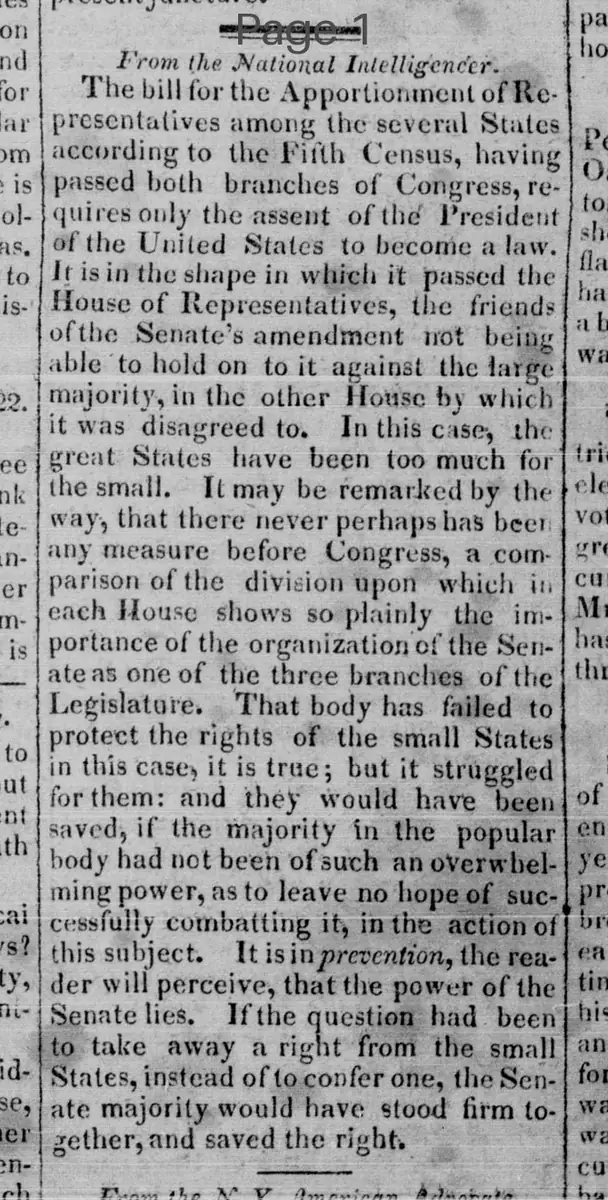
The bill for apportioning U.S. House representatives based on the Fifth Census has passed both chambers of Congress and awaits the President's signature. It retained the House version after rejecting the Senate's amendment, favoring larger states over smaller ones, highlighting the Senate's role in legislative balance.
Clipping
OCR Quality
Full Text
The bill for the Apportionment of Representatives among the several States according to the Fifth Census, having passed both branches of Congress, requires only the assent of the President of the United States to become a law. It is in the shape in which it passed the House of Representatives, the friends of the Senate's amendment not being able to hold on to it against the large majority, in the other House by which it was disagreed to. In this case, the great States have been too much for the small. It may be remarked by the way, that there never perhaps has been any measure before Congress, a comparison of the division upon which in each House shows so plainly the importance of the organization of the Senate as one of the three branches of the Legislature. That body has failed to protect the rights of the small States in this case, it is true; but it struggled for them: and they would have been saved, if the majority in the popular body had not been of such an overwhelming power, as to leave no hope of successfully combatting it, in the action of this subject. It is in prevention, the reader will perceive, that the power of the Senate lies. If the question had been to take away a right from the small States, instead of to confer one, the Senate majority would have stood firm together, and saved the right.
What sub-type of article is it?
What keywords are associated?
Domestic News Details
Outcome
bill passed both houses in house version; awaits president's assent; larger states prevailed over smaller states' interests.
Event Details
The Apportionment of Representatives bill according to the Fifth Census passed both branches of Congress. The Senate's amendment was rejected by the House majority, resulting in the original House version prevailing. Commentary notes the Senate's struggle to protect small states' rights but its inability against the House's overwhelming majority, emphasizing the Senate's preventive power in legislation.