Thank you for visiting SNEWPapers!
Sign up free
Literary
February 23, 1922
Okolona Messenger
Okolona, Chickasaw County, Mississippi
What is this article about?
In chapters XVII (continued) and XVIII of 'Spanish Doubloons,' narrator Virginia recounts a struggle with drunken Captain Magnus, aided by her dog Crusoe and Dugald Shaw. They defeat guards, trap remaining pirates in a cave using dynamite, and learn from a diary that the treasure is on the sunken ship Island Queen, not the cave.
Clipping
OCR Quality
96%
Excellent
Full Text
SPANISH DOUBLOONS
(CHAPTER XVII—Continued.)
20
"Down, Crusoe!" I kept desperately whispering. But Crusoe was unused to whispered orders. He kept bounding up on me, intent to fulfill an unachieved ambition of licking my ear. Cuthbert Vane tried, under his breath, to lure him away. But Crusoe's emotions were all for me, and swiftly becoming uncontrollable they burst forth in a volley of shrill yelps.
A loud cry answered them. It came from Captain Magnus, who had scrambled to his feet and was staggering across the clearing. One hand was groping at his belt—it was flourished in the air with the gleam of a knife in it—and staggering and shouting the captain came on.
"Ah, you would, would you? I'll teach you—but first I'll settle him, the porridge-eatin' Scotch swine—"
The reeling figure with the knife was right above me. I sprang up, in my hand the little two-inch weapon which was all I had for my defense—and Dugald Shaw's. There were loud noises in my ears, the shouting of men, and a shrill continuous note which I have since realized came from the lungs of Miss Higglesby-Browne. Magnus made a lunge forward—the arm with the knife descended. I caught it—wrenched at it frantically—striving blindly to wield my little penknife whether or not with deadly intent I don't know to this day. He turned on me savagely, and the penknife was whirled from my hand as he caught my wrist in a terrible clutch.
All I remember after that is the terrible steely grip of the captain's arms and a face, flushed, wild-eyed, horrible, that was close to mine and inevitably coming closer, though I fought and tore at it—of hot feverish lips whose touch I knew would scorch me to the soul—and then I was suddenly free, and falling, falling, a long way through darkness.
CHAPTER XVIII.
The Young Person Scores.
My first memory is of voices, and after that I was shot swiftly out of a tunnel from an immense distance and opened my eyes upon the same faces which I had left at some indefinite period in the past. There was Aunt Jane's, very tearful, and Miss Higglesby-Browne's, very glum, and the Honorable Cuthbert's, very anxious and a little dazed, and Cookie's, very, very black. The face of Dugald Shaw I did not see, for the quite intelligible reason that I was lying with my head upon his shoulder.
As soon as I realized this I sat up suddenly, while every one exclaimed at once, "There, she's quite all right—see how her color is coming back!"
The penknife that I had lost in my struggle with Captain Magnus had fallen at the Scotchman's feet. Wrenching himself free of his all but severed bonds he had seized the knife, slashed through the rope that held him to the tree, and flung himself on Captain Magnus. It was a brief struggle—a fist neatly planted on the ruffian's jaw had ended it, and the captain, half dazed from his potations, went down limply.
Throughout the fray Chris slumbered undisturbed, and he and the unconscious Magnus were now reposing side by side, until they should awake to find themselves neatly trussed up with Cookie's clothes-lines.
But my poor brave Crusoe dragged a broken leg, from a kick bestowed on him by Captain Magnus, at whom he had flown valiantly in my defense.
So far so good; we had signally defeated our two guards, and the camp was ours. But what about the pirates who were still in the cave and would shortly be returning from it? They were three armed and sturdy ruffians. It would mean a battle to the death. Our best hope would be to wait in ambush behind the trees of the clearing—I mean for Dugald Shaw and Cuthbert Vane to do it—and shoot down the unsuspecting pirates as they returned. This desperate plan, which so unpleasantly resembled murder, cast gloom on every brow.
"It's the women, lad," said the Scotchman in a low voice to Cuthbert.
"It's—it's Virginia."
And Cuthbert heavily assented.
Seeing myself as the motif of such slaughter shocked my mind suddenly back to clearness.
"Oh," I cried, "not that. Why not surprise them in the cave, and make them stay there? One man could guard the entrance easily—and afterward we could build it up with logs or something."
Everybody stared.
"A remarkably neat scheme," said Mr. Shaw, "but impossible of application, I'm afraid, because none of us know where to find the cave."
I shook my head.
"I know!"
There was a lengthy silence. People looked at one another, and their eyes said, "This has been too much for her!"
"I know," I impatiently repeated. "I can take you straight there. I found the tombstone before Mr. Tubbs did, and the cave, too. Come, let's not waste time. We must hurry—they'll be getting back!"
Amazement, still more than half incredulous, surged round me. Then Mr. Shaw said rapidly:
"You're right. Of course, if you have found the cave, the best thing we can do is to keep them shut up in it. But we must move fast—perhaps we're too late already. If they have found the chest they may by now be starting for camp with the first load of doubloons."
Again I shook my head.
"They haven't found the gold," I assured him.
The astonished faces grew more anxious. "It sho' have told on li'le Miss Jinny's brain," muttered Cookie to himself.
"They haven't found the gold," I reiterated with emphasis, "because the gold is not in the cave. Don't ask me how I know, because there isn't time to tell you. There was no gold there but the two bags that the pirates brought back last night. The—the skeleton moved it all out."
"My Lawd!" groaned Cookie, staggering backward.
"Virginia! I had no idea you were superstitious!" quavered Aunt Jane.
"I say, do take some sleeping tablets or something and quiet your nerves!" implored Cuthbert with the tenderest solicitude.
In my exasperation I stamped my foot.
"And while we are arguing here the pirates may be starting back to camp! And then we'll have to kill them and go home and give ourselves up to be hanged! Please, please, come with me and let me show you that I know!" I lifted my eyes to the intent face of Dugald Shaw.
"All right," he said tersely. "I think you do know. How and what, we'll find out later." Rapidly he made his plan, got together the things needful for its execution, looked to the bonds of the still dazed and drowsy prisoners, posted Cookie in their neighborhood with a pair of pistols, and commanded Aunt Jane to dry her tears and look after Miss Higglesby-Browne, who had dismayed every one by most inopportunely toppling over in a perfectly genuine swoon.
Then the Scotchman, Cuthbert Vane and I set off through the woods. The men were heavily armed, and I had recovered my own little revolver and restored it to my belt. Mr. Shaw had seen to this, and had said to me, very quietly:
"You know, Virginia, if things don't go our way, it may be necessary for you to use it—on yourself."
And I nodded assentingly.
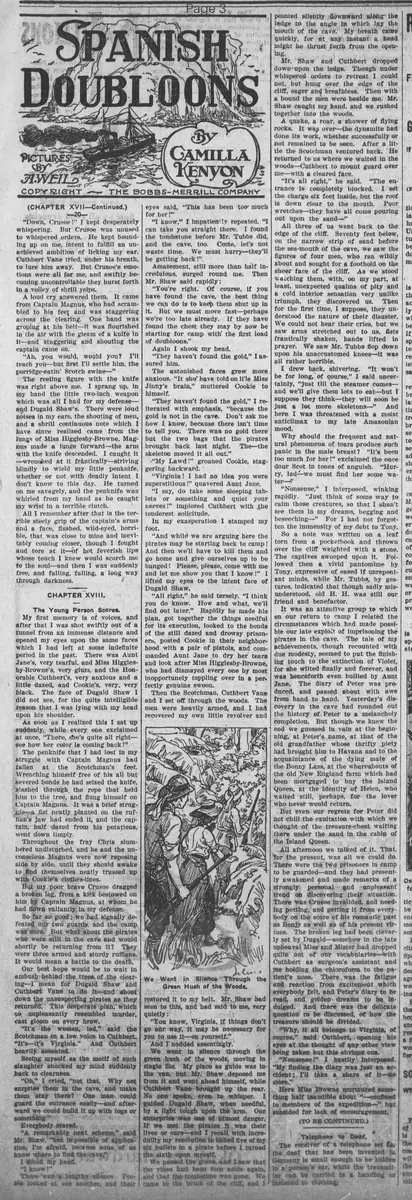
We went in silence through the green hush of the woods, moving in single file. My place as guide was in the van, but Mr. Shaw deposed me from it and went ahead himself, while Cuthbert Vane brought up the rear. No one spoke, even to whisper. I guided Dugald Shaw, when needful, by a light touch upon the arm. Our enterprise was one of utmost danger. If we met the pirates it was their lives or ours—and I recall with incredulity my resolution to imbed five of my six bullets in a pirate before I turned the sixth upon myself.
We passed the grave, and I saw that the vines had been torn aside again, and that the tombstone was gone. We came to the brink of the cliff, and I pointed silently downward along the ledge to the angle in which lay the mouth of the cave. My breath came quickly, for at any instant a head might be thrust forth from the opening.
Mr. Shaw and Cuthbert dropped down upon the ledge. Though under whispered orders to retreat I could not, but hung over the edge of the cliff, eager and breathless. Then with a bound the men were beside me. Mr. Shaw caught my hand, and we rushed together into the woods.
A quake, a roar, a shower of flying rocks. It was over—the dynamite had done its work, whether successfully or not remained to be seen. After a little the Scotchman ventured back. He returned to us where we waited in the woods—Cuthbert to mount guard over me—with a cleared face.
"It's all right," he said. "The entrance is completely blocked. I set the charge six feet inside, but the roof is down clear to the mouth. Poor wretches—they have all come pouring out upon the sand."
All three of us went back to the edge of the cliff. Seventy feet below on the narrow strip of sand before the sea-mouth of the cave, we saw the figures of four men, who ran wildly about and sought for a foothold on the sheer face of the cliff. As we stood watching them, with, on my part, at least, unexpected qualms of pity and a cold interior sensation very unlike triumph, they discovered us. Then for the first time, I suppose, they understood the nature of their disaster. We could not hear their cries, but we saw arms stretched out to us, fists frantically shaken, hands lifted in prayer. We saw Mr. Tubbs flop down upon his unaccustomed knees—it was all rather horrible.
I drew back, shivering. "It won't be for long, of course," I said uncertainly, "just till the steamer comes and we'll give them lots to eat—but I suppose they think—they will soon be just a lot more skeletons—" And here I was threatened with a moist anticlimax to my late Amazonian mood.
Why should the frequent and natural phenomena of tears produce such panic in the male breast? "It's been too much for her!" exclaimed the once dour Scot in tones of anguish. "Hurry, lad—we must find her some water."
"Nonsense," I interposed, winking rapidly. "Just think of some way to calm those creatures, so that I shan't see them in my dreams, begging and beseeching—" For I had not forgotten the immensity of my debt to Tony.
So a note was written on a leaf torn from a pocketbook and thrown over the cliff weighted with a stone. The captives swooped upon it. Followed then a vivid pantomime by Tony, expressive of eased if unrepentant minds, while Mr. Tubbs, by gestures, indicated that though sadly misunderstood, old H. H. was still our friend and benefactor.
It was an attentive group to which on our return to camp I related the circumstances which had made possible our late exploit of imprisoning the pirates in the cave. The tale of my achievements, though recounted with due modesty, seemed to put the finishing touch to the extinction of Violet, for she wilted finally and forever, and was henceforth even bullied by Aunt Jane. The diary of Peter was produced and passed about with awe from hand to hand. Yesterday's discovery in the cave had rounded out the history of Peter to a melancholy completion. But though we knew the end we guessed in vain at the beginning, at Peter's name, at that of the old grandfather whose thrifty piety had brought him to Havana and to the acquaintance of the dying mate of the Bonny Lass, at the whereabouts of the old New England farm which had been mortgaged to buy the Island Queen, at the identity of Helen, who waited still, perhaps, for the lover who never would return.
But even our regrets for Peter did not chill the exultation with which we thought of the treasure-chest waiting there under the sand in the cabin of the Island Queen.
All afternoon we talked of it. That, for the present, was all we could do. There were the two prisoners in camp to be guarded—and they had presently awakened and made remarks of a strongly personal and unpleasant trend on discovering their situation. There was Crusoe invalided, and needing petting, and getting it from everybody on the score of his romantic past as Benjy as well as of his present virtues. The broken leg had been cleverly set by Dugald—somehow in the late upheaval Miss and Mister had dropped quite out of our vocabularies—with Cuthbert as surgeon's assistant and me holding the chloroform to the patient's nose. There was the fatigue and reaction from excitement which everybody felt, and Peter's diary to be read, and golden dreams to be indulged. And there was the delicate question to be discussed, of how the treasure should be divided.
"Why, it all belongs to Virginia, of course," said Cuthbert, opening his eyes at the thought of any other view being taken but this obvious one.
"Nonsense!" I hastily interposed. My finding the diary was just an accident; I'll take a share of it—no more."
Here Miss Browne murmured something half inaudible about "—confined to members of the expedition—" but subsided for lack of encouragement.
(TO BE CONTINUED.)
(CHAPTER XVII—Continued.)
20
"Down, Crusoe!" I kept desperately whispering. But Crusoe was unused to whispered orders. He kept bounding up on me, intent to fulfill an unachieved ambition of licking my ear. Cuthbert Vane tried, under his breath, to lure him away. But Crusoe's emotions were all for me, and swiftly becoming uncontrollable they burst forth in a volley of shrill yelps.
A loud cry answered them. It came from Captain Magnus, who had scrambled to his feet and was staggering across the clearing. One hand was groping at his belt—it was flourished in the air with the gleam of a knife in it—and staggering and shouting the captain came on.
"Ah, you would, would you? I'll teach you—but first I'll settle him, the porridge-eatin' Scotch swine—"
The reeling figure with the knife was right above me. I sprang up, in my hand the little two-inch weapon which was all I had for my defense—and Dugald Shaw's. There were loud noises in my ears, the shouting of men, and a shrill continuous note which I have since realized came from the lungs of Miss Higglesby-Browne. Magnus made a lunge forward—the arm with the knife descended. I caught it—wrenched at it frantically—striving blindly to wield my little penknife whether or not with deadly intent I don't know to this day. He turned on me savagely, and the penknife was whirled from my hand as he caught my wrist in a terrible clutch.
All I remember after that is the terrible steely grip of the captain's arms and a face, flushed, wild-eyed, horrible, that was close to mine and inevitably coming closer, though I fought and tore at it—of hot feverish lips whose touch I knew would scorch me to the soul—and then I was suddenly free, and falling, falling, a long way through darkness.
CHAPTER XVIII.
The Young Person Scores.
My first memory is of voices, and after that I was shot swiftly out of a tunnel from an immense distance and opened my eyes upon the same faces which I had left at some indefinite period in the past. There was Aunt Jane's, very tearful, and Miss Higglesby-Browne's, very glum, and the Honorable Cuthbert's, very anxious and a little dazed, and Cookie's, very, very black. The face of Dugald Shaw I did not see, for the quite intelligible reason that I was lying with my head upon his shoulder.
As soon as I realized this I sat up suddenly, while every one exclaimed at once, "There, she's quite all right—see how her color is coming back!"
The penknife that I had lost in my struggle with Captain Magnus had fallen at the Scotchman's feet. Wrenching himself free of his all but severed bonds he had seized the knife, slashed through the rope that held him to the tree, and flung himself on Captain Magnus. It was a brief struggle—a fist neatly planted on the ruffian's jaw had ended it, and the captain, half dazed from his potations, went down limply.
Throughout the fray Chris slumbered undisturbed, and he and the unconscious Magnus were now reposing side by side, until they should awake to find themselves neatly trussed up with Cookie's clothes-lines.
But my poor brave Crusoe dragged a broken leg, from a kick bestowed on him by Captain Magnus, at whom he had flown valiantly in my defense.
So far so good; we had signally defeated our two guards, and the camp was ours. But what about the pirates who were still in the cave and would shortly be returning from it? They were three armed and sturdy ruffians. It would mean a battle to the death. Our best hope would be to wait in ambush behind the trees of the clearing—I mean for Dugald Shaw and Cuthbert Vane to do it—and shoot down the unsuspecting pirates as they returned. This desperate plan, which so unpleasantly resembled murder, cast gloom on every brow.
"It's the women, lad," said the Scotchman in a low voice to Cuthbert.
"It's—it's Virginia."
And Cuthbert heavily assented.
Seeing myself as the motif of such slaughter shocked my mind suddenly back to clearness.
"Oh," I cried, "not that. Why not surprise them in the cave, and make them stay there? One man could guard the entrance easily—and afterward we could build it up with logs or something."
Everybody stared.
"A remarkably neat scheme," said Mr. Shaw, "but impossible of application, I'm afraid, because none of us know where to find the cave."
I shook my head.
"I know!"
There was a lengthy silence. People looked at one another, and their eyes said, "This has been too much for her!"
"I know," I impatiently repeated. "I can take you straight there. I found the tombstone before Mr. Tubbs did, and the cave, too. Come, let's not waste time. We must hurry—they'll be getting back!"
Amazement, still more than half incredulous, surged round me. Then Mr. Shaw said rapidly:
"You're right. Of course, if you have found the cave, the best thing we can do is to keep them shut up in it. But we must move fast—perhaps we're too late already. If they have found the chest they may by now be starting for camp with the first load of doubloons."
Again I shook my head.
"They haven't found the gold," I assured him.
The astonished faces grew more anxious. "It sho' have told on li'le Miss Jinny's brain," muttered Cookie to himself.
"They haven't found the gold," I reiterated with emphasis, "because the gold is not in the cave. Don't ask me how I know, because there isn't time to tell you. There was no gold there but the two bags that the pirates brought back last night. The—the skeleton moved it all out."
"My Lawd!" groaned Cookie, staggering backward.
"Virginia! I had no idea you were superstitious!" quavered Aunt Jane.
"I say, do take some sleeping tablets or something and quiet your nerves!" implored Cuthbert with the tenderest solicitude.
In my exasperation I stamped my foot.
"And while we are arguing here the pirates may be starting back to camp! And then we'll have to kill them and go home and give ourselves up to be hanged! Please, please, come with me and let me show you that I know!" I lifted my eyes to the intent face of Dugald Shaw.
"All right," he said tersely. "I think you do know. How and what, we'll find out later." Rapidly he made his plan, got together the things needful for its execution, looked to the bonds of the still dazed and drowsy prisoners, posted Cookie in their neighborhood with a pair of pistols, and commanded Aunt Jane to dry her tears and look after Miss Higglesby-Browne, who had dismayed every one by most inopportunely toppling over in a perfectly genuine swoon.
Then the Scotchman, Cuthbert Vane and I set off through the woods. The men were heavily armed, and I had recovered my own little revolver and restored it to my belt. Mr. Shaw had seen to this, and had said to me, very quietly:
"You know, Virginia, if things don't go our way, it may be necessary for you to use it—on yourself."
And I nodded assentingly.
We went in silence through the green hush of the woods, moving in single file. My place as guide was in the van, but Mr. Shaw deposed me from it and went ahead himself, while Cuthbert Vane brought up the rear. No one spoke, even to whisper. I guided Dugald Shaw, when needful, by a light touch upon the arm. Our enterprise was one of utmost danger. If we met the pirates it was their lives or ours—and I recall with incredulity my resolution to imbed five of my six bullets in a pirate before I turned the sixth upon myself.
We passed the grave, and I saw that the vines had been torn aside again, and that the tombstone was gone. We came to the brink of the cliff, and I pointed silently downward along the ledge to the angle in which lay the mouth of the cave. My breath came quickly, for at any instant a head might be thrust forth from the opening.
Mr. Shaw and Cuthbert dropped down upon the ledge. Though under whispered orders to retreat I could not, but hung over the edge of the cliff, eager and breathless. Then with a bound the men were beside me. Mr. Shaw caught my hand, and we rushed together into the woods.
A quake, a roar, a shower of flying rocks. It was over—the dynamite had done its work, whether successfully or not remained to be seen. After a little the Scotchman ventured back. He returned to us where we waited in the woods—Cuthbert to mount guard over me—with a cleared face.
"It's all right," he said. "The entrance is completely blocked. I set the charge six feet inside, but the roof is down clear to the mouth. Poor wretches—they have all come pouring out upon the sand."
All three of us went back to the edge of the cliff. Seventy feet below on the narrow strip of sand before the sea-mouth of the cave, we saw the figures of four men, who ran wildly about and sought for a foothold on the sheer face of the cliff. As we stood watching them, with, on my part, at least, unexpected qualms of pity and a cold interior sensation very unlike triumph, they discovered us. Then for the first time, I suppose, they understood the nature of their disaster. We could not hear their cries, but we saw arms stretched out to us, fists frantically shaken, hands lifted in prayer. We saw Mr. Tubbs flop down upon his unaccustomed knees—it was all rather horrible.
I drew back, shivering. "It won't be for long, of course," I said uncertainly, "just till the steamer comes and we'll give them lots to eat—but I suppose they think—they will soon be just a lot more skeletons—" And here I was threatened with a moist anticlimax to my late Amazonian mood.
Why should the frequent and natural phenomena of tears produce such panic in the male breast? "It's been too much for her!" exclaimed the once dour Scot in tones of anguish. "Hurry, lad—we must find her some water."
"Nonsense," I interposed, winking rapidly. "Just think of some way to calm those creatures, so that I shan't see them in my dreams, begging and beseeching—" For I had not forgotten the immensity of my debt to Tony.
So a note was written on a leaf torn from a pocketbook and thrown over the cliff weighted with a stone. The captives swooped upon it. Followed then a vivid pantomime by Tony, expressive of eased if unrepentant minds, while Mr. Tubbs, by gestures, indicated that though sadly misunderstood, old H. H. was still our friend and benefactor.
It was an attentive group to which on our return to camp I related the circumstances which had made possible our late exploit of imprisoning the pirates in the cave. The tale of my achievements, though recounted with due modesty, seemed to put the finishing touch to the extinction of Violet, for she wilted finally and forever, and was henceforth even bullied by Aunt Jane. The diary of Peter was produced and passed about with awe from hand to hand. Yesterday's discovery in the cave had rounded out the history of Peter to a melancholy completion. But though we knew the end we guessed in vain at the beginning, at Peter's name, at that of the old grandfather whose thrifty piety had brought him to Havana and to the acquaintance of the dying mate of the Bonny Lass, at the whereabouts of the old New England farm which had been mortgaged to buy the Island Queen, at the identity of Helen, who waited still, perhaps, for the lover who never would return.
But even our regrets for Peter did not chill the exultation with which we thought of the treasure-chest waiting there under the sand in the cabin of the Island Queen.
All afternoon we talked of it. That, for the present, was all we could do. There were the two prisoners in camp to be guarded—and they had presently awakened and made remarks of a strongly personal and unpleasant trend on discovering their situation. There was Crusoe invalided, and needing petting, and getting it from everybody on the score of his romantic past as Benjy as well as of his present virtues. The broken leg had been cleverly set by Dugald—somehow in the late upheaval Miss and Mister had dropped quite out of our vocabularies—with Cuthbert as surgeon's assistant and me holding the chloroform to the patient's nose. There was the fatigue and reaction from excitement which everybody felt, and Peter's diary to be read, and golden dreams to be indulged. And there was the delicate question to be discussed, of how the treasure should be divided.
"Why, it all belongs to Virginia, of course," said Cuthbert, opening his eyes at the thought of any other view being taken but this obvious one.
"Nonsense!" I hastily interposed. My finding the diary was just an accident; I'll take a share of it—no more."
Here Miss Browne murmured something half inaudible about "—confined to members of the expedition—" but subsided for lack of encouragement.
(TO BE CONTINUED.)
What sub-type of article is it?
Prose Fiction
What themes does it cover?
Commerce Trade
War Peace
What keywords are associated?
Spanish Doubloons
Pirates
Treasure Chest
Cave Trap
Island Queen
Dugald Shaw
Virginia
Dynamite
Peter Diary
Literary Details
Title
Spanish Doubloons (Chapter Xvii—Continued.) Chapter Xviii. The Young Person Scores.
Key Lines
"They Haven't Found The Gold," I Reiterated With Emphasis, "Because The Gold Is Not In The Cave. Don't Ask Me How I Know, Because There Isn't Time To Tell You. There Was No Gold There But The Two Bags That The Pirates Brought Back Last Night. The—The Skeleton Moved It All Out."
"It's All Right," He Said. "The Entrance Is Completely Blocked. I Set The Charge Six Feet Inside, But The Roof Is Down Clear To The Mouth. Poor Wretches—They Have All Come Pouring Out Upon The Sand."
But Even Our Regrets For Peter Did Not Chill The Exultation With Which We Thought Of The Treasure Chest Waiting There Under The Sand In The Cabin Of The Island Queen.