Thank you for visiting SNEWPapers!
Sign up free
Richmond Enquirer
Richmond, Richmond County, Virginia
What is this article about?
Report by Secretary of the Treasury John C. Spencer to the Senate, dated December 5, 1843, discussing revenue improvement measures including tonnage and light-money duties for seamen relief and lighthouse maintenance, transit duties on merchandise, warehouse system for imports, management of Treasury notes, and suggestions to address fiscal deficiencies without increasing permanent debt.
Merged-components note: This is a continuation of the Secretary of the Treasury's report across pages 1 and 2, forming a single coherent domestic news component on U.S. government finances.
Clippings
1 of 2
OCR Quality
Full Text
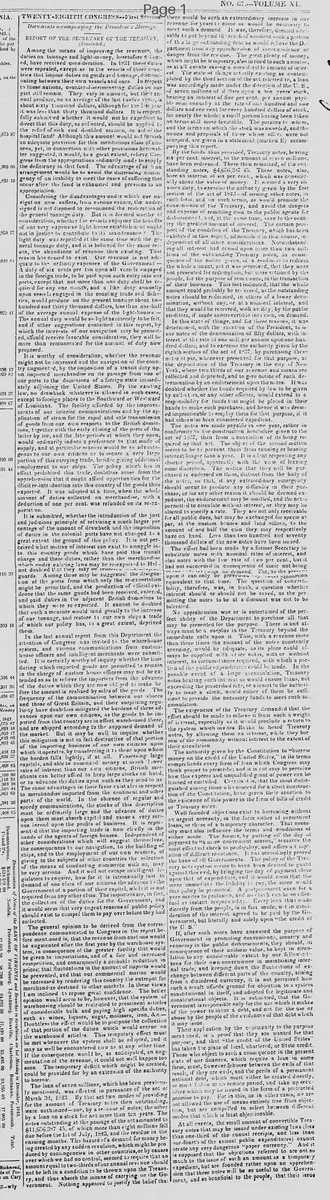
Documents accompanying the President's Message.
REPORT OF THE SECRETARY OF THE TREASURY.
(Concluded.)
Among the means of improving the revenues, the duties on tonnage and light-money, heretofore collected, have received consideration. In 1831 these duties were repealed, except as to the vessels of those countries that impose duties on goods and tonnage, discriminating between their own vessels and ours. In respect to those nations, counter-discriminating duties on our part still remain. They vary in amount, but the annual produce, on an average of the last twelve years, is about sixty thousand dollars, although for the last year it was less than thirty thousand dollars. It is respectfully submitted whether it would not be expedient to direct that this duty, as collected, should be applied to the relief of sick and disabled seamen, in aid of the hospital fund? Although this amount would not furnish an adequate provision for this meritorious class of citizens, yet, in connection with other provisions hereinafter suggested, it would, to a great extent, relieve Congress from the appropriations ordinarily made to supply the deficiency in that fund. The advantage of such an arrangement would be to avoid the distressing contingency of an inability to meet the cases of suffering that occur after the fund is exhausted and previous to an appropriation.
Considering the disadvantages under which our navigation now suffers, from various causes, the undersigned is not disposed to recommend the restoration of the general tonnage duty. But it is deemed worthy of consideration, whether the vessels enjoying the benefits of our very expensive light house establishment ought not in justice to contribute to its maintenance? The light duty was repealed at the same time with the general tonnage duty, and it is believed for the same reason, the abundance of revenue then existing. That reason has ceased to exist. Our revenue is not adequate to the ordinary expenses of the Government—
A duty of six cents per ton upon all vessels engaged in the foreign trade, to be paid upon each entry into our ports, except that not more than one duty shall be required for any one month, and a like duty annually upon vessels engaged in the coasting trade and fisheries, would produce on the present tonnage about two hundred and thirty thousand dollars, less than one-half of the average annual expense of the light-houses—
The annual duty would be so light as scarcely to be felt. and if other suggestions contained in this report, by which the interests of our navigation may be promoted, should receive favorable consideration, they will be more than remunerated for the amount of duty now proposed.
It is worthy of consideration, whether the revenue might not be improved and the navigation of the country augmented, by the imposition of a transit duty upon imported merchandise on its passage from one of our ports to the dominions of a foreign state immediately adjoining the United States. By the existing law, no drawback whatever is allowed in such cases, except to foreign places to the Southward or Westward of Louisiana. The facility afforded by the improvements of our interior communications and by the application of steam for the rapid and safe transmission of goods from our own seaports to the British dominions, together with the early closing of the ports of the latter by ice, and the late periods at which they open, would ordinarily induce a preference to that mode of supply, and at particular seasons would be so advantageous to our own citizens as to secure a very large portion of this carrying trade, besides giving additional employment to our ships. The policy which has in effect prohibited this trade, doubtless arose from the apprehension that it might afford opportunities for the illicit re-introduction into this country of the goods thus exported. It was adopted at a time, when the whole amount of duties collected on merchandise, with a deduction of one per cent. was refunded on its re-exportation.
It is submitted, whether the introduction of the just and judicious principle of retaining a much larger percentage of the amount of drawback and the imposition of duties in the colonial ports have not changed to a great extent the ground of this policy. It is not perceived what motive of interest can exist to smuggle into this country goods which have paid this transit charge and these duties, rather than the merchandise which under existing laws may be re-exported to Halifax without any such payment. It cannot be doubted that they may be restored with proper guards. Among these may be suggested the designation of the ports from which only the re-exportation might be permitted, and the production of official evidence that the same goods had been received, entered, and paid duties in the adjacent British dominions to which they were re-exported. It cannot be doubted that such a measure would tend greatly to the increase of our tonnage, and restore to our own ships a trade of which our policy has, to a great extent, deprived them.
In the last annual report from this Department the attention of Congress was invited to the warehouse system, and various communications from custom-house officers and intelligent merchants were submitted. It is certainly worthy of inquiry whether the time during which imported goods are permitted to remain in the charge of custom house officers may not be extended so as to relieve the importers from the advance of the duties which they are now obliged to make before the amount is realized by sales of the goods. The frequency of the communication between our shores and those of Great Britain, and their surprising regularity have doubtless mitigated the burdens of these advances upon our own citizens, as the goods to be imported from that country are in effect warehoused there, and are shipped according to the supposed demand of the market. But it may be well to inquire whether this mitigation is not in fact destructive of that portion of the importing business of our own citizens upon which the burden falls lightly, if at all. Possessing large capitals, and able to command money at much lower rates of interest than our own citizens, British merchants can better afford to keep large stocks on hand, or to advance the duties upon such as they send to us. The same advantages in their favor exist also in respect to merchandise imported from the continent and other parts of the world. In the absence of regular and speedy communications, the stocks of this description must be ordinarily large and the advance of duties upon them must absorb capital and cause a very serious inroad upon the profits of business. It is represented that the importing trade is now chiefly in the hands of the agents of foreign houses. Independent of other considerations which will suggest themselves, the consequences to our navigation, to the building of ships, and to the employment of our own seamen, of giving to the subjects of other countries the selection of the means of conducting commerce with us, may be very serious. And it will not escape intelligent legislators to enquire, how far it is intrinsically just to demand of one class of our citizens the advance to the Government of a portion of their capital, while it is not required from any other class. The importers are, in fact, the collectors of the duties for the Government, and it would seem that very cogent reasons of public policy should exist to compel them to pay over before they had collected.
The general opinion to be derived from the correspondence communicated to Congress in the report before mentioned is, that the revenue from customs would be augmented after the first year by the warehouse system, in consequence of the greater facility that would be given to importations, and of a fairer and increased competition, and consequently a probable reduction in prices; that fluctuations in the amount of imports would be prevented, and that our commercial marine would be benefited by rendering this country the entrepot for merchandise destined to other markets. In these views I am inclined to repose great confidence. The better opinion would seem to be, however, that the system of warehousing should be restricted to prominent articles of considerable bulk and paying high specific duties, such as wines, liquors, sugar, molasses, iron, &c.—
Doubtless the effect would be to postpone the collection of that portion of the duties which would accrue on the warehoused articles. This temporary effect must be met whenever the system shall be adopted, and it may as well be encountered now as at any other time soon. The temporary deficit which might be created, if the consequence would be, as anticipated, an augmentation of the revenue, it could not well happen too soon. The temporary deficit could be provided for by an extension of the authority to borrow.
The loan of seven millions, which has been previously mentioned, was effected in pursuance of the act of March 3d, 1843. By that act two modes of providing for the amount of Treasury notes then outstanding, were authorized—one, by a re-issue of notes; the other by a loan on a stock for not more than ten years. The notes outstanding at the passage of the act amounted to $11,656,387 45, of which more than eight millions fell due before the 1st of July, 1843, and the residue in the ensuing months. The hazard of a demand for money being created by any sudden revulsion, which might be produced by contingencies in other countries, or by causes over which we had no control, seemed to require that an amount equal to two-thirds of our annual revenue should not be left in a condition to be thrown upon the Treasury, and thus absorb the means of carrying on the Government. Nothing appeared to justify the belief that there would be such an extraordinary increase in our revenue for years to come as would be necessary to meet such a demand It was, therefore, deemed advisable to put beyond the reach of accident such a portion of this large outstanding debt as would relieve the Department from any apprehension of inconvenience or danger from the residue. The great plenty of money, which might be temporary, also invited to such a course, as at all events saving a considerable amount of interest The state of things actually existing as contemplated by the third section of the act referred to, a loan was accordingly made under the direction of the U. S., of seven millions of dollars upon a ten years' stock, bearing an interest of five per cent. per annum payable semi-annually, at the rate of one hundred and one dollars and one cent for every hundred dollars of stock, for nearly the whole; a small portion having been taken on terms still more favorable. The persons to whom, and the terms on which the stock was awarded, and the names and proposals of those whose offers were not accepted, are given in a statement (marked E) accompanying this report.
By the funds thus provided, Treasury notes, bearing six per cent interest, to the amount of seven millions, have been redeemed There then remained, of the outstanding notes, $4,656,387 45. These notes, also, bore an interest of six per cent., which was considerably above the value of money. It seemed a very obvious duty, to exercise the authority given by the first section of the act of 1843—of issuing other notes, in such form, and on such terms, as would promote the convenience of the Treasury, and avoid the dangers and expense of remitting coin to the public agents for disbursement, and, at the same time, save to the country the greatest amount of interest. The certain prospect of the condition of the Treasury, which has been exhibited in this report, admonished to this course, independent of all other considerations. Notwithstanding all interest had ceased upon more than two millions of the outstanding Treasury notes, in consequence of the notice given, of a readiness to redeem the whole amount, yet it was perceived, that they were not presented for redemption, but were retained by the people, for the purpose of remittance, in the transaction of their business. This fact indicated, that the whole amount could probably be re-issued, as the outstanding notes should be redeemed, in others of a lower denomination, without any, or at a nominal interest, and that they would be received, with avidity, by the public creditors, if made convertible into coin, on demand.
In this state of things, and for these reasons, it was determined, with the sanction of the President, to issue notes of the denomination of fifty dollars, with interest at the rate of one mill per annum upon one hundred dollars, and to exercise the authority given by the eighth section of the act of 1837, by purchasing these notes at par, whenever presented for that purpose, at the depositories of the Treasury in the city of New York, where two thirds of our revenue and means are collected and deposited, and to give notice of such determination by an endorsement upon the notes. It was doubted whether the bonds required by law to be given by collectors, or any other officers, would extend to a responsibility for funds that might be placed in their hands to make such purchases, and hence it was deemed impracticable to employ them for that purpose, if it had otherwise been considered expedient.
The notes are made payable in one year, rather in conformity to the construction heretofore given to the act of 1837, than from a conviction of its being required by that act. The object of the second section seems to be to prevent them from running or bearing interest longer than a year. It is silent respecting any shorter period, apparently with the view of leaving some discretion. The notice that they will be purchased is endorsed on them, distinct from the body of the notes, so that, if any extraordinary emergency should occur to produce any difficulty in their purchase, or for any other reason it should be deemed expedient, the endorsement may be omitted, and the notes permitted to circulate without interest, or they may be altered to specify a rate. They are not only receivable for all public dues, but may be exchanged for specie at par, at the custom houses and land offices, to the amount of one half the coin they may respectively have on hand. Less than two hundred and seventy thousand dollars of the new notes have been issued.
The effort had been made by a former Secretary to substitute notes with nominal rates of interest, and also notes with the low rate of two per cent, but it had not succeeded in consequence of their not being convertible into coin on demand. For, as the preceding notes had been kept in circulation by the avidity with which they were received by the public creditors, so these could only be prevented from remaining idle, by being at a discount equivalent to that time. The question of convertibility, therefore, was, in truth, a question whether interest should or should not be saved, as the permitting the notes to be at a discount was not to be tolerated.
No apprehension was or is entertained of the perfect ability of the Department to purchase all that may be presented for the purpose. There is and always must be a surplus in the Treasury beyond the immediate calls upon it This, with a revenue more than three times the amount of the notes constantly accruing, would be adequate, as its place could always be supplied with other notes, with or without interest, as circumstances required, with which a portion of the public expenditures could be made. In the possible event of a large accumulation, Treasury notes bearing such interest as would ensure loans, not exceeding the prescribed rate, or a resort to the authority to issue a stock, would either of them be sufficient to provide the necessary funds to meet such accumulation.
The exigencies of the Treasury demanded that the effort should be made to relieve it from such a weight of interest, especially as it would preclude a return to the system which invites Banks to hoard Treasury notes, by allowing them an interest, while they borrow of the community without interest to the extent of their circulation.
The authority given by the Constitution to "borrow money on the credit of the United States," in its terms comprehends every form of loan which Congress may think proper to prescribe; and it is not easy to perceive how this express and unqualified grant of power can be limited or curtailed. Certain it is, that the most distinguished among those who contend for a strict construction of the Constitution, have given their sanction to the existence of this power in the form of bills of credit or Treasury notes.
Well founded objections exist to borrowing without an urgent necessity, in the form either of permanent loans, or those of a temporary character. That necessity must also influence the terms and conditions of either mode. The former, by putting off the day of payment to "a more convenient season," removes the most effectual check to prodigality, and offers a temptation of difficult resistance. It has accordingly proved the bane of all Governments. The policy of the Treasury note system seems to have been devised to guard against this evil, by bringing the day of payment close upon that of expenditure, and it would seem that the more immediate the liability to pay, the more would that policy be promoted. A postponement even for a year invites to profusion, and no check can be so effectual as instant responsibility. Every loan thus made directly from the people, is in fact made, not in consideration of the interest agreed to be paid by the Government, but literally and solely upon "the credit of the U. S."
If, after such notes have answered the purpose of Government in promoting convenience, security and economy in the public disbursements, they should, in consequence of their uniform value, be kept in circulation to any considerable extent by our fellow-citizens for their own convenience in maintaining internal trade, and keeping down the fluctuations of exchange between different parts of the country, arising from a disordered currency, it is not perceived how such a result affords ground for objection to a system constitutional in itself, and adopted for legitimate and constitutional objects. It is submitted, that the Government is responsible only for the use which it makes of the power to incur a debt, and not for the use or abuse by the people of the evidences of that debt which it may issue.
Their application by the community to the purpose mentioned, is a proof that they are wanted for that purpose, and that "the credit of the United States" has taken the place of local, chartered, or State credit.
Those who object to such a consequence in the present state of our finances, which require a loan in some form, must, however, choose between the evils of that result, if they are evils, and the perils of a permanent national debt, which must either be created directly, or must follow at no remote period, and take up securities which may be issued in the form of a protracted promise to pay." For in this, as in other cases, we are not allowed the use of means entirely free from objection, but are compelled to select between different modes that which is least objectionable.
At all events, the small amount of convertible Treasury notes that may be issued under existing laws (less than one-fourth of the annual public expenditures) cannot create any very dangerous "paper currency."
And it is supposed that the objections referred to are not so much to the issue of such an amount as a temporary expedient, but are founded rather upon an apprehension that these notes will be so useful to the Government, and so beneficial to the people, that their issue will be indefinitely prolonged.
Dec. 5
60-6w
may hereafter be carried to excess. It is a fair question, whether the danger of excess in this mode of borrowing money is equal to that arising from loans upon deferred times of payment? While the wisdom and firmness of Congress ought not to be distrusted in either case, yet it is worthy of observation, that the mode which requires immediate liability to pay, furnishes a guard in itself against abuse by the instant and infallible check which it furnishes upon issues beyond the means of converting into coin.
Suggestions in relation to the deficiency of means to meet the ordinary expenses of Government during the current and the next fiscal year, may be useful. A brief synopsis of the foregoing statements and: By extending the loan which becomes due 1st January, 1845, its amount ($5,672,976 88,) may be provided for. By raising of light-money, by a duty on articles now free, particularly tea and coffee, and, by the other means suggested in this report, an addition may be made to the revenue, of between four and five millions of dollars. Estimating this at four millions five hundred thousand dollars, there will be left to be provided for, four millions five hundred thousand dollars, and the outstanding Treasury notes, amounting to a little more than four millions six hundred thousand dollars. These two items, amounting in the whole, to nine millions one hundred thousand dollars, might be supplied by a continuation of the act of March 3, 1843, (providing for the re-issue of Treasury notes, with a contingent authority to fund into a stock,) which is limited to the 1st of July, 1844, and by extending it, so as to include the anticipated deficiency of four millions five hundred thousand dollars, or such portion of it, as it may be found expedient, to meet in this manner. By this, an increase of the permanent public debt may be avoided, and any reduction of expenditures, or increase of revenue that may take place, will enable the Department to redeem a portion of this floating debt.— For this reason, if for no other, it is advisable, that this portion of our debt should be kept in such a condition, that it may be redeemed at pleasure. Should the discretion, as to the rate of interest on the Treasury notes to be issued, be abrogated, or should the authority to purchase them on presentation be withheld, notes to be issued, be abrogated, or should the authority to purchase them on presentation be withheld, shall be paid, at all events, then it will be necessary to add to the estimated deficiency, for the services of the next fiscal year, at least four hundred and fifty thousand dollars.
There are some subjects, to which it seems a duty to invite the attention of Congress, before closing this report. To prevent illegal importations on our Southwestern frontier, as well as to afford the proper facilities to traders who may wish to bring merchandise in that direction, it would be advisable that a port of entry should be established in that quarter. The town of Independence, in Missouri, has been suggested as a good position.
By the existing law an appeal to the Supreme Court cannot be made from the decision of a Circuit Court in cases involving the amount of duty that may be levied on imported merchandise, because the amount in controversy in the particular case never exceeds the prescribed limit. The courtesy of the judges sometimes induces them to disagree in form, in order to obtain the opinion of the Supreme Court. But it frequently happens that only one judge holds the Court, and it would seem that the Government ought not to be indebted to the courtesy of any officer for the opportunity of correcting what may be an erroneous construction of its revenue laws. The principle which prescribes a limitation of the value of the subject in controversy in civil suits to entitle a party to an appeal, is believed not to be applicable to questions of revenue, when the decision of a particular case may, and often does, involve hundreds of thousands of dollars; and it is submitted, that in all such cases the United States should have the right of appeal, of course, but that the costs consequent upon such a proceeding should not in any event be charged upon the opposite party.
A practice has prevailed of allowing the compensation of clerks employed in the custom houses to be paid out of the revenue, in cases where the fees were not deemed adequate to obtain the necessary number Believing this practice unwarranted by law, and being confirmed in that view by the opinion of the Attorney General, it has been abolished. There are probably cases, however, where legislative provisions will be necessary to procure the proper assistance to the collectors and naval officers.
The provision for the relief of sick and disabled seamen is, and for years has been, wholly inadequate to its purpose. Seamen being from their pursuits usually unable to share in the general provision for the destitute, and having contributed to this fund what the law demands, claim its benefits, without knowing or referring to its amount, or to the legal restraints upon those charged with its administration. All efforts to prevent the expenditure exceeding the means provided, have heretofore been unavailing, and there is constantly a balance against the fund, which is supplied by appropriations from the Treasury. To increase the amount demanded from them would be odious, if not onerous By the act of March 1, 1843, the laws requiring contributions to this fund are extended to the owners of registered vessels. It is submitted, whether this principle might not with great propriety be extended to the tonnage of such vessel. This provision, with that already suggested of appropriating to the same purpose the discriminating tonnage duty, would probably furnish the relief which humanity as well as policy dictates should be extended to a class of men proverbially improvident, but yet identified with the power and prosperity of the country.
The condition of the marine preventive service against smuggling has been materially improved, while a wholesome economy has been preserved. It will be the subject of a special report. The light-house establishment will also be the subject of a future communication to Congress. Reports from the Commissioner of the Land Office, and from the Solicitor of the Treasury, respecting suits and prosecutions in behalf of the Government, will also be submitted.
It affords great pleasure to state, there has been no delinquency or default on the part of collectors of the customs, the receivers of public moneys, or any other officer or agent, charged with the receipt or deposite of the public funds. The sums which collectors and receivers are permitted to retain in their hands, have been limited to the very lowest amount the public service would allow, while they have been required to deposite the surplus immediately in the institutions designated for that purpose. A rigid adherence to these regulations is maintained by means of a constant watchfulness of their accounts. A list of the depositories selected by the Treasury accompanies this report. The terms on which they are employed are the same as those settled in 1833, and promulgated in the circular of the Secretary of the Treasury on the 9th day of October, in that year. A few of them merely received the public moneys in special deposit. It is but an act of justice to say, that they have faithfully fulfilled all their engagements, have transferred the funds as required without expense to the Government, and have promptly met all drafts upon them.
I am unwilling to omit the opportunity of inviting the attention of Congress to the multitude and frequency of oaths prescribed in our system of collecting the revenue. A Custom House oath has become a by-word to describe an unmeaning ceremony, and it is doubted whether it is felt as imposing an obligation equal to that of a simple affirmation. It is not perceived why the same penalties may not be inflicted for the wilful falsehood of a declaration in writing which might be substituted in most cases for the irreverent invocation of the Supreme Being. A bare allusion to the subject, it is hoped, will be sufficient to induce that consideration of it to which it may be entitled.
Respectfully,
JOHN C. SPENCER,
Secretary of the Treasury.
To the Hon. Willie P. Mangum,
President of the Senate.
What sub-type of article is it?
What keywords are associated?
What entities or persons were involved?
Domestic News Details
Event Date
Dec. 5
Key Persons
Event Details
The Secretary of the Treasury submits a report to Congress recommending measures to improve revenues, including redirecting tonnage duties to seamen relief, reinstating light-money duties for lighthouse maintenance, imposing transit duties on merchandise to British dominions, extending the warehouse system for imports, managing Treasury notes with low interest and convertibility, and addressing fiscal deficiencies through re-issuance and borrowing authority.