Thank you for visiting SNEWPapers!
Sign up free
Editorial
December 18, 1818
The Rhode Island American, And General Advertiser
Providence, Providence County, Rhode Island
What is this article about?
Editorial from Providence, 1818, criticizes General Jackson's imperious rejection of a court-martial decision and hasty execution of Arbuthnot and Ambrister without executive clemency, urging Congress to investigate to uphold U.S. humane reputation against international scrutiny.
Clipping
OCR Quality
95%
Excellent
Full Text
THE AMERICAN.
PROVIDENCE,
Friday, December 18. 1818.
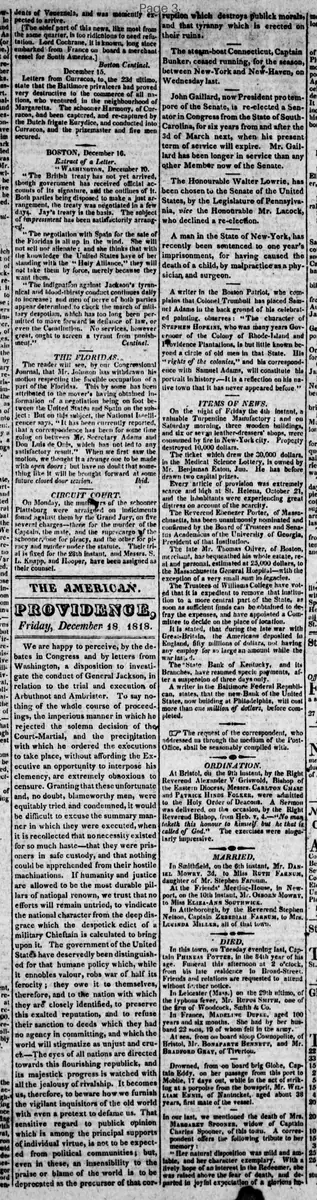
We are happy to perceive, by the debates in Congress and by letters from Washington, a disposition to investigate the conduct of General Jackson, in relation to the trial and execution of Arbuthnot and Ambrister. To say nothing of the whole course of proceedings, the imperious manner in which he rejected the solemn decision of the Court-Martial, and the precipitation with which he ordered the executions to take place, without affording the Executive an opportunity to interpose his clemency, are extremely obnoxious to censure. Granting that these unfortunate and, no doubt, blameworthy men, were equitably tried and condemned, it would be difficult to excuse the summary manner in which they were executed, when it is recollected that no necessity existed for so much haste—that they were prisoners in safe custody, and that nothing could be apprehended from their hostile machinations. If humanity and justice are allowed to be the most durable pillars of national renown, we trust that no efforts will remain untried, to vindicate the national character from the deep disgrace which the despotick edict of a military Chieftain is calculated to bring upon it. The government of the United States have deservedly been distinguished for that humane policy which, while it ennobles valour, robs war of half its ferocity; they owe it to themselves, therefore, and to the nation with which they are closely identified, to preserve this exalted reputation, and to refuse their sanction to deeds which they had no agency in committing, and which the world will stigmatize as unjust and cruel. The eyes of all nations are directed towards this flourishing republick, and its majestick progress is watched with all the jealousy of rivalship. It becomes us, therefore, to beware how we furnish the vigilant inquisitors of the old world with even a pretext to deem us. That sensitive regard to publick opinion which is among the principal supports of individual virtue, is not to be expected from political communities; but, even in these, an insensibility to the praise or blame of the world is to be deprecated as the precursor of that corruption which destroys publick morals, and that tyranny which is erected on their ruins.
PROVIDENCE,
Friday, December 18. 1818.
We are happy to perceive, by the debates in Congress and by letters from Washington, a disposition to investigate the conduct of General Jackson, in relation to the trial and execution of Arbuthnot and Ambrister. To say nothing of the whole course of proceedings, the imperious manner in which he rejected the solemn decision of the Court-Martial, and the precipitation with which he ordered the executions to take place, without affording the Executive an opportunity to interpose his clemency, are extremely obnoxious to censure. Granting that these unfortunate and, no doubt, blameworthy men, were equitably tried and condemned, it would be difficult to excuse the summary manner in which they were executed, when it is recollected that no necessity existed for so much haste—that they were prisoners in safe custody, and that nothing could be apprehended from their hostile machinations. If humanity and justice are allowed to be the most durable pillars of national renown, we trust that no efforts will remain untried, to vindicate the national character from the deep disgrace which the despotick edict of a military Chieftain is calculated to bring upon it. The government of the United States have deservedly been distinguished for that humane policy which, while it ennobles valour, robs war of half its ferocity; they owe it to themselves, therefore, and to the nation with which they are closely identified, to preserve this exalted reputation, and to refuse their sanction to deeds which they had no agency in committing, and which the world will stigmatize as unjust and cruel. The eyes of all nations are directed towards this flourishing republick, and its majestick progress is watched with all the jealousy of rivalship. It becomes us, therefore, to beware how we furnish the vigilant inquisitors of the old world with even a pretext to deem us. That sensitive regard to publick opinion which is among the principal supports of individual virtue, is not to be expected from political communities; but, even in these, an insensibility to the praise or blame of the world is to be deprecated as the precursor of that corruption which destroys publick morals, and that tyranny which is erected on their ruins.
What sub-type of article is it?
Military Affairs
Crime Or Punishment
Legal Reform
What keywords are associated?
Jackson Conduct
Arbuthnot Ambrister
Court Martial
Executions
National Reputation
Humane Policy
What entities or persons were involved?
General Jackson
Arbuthnot
Ambrister
Congress
Executive
Editorial Details
Primary Topic
Critique Of General Jackson's Execution Of Arbuthnot And Ambrister
Stance / Tone
Critical Of Military Overreach And Hasty Executions
Key Figures
General Jackson
Arbuthnot
Ambrister
Congress
Executive
Key Arguments
Jackson Rejected The Court Martial's Decision Imperiously
Executions Were Precipitated Without Allowing Executive Clemency
No Necessity For Haste As Prisoners Were In Safe Custody
Investigation Needed To Vindicate National Character From Disgrace
Government Should Preserve Humane Policy And Refuse Sanction To Unjust Deeds