Thank you for visiting SNEWPapers!
Sign up free
Literary
September 21, 1910
New Ulm Review
New Ulm, Brown County, Minnesota
What is this article about?
In this excerpt from Rex Beach's novel 'The Silver Horde,' Boyd Emerson and his companions arrive in the remote Alaskan village of Kalvik. Cherry Malotte, a resourceful businesswoman, hosts them and shares insights into the lucrative salmon canning industry. Amid growing romantic tension, she proposes a partnership with Emerson to build a rival cannery on her site, recruiting the outcast expert George Balt to challenge the dominant Willis Marsh. The narrative explores themes of opportunity, rivalry, and the epic salmon migration.
Clipping
OCR Quality
98%
Excellent
Full Text
The Silver Horde
By REX BEACH
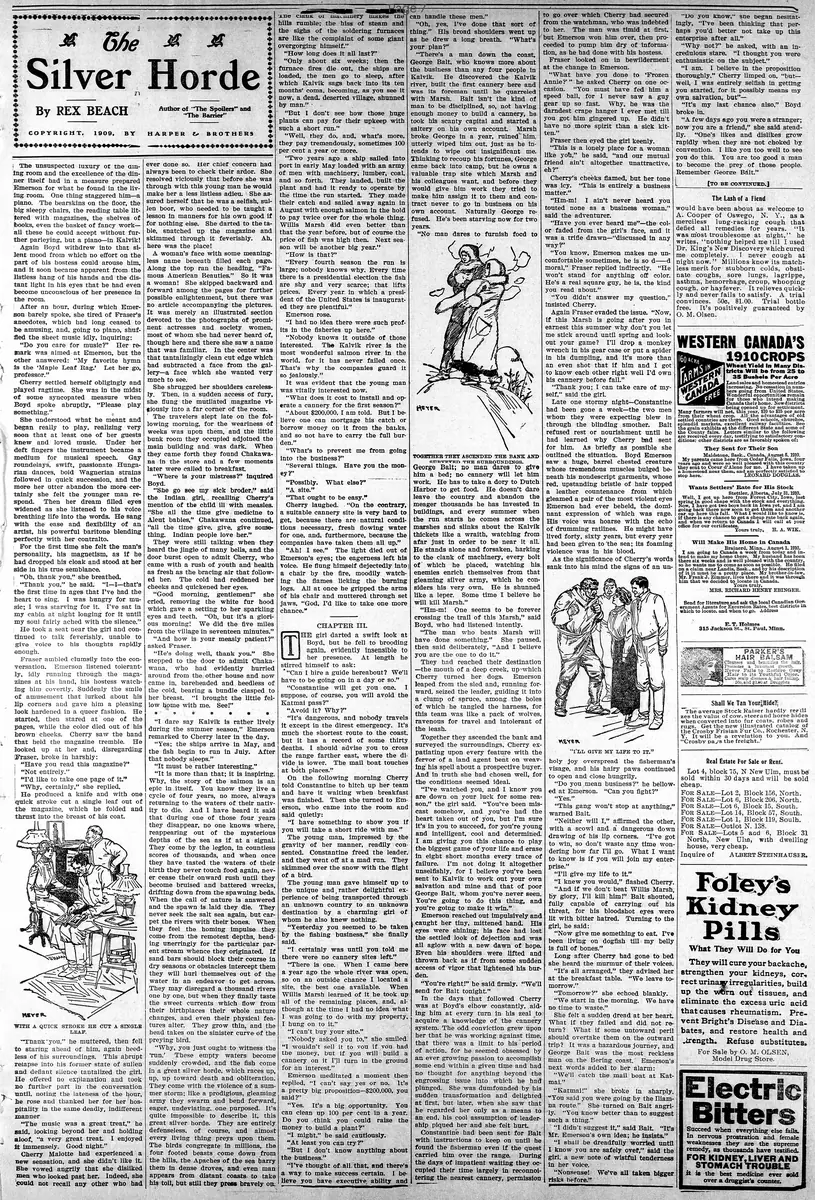
The unsuspected luxury of the dining room and the excellence of the dinner itself had in a measure prepared Emerson for what he found in the living room. One thing staggered him—a piano. The bearskins on the floor, the big sleepy chairs, the reading table littered with magazines, the shelves of books, even the basket of fancy work—all these he could accept without further parleying, but a piano—in Kalvik!
Again Boyd withdrew into that silent mood from which no effort on the part of his hostess could arouse him, and it soon became apparent from the listless hang of his hands and the distant light in his eyes that he had even become unconscious of her presence in the room.
After an hour, during which Emerson barely spoke, she tired of Fraser's anecdotes, which had long ceased to be amusing, and, going to the piano, shuffled the sheet music idly, inquiring: "Do you care for music?" Her remark was aimed at Emerson, but the other answered: "My favorite hymn is the 'Maple Leaf Rag.' Let her go, professor."
Cherry settled herself obligingly and played ragtime. She was in the midst of some syncopated measure when Boyd spoke abruptly, "Please play something."
She understood what he meant and began really to play, realizing very soon that at least one of her guests knew and loved music. Under her deft fingers the instrument became a medium for musical speech. Gay roundelays, swift, passionate Hungarian dances, bold Wagnerian strains followed in quick succession, and the more her utter abandon the more certainly she felt the younger man respond. Then her dream-filled eyes widened as she listened to his voice breathing life into the words. He sang with the ease and flexibility of an artist, his powerful baritone blending perfectly with her contralto.
For the first time she felt the man's personality, his magnetism, as if he had dropped his cloak and stood at her side in his true semblance.
"Oh, thank you," she breathed.
"Thank you," he said. "I—that's the first time in ages that I've had the heart to sing. I was hungry for music; I was starving for it. I've sat in my cabin at night longing for it until my soul fairly ached with the silence."
He took a seat near the girl and continued to talk feverishly, unable to give voice to his thoughts rapidly enough.
Fraser ambled clumsily into the conversation. Emerson listened tolerantly, idly running through the magazines at his hand, his hostess watching him covertly. Suddenly the smile of amusement that lurked about his lip corners and gave him a pleasing look hardened in a queer fashion. He started, then stared at one of the pages, while the color died out of his brown cheeks. Cherry saw the hand that held the magazine tremble. He looked up at her and, disregarding Fraser, broke in harshly:
"Have you read this magazine?"
"Not entirely."
"I'd like to take one page of it."
"Why, certainly," she replied.
He produced a knife and with one quick stroke cut a single leaf out of the magazine, which he folded and thrust into the breast of his coat.
"Thank you," he muttered, then fell to staring ahead of him, again heedless of his surroundings. This abrupt relapse into his former state of sullen and defiant silence tantalized the girl. He offered no explanation and took no further part in the conversation until, noting the lateness of the hour, he rose and thanked her for her hospitality in the same deadly, indifferent manner.
"The music was a great treat," he said, looking beyond her and holding aloof, "a very great treat. I enjoyed it immensely. Good night."
Cherry Malotte had experienced a new sensation, and she didn't like it. She vowed angrily that she disliked men who looked past her. Indeed, she could not recall any other who had ever done so. Her chief concern had always been to check their ardor. She resolved viciously that before she was through with this young man he would make her a less listless adieu. She assured herself that he was a selfish, sullen boor, who needed to be taught a lesson in manners for his own good if for nothing else. She darted to the table, snatched up the magazine and skimmed through it feverishly. Ah, here was the place!
A woman's face with some meaningless name beneath filled each page. Along the top ran the heading, "Famous American Beauties." So it was a woman! She skipped backward and forward among the pages for further possible enlightenment, but there was no article accompanying the pictures. It was merely an illustrated section devoted to the photographs of prominent actresses and society women, most of whom she had never heard of, though here and there she saw a name that was familiar. In the center was that tantalizingly clean-cut edge which had subtracted a face from the gallery—a face which she wanted very much to see.
She shrugged her shoulders carelessly. Then, in a sudden access of fury, she flung the mutilated magazine viciously into a far corner of the room.
The travelers slept late on the following morning, for the weariness of weeks was upon them, and the little bunk room they occupied adjoined the main building and was dark. When they came forth they found Chakawana in the store and a few moments later were called to breakfast.
"Where is your mistress?" inquired Boyd.
"She go see my sick broder," said the Indian girl, recalling Cherry's mention of the child ill with measles.
"She all the time give medicine to Aleut babies," Chakawana continued, "all the time give, give, give something. Indian people love her."
They were still talking when they heard the jingle of many bells, and the door burst open to admit Cherry, who came with a rush of youth and health as fresh as the bracing air that followed her. The cold had reddened her cheeks and quickened her eyes.
"Good morning, gentlemen!" she cried, removing the white fur hood which gave a setting to her sparkling eyes and teeth. "Oh, but it's a glorious morning! We did the five miles from the village in seventeen minutes."
"And how is your measly patient?" asked Fraser.
"He's doing well, thank you."
She stepped to the door to admit Chakawana, who had evidently hurried around from the other house and now came in, bareheaded and, heedless of the cold, bearing a bundle clasped to her breast. "I brought the little fellow home with me. See!"
"I dare say Kalvik is rather lively during the summer season," Emerson remarked to Cherry later in the day.
"Yes; the ships arrive in May, and the fish begin to run in July. After that nobody sleeps."
"It must be rather interesting."
"It is more than that; it is inspiring. Why, the story of the salmon is an epic in itself. You know they live a cycle of four years, no more, always returning to the waters of their nativity to die. And I have heard it said that during one of those four years they disappear, no one knows where, reappearing out of the mysterious depths of the sea as if at a signal. They come by the legion, in countless scores of thousands, and when once they have tasted the waters of their birth they never touch food again, never cease their onward rush until they become bruised and battered wrecks, drifting down from the spawning beds. When the call of nature is answered and the spawn is laid they die. They never seek the salt sea again, but carpet the rivers with their bones. When they feel the homing impulse they come from the remotest depths, heading unerringly for the particular parent stream whence they originated. If sand bars should block their course in dry seasons or obstacles intercept them they will hurl themselves out of the water in an endeavor to get across. They may disregard a thousand rivers one by one, but when they finally taste the sweet currents which flow from their birthplaces their whole nature changes, and even their physical features alter. They grow thin, and the head takes on the sinister curve of the preying bird.
"Why, you just ought to witness the 'run.' These empty waters become suddenly crowded, and the fish come in a great silver horde, which races up, up, up toward death and obliteration. They come with the violence of a summer storm; like a prodigious, gleaming army they swarm and bend forward, eager, undeviating, one-purposed. It's quite impossible to describe it, this great silver horde. They are entirely defenseless, of course, and almost every living thing preys upon them. The birds congregate in millions, the four-footed beasts come down from the hills, the Apaches of the sea harry them in dense droves, and even man appears from distant coasts to take his toll, but still they press bravely on.
The clank of machinery makes the hills rumble; the hiss of steam and the sighs of the soldering furnaces are like the complaint of some giant overgorging himself."
"How long does it all last?"
"Only about six weeks; then the furnace fires die out, the ships are loaded, the men go to sleep, after which Kalvik sags back into its ten months' coma, becoming, as you see it now, a dead, deserted village, shunned by man."
"But I don't see how those huge plants can pay for their upkeep with such a short run."
"Well, they do, and, what's more, they pay tremendously, sometimes 100 per cent a year or more.
"Two years ago a ship sailed into port in early May loaded with an army of men with machinery, lumber, coal, and so forth. They landed, built the plant and had it ready to operate by the time the run started. They made their catch and sailed away again in August with enough salmon in the hold to pay twice over for the whole thing. Willis Marsh did even better than that the year before, but of course the price of fish was high then. Next season will be another big year."
"How is that?"
"Every fourth season the run is large; nobody knows why. Every time there is a presidential election the fish are shy and very scarce; that lifts prices. Every year in which a president of the United States is inaugurated they are plentiful."
Emerson rose.
"I had no idea there were such profits in the fisheries up here."
"Nobody knows it outside of those interested. The Kalvik river is the most wonderful salmon river in the world, for it has never failed once. That's why the companies guard it so jealously."
It was evident that the young man was vitally interested now.
"What does it cost to install and operate a cannery for the first season?"
"About $200,000, I am told. But I believe one can mortgage his catch or borrow money on it from the banks, and so not have to carry the full burden."
"What's to prevent me from going into the business?"
"Several things. Have you the money?"
"Possibly. What else?"
"A site."
"That ought to be easy."
Cherry laughed. "On the contrary, a suitable cannery site is very hard to get, because there are natural conditions necessary, fresh flowing water for one, and, furthermore, because the companies have taken them all up."
"Ah! I see." The light died out of Emerson's eyes; the eagerness left his voice. He flung himself dejectedly into a chair by the fire, moodily watching the flames licking the burning logs. All at once he gripped the arms of his chair and muttered through set jaws, "God, I'd like to take one more chance."
CHAPTER III
The girl darted a swift look at her presence. At length he stirred himself to ask:
"Can I hire a guide hereabout? We'll have to be going on in a day or so."
"Constantine will get you one. I suppose, of course, you will avoid the Katmai pass?"
"Avoid it? Why?"
"It's dangerous, and nobody travels it except in the direst emergency. It's much the shortest route to the coast but it has a record of some thirty deaths. I should advise you to cross the range farther east, where the divide is lower. The mail boat touches at both places."
On the following morning Cherry told Constantine to hitch up her team and have it waiting when breakfast was finished. Then she turned to Emerson, who came into the room and said quietly:
"I have something to show you if you will take a short ride with me."
The young man, impressed by the gravity of her manner, readily consented. Constantine freed the leader, and they went off at a mad run. They skimmed over the snow with the flight of a bird.
The young man gave himself up to the unique and rather delightful experience of being transported through an unknown country to an unknown destination by a charming girl of whom he also knew nothing.
"Yesterday you seemed to be taken by the fishing business," she finally said.
"I certainly was until you told me there were no cannery sites left."
"There is one. When I came here a year ago the whole river was open, so on an outside chance I located a site, the best one available. When Willis Marsh learned of it he took up all of the remaining places, and, although at the time I had no idea what I was going to do with my property, I hung on to it."
"I can't buy your site."
"Nobody asked you to," she smiled. "I wouldn't sell it to you if you had the money, but if you will build a cannery on it I'll turn in the ground for an interest."
Emerson meditated a moment then replied, "I can't say yes or no. It's a pretty big proposition—$200,000, you said?"
"Yes. It's a big opportunity. You can clean up 100 per cent in a year. Do you think you could raise the money to build a plant?"
"I might," he said cautiously.
"At least you can try?"
"But I don't know anything about the business."
"I've thought of all that and there's a way to make success certain. I believe you have executive ability and can handle these men."
"Oh, yes, I've done that sort of thing." His broad shoulders went up as he drew a long breath. "What's your plan?"
"There's a man down the coast, George Balt, who knows more about the business than any four people in Kalvik. He discovered the Kalvik river, built the first cannery here and was its foreman until he quarreled with Marsh. Balt isn't the kind of man to be disciplined, so, not having enough money to build a cannery, he took his scanty capital and started a saltery on his own account. Marsh broke George in a year, ruined him utterly, wiped him out, just as he intends to wipe out insignificant me. Thinking to recoup his fortunes, George came back into camp, but he owns a valuable trap site which Marsh and his colleagues want, and before they would give him work they tried to make him assign it to them and contract never to go in business on his own account. Naturally George refused. He's been starving now for two years.
"No man dares to furnish food to George Balt; no man dares to give him a bed; no cannery will let him work. He has to take a dory to Dutch Harbor to get food. He doesn't dare leave the country and abandon the meager thousands he has invested in buildings, and every summer when the run starts he comes across the marshes and slinks about the Kalvik thickets like a wraith, watching from afar just in order to be near it all. He stands alone and forsaken, harking to the clank of machinery, every bolt of which he placed, watching his enemies enrich themselves from that gleaming silver army, which he considers his very own. He is shunned like a leper. Some time I believe he will kill Marsh."
"Hm-m! One seems to be forever crossing the trail of this Marsh," said Boyd, who had listened intently.
"The man who beats Marsh will have done something."
She paused, then said deliberately, "And I believe you are the one to do it."
They had reached their destination—the mouth of a deep creek, up which Cherry turned her dogs. Emerson leaped from the sled and, running forward, seized the leader, guiding it into a clump of spruce, among the boles of which he tangled the harness, for this team was like a pack of wolves, ravenous for travel and intolerant of the leash.
Together they ascended the bank and surveyed the surroundings, Cherry expatiating upon every feature with the fervor of a land agent bent on weaving his spell about a prospective buyer. And in truth she had chosen well, for the conditions seemed ideal.
"I've watched you, and I know you are down on your luck for some reason," the girl said. "You've been miscast somehow, and you've had the heart taken out of you, but I'm sure it's in you to succeed, for you're young and intelligent, cool and determined. I am giving you this chance to play the biggest game of your life and erase in eight short months every trace of failure. I'm not doing it altogether unselfishly, for I believe you've been sent to Kalvik to work out your own salvation and mine and that of poor George Balt, whom you've never seen. You're going to do this thing, and you're going to make it win."
Emerson reached out impulsively and caught her tiny, mittened hand. His eyes were shining; his face had lost the settled look of dejection and was all aglow with a new dawn of hope. Even his shoulders were lifted and thrown back as if from some sudden access of vigor that lightened his burden.
"You're right!" he said firmly. "We'll send for Balt tonight."
In the days that followed Cherry was at Boyd's elbow constantly, aiding him at every turn in his zeal to acquire a knowledge of the cannery system. The odd conviction grew upon her that he was working against time, that there was a limit to his period of action, for he seemed obsessed by an ever-growing passion to accomplish some end within a given time and had no thought for anything beyond the engrossing issue into which he had plunged. She was dumfounded by his sudden transformation and delighted at first, but later, when she saw that he regarded her only as a means to an end, his cool assumption of leadership piqued her and she felt hurt.
Constantine had been sent for Balt with instructions to keep on until he found the fisherman even if the quest carried him over the range. During the days of impatient waiting they occupied their time largely in reconnoitering the nearest cannery, permission to go over which Cherry had secured from the watchman, who was indebted to her. The man was timid at first, but Emerson won him over, then proceeded to pump him dry of information, as he had done with his hostess.
Fraser looked on in bewilderment at the change in Emerson.
"What have you done to Frozen Annie?" he asked Cherry on one occasion. "You must have fed him a speed ball, for I never saw a guy gear up so fast. Why, he was the darndest crape hanger I ever met till you got him gingered up. He didn't have no more spirit than a sick kitten."
Fraser then eyed the girl keenly.
"This is a lonely place for a woman like you," he said, "and our mutual friend ain't altogether unattractive, eh?"
Cherry's cheeks flamed, but her tone was icy. "This is entirely a business matter."
"Hm-m! I ain't never heard you touted none as a business woman," said the adventurer.
"Have you ever heard me"—the color faded from the girl's face, and it was a trifle drawn—"discussed in any way?"
"You know, Emerson makes me uncomfortable sometimes, he is so d—d moral," Fraser replied indirectly. "He won't stand for anything off color. He's a real square guy, he is, the kind you read about."
"You didn't answer my question," insisted Cherry.
Again Fraser evaded the issue. "Now, if this Marsh is going after you in earnest this summer why don't you let me stick around until spring and look out your game? I'll drop a monkey wrench in his gear case or put a spider in his dumpling, and it's more than an even shot that if him and I got to know each other right well I'd own his cannery before fall."
"Thank you; I can take care of myself," said the girl.
Late one stormy night—Constantine had been gone a week—the two men whom they were expecting blew in through the blinding smother. Balt refused rest or nourishment until he had learned why Cherry had sent for him.
As briefly as possible she outlined the situation. Boyd Emerson saw a huge, barrel-chested creature whose tremendous muscles bulged beneath his nondescript garments, whose red, upstanding bristle of hair topped a leather countenance from which gleamed a pair of the most violent eyes Emerson had ever beheld, the dominant expression of which was rage. His voice was hoarse with the echo of drumming ratlines. He might have lived forty, sixty years, but every year had been given to the sea; its foaming violence was in his blood.
As the significance of Cherry's words sank into his mind the signs of an unholy joy overspread the fisherman's visage, and his hairy paws continued to open and close hungrily.
"Do you mean business?" he bellowed at Emerson. "Can you fight?"
"Yes."
"This gang won't stop at anything," warned Balt.
"Neither will I," affirmed the other, with a scowl and a dangerous down-drawing of his lip corners. "I've got to win, so don't waste any time wondering how far I'll go. What I want to know is if you will join my enterprise."
"I'll give my life to it."
"I knew you would," flashed Cherry.
"And if we don't beat Willis Marsh, by glory, I'll kill him!" Balt shouted, fully capable of carrying out his threat, for his bloodshot eyes were lit with bitter hatred. Turning to the girl, he said:
"Now give me something to eat. I've been living on dogfish till my belly is full of bones."
Long after Cherry had gone to bed she heard the murmur of their voices.
"It's all arranged," they advised her at the breakfast table. "We leave tomorrow."
"Tomorrow?" she echoed blankly.
"We start in the morning. We have no time to waste."
She felt a sudden dread at her heart. What if they failed and did not return? What if some untoward peril should overtake them on the outward trip? It was a hazardous journey, and George Balt was the most reckless man on the Bering coast. Emerson's next words added to her alarm:
"We'll catch the mail boat at Katmai."
"Katmai!" she broke in sharply.
"You said you were going by the Iliamna route." She turned on Balt angrily. "You know better than to suggest such a thing."
"I didn't suggest it," said Balt. "It's Mr. Emerson's own idea; he insists."
"I shall be dreadfully worried until I know you are safely over," said the girl, a new note of wistful tenderness in her voice.
"Nonsense! We've all taken bigger risks before."
Do you know," she began hesitatingly, "I've been thinking that perhaps you'd better not take up this enterprise after all."
"Why not?" he asked, with an incredulous stare. "I thought you were enthusiastic on the subject."
"I am. I believe in the proposition thoroughly." Cherry limped on, "but well, I was entirely selfish in getting you started, for it possibly means my own salvation, but"
"It's my last chance also," Boyd broke in.
"A few days ago you were a stranger; now you are a friend," she said steadily. "One's likes and dislikes grow rapidly when they are not choked by convention. I like you too well to see you do this. You are too good a man to become the prey of those people. Remember George Balt."
[TO BE CONTINUED.]
By REX BEACH
The unsuspected luxury of the dining room and the excellence of the dinner itself had in a measure prepared Emerson for what he found in the living room. One thing staggered him—a piano. The bearskins on the floor, the big sleepy chairs, the reading table littered with magazines, the shelves of books, even the basket of fancy work—all these he could accept without further parleying, but a piano—in Kalvik!
Again Boyd withdrew into that silent mood from which no effort on the part of his hostess could arouse him, and it soon became apparent from the listless hang of his hands and the distant light in his eyes that he had even become unconscious of her presence in the room.
After an hour, during which Emerson barely spoke, she tired of Fraser's anecdotes, which had long ceased to be amusing, and, going to the piano, shuffled the sheet music idly, inquiring: "Do you care for music?" Her remark was aimed at Emerson, but the other answered: "My favorite hymn is the 'Maple Leaf Rag.' Let her go, professor."
Cherry settled herself obligingly and played ragtime. She was in the midst of some syncopated measure when Boyd spoke abruptly, "Please play something."
She understood what he meant and began really to play, realizing very soon that at least one of her guests knew and loved music. Under her deft fingers the instrument became a medium for musical speech. Gay roundelays, swift, passionate Hungarian dances, bold Wagnerian strains followed in quick succession, and the more her utter abandon the more certainly she felt the younger man respond. Then her dream-filled eyes widened as she listened to his voice breathing life into the words. He sang with the ease and flexibility of an artist, his powerful baritone blending perfectly with her contralto.
For the first time she felt the man's personality, his magnetism, as if he had dropped his cloak and stood at her side in his true semblance.
"Oh, thank you," she breathed.
"Thank you," he said. "I—that's the first time in ages that I've had the heart to sing. I was hungry for music; I was starving for it. I've sat in my cabin at night longing for it until my soul fairly ached with the silence."
He took a seat near the girl and continued to talk feverishly, unable to give voice to his thoughts rapidly enough.
Fraser ambled clumsily into the conversation. Emerson listened tolerantly, idly running through the magazines at his hand, his hostess watching him covertly. Suddenly the smile of amusement that lurked about his lip corners and gave him a pleasing look hardened in a queer fashion. He started, then stared at one of the pages, while the color died out of his brown cheeks. Cherry saw the hand that held the magazine tremble. He looked up at her and, disregarding Fraser, broke in harshly:
"Have you read this magazine?"
"Not entirely."
"I'd like to take one page of it."
"Why, certainly," she replied.
He produced a knife and with one quick stroke cut a single leaf out of the magazine, which he folded and thrust into the breast of his coat.
"Thank you," he muttered, then fell to staring ahead of him, again heedless of his surroundings. This abrupt relapse into his former state of sullen and defiant silence tantalized the girl. He offered no explanation and took no further part in the conversation until, noting the lateness of the hour, he rose and thanked her for her hospitality in the same deadly, indifferent manner.
"The music was a great treat," he said, looking beyond her and holding aloof, "a very great treat. I enjoyed it immensely. Good night."
Cherry Malotte had experienced a new sensation, and she didn't like it. She vowed angrily that she disliked men who looked past her. Indeed, she could not recall any other who had ever done so. Her chief concern had always been to check their ardor. She resolved viciously that before she was through with this young man he would make her a less listless adieu. She assured herself that he was a selfish, sullen boor, who needed to be taught a lesson in manners for his own good if for nothing else. She darted to the table, snatched up the magazine and skimmed through it feverishly. Ah, here was the place!
A woman's face with some meaningless name beneath filled each page. Along the top ran the heading, "Famous American Beauties." So it was a woman! She skipped backward and forward among the pages for further possible enlightenment, but there was no article accompanying the pictures. It was merely an illustrated section devoted to the photographs of prominent actresses and society women, most of whom she had never heard of, though here and there she saw a name that was familiar. In the center was that tantalizingly clean-cut edge which had subtracted a face from the gallery—a face which she wanted very much to see.
She shrugged her shoulders carelessly. Then, in a sudden access of fury, she flung the mutilated magazine viciously into a far corner of the room.
The travelers slept late on the following morning, for the weariness of weeks was upon them, and the little bunk room they occupied adjoined the main building and was dark. When they came forth they found Chakawana in the store and a few moments later were called to breakfast.
"Where is your mistress?" inquired Boyd.
"She go see my sick broder," said the Indian girl, recalling Cherry's mention of the child ill with measles.
"She all the time give medicine to Aleut babies," Chakawana continued, "all the time give, give, give something. Indian people love her."
They were still talking when they heard the jingle of many bells, and the door burst open to admit Cherry, who came with a rush of youth and health as fresh as the bracing air that followed her. The cold had reddened her cheeks and quickened her eyes.
"Good morning, gentlemen!" she cried, removing the white fur hood which gave a setting to her sparkling eyes and teeth. "Oh, but it's a glorious morning! We did the five miles from the village in seventeen minutes."
"And how is your measly patient?" asked Fraser.
"He's doing well, thank you."
She stepped to the door to admit Chakawana, who had evidently hurried around from the other house and now came in, bareheaded and, heedless of the cold, bearing a bundle clasped to her breast. "I brought the little fellow home with me. See!"
"I dare say Kalvik is rather lively during the summer season," Emerson remarked to Cherry later in the day.
"Yes; the ships arrive in May, and the fish begin to run in July. After that nobody sleeps."
"It must be rather interesting."
"It is more than that; it is inspiring. Why, the story of the salmon is an epic in itself. You know they live a cycle of four years, no more, always returning to the waters of their nativity to die. And I have heard it said that during one of those four years they disappear, no one knows where, reappearing out of the mysterious depths of the sea as if at a signal. They come by the legion, in countless scores of thousands, and when once they have tasted the waters of their birth they never touch food again, never cease their onward rush until they become bruised and battered wrecks, drifting down from the spawning beds. When the call of nature is answered and the spawn is laid they die. They never seek the salt sea again, but carpet the rivers with their bones. When they feel the homing impulse they come from the remotest depths, heading unerringly for the particular parent stream whence they originated. If sand bars should block their course in dry seasons or obstacles intercept them they will hurl themselves out of the water in an endeavor to get across. They may disregard a thousand rivers one by one, but when they finally taste the sweet currents which flow from their birthplaces their whole nature changes, and even their physical features alter. They grow thin, and the head takes on the sinister curve of the preying bird.
"Why, you just ought to witness the 'run.' These empty waters become suddenly crowded, and the fish come in a great silver horde, which races up, up, up toward death and obliteration. They come with the violence of a summer storm; like a prodigious, gleaming army they swarm and bend forward, eager, undeviating, one-purposed. It's quite impossible to describe it, this great silver horde. They are entirely defenseless, of course, and almost every living thing preys upon them. The birds congregate in millions, the four-footed beasts come down from the hills, the Apaches of the sea harry them in dense droves, and even man appears from distant coasts to take his toll, but still they press bravely on.
The clank of machinery makes the hills rumble; the hiss of steam and the sighs of the soldering furnaces are like the complaint of some giant overgorging himself."
"How long does it all last?"
"Only about six weeks; then the furnace fires die out, the ships are loaded, the men go to sleep, after which Kalvik sags back into its ten months' coma, becoming, as you see it now, a dead, deserted village, shunned by man."
"But I don't see how those huge plants can pay for their upkeep with such a short run."
"Well, they do, and, what's more, they pay tremendously, sometimes 100 per cent a year or more.
"Two years ago a ship sailed into port in early May loaded with an army of men with machinery, lumber, coal, and so forth. They landed, built the plant and had it ready to operate by the time the run started. They made their catch and sailed away again in August with enough salmon in the hold to pay twice over for the whole thing. Willis Marsh did even better than that the year before, but of course the price of fish was high then. Next season will be another big year."
"How is that?"
"Every fourth season the run is large; nobody knows why. Every time there is a presidential election the fish are shy and very scarce; that lifts prices. Every year in which a president of the United States is inaugurated they are plentiful."
Emerson rose.
"I had no idea there were such profits in the fisheries up here."
"Nobody knows it outside of those interested. The Kalvik river is the most wonderful salmon river in the world, for it has never failed once. That's why the companies guard it so jealously."
It was evident that the young man was vitally interested now.
"What does it cost to install and operate a cannery for the first season?"
"About $200,000, I am told. But I believe one can mortgage his catch or borrow money on it from the banks, and so not have to carry the full burden."
"What's to prevent me from going into the business?"
"Several things. Have you the money?"
"Possibly. What else?"
"A site."
"That ought to be easy."
Cherry laughed. "On the contrary, a suitable cannery site is very hard to get, because there are natural conditions necessary, fresh flowing water for one, and, furthermore, because the companies have taken them all up."
"Ah! I see." The light died out of Emerson's eyes; the eagerness left his voice. He flung himself dejectedly into a chair by the fire, moodily watching the flames licking the burning logs. All at once he gripped the arms of his chair and muttered through set jaws, "God, I'd like to take one more chance."
CHAPTER III
The girl darted a swift look at her presence. At length he stirred himself to ask:
"Can I hire a guide hereabout? We'll have to be going on in a day or so."
"Constantine will get you one. I suppose, of course, you will avoid the Katmai pass?"
"Avoid it? Why?"
"It's dangerous, and nobody travels it except in the direst emergency. It's much the shortest route to the coast but it has a record of some thirty deaths. I should advise you to cross the range farther east, where the divide is lower. The mail boat touches at both places."
On the following morning Cherry told Constantine to hitch up her team and have it waiting when breakfast was finished. Then she turned to Emerson, who came into the room and said quietly:
"I have something to show you if you will take a short ride with me."
The young man, impressed by the gravity of her manner, readily consented. Constantine freed the leader, and they went off at a mad run. They skimmed over the snow with the flight of a bird.
The young man gave himself up to the unique and rather delightful experience of being transported through an unknown country to an unknown destination by a charming girl of whom he also knew nothing.
"Yesterday you seemed to be taken by the fishing business," she finally said.
"I certainly was until you told me there were no cannery sites left."
"There is one. When I came here a year ago the whole river was open, so on an outside chance I located a site, the best one available. When Willis Marsh learned of it he took up all of the remaining places, and, although at the time I had no idea what I was going to do with my property, I hung on to it."
"I can't buy your site."
"Nobody asked you to," she smiled. "I wouldn't sell it to you if you had the money, but if you will build a cannery on it I'll turn in the ground for an interest."
Emerson meditated a moment then replied, "I can't say yes or no. It's a pretty big proposition—$200,000, you said?"
"Yes. It's a big opportunity. You can clean up 100 per cent in a year. Do you think you could raise the money to build a plant?"
"I might," he said cautiously.
"At least you can try?"
"But I don't know anything about the business."
"I've thought of all that and there's a way to make success certain. I believe you have executive ability and can handle these men."
"Oh, yes, I've done that sort of thing." His broad shoulders went up as he drew a long breath. "What's your plan?"
"There's a man down the coast, George Balt, who knows more about the business than any four people in Kalvik. He discovered the Kalvik river, built the first cannery here and was its foreman until he quarreled with Marsh. Balt isn't the kind of man to be disciplined, so, not having enough money to build a cannery, he took his scanty capital and started a saltery on his own account. Marsh broke George in a year, ruined him utterly, wiped him out, just as he intends to wipe out insignificant me. Thinking to recoup his fortunes, George came back into camp, but he owns a valuable trap site which Marsh and his colleagues want, and before they would give him work they tried to make him assign it to them and contract never to go in business on his own account. Naturally George refused. He's been starving now for two years.
"No man dares to furnish food to George Balt; no man dares to give him a bed; no cannery will let him work. He has to take a dory to Dutch Harbor to get food. He doesn't dare leave the country and abandon the meager thousands he has invested in buildings, and every summer when the run starts he comes across the marshes and slinks about the Kalvik thickets like a wraith, watching from afar just in order to be near it all. He stands alone and forsaken, harking to the clank of machinery, every bolt of which he placed, watching his enemies enrich themselves from that gleaming silver army, which he considers his very own. He is shunned like a leper. Some time I believe he will kill Marsh."
"Hm-m! One seems to be forever crossing the trail of this Marsh," said Boyd, who had listened intently.
"The man who beats Marsh will have done something."
She paused, then said deliberately, "And I believe you are the one to do it."
They had reached their destination—the mouth of a deep creek, up which Cherry turned her dogs. Emerson leaped from the sled and, running forward, seized the leader, guiding it into a clump of spruce, among the boles of which he tangled the harness, for this team was like a pack of wolves, ravenous for travel and intolerant of the leash.
Together they ascended the bank and surveyed the surroundings, Cherry expatiating upon every feature with the fervor of a land agent bent on weaving his spell about a prospective buyer. And in truth she had chosen well, for the conditions seemed ideal.
"I've watched you, and I know you are down on your luck for some reason," the girl said. "You've been miscast somehow, and you've had the heart taken out of you, but I'm sure it's in you to succeed, for you're young and intelligent, cool and determined. I am giving you this chance to play the biggest game of your life and erase in eight short months every trace of failure. I'm not doing it altogether unselfishly, for I believe you've been sent to Kalvik to work out your own salvation and mine and that of poor George Balt, whom you've never seen. You're going to do this thing, and you're going to make it win."
Emerson reached out impulsively and caught her tiny, mittened hand. His eyes were shining; his face had lost the settled look of dejection and was all aglow with a new dawn of hope. Even his shoulders were lifted and thrown back as if from some sudden access of vigor that lightened his burden.
"You're right!" he said firmly. "We'll send for Balt tonight."
In the days that followed Cherry was at Boyd's elbow constantly, aiding him at every turn in his zeal to acquire a knowledge of the cannery system. The odd conviction grew upon her that he was working against time, that there was a limit to his period of action, for he seemed obsessed by an ever-growing passion to accomplish some end within a given time and had no thought for anything beyond the engrossing issue into which he had plunged. She was dumfounded by his sudden transformation and delighted at first, but later, when she saw that he regarded her only as a means to an end, his cool assumption of leadership piqued her and she felt hurt.
Constantine had been sent for Balt with instructions to keep on until he found the fisherman even if the quest carried him over the range. During the days of impatient waiting they occupied their time largely in reconnoitering the nearest cannery, permission to go over which Cherry had secured from the watchman, who was indebted to her. The man was timid at first, but Emerson won him over, then proceeded to pump him dry of information, as he had done with his hostess.
Fraser looked on in bewilderment at the change in Emerson.
"What have you done to Frozen Annie?" he asked Cherry on one occasion. "You must have fed him a speed ball, for I never saw a guy gear up so fast. Why, he was the darndest crape hanger I ever met till you got him gingered up. He didn't have no more spirit than a sick kitten."
Fraser then eyed the girl keenly.
"This is a lonely place for a woman like you," he said, "and our mutual friend ain't altogether unattractive, eh?"
Cherry's cheeks flamed, but her tone was icy. "This is entirely a business matter."
"Hm-m! I ain't never heard you touted none as a business woman," said the adventurer.
"Have you ever heard me"—the color faded from the girl's face, and it was a trifle drawn—"discussed in any way?"
"You know, Emerson makes me uncomfortable sometimes, he is so d—d moral," Fraser replied indirectly. "He won't stand for anything off color. He's a real square guy, he is, the kind you read about."
"You didn't answer my question," insisted Cherry.
Again Fraser evaded the issue. "Now, if this Marsh is going after you in earnest this summer why don't you let me stick around until spring and look out your game? I'll drop a monkey wrench in his gear case or put a spider in his dumpling, and it's more than an even shot that if him and I got to know each other right well I'd own his cannery before fall."
"Thank you; I can take care of myself," said the girl.
Late one stormy night—Constantine had been gone a week—the two men whom they were expecting blew in through the blinding smother. Balt refused rest or nourishment until he had learned why Cherry had sent for him.
As briefly as possible she outlined the situation. Boyd Emerson saw a huge, barrel-chested creature whose tremendous muscles bulged beneath his nondescript garments, whose red, upstanding bristle of hair topped a leather countenance from which gleamed a pair of the most violent eyes Emerson had ever beheld, the dominant expression of which was rage. His voice was hoarse with the echo of drumming ratlines. He might have lived forty, sixty years, but every year had been given to the sea; its foaming violence was in his blood.
As the significance of Cherry's words sank into his mind the signs of an unholy joy overspread the fisherman's visage, and his hairy paws continued to open and close hungrily.
"Do you mean business?" he bellowed at Emerson. "Can you fight?"
"Yes."
"This gang won't stop at anything," warned Balt.
"Neither will I," affirmed the other, with a scowl and a dangerous down-drawing of his lip corners. "I've got to win, so don't waste any time wondering how far I'll go. What I want to know is if you will join my enterprise."
"I'll give my life to it."
"I knew you would," flashed Cherry.
"And if we don't beat Willis Marsh, by glory, I'll kill him!" Balt shouted, fully capable of carrying out his threat, for his bloodshot eyes were lit with bitter hatred. Turning to the girl, he said:
"Now give me something to eat. I've been living on dogfish till my belly is full of bones."
Long after Cherry had gone to bed she heard the murmur of their voices.
"It's all arranged," they advised her at the breakfast table. "We leave tomorrow."
"Tomorrow?" she echoed blankly.
"We start in the morning. We have no time to waste."
She felt a sudden dread at her heart. What if they failed and did not return? What if some untoward peril should overtake them on the outward trip? It was a hazardous journey, and George Balt was the most reckless man on the Bering coast. Emerson's next words added to her alarm:
"We'll catch the mail boat at Katmai."
"Katmai!" she broke in sharply.
"You said you were going by the Iliamna route." She turned on Balt angrily. "You know better than to suggest such a thing."
"I didn't suggest it," said Balt. "It's Mr. Emerson's own idea; he insists."
"I shall be dreadfully worried until I know you are safely over," said the girl, a new note of wistful tenderness in her voice.
"Nonsense! We've all taken bigger risks before."
Do you know," she began hesitatingly, "I've been thinking that perhaps you'd better not take up this enterprise after all."
"Why not?" he asked, with an incredulous stare. "I thought you were enthusiastic on the subject."
"I am. I believe in the proposition thoroughly." Cherry limped on, "but well, I was entirely selfish in getting you started, for it possibly means my own salvation, but"
"It's my last chance also," Boyd broke in.
"A few days ago you were a stranger; now you are a friend," she said steadily. "One's likes and dislikes grow rapidly when they are not choked by convention. I like you too well to see you do this. You are too good a man to become the prey of those people. Remember George Balt."
[TO BE CONTINUED.]
What sub-type of article is it?
Prose Fiction
What themes does it cover?
Commerce Trade
Love Romance
Nature
What keywords are associated?
Salmon Run
Cannery Business
Alaska Adventure
Business Rivalry
Romantic Tension
What entities or persons were involved?
By Rex Beach
Literary Details
Title
The Silver Horde
Author
By Rex Beach
Form / Style
Novel Excerpt
Key Lines
The Clank Of Machinery Makes The Hills Rumble; The Hiss Of Steam And The Sighs Of The Soldering Furnaces Are Like The Complaint Of Some Giant Overgorging Himself.
They Come By The Legion, In Countless Scores Of Thousands, And When Once They Have Tasted The Waters Of Their Birth They Never Touch Food Again, Never Cease Their Onward Rush Until They Become Bruised And Battered Wrecks, Drifting Down From The Spawning Beds.
You're Going To Do This Thing, And You're Going To Make It Win.
It's My Last Chance Also.
And If We Don't Beat Willis Marsh, By Glory, I'll Kill Him!