Thank you for visiting SNEWPapers!
Sign up free
Letter to Editor
September 28, 1832
Delaware Gazette And American Watchman
Wilmington, New Castle County, Delaware
What is this article about?
Judge A.S. Clayton publishes confidential correspondence with J. Watson Webb to defend against Webb's attacks on a Congressional committee report investigating the Bank of the United States, exposing Webb's attempts to influence the report and Clayton's role in it.
Clipping
OCR Quality
95%
Excellent
Full Text
From the Georgia Journal.
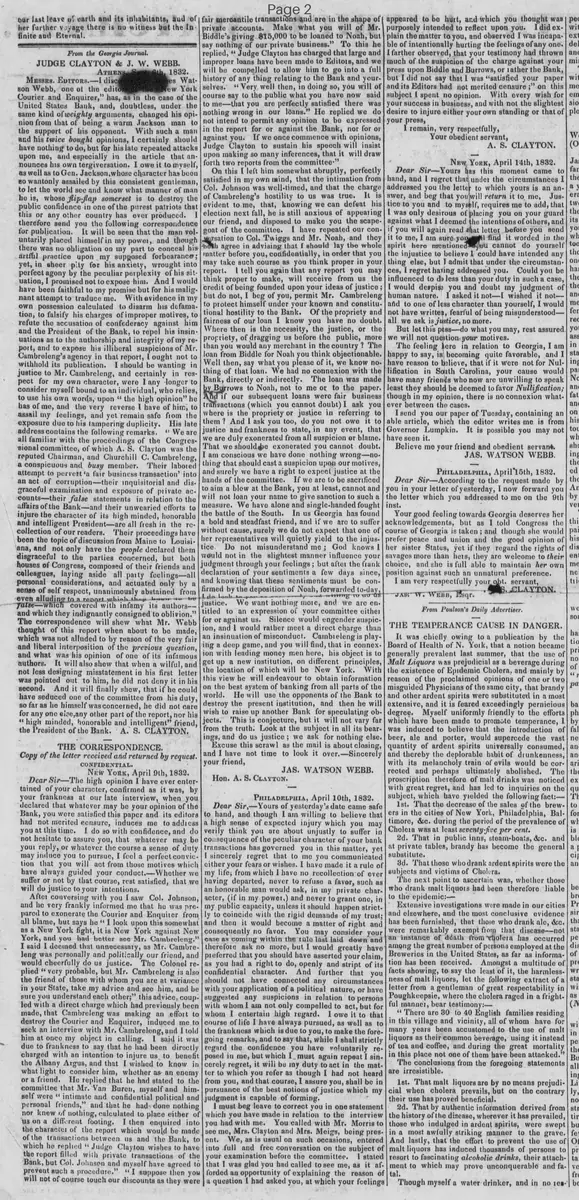
JUDGE CLAYTON & J. W. WEBB.
ATHENS, Sept. 3, 1832.
Messrs. Editors—I design to notice Watson Webb, one of the editors of the New York Courier and Enquirer, has, as in the case of the United States Bank, and, doubtless, under the same kind of weighty arguments, changed his opinion from that of being a warm Jackson man to the support of his opponent. With such a man and his twice bought opinions, I certainly should have nothing to do, but for his late repeated attacks upon me, and especially in the article that announces his own tergiversation. I owe it to myself as well as to Gen. Jackson, whose character has been so wantonly assailed by this consistent gentleman, to let the world see and know what manner of man he is, whose flip-flap somerset is to destroy the public confidence in one of the purest patriots that this or any other country has ever produced. I therefore send you the following correspondence for publication. It will be seen that the man voluntarily placed himself in my power, and though there was no obligation on my part to conceal his artful practice upon my supposed forbearance; yet, in sheer pity for his anxiety, wrought into perfect agony by the peculiar perplexity of his situation, I promised not to expose him. And I would have been faithful to my promise but for his malignant attempt to traduce me. With evidence in my own possession calculated to disarm his defamation, to falsify his charges of improper motives, to refute the accusation of confederacy against him and the President of the Bank, to repel his insinuations as to the authorship and integrity of my report, and to expose his illiberal suspicions of Mr. Cambreleng's agency in that report, I ought not to withhold its publication. I should be wanting in justice to Mr. Cambreleng, and certainly in respect for my own character, were I any longer to consider myself bound to an individual, who relies, to use his own words, upon "the high opinion" he has of me, and the very reverse I have of him, to assail my feelings, and yet remain safe from the exposure due to his tampering duplicity. His late address contains the following remarks, "We are all familiar with the proceedings of the Congressional committee, of which A. S. Clayton was the reputed Chairman, and Churchill C. Cambreleng a conspicuous and busy member. Their labored attempt to pervert 'a fair business transaction' into an act of corruption—their inquisitorial and disgraceful examination and exposure of private accounts—their false statements in relation to the affairs of the Bank—and their unwearied efforts to injure the character of its high minded, honorable and intelligent President—are all fresh in the recollection of our readers. Their proceedings have been the topic of discussion from Maine to Louisiana, and not only have the people declared them disgraceful to the parties concerned, but both houses of Congress, composed of their friends and colleagues, laying aside all party feelings—all personal considerations, and actuated only by a sense of self respect, unanimously abstained from even alluding to a report which they knew to be false—which covered with infamy its authors—and which they indignantly consigned to oblivion."
The correspondence will shew what Mr. Webb thought of this report when about to be made, which was not alluded to by reason of the very fair and liberal interposition of the previous question, and what was his opinion of one of its infamous authors. It will also shew that when a wilful, and not less designing misstatement in his first letter was pointed out to him, he did not deny it in his second. And it will finally shew, that if he could have seduced one of the committee from his duty, so far as he himself was concerned, he did not care for any one else, any other part of the report, nor his "high minded, honorable and intelligent" friend the President of the Bank. A. S. CLAYTON.
THE CORRESPONDENCE.
Copy of the letter received and returned by request.
CONFIDENTIAL
New York, April 9th, 1832.
Dear Sir—The high opinion I have ever entertained of your character, confirmed as it was, by your frankness at our late interview, when you declared that whatever may be your opinion of the Bank, you were satisfied this paper and its editors had not merited censure, induces me to address you at this time. I do so with confidence, and do not hesitate to assure you, that whatever may be your reply, or whatever the course a sense of duty may induce you to pursue, I feel a perfect conviction that you will act from those motives which have always guided your conduct.—Whether we suffer or not by that course, rest satisfied, that we will do justice to your intentions.
After conversing with you I saw Col. Johnson, and he very frankly informed me that he was prepared to exonerate the Courier and Enquirer from all blame, but says he "I look upon this somewhat as a New York fight, it is New York against New York, and you had better see Mr. Cambreleng."
I said I deemed that unnecessary, as Mr. Cambreleng was personally and politically our friend, and would cheerfully do us justice. The Colonel replied "very probable, but, Mr. Cambreleng is also the friend of those with whom you are at variance in your State, take my advice and see him, and be sure you understand each other;" this advice, coupled with a direct charge which had previously been made, that Cambreleng was making an effort to destroy the Courier and Enquirer, induced me to seek an interview with Mr. Cambreleng, and I told him at once my object in calling. I said it was due to frankness to say that he had been directly charged with an intention to injure us to benefit the Albany Argus, and that I wished to know in what light to consider him, whether as an enemy or a friend, He replied that he had stated to the committee that Mr. Van Buren, myself and himself were "intimate and confidential political and personal friends," and that he had done nothing nor knew of nothing, calculated to place either of us on a different footing. I then enquired into the character of the report which would be made of the transactions between us and the Bank, to which he replied "Judge Clayton wishes to have the report filled with private transactions of the Bank, but Col. Johnson and myself have agreed to prevent such a procedure." "I suppose then you will not of course touch our discounts as they were fair mercantile transactions and are in the shape of private accounts. Make what you will of Mr. Biddle's giving $15,000 to be loaned to Noah, but say nothing of our private business." To this he replied, "Judge Clayton has charged that large and improper loans have been made to Editors, and we will be compelled to allow him to go into a full history of any thing relating to the Bank and yourselves." "Very well then, in doing so, you will of course say to the public what you have now said to me—that you are perfectly satisfied there was nothing wrong in our loans." He replied we do not intend to permit any opinion to be expressed in the report for or against the Bank, nor for or against you. If we once commence with opinions, Judge Clayton to sustain his speech will insist upon making so many inferences, that it will draw forth two reports from the committee."
On this I left him somewhat abruptly, perfectly satisfied in my own mind, that the intimation from Col. Johnson was well-timed, and that the charge of Cambreleng's hostility to us was true. It is evident to me, that, knowing we can defeat his election next fall, he is still anxious of appearing our friend, and disposed to make you the scape-goat of the committee. I have repeated our conversation to Col. Tuiggs and Mr. Noah, and they both agree in advising that I should lay the whole matter before you, confidentially, in order that you may take such course as you think proper in your report. I tell you again that any report you may think proper to make, will receive from us the credit of being founded upon your ideas of justice; but do not, I beg of you, permit Mr. Cambreleng to protect himself under your known and constitutional hostility to the Bank. Of the propriety and fairness of our loan I know you have no doubt. Where then is the necessity, the justice, or the propriety, of dragging us before the public, more than you would any merchant in the country? The loan from Biddle for Noah you think objectionable. Well then, say what you please of it, we know nothing of that loan. We had no connexion with the Bank, directly or indirectly. The loan was made by Burrows to Noah, not to me or to the paper. And if our subsequent loans were fair business transactions (which you cannot doubt) I ask you where is the propriety or justice in referring to them? And I ask you too, do you not owe it to justice and frankness to state, in any event, that we are duly exonerated from all suspicion or blame. That we should be exonerated you cannot doubt. I am conscious we have done nothing wrong—nothing that should cast a suspicion upon our motives, and surely we have a right to expect justice at the hands of the committee. If we are to be sacrificed to aim a blow at the Bank, you at least, cannot and will not loan your name to give sanction to such a measure. We have alone and single-handed fought the battle of the South. In us Georgia has found a bold and steadfast friend, and if we are to suffer without cause, surely we do not expect that one of her representatives will quietly yield to the injustice. Do not misunderstand me; God knows I would not in the slightest manner influence your judgment through your feelings; but after the frank declaration of your sentiments a few days since, and knowing that these sentiments must be confirmed by the deposition of Noah, forwarded to-day. I do expect justice. We want nothing more, and we are entitled to an expression of your committee either for or against us. Silence would engender suspicion, and I would rather meet a direct charge than an insinuation of misconduct. Cambreleng is playing a deep game, and you will find, that in connexion with leading money men here, his object is to get up a new institution, on different principles, the location of which will be New York. With this view he will endeavour to obtain information on the best system of banking from all parts of the world. He will use the opponents of the Bank to destroy the present institution, and then he will wish to raise up another Bank for speculating objects." This is conjecture, but it will not vary far from the truth: Look at the subject in all its bearings, and do us justice; we ask for nothing else.
Excuse this scrawl as the mail is about closing, and I have not time to look it over.—Sincerely your friend,
JAS. WATSON WEBB.
Hon. A. S. CLAYTON.
PHILADELPHIA, April 10th, 1832.
Dear Sir,—Yours of yesterday's date came safe to hand, and though I am willing to believe that a high sense of expected injury which you may verily think you are about unjustly to suffer in consequence of the peculiar character of your bank transactions has governed you in this matter, yet I sincerely regret that to me you communicated either your fears or wishes. I have made it a rule of my life; from which I have no recollection of ever having departed, never to refuse a favor, such as an honorable man would ask, in my private character, (if in my power,) and never to grant one, in my public capacity, unless it should happen strictly to coincide with the rigid demands of my trust; and then it would become a matter of right and consequently no favor. You may consider your case as coming within the rule last laid down and therefore ask no more, but I would greatly have preferred that you should have asserted your claim, as you had a right to do, openly and stript of its confidential character. And further that you should not have connected any circumstances with your application of a political nature, or have suggested any suspicions in relation to persons with whom I am not only compelled to act, but for whom I entertain high regard. I owe it to that course of life I have always pursued, as well as to the frankness which is due to you, to make the foregoing remarks, and to say that, while I shall strictly regard the confidence you have voluntarily reposed in me, but which I must again repeat I sincerely regret, it will be my duty to act in the matter to which you refer as though I had not heard from you, and that course, I assure you, shall be in pursuance of the best notions of justice which my judgment is capable of forming.
I must beg leave to correct you in one statement which you have made in relation to the interview you had with me. You called with Mr. Morris to see me, Mrs. Clayton and Mrs. Meigs, being present. We, as is usual on such occasions, entered into full and free conversation on the subject of your examination before the committee. I stated that I was glad you had called to see me, as it afforded an opportunity of explaining the reason of a question I had asked you, at which your feelings appeared to be hurt, and which you thought was purposely intended to reflect upon you. I did explain the matter to you, and observed I was incapable of intentionally hurting the feelings of any one. I farther observed, that your testimony had thrown much of the suspicion of the charge against your press upon Biddle and Burrows, or rather the Bank. but I did not say that I was "satisfied your paper and its Editors had not merited censure ;" on this subject I spent no opinion. With every wish for your success in business, and with not the slightest desire to injure either your own standing or that of your press,
I remain, very respectfully
Your obedient servant,
A. S. CLAYTON.
New York, April 14th, 1832.
Dear Sir—Yours has this moment came to hand, and I regret that under the circumstances I addressed you the letter to which yours is an answer, and beg that you will return it to me, Justice to you and to myself, requires me to add, that I was only desirous of placing you on your guard against what I deemed the intentions of others, and if you will again read that letter before you send it to me, I am sure you will find it worded in the spirit here mentioned you cannot do yourself the injustice to believe I could have intended any thing else, but I admit that under the circumstances, I regret having addressed you. Could you be influenced to do less than your duty in such a case, I would despise you and doubt my judgment of human nature. I asked it not—I wished it not—and to one of less character than yourself, I would not have written, fearful of being misunderstood—all we ask is justice, no more.
But let this pass—do what you may, rest assured we will not question your motives.
The feeling here in relation to Georgia, I am happy to say, is becoming quite favorable, and I have reason to believe, that if it were not for Nullification in South Carolina, your cause would have many friends who now are unwilling to speak least they should be deemed to favor Nullification; though in my opinion, there is no connexion whatever between the cases.
I send you our paper of Tuesday, containing an able article, which the editor writes me is from Governor Lumpkin. It is possible you may not have seen it.
Believe me your friend and obedient servant,
JAS. WATSON WEBB.
PHILADELPHIA, April 15th, 1832.
Dear Sir—According to the request made by you in your letter of yesterday, I now forward you the letter which you addressed to me on the 9th inst.
Your good feeling towards Georgia deserves her acknowledgements, but as I told Congress the course of Georgia is taken; and though she would prefer peace and union and the good opinion of her sister States, yet if they regard the rights of savages more than hers, they are welcome to their choice, and she is full able to maintain her own position against such an unnatural preference.
I am very respectfully your obt. servant,
A. S. CLAYTON.
JAS. W. WEBB, Esqr.
JUDGE CLAYTON & J. W. WEBB.
ATHENS, Sept. 3, 1832.
Messrs. Editors—I design to notice Watson Webb, one of the editors of the New York Courier and Enquirer, has, as in the case of the United States Bank, and, doubtless, under the same kind of weighty arguments, changed his opinion from that of being a warm Jackson man to the support of his opponent. With such a man and his twice bought opinions, I certainly should have nothing to do, but for his late repeated attacks upon me, and especially in the article that announces his own tergiversation. I owe it to myself as well as to Gen. Jackson, whose character has been so wantonly assailed by this consistent gentleman, to let the world see and know what manner of man he is, whose flip-flap somerset is to destroy the public confidence in one of the purest patriots that this or any other country has ever produced. I therefore send you the following correspondence for publication. It will be seen that the man voluntarily placed himself in my power, and though there was no obligation on my part to conceal his artful practice upon my supposed forbearance; yet, in sheer pity for his anxiety, wrought into perfect agony by the peculiar perplexity of his situation, I promised not to expose him. And I would have been faithful to my promise but for his malignant attempt to traduce me. With evidence in my own possession calculated to disarm his defamation, to falsify his charges of improper motives, to refute the accusation of confederacy against him and the President of the Bank, to repel his insinuations as to the authorship and integrity of my report, and to expose his illiberal suspicions of Mr. Cambreleng's agency in that report, I ought not to withhold its publication. I should be wanting in justice to Mr. Cambreleng, and certainly in respect for my own character, were I any longer to consider myself bound to an individual, who relies, to use his own words, upon "the high opinion" he has of me, and the very reverse I have of him, to assail my feelings, and yet remain safe from the exposure due to his tampering duplicity. His late address contains the following remarks, "We are all familiar with the proceedings of the Congressional committee, of which A. S. Clayton was the reputed Chairman, and Churchill C. Cambreleng a conspicuous and busy member. Their labored attempt to pervert 'a fair business transaction' into an act of corruption—their inquisitorial and disgraceful examination and exposure of private accounts—their false statements in relation to the affairs of the Bank—and their unwearied efforts to injure the character of its high minded, honorable and intelligent President—are all fresh in the recollection of our readers. Their proceedings have been the topic of discussion from Maine to Louisiana, and not only have the people declared them disgraceful to the parties concerned, but both houses of Congress, composed of their friends and colleagues, laying aside all party feelings—all personal considerations, and actuated only by a sense of self respect, unanimously abstained from even alluding to a report which they knew to be false—which covered with infamy its authors—and which they indignantly consigned to oblivion."
The correspondence will shew what Mr. Webb thought of this report when about to be made, which was not alluded to by reason of the very fair and liberal interposition of the previous question, and what was his opinion of one of its infamous authors. It will also shew that when a wilful, and not less designing misstatement in his first letter was pointed out to him, he did not deny it in his second. And it will finally shew, that if he could have seduced one of the committee from his duty, so far as he himself was concerned, he did not care for any one else, any other part of the report, nor his "high minded, honorable and intelligent" friend the President of the Bank. A. S. CLAYTON.
THE CORRESPONDENCE.
Copy of the letter received and returned by request.
CONFIDENTIAL
New York, April 9th, 1832.
Dear Sir—The high opinion I have ever entertained of your character, confirmed as it was, by your frankness at our late interview, when you declared that whatever may be your opinion of the Bank, you were satisfied this paper and its editors had not merited censure, induces me to address you at this time. I do so with confidence, and do not hesitate to assure you, that whatever may be your reply, or whatever the course a sense of duty may induce you to pursue, I feel a perfect conviction that you will act from those motives which have always guided your conduct.—Whether we suffer or not by that course, rest satisfied, that we will do justice to your intentions.
After conversing with you I saw Col. Johnson, and he very frankly informed me that he was prepared to exonerate the Courier and Enquirer from all blame, but says he "I look upon this somewhat as a New York fight, it is New York against New York, and you had better see Mr. Cambreleng."
I said I deemed that unnecessary, as Mr. Cambreleng was personally and politically our friend, and would cheerfully do us justice. The Colonel replied "very probable, but, Mr. Cambreleng is also the friend of those with whom you are at variance in your State, take my advice and see him, and be sure you understand each other;" this advice, coupled with a direct charge which had previously been made, that Cambreleng was making an effort to destroy the Courier and Enquirer, induced me to seek an interview with Mr. Cambreleng, and I told him at once my object in calling. I said it was due to frankness to say that he had been directly charged with an intention to injure us to benefit the Albany Argus, and that I wished to know in what light to consider him, whether as an enemy or a friend, He replied that he had stated to the committee that Mr. Van Buren, myself and himself were "intimate and confidential political and personal friends," and that he had done nothing nor knew of nothing, calculated to place either of us on a different footing. I then enquired into the character of the report which would be made of the transactions between us and the Bank, to which he replied "Judge Clayton wishes to have the report filled with private transactions of the Bank, but Col. Johnson and myself have agreed to prevent such a procedure." "I suppose then you will not of course touch our discounts as they were fair mercantile transactions and are in the shape of private accounts. Make what you will of Mr. Biddle's giving $15,000 to be loaned to Noah, but say nothing of our private business." To this he replied, "Judge Clayton has charged that large and improper loans have been made to Editors, and we will be compelled to allow him to go into a full history of any thing relating to the Bank and yourselves." "Very well then, in doing so, you will of course say to the public what you have now said to me—that you are perfectly satisfied there was nothing wrong in our loans." He replied we do not intend to permit any opinion to be expressed in the report for or against the Bank, nor for or against you. If we once commence with opinions, Judge Clayton to sustain his speech will insist upon making so many inferences, that it will draw forth two reports from the committee."
On this I left him somewhat abruptly, perfectly satisfied in my own mind, that the intimation from Col. Johnson was well-timed, and that the charge of Cambreleng's hostility to us was true. It is evident to me, that, knowing we can defeat his election next fall, he is still anxious of appearing our friend, and disposed to make you the scape-goat of the committee. I have repeated our conversation to Col. Tuiggs and Mr. Noah, and they both agree in advising that I should lay the whole matter before you, confidentially, in order that you may take such course as you think proper in your report. I tell you again that any report you may think proper to make, will receive from us the credit of being founded upon your ideas of justice; but do not, I beg of you, permit Mr. Cambreleng to protect himself under your known and constitutional hostility to the Bank. Of the propriety and fairness of our loan I know you have no doubt. Where then is the necessity, the justice, or the propriety, of dragging us before the public, more than you would any merchant in the country? The loan from Biddle for Noah you think objectionable. Well then, say what you please of it, we know nothing of that loan. We had no connexion with the Bank, directly or indirectly. The loan was made by Burrows to Noah, not to me or to the paper. And if our subsequent loans were fair business transactions (which you cannot doubt) I ask you where is the propriety or justice in referring to them? And I ask you too, do you not owe it to justice and frankness to state, in any event, that we are duly exonerated from all suspicion or blame. That we should be exonerated you cannot doubt. I am conscious we have done nothing wrong—nothing that should cast a suspicion upon our motives, and surely we have a right to expect justice at the hands of the committee. If we are to be sacrificed to aim a blow at the Bank, you at least, cannot and will not loan your name to give sanction to such a measure. We have alone and single-handed fought the battle of the South. In us Georgia has found a bold and steadfast friend, and if we are to suffer without cause, surely we do not expect that one of her representatives will quietly yield to the injustice. Do not misunderstand me; God knows I would not in the slightest manner influence your judgment through your feelings; but after the frank declaration of your sentiments a few days since, and knowing that these sentiments must be confirmed by the deposition of Noah, forwarded to-day. I do expect justice. We want nothing more, and we are entitled to an expression of your committee either for or against us. Silence would engender suspicion, and I would rather meet a direct charge than an insinuation of misconduct. Cambreleng is playing a deep game, and you will find, that in connexion with leading money men here, his object is to get up a new institution, on different principles, the location of which will be New York. With this view he will endeavour to obtain information on the best system of banking from all parts of the world. He will use the opponents of the Bank to destroy the present institution, and then he will wish to raise up another Bank for speculating objects." This is conjecture, but it will not vary far from the truth: Look at the subject in all its bearings, and do us justice; we ask for nothing else.
Excuse this scrawl as the mail is about closing, and I have not time to look it over.—Sincerely your friend,
JAS. WATSON WEBB.
Hon. A. S. CLAYTON.
PHILADELPHIA, April 10th, 1832.
Dear Sir,—Yours of yesterday's date came safe to hand, and though I am willing to believe that a high sense of expected injury which you may verily think you are about unjustly to suffer in consequence of the peculiar character of your bank transactions has governed you in this matter, yet I sincerely regret that to me you communicated either your fears or wishes. I have made it a rule of my life; from which I have no recollection of ever having departed, never to refuse a favor, such as an honorable man would ask, in my private character, (if in my power,) and never to grant one, in my public capacity, unless it should happen strictly to coincide with the rigid demands of my trust; and then it would become a matter of right and consequently no favor. You may consider your case as coming within the rule last laid down and therefore ask no more, but I would greatly have preferred that you should have asserted your claim, as you had a right to do, openly and stript of its confidential character. And further that you should not have connected any circumstances with your application of a political nature, or have suggested any suspicions in relation to persons with whom I am not only compelled to act, but for whom I entertain high regard. I owe it to that course of life I have always pursued, as well as to the frankness which is due to you, to make the foregoing remarks, and to say that, while I shall strictly regard the confidence you have voluntarily reposed in me, but which I must again repeat I sincerely regret, it will be my duty to act in the matter to which you refer as though I had not heard from you, and that course, I assure you, shall be in pursuance of the best notions of justice which my judgment is capable of forming.
I must beg leave to correct you in one statement which you have made in relation to the interview you had with me. You called with Mr. Morris to see me, Mrs. Clayton and Mrs. Meigs, being present. We, as is usual on such occasions, entered into full and free conversation on the subject of your examination before the committee. I stated that I was glad you had called to see me, as it afforded an opportunity of explaining the reason of a question I had asked you, at which your feelings appeared to be hurt, and which you thought was purposely intended to reflect upon you. I did explain the matter to you, and observed I was incapable of intentionally hurting the feelings of any one. I farther observed, that your testimony had thrown much of the suspicion of the charge against your press upon Biddle and Burrows, or rather the Bank. but I did not say that I was "satisfied your paper and its Editors had not merited censure ;" on this subject I spent no opinion. With every wish for your success in business, and with not the slightest desire to injure either your own standing or that of your press,
I remain, very respectfully
Your obedient servant,
A. S. CLAYTON.
New York, April 14th, 1832.
Dear Sir—Yours has this moment came to hand, and I regret that under the circumstances I addressed you the letter to which yours is an answer, and beg that you will return it to me, Justice to you and to myself, requires me to add, that I was only desirous of placing you on your guard against what I deemed the intentions of others, and if you will again read that letter before you send it to me, I am sure you will find it worded in the spirit here mentioned you cannot do yourself the injustice to believe I could have intended any thing else, but I admit that under the circumstances, I regret having addressed you. Could you be influenced to do less than your duty in such a case, I would despise you and doubt my judgment of human nature. I asked it not—I wished it not—and to one of less character than yourself, I would not have written, fearful of being misunderstood—all we ask is justice, no more.
But let this pass—do what you may, rest assured we will not question your motives.
The feeling here in relation to Georgia, I am happy to say, is becoming quite favorable, and I have reason to believe, that if it were not for Nullification in South Carolina, your cause would have many friends who now are unwilling to speak least they should be deemed to favor Nullification; though in my opinion, there is no connexion whatever between the cases.
I send you our paper of Tuesday, containing an able article, which the editor writes me is from Governor Lumpkin. It is possible you may not have seen it.
Believe me your friend and obedient servant,
JAS. WATSON WEBB.
PHILADELPHIA, April 15th, 1832.
Dear Sir—According to the request made by you in your letter of yesterday, I now forward you the letter which you addressed to me on the 9th inst.
Your good feeling towards Georgia deserves her acknowledgements, but as I told Congress the course of Georgia is taken; and though she would prefer peace and union and the good opinion of her sister States, yet if they regard the rights of savages more than hers, they are welcome to their choice, and she is full able to maintain her own position against such an unnatural preference.
I am very respectfully your obt. servant,
A. S. CLAYTON.
JAS. W. WEBB, Esqr.
What sub-type of article is it?
Political
Persuasive
Investigative
What themes does it cover?
Politics
Economic Policy
Press Freedom
What keywords are associated?
Bank Of United States
Congressional Committee
Watson Webb
A S Clayton
Political Correspondence
Jackson Man
Cambreleng
Biddle Loans
What entities or persons were involved?
A. S. Clayton
Messrs. Editors
Letter to Editor Details
Author
A. S. Clayton
Recipient
Messrs. Editors
Main Argument
judge clayton publishes confidential correspondence with j. watson webb to refute webb's recent attacks on clayton's role in a congressional committee report on the bank of the united states, exposing webb's duplicity and attempts to influence the report while defending clayton's integrity and that of the committee.
Notable Details
References Congressional Committee Proceedings On Bank Loans To Editors
Mentions Nicholas Biddle As Bank President
Discusses Churchill C. Cambreleng's Involvement
Involves Political Maneuvering Around Jackson Support And Bank Opposition