Thank you for visiting SNEWPapers!
Sign up free
Edwardsville Spectator
Edwardsville, Madison County, Illinois
What is this article about?
In a heated House debate on Missouri's statehood, Rep. James Tallmadge of New York defends his amendment prohibiting slavery's introduction into the territory and gradual emancipation of existing slaves' children, arguing its constitutionality, responding to southern threats of union dissolution and civil war, and stressing the moral and political necessity to restrict slavery's spread.
Merged-components note: These components form a continuous narrative report on the congressional debate regarding the Missouri territory and slavery; sequential reading order and text flow indicate they belong to the same story.
Clippings
1 of 2
OCR Quality
Full Text
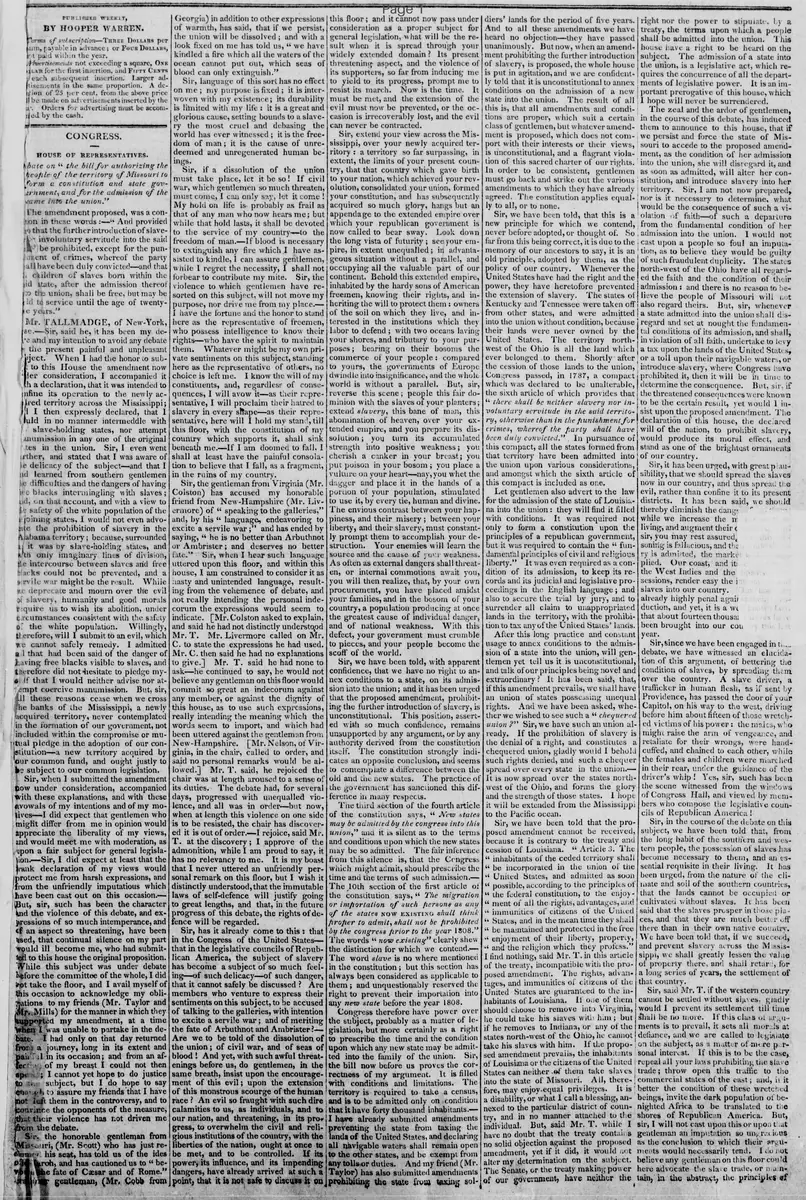
HOUSE OF REPRESENTATIVES.
Debate on 'the bill for authorizing the people of the territory of Missouri to form a constitution and state government, and for the admission of the same into the union.'
The amendment proposed, was a condition in these words: 'And provided, that the further introduction of slavery or involuntary servitude into the said territory be prohibited, except for the punishment of crimes, whereof the party shall have been duly convicted—and that the children of slaves born within the said state, after the admission thereof into the union, shall be free, but may be held to service until the age of twenty-five years.'
Mr. TALLMADGE, of New-York, rose—Sir, said he, it has been my desire and my intention to avoid any debate on the present painful and unpleasant subject. When I had the honor to submit to this House the amendment now under consideration, I accompanied it with a declaration, that it was intended to confine its operation to the newly acquired territory across the Mississippi; I then expressly declared, that I would in no manner intermeddle with the slave-holding states, nor attempt manumission in any one of the original states in the union. Sir, I even went further, and stated that I was aware of the delicacy of the subject—and that I had learned from southern gentlemen the difficulties and the dangers of having free blacks intermingling with slaves; and, on that account, and with a view to the safety of the white population of the adjoining states, I would not even advocate the prohibition of slavery in the Alabama territory; because, surrounded as it was by slave-holding states, and with only imaginary lines of division, the intercourse between slaves and free blacks could not be prevented, and a servile war might be the result. While we deprecate and mourn over the evil of slavery, humanity and good morals require us to wish its abolition, under circumstances consistent with the safety of the white population. Willingly, therefore, will I submit to an evil, which we cannot safely remedy. I admitted all that had been said of the danger of having free blacks visible to slaves, and therefore did not hesitate to pledge myself that I would neither advise nor attempt coercive manumission. But, sir, all these reasons cease when we cross the banks of the Mississippi, a newly acquired territory, never contemplated in the formation of our government, not included within the compromise or mutual pledge in the adoption of our constitution—a new territory acquired by our common fund, and ought justly to be subject to our common legislation.
Sir, when I submitted the amendment now under consideration, accompanied with these explanations, and with these avowals of my intentions and of my motives—I did expect that gentlemen who might differ from me in opinion would appreciate the liberality of my views, and would meet me with moderation, as upon a fair subject for general legislation.—Sir, I did expect at least that the frank declaration of my views would protect me from harsh expressions, and from the unfriendly imputations which have been cast out on this occasion.—But, sir, such has been the character and the violence of this debate, and expressions of so much intemperance, and of an aspect so threatening, have been used, that continual silence on my part would ill become me, who had submitted to this house the original proposition.
While this subject was under debate before the committee of the whole, I did not take the floor, and I avail myself of this occasion to acknowledge my obligations to my friends (Mr. Taylor and Mr. Mills) for the manner in which they supported my amendment, at a time when I was unable to partake in the debate. I had only on that day returned from a journey, long in its extent and painful in its occasion; and from an affection of my breast I could not then speak; I cannot yet hope to do justice to the subject, but I do hope to say enough to assure my friends that I have not left them in the controversy, and to convince the opponents of the measure, that their violence has not driven me from the debate.
Sir, the honorable gentleman from Missouri, (Mr. Scott) who has just resumed his seat, has told us of the ides of March, and has cautioned us to 'beware the fate of Cæsar and of Rome.' The gentleman, (Mr. Cobb from Georgia) in addition to other expressions of warmth, has said, that if we persist, the union will be dissolved; and with a look fixed on me has told us, 'we have kindled a fire which all the waters of the ocean cannot put out, which seas of blood can only extinguish.'
Sir, language of this sort has no effect on me; my purpose is fixed; it is interwoven with my existence; its durability is limited with my life: it is a great and glorious cause, setting bounds to a slavery the most cruel and debasing the world has ever witnessed; it is the freedom of man; it is the cause of unredeemed and unregenerated human beings.
Sir, if a dissolution of the union must take place, let it be so! If civil war, which gentlemen so much threaten, must come, I can only say, let it come! My hold on life is probably as frail as that of any man who now hears me; but while that hold lasts, it shall be devoted to the service of my country—to the freedom of man.—If blood is necessary to extinguish any fire which I have assisted to kindle, I can assure gentlemen, while I regret the necessity, I shall not forbear to contribute my mite. Sir, the violence to which gentlemen have resorted on this subject, will not move my purpose, nor drive me from my place.—I have the fortune and the honor to stand here as the representative of freemen, who possess intelligence to know their rights—who have the spirit to maintain them. Whatever might be my own private sentiments on this subject, standing here as the representative of others, no choice is left me. I know the will of my constituents, and, regardless of consequences, I will avow it—as their representative, I will proclaim their hatred to slavery in every shape—as their representative, here will I hold my stand, till this floor, with the constitution of my country which supports it, shall sink beneath me.—If I am doomed to fall, I shall at least have the painful consolation to believe that I fall, as a fragment, in the ruins of my country.
Sir, the gentleman from Virginia (Mr. Colston) has accused my honorable friend from New-Hampshire (Mr. Livermore) of 'speaking to the galleries,' and, by his 'language, endeavoring to excite a servile war;' and has ended by saying, 'he is no better than Arbuthnot or Ambrister; and deserves no better fate.' Sir, when I hear such language uttered upon this floor, and within this house, I am constrained to consider it as hasty and unintended language, resulting from the vehemence of debate, and not really intending the personal indecorum the expressions would seem to indicate. [Mr. Colston asked to explain, and said he had not distinctly understood Mr. T. Mr. Livermore called on Mr. C. to state the expressions he had used. Mr. C. then said he had no explanations to give.] Mr. T. said he had none to ask—he continued to say, he would not believe any gentleman on this floor would commit so great an indecorum against any member, or against the dignity of this house, as to use such expressions, really intending the meaning which the words seem to import, and which had been uttered against the gentleman from New-Hampshire. Mr. Nelson, of Virginia, in the chair, called to order, and said no personal remarks would be allowed.] Mr. T. said, he rejoiced the chair was at length aroused to a sense of its duties. The debate had, for several days, progressed with unequalled violence, and all was in order—but now, when at length this violence on one side is to be resisted, the chair has discovered it is out of order.—I rejoice, said Mr. T. at the discovery; I approve of the admonition, while I am proud to say, it has no relevancy to me. It is my boast that I never uttered an unfriendly personal remark on this floor, but I wish it distinctly understood, that the immutable laws of self-defence will justify going to great lengths, and that, in the future progress of this debate, the rights of defence will be regarded.
Sir, has it already come to this: that in the Congress of the United States—that in the legislative councils of Republican America, the subject of slavery has become a subject of so much feeling—of such delicacy—of such danger, that it cannot safely be discussed? Are members who venture to express their sentiments on this subject, to be accused of talking to the galleries, with intention to excite a servile war; and of meriting the fate of Arbuthnot and Ambrister? Are we to be told of the dissolution of the union; of civil war, and of seas of blood! And yet, with such awful threatenings before us, do gentlemen, in the same breath, insist upon the encouragement of this evil; upon the extension of this monstrous scourge of the human race? An evil so fraught with such dire calamities to us, as individuals, and to our nation, and threatening, in its progress, to overwhelm the civil and religious institutions of the country, with the liberties of the nation, ought at once to be met, and to be controlled. If its power, its influence, and its impending dangers, have already arrived at such a point, that it is not safe to discuss it on this floor; and it cannot now pass under consideration as a proper subject for general legislation, what will be the result when it is spread through your widely extended domain? Its present threatening aspect, and the violence of its supporters, so far from inducing me to yield to its progress, prompt me to resist its march. Now is the time. It must be met, and the extension of the evil must now be prevented, or the occasion is irrecoverably lost, and the evil can never be contracted.
Sir, extend your view across the Mississippi, over your newly acquired territory: a territory so far surpassing, in extent, the limits of your present country, that that country which gave birth to your nation, which achieved your revolution, consolidated your union, formed your constitution, and has subsequently acquired so much glory, hangs but an appendage to the extended empire over which your republican government is now called to bear sway. Look down the long vista of futurity; see your empire, in extent unequalled; in advantageous situation without a parallel, and occupying all the valuable part of our continent. Behold this extended empire, inhabited by the hardy sons of American freemen, knowing their rights, and inheriting the will to protect them: owners of the soil on which they live, and interested in the institutions which they labor to defend; with two oceans laving your shores, and tributary to your purposes; bearing on their bosoms the commerce of your people: compared to yours, the governments of Europe dwindle into insignificance, and the whole world is without a parallel. But, sir, reverse this scene; people this fair dominion with the slaves of your planters; extend slavery, this bane of man, this abomination of heaven, over your extended empire, and you prepare its dissolution; you turn its accumulated strength into positive weakness; you cherish a canker in your breast; you put poison in your bosom; you place a vulture on your heart—nay, you whet the dagger and place it in the hands of a portion of your population, stimulated to use it, by every tie, human and divine. The envious contrast between your happiness, and their misery; between your liberty, and their slavery, must constantly prompt them to accomplish your destruction. Your enemies will learn the source and the cause of your weakness. As often as external dangers shall threaten, or internal commotions await you, you will then realize, that, by your own procurement, you have placed amidst your families, and in the bosom of your country, a population producing at once the greatest cause of individual danger, and of national weakness. With this defect, your government must crumble to pieces, and your people become the scoff of the world.
Sir, we have been told, with apparent confidence, that we have no right to annex conditions to a state, on its admission into the union; and it has been urged that the proposed amendment, prohibiting the further introduction of slavery, is unconstitutional. This position, asserted with so much confidence, remains unsupported by any argument, or by any authority derived from the constitution itself. The constitution strongly indicates an opposite conclusion, and seems to contemplate a difference between the old and the new states. The practice of the government has sanctioned this difference in many respects.
The third section of the fourth article of the constitution says, 'New states may be admitted by the congress into this union,' and it is silent as to the terms and conditions upon which the new states may be so admitted. The fair inference from this silence is, that the Congress which might admit, should prescribe the time and the terms of such admission.—The 9th section of the first article of the constitution says, 'The migration or importation of such persons as any of the states now existing shall think proper to admit, shall not be prohibited by the congress prior to the year 1808.' The words 'now existing' clearly shew the distinction for which we contend.—The word slave is no where mentioned in the constitution: but this section has always been considered as applicable to them; and unquestionably reserved the right to prevent their importation into any new state before the year 1808. Congress therefore have power over the subject, probably as a matter of legislation, but more certainly as a right to prescribe the time and the condition upon which any new state may be admitted into the family of the union.
Sir, the bill now before us proves the correctness of my argument. It is filled with conditions and limitations. The territory is required to take a census, and is to be admitted only on condition that it have forty thousand inhabitants.—I have already submitted amendments preventing the state from taxing the lands of the United States, and declaring all navigable waters shall remain open to the other states, and be exempt from any tolls or duties. And my friend (Mr. Taylor) has also submitted amendments prohibiting the state from taxing soldiers' lands for the period of five years. And to all these amendments we have heard no objection—they have passed unanimously. But now, when an amendment prohibiting the further introduction of slavery, is proposed, the whole house is put in agitation, and we are confidently told that it is unconstitutional to annex conditions on the admission of a new state into the union. The result of all this is, that all amendments and conditions are proper, which suit a certain class of gentlemen, but whatever amendment is proposed, which does not comport with their interests or their views, is unconstitutional, and a flagrant violation of this sacred charter of our rights. In order to be consistent, gentlemen must go back and strike out the various amendments to which they have already agreed. The constitution applies equally to all, or to none.
Sir, we have been told, that this is a new principle for which we contend, never before adopted, or thought of. So far from this being correct, it is due to the memory of our ancestors to say, it is an old principle, adopted by them, as the policy of our country. 'Whenever the United States have had the right and the power, they have heretofore prevented the extension of slavery. The states of Kentucky and Tennessee were taken off from other states, and were admitted into the union without condition, because their lands were never owned by the United States. The territory north-west of the Ohio is all the land which ever belonged to them. Shortly after the cession of those lands to the union, Congress passed, in 1787, a compact which was declared to be unalterable, the sixth article of which provides that 'there shall be neither slavery nor involuntary servitude in the said territory, otherwise than in the punishment for crimes, whereof the party shall have been duly convicted.' In pursuance of this compact, all the states formed from that territory have been admitted into the union upon various considerations, and amongst which the sixth article of this compact is included as one.
Let gentlemen also advert to the law for the admission of the state of Louisiana into the union: they will find it filled with conditions. It was required not only to form a constitution upon the principles of a republican government, but it was required to contain the 'fundamental principles of civil and religious liberty.' It was even required as a condition of its admission, to keep its records and its judicial and legislative proceedings in the English language; and also to secure the trial by jury, and to surrender all claim to unappropriated lands in the territory, with the prohibition to tax any of the United States' lands. After this long practice and constant usage to annex conditions to the admission of a state into the union, will gentlemen yet tell us it is unconstitutional, and talk of our principles being novel and extraordinary?
It has been said, that if this amendment prevails, we shall have an union of states possessing unequal rights. And we have been asked, whether we wished to see such a 'chequered union?' Sir, we have such an union already. If the prohibition of slavery is the denial of a right, and constitutes a chequered union, gladly would I behold such rights denied, and such a chequer spread over every state in the union.—It is now spread over the states north-west of the Ohio, and forms the glory and the strength of those states. I hope it will be extended from the Mississippi to the Pacific ocean.
Sir, we have been told that the proposed amendment cannot be received, because it is contrary to the treaty and cession of Louisiana. 'Article 3. The inhabitants of the ceded territory shall be incorporated in the union of the United States, and admitted as soon as possible, according to the principles of the federal constitution, to the enjoyment of all the rights, advantages, and immunities of citizens of the United States, and in the mean time they shall be maintained and protected in the free enjoyment of their liberty, property, and the religion which they profess.' I find nothing, said Mr. T. in this article of the treaty, incompatible with the proposed amendment. The rights, advantages, and immunities of citizens of the United States are guaranteed to the inhabitants of Louisiana. If one of them should choose to remove into Virginia, he could take his slaves with him; but if he removes to Indiana, or any of the states north-west of the Ohio, he cannot take his slaves with him. If the proposed amendment prevails, the inhabitants of Louisiana or the citizens of the United States can neither of them take slaves into the state of Missouri. All, therefore, may enjoy equal privileges. It is a disability, or what I call a blessing, annexed to the particular district of country, and in no manner attached to the individual.
But, said Mr. T. while I have no doubt that the treaty contains no solid objection against the proposed amendment, yet if it did, it would not alter my determination on the subject. The Senate, or the treaty making power of our government, have neither the right nor the power to stipulate, by a treaty, the terms upon which a people shall be admitted into the union. This house have a right to be heard on the subject. The admission of a state into the union, is a legislative act, which requires the concurrence of all the departments of legislative power. It is an important prerogative of this house, which I hope will never be surrendered.
The zeal and the ardor of gentlemen, in the course of this debate, has induced them to announce to this house, that if we persist and force the state of Missouri to accede to the proposed amendment, as the condition of her admission into the union, she will disregard it, and as soon as admitted, will alter her constitution, and introduce slavery into her territory. Sir, I am not now prepared, nor is it necessary to determine, what would be the consequence of such a violation of faith—of such a departure from the fundamental condition of her admission into the union. I would not cast upon a people so foul an imputation, as to believe they would be guilty of such fraudulent duplicity. The states north-west of the Ohio have all regarded the faith and the condition of their admission: and there is no reason to believe the people of Missouri will not also regard theirs. But, sir, whenever a state admitted into the union shall disregard and set at nought the fundamental conditions of its admission, and shall, in violation of all faith, undertake to levy a tax upon the lands of the United States, or a toll upon their navigable waters, or introduce slavery, where Congress have prohibited it, then it will be in time to determine the consequence. But, sir, if the threatened consequences were known to be the certain result, yet would I insist upon the proposed amendment. The declaration of this house, the declared will of the nation, to prohibit slavery, would produce its moral effect, and stand as one of the brightest ornaments of our country.
Sir, it has been urged, with great plausibility, that we should spread the slaves now in our country, and thus spread the evil, rather than confine it to its present districts. It has been said, we should thereby diminish the danger while we increase the number of the living, and augment their comforts. Sir, you may rest assured, that this reasoning is fallacious, and that if slavery is admitted, the market will be abundantly supplied. Our coast, and its proximity to the West Indies and the Spanish possessions, render easy the introduction of slaves into our country. It is already highly penal against introduction, and yet, it is a well known fact that about fourteen thousand have been brought into our country the last year.
Sir, since we have been engaged in this debate, we have witnessed an elucidation of this argument, of bettering the condition of slaves, by spreading them over the country. A slave driver, a trafficker in human flesh, as if sent by Providence, has passed the door of your Capitol, on his way to the west, driving before him about fifteen of those wretched victims of his power: the males, who might raise the arm of vengeance, and retaliate for their wrongs, were handcuffed, and chained to each other, while the females and children were marched in their rear, under the guidance of the driver's whip! Yes, sir, such has been the scene witnessed from the windows of Congress Hall, and viewed by members who compose the legislative councils of Republican America!
Sir, in the course of the debate on this subject, we have been told that, from the long habit of the southern and western people, the possession of slaves has become necessary to them, and an essential requisite in their living. It has been urged, from the nature of the climate and soil of the southern countries, that the lands cannot be occupied or cultivated without slaves. It has been said that the slaves prosper in those places, and that they are much better off there than in their own native country. We have been told that, if we succeed, and prevent slavery across the Mississippi, we shall greatly lessen the value of property there, and shall retard, for a long series of years, the settlement of that country.
Sir, said Mr. T. if the western country cannot be settled without slaves, gladly would I prevent its settlement till time shall be no more. If this class of arguments is to prevail, it sets all morals at defiance, and we are called to legislate on the subject, as a matter of mere personal interest. If this is to be the case, repeal all your laws prohibiting the slave trade; throw open this traffic to the commercial states of the east; and, if it better the condition of these wretched beings, invite the dark population of benighted Africa to be translated to the shores of Republican America. But, sir, I will not cast upon this or upon that gentleman an imputation so ungracious as the conclusion to which their arguments would necessarily tend. I do not believe any gentleman on this floor could here advocate the slave trade, or maintain, in the abstract, the principles of slavery. Such advocacy would be shocking to the moral sense of the community, and would be reprobated by the free and enlightened portion of our citizens.
slavery. I will not outrage the decorum, nor insult the dignity of this house, by attempting to argue in this place, as an abstract proposition, the moral right of slavery. How gladly would the "legitimates of Europe" chuckle to find an American Congress in debate on such a question!
As an evil brought upon us without our own fault, before the formation of our government, and as one of the sins of that nation from which we have revolted, we must of necessity legislate upon this subject. It is our business so to legislate, as never to encourage, but always to control this evil; and, while we strive to eradicate it, we ought to fix its limits, and render it subordinate to the safety of the white population, and the good order of civil society.
Sir, on this subject the eyes of Europe are turned upon you. You boast of the freedom of your constitution and your laws; you have proclaimed, in the Declaration of Independence, "That all men are created equal, that they are endowed by their Creator with certain unalienable rights--that amongst these are life, liberty, and the pursuit of happiness;" and yet you have slaves in your country. The enemies of your government, and the legitimates of Europe, point to your inconsistencies, and blazon your supposed defects. If you allow slavery to pass into territories where you have the lawful power to exclude it, you will justly take upon yourself all the charges of inconsistency; but, confine it to the original slave holding states, where you found it at the formation of your government, and you stand acquitted of all imputation.
Sir, this is a subject upon which I have great feeling for the honor of my country. In a former debate upon the Illinois constitution, I mentioned that our enemies had drawn a picture of our country, as holding in one hand the Declaration of Independence, and with the other brandishing a whip over our affrighted slaves. I then made it my boast that we could cast back upon England the accusation, and that she had committed the original sin of bringing slaves into our country. Sir, I have since received, through the post office, a letter, post-marked in South Carolina, and signed "A Native of England," desiring that, when I again had occasion to repeat my boast against England, I would also state that she had atoned for her original sin, by establishing in her slave colonies a system of humane laws, ameliorating their condition, and providing for their safety: while America had committed the secondary sin of disregarding their condition, and had even provided laws by which it was not murder to kill a slave. Sir, I felt the severity of the reproof; and felt for my country. I have inquired on the subject, and I find such were formerly the laws in some of the slave holding states; and that even now in the state of South Carolina, by law, the penalty of death is provided for stealing a slave, while the murder of a slave is punished by a trivial fine. Such, sir, is the contrast and the relative value which is placed, in the opinion of a slave holding state, between the property of the master and the life of a slave.
Sir, gentlemen have undertaken to discriminate and to draw odious contrasts between different sections of our country. I shall not combat such arguments; I have made no pretence to exclusive morality on this subject, either for myself or my constituents; nor have I cast any imputations on others. On the contrary, I hold, that mankind under like circumstances are alike, the world over. The vicious and the unprincipled are confined to no district of country; and it is for this portion of the community we are bound to legislate. When honorable gentlemen inform us we overrate the cruelty and the dangers of slavery, and tell us that their slaves are happy and contented, and would even contribute to their safety, they tell us but very little: they do not tell us, that, while their slaves are happy, the slaves of some depraved and cruel wretch, in their neighborhood, may not be stimulated to revenge, and thus involve the country in ruin. If we had to legislate only for such gentlemen as are now embraced within my view, a law against robbing the mail would be a disgrace upon the nation; and, as useless, I would tear it from the pages of your statute book: yet sad experience has taught us the necessity of such laws--and honor, justice, and policy, teach us the wisdom of legislating to limit the extension of slavery.
Sir, in the zeal to draw sectional contrasts, we have been told by one gentleman, that gentlemen from one district of country talk of their religion and their morality, while those of another practice it. And the superior liberality has been asserted of southern gentlemen over those of the north, in all contributions to moral institutions, for Bible and missionary societies. Sir, I understand too well the pursuit of my purpose to be deceived, and drawn off into the discussion of a collateral subject. I have no inclination to controvert these assertions of comparative liberality. Although I have no idea they are founded in fact, yet, because it better suits the object of my present argument, I will on this occasion, admit them to the fullest extent. And what is the result? Southern gentlemen, by their superior liberality in contributions to moral institutions, justly stand in the first rank; and hold the first place in the brightest page of the history of our country. But, turn over this page and what do you behold? You behold them contributing to teach the doctrines
of Christianity in every quarter of the globe. You behold them legislating to secure the ignorance and stupidity of their own slaves! You behold them prescribing by law, penalties against the man that dares teach a negro to read. Such, sir, is the statute law of the state of Virginia. Mr. Bassett and Mr. Tyler said that there was no such law in Virginia. No, sir, said Mr. T. I have misspoken myself; I ought to have said, such is the statute law of the state of Georgia. Yes, sir, while we hear of a liberality which civilizes the savages of all countries, and carries the gospel alike to the Hottentot and the Hindoo, it has been reserved for the republican state of Georgia, not content with the care of its overseers, to legislate to secure the oppression & the ignorance of their slaves. The man who there teaches a negro to read is liable to a criminal prosecution. The dark benighted beings of all creation profit by our liberality--save those on our own plantations. Where is the missionary who possesses sufficient hardihood to venture a residence to teach the slaves of a plantation? Here is the stain! Here is the stigma!--which fastens upon the character of our country; and which, in the appropriate language of the gentleman from Georgia, (Mr. Cobb,) all the waters of the ocean cannot wash out; which seas of blood can only take away.
Sir, there is yet another, and an important point of view in which this subject ought to be considered. We have been told by those who advocate the extension of slavery into Missouri, that any attempt to control this subject by legislation is a violation of that faith and mutual confidence upon which our union was formed and our constitution adopted. This argument might be considered plausible, if the restriction was attempted to be enforced against any of the slave holding states, which had been a party in the adoption of the constitution. But it can have no reference or application to a new district of country recently acquired, and never contemplated in the formation of the government, and not embraced in the mutual concessions and declared faith upon which the constitution was adopted. The constitution provides, that the representatives of the several states to this house shall be according to their numbers, including three-fifths of the slaves in the respective states. This is an important benefit yielded to the slave holding states, as one of the mutual sacrifices of the union. On this subject, I consider the faith of the union pledged, and I never would attempt coercive manumission in a slave holding state.
But none of the causes which induced the sacrifice of this principle; and which now produce such an unequal representation of the free population of the country, exist as between us and the newly acquired territory across the Mississippi. That portion of country has no claims to such an unequal representation, unjust in its results upon the other states. Are the numerous slaves in extensive countries, which we may acquire by purchase, and admit as states into the union, at once to be represented on this floor, under a clause of the constitution, granted as a compromise and a benefit to the southern states which had borne part in the revolution? Such an extension of that clause in the constitution would be unjust in its operations, unequal in its results, and a violation of its original intention. Abstract from the moral effects of slavery, its political consequences in the representation under this clause of the constitution, demonstrate the importance of the proposed amendment.
Sir, I shall bow in silence to the will of the majority, on which ever side it shall be expressed; yet I confidently hope that majority will be found on the side of an amendment so replete with moral consequences, so pregnant with important political results.
What sub-type of article is it?
What themes does it cover?
What keywords are associated?
What entities or persons were involved?
Where did it happen?
Story Details
Key Persons
Location
House Of Representatives
Story Details
Mr. Tallmadge defends his amendment to prohibit further slavery in Missouri Territory, except for crime punishment, and free children of slaves at age 25; argues it applies only to new territory, not original states; responds to opponents' threats of union dissolution and civil war; asserts Congress's power to impose conditions on new states' admission; cites precedents like Northwest Ordinance and Louisiana admission; warns of slavery's dangers to the union and morality.