Thank you for visiting SNEWPapers!
Sign up free
Alexandria Gazette
Alexandria, Alexandria County, District Of Columbia
What is this article about?
In Charleston, SC, slave Frederick, owned by Mrs. M. Michel, was tried for robbing multiple churches. Charged under an old English statute making it a capital offense, but convicted only of larceny. Sentenced to two months imprisonment with solitary and labor, plus 20 lashes in April and May. First such trial in state history sparked debate on statute's validity.
Clipping
OCR Quality
Full Text
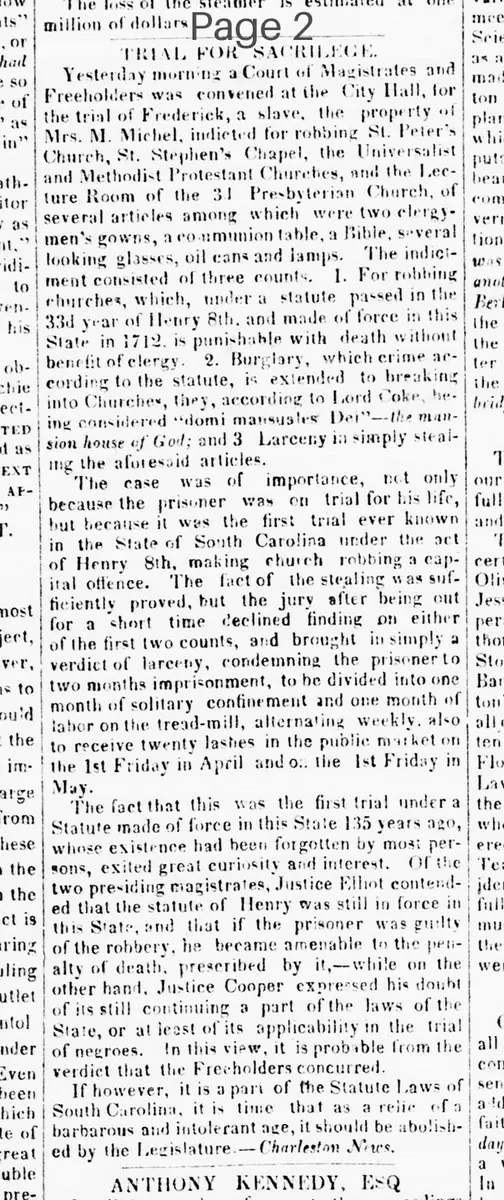
Yesterday morning a Court of Magistrates and Freeholders was convened at the City Hall, for the trial of Frederick, a slave, the property of Mrs. M. Michel, indicted for robbing St. Peter's Church, St. Stephen's Chapel, the Universalist and Methodist Protestant Churches, and the Lecture Room of the 1st Presbyterian Church, of several articles among which were two clergymen's gowns, a communion table, a Bible, several looking glasses, oil cans and lamps. The indictment consisted of three counts. 1. For robbing churches, which, under a statute passed in the 3d year of Henry 8th, and made of force in this State in 1712, is punishable with death without benefit of clergy. 2. Burglary, which crime according to the statute, is extended to breaking into Churches, they, according to Lord Coke, being considered "domus mansuetris Dei"—the mansion house of God; and 3 Larceny in simply stealing the aforesaid articles.
The case was of importance, not only because the prisoner was on trial for his life, but because it was the first trial ever known in the State of South Carolina under the act of Henry 8th, making church robbing a capital offence. The fact of the stealing was sufficiently proved, but the jury after being out for a short time declined finding on either of the first two counts, and brought in simply a verdict of larceny, condemning the prisoner to two months imprisonment, to be divided into one month of solitary confinement and one month of labor on the tread-mill, alternating weekly, also to receive twenty lashes in the public market on the 1st Friday in April and on the 1st Friday in May.
The fact that this was the first trial under a Statute made of force in this State 135 years ago, whose existence had been forgotten by most persons, excited great curiosity and interest. Of the two presiding magistrates, Justice Elliot contended that the statute of Henry was still in force in this State, and that if the prisoner was guilty of the robbery, he became amenable to the penalty of death, prescribed by it,—while on the other hand, Justice Cooper expressed his doubt of its still continuing a part of the laws of the State, or at least of its applicability in the trial of negroes. In this view, it is probable from the verdict that the Freeholders concurred.
If however, it is a part of the Statute Laws of South Carolina, it is time that as a relic of a barbarous and intolerant age, it should be abolished by the Legislature.—Charleston News.
What sub-type of article is it?
What keywords are associated?
What entities or persons were involved?
Where did it happen?
Domestic News Details
Primary Location
Charleston, South Carolina
Event Date
Yesterday Morning
Key Persons
Outcome
verdict of larceny; sentenced to two months imprisonment (one month solitary confinement and one month labor on the tread-mill, alternating weekly); to receive twenty lashes in the public market on the 1st friday in april and on the 1st friday in may.
Event Details
A Court of Magistrates and Freeholders tried Frederick, a slave owned by Mrs. M. Michel, for robbing several churches including St. Peter's Church, St. Stephen's Chapel, Universalist and Methodist Protestant Churches, and the Lecture Room of the 1st Presbyterian Church. Items stolen included two clergymen's gowns, a communion table, a Bible, looking glasses, oil cans, and lamps. Indicted on three counts: robbing churches (capital under 3d year of Henry 8th statute, in force since 1712), burglary, and larceny. First such trial in South Carolina. Stealing proved, but jury convicted only on larceny. Justices debated statute's applicability to negroes.