Thank you for visiting SNEWPapers!
Sign up free
Story
April 9, 1875
The Rutland Daily Globe
Rutland, Rutland County, Vermont
What is this article about?
Professor F. W. Walker died from paralysis caused by an overdose of hemlock extract prescribed for muscular contraction. He documented symptoms as they progressed until his death in Brooklyn, observed by his wife.
Clipping
OCR Quality
95%
Excellent
Full Text
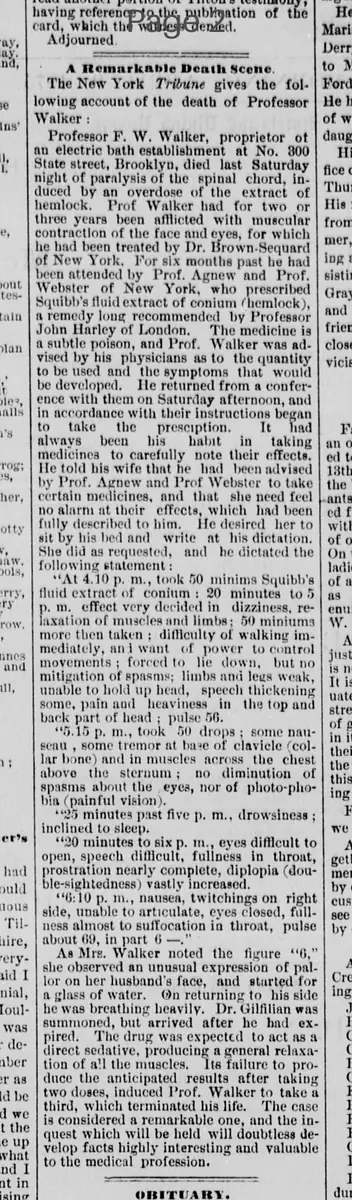
A Remarkable Death Scene
The New York Tribune gives the following account of the death of Professor Walker:
Professor F. W. Walker, proprietor of an electric bath establishment at No. 300 State street, Brooklyn, died last Saturday night of paralysis of the spinal chord, induced by an overdose of the extract of hemlock. Prof Walker had for two or three years been afflicted with muscular contraction of the face and eyes, for which he had been treated by Dr. Brown-Sequard of New York. For six months past he had been attended by Prof. Agnew and Prof. Webster of New York, who prescribed Squibb's fluid extract of conium (hemlock), a remedy long recommended by Professor John Harley of London. The medicine is a subtle poison, and Prof. Walker was advised by his physicians as to the quantity to be used and the symptoms that would be developed. He returned from a conference with them on Saturday afternoon, and in accordance with their instructions began to take the prescription. It had always been his habit in taking medicines to carefully note their effects. He told his wife that he had been advised by Prof. Agnew and Prof. Webster to take certain medicines, and that she need feel no alarm at their effects, which had been fully described to him. He desired her to sit by his bed and write at his dictation. She did as requested, and he dictated the following statement:
"At 4.10 p. m., took 50 minims Squibb's fluid extract of conium: 20 minutes to 5 p. m. effect very decided in dizziness, relaxation of muscles and limbs; 50 minims more then taken: difficulty of walking immediately, and want of power to control movements; forced to lie down, but no mitigation of spasms; limbs and legs weak, unable to hold up head, speech thickening some, pain and heaviness in the top and back part of head: pulse 56.
"5.15 p. m., took 50 drops; some nausea, some tremor at base of clavicle (collar bone) and in muscles across the chest above the sternum; no diminution of spasms about the eyes, nor of photo-phobia (painful vision).
5 minutes past five p. m., drowsiness; inclined to sleep.
"20 minutes to six p. m., eyes difficult to open, speech difficult, fullness in throat, prostration nearly complete, diplopia (double-sightedness) vastly increased.
"6:10 p. m., nausea, twitchings on right side, unable to articulate, eyes closed, fullness almost to suffocation in throat, pulse about 69, in part 6-.
As Mrs. Walker noted the figure "6," she observed an unusual expression of pallor on her husband's face, and started for a glass of water. On returning to his side he was breathing heavily. Dr. Gilfilian was summoned, but arrived after he had expired. The drug was expected to act as a direct sedative, producing a general relaxation of all the muscles. Its failure to produce the anticipated results after taking two doses, induced Prof. Walker to take a third, which terminated his life. The case is considered a remarkable one, and the inquest which will be held will doubtless develop facts highly interesting and valuable to the medical profession.
The New York Tribune gives the following account of the death of Professor Walker:
Professor F. W. Walker, proprietor of an electric bath establishment at No. 300 State street, Brooklyn, died last Saturday night of paralysis of the spinal chord, induced by an overdose of the extract of hemlock. Prof Walker had for two or three years been afflicted with muscular contraction of the face and eyes, for which he had been treated by Dr. Brown-Sequard of New York. For six months past he had been attended by Prof. Agnew and Prof. Webster of New York, who prescribed Squibb's fluid extract of conium (hemlock), a remedy long recommended by Professor John Harley of London. The medicine is a subtle poison, and Prof. Walker was advised by his physicians as to the quantity to be used and the symptoms that would be developed. He returned from a conference with them on Saturday afternoon, and in accordance with their instructions began to take the prescription. It had always been his habit in taking medicines to carefully note their effects. He told his wife that he had been advised by Prof. Agnew and Prof. Webster to take certain medicines, and that she need feel no alarm at their effects, which had been fully described to him. He desired her to sit by his bed and write at his dictation. She did as requested, and he dictated the following statement:
"At 4.10 p. m., took 50 minims Squibb's fluid extract of conium: 20 minutes to 5 p. m. effect very decided in dizziness, relaxation of muscles and limbs; 50 minims more then taken: difficulty of walking immediately, and want of power to control movements; forced to lie down, but no mitigation of spasms; limbs and legs weak, unable to hold up head, speech thickening some, pain and heaviness in the top and back part of head: pulse 56.
"5.15 p. m., took 50 drops; some nausea, some tremor at base of clavicle (collar bone) and in muscles across the chest above the sternum; no diminution of spasms about the eyes, nor of photo-phobia (painful vision).
5 minutes past five p. m., drowsiness; inclined to sleep.
"20 minutes to six p. m., eyes difficult to open, speech difficult, fullness in throat, prostration nearly complete, diplopia (double-sightedness) vastly increased.
"6:10 p. m., nausea, twitchings on right side, unable to articulate, eyes closed, fullness almost to suffocation in throat, pulse about 69, in part 6-.
As Mrs. Walker noted the figure "6," she observed an unusual expression of pallor on her husband's face, and started for a glass of water. On returning to his side he was breathing heavily. Dr. Gilfilian was summoned, but arrived after he had expired. The drug was expected to act as a direct sedative, producing a general relaxation of all the muscles. Its failure to produce the anticipated results after taking two doses, induced Prof. Walker to take a third, which terminated his life. The case is considered a remarkable one, and the inquest which will be held will doubtless develop facts highly interesting and valuable to the medical profession.
What sub-type of article is it?
Medical Curiosity
Biography
Curiosity
What themes does it cover?
Tragedy
Misfortune
What keywords are associated?
Hemlock Overdose
Medical Death
Paralysis
Conium Extract
Symptom Dictation
Spinal Chord Paralysis
What entities or persons were involved?
Professor F. W. Walker
Dr. Brown Sequard
Prof. Agnew
Prof. Webster
Professor John Harley
Mrs. Walker
Dr. Gilfilian
Where did it happen?
No. 300 State Street, Brooklyn
Story Details
Key Persons
Professor F. W. Walker
Dr. Brown Sequard
Prof. Agnew
Prof. Webster
Professor John Harley
Mrs. Walker
Dr. Gilfilian
Location
No. 300 State Street, Brooklyn
Event Date
Last Saturday Night
Story Details
Professor Walker, suffering from muscular contraction, took prescribed hemlock extract and dictated symptoms to his wife as they worsened, leading to his death from overdose paralysis.