Thank you for visiting SNEWPapers!
Sign up free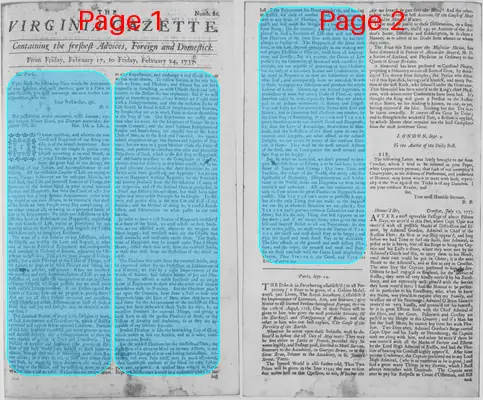
The Virginia Gazette
Richmond, Williamsburg, Richmond County, Virginia
What is this article about?
Philosophical essay submitted to Mr. Parks for the Gazette, arguing that true happiness and felicity arise from virtue, wisdom, and intellectual pleasures, not from sensual delights, avarice, or ambition. It critiques mistaken pursuits and emphasizes following nature and moral integrity, quoting Horace and Shaftesbury.
Merged-components note: This is a single philosophical essay presented as a letter to the editor, continuing directly from page 1 to page 2. The second part was mislabeled as 'literary' but belongs to the letter.
Clippings
1 of 2
OCR Quality
Full Text
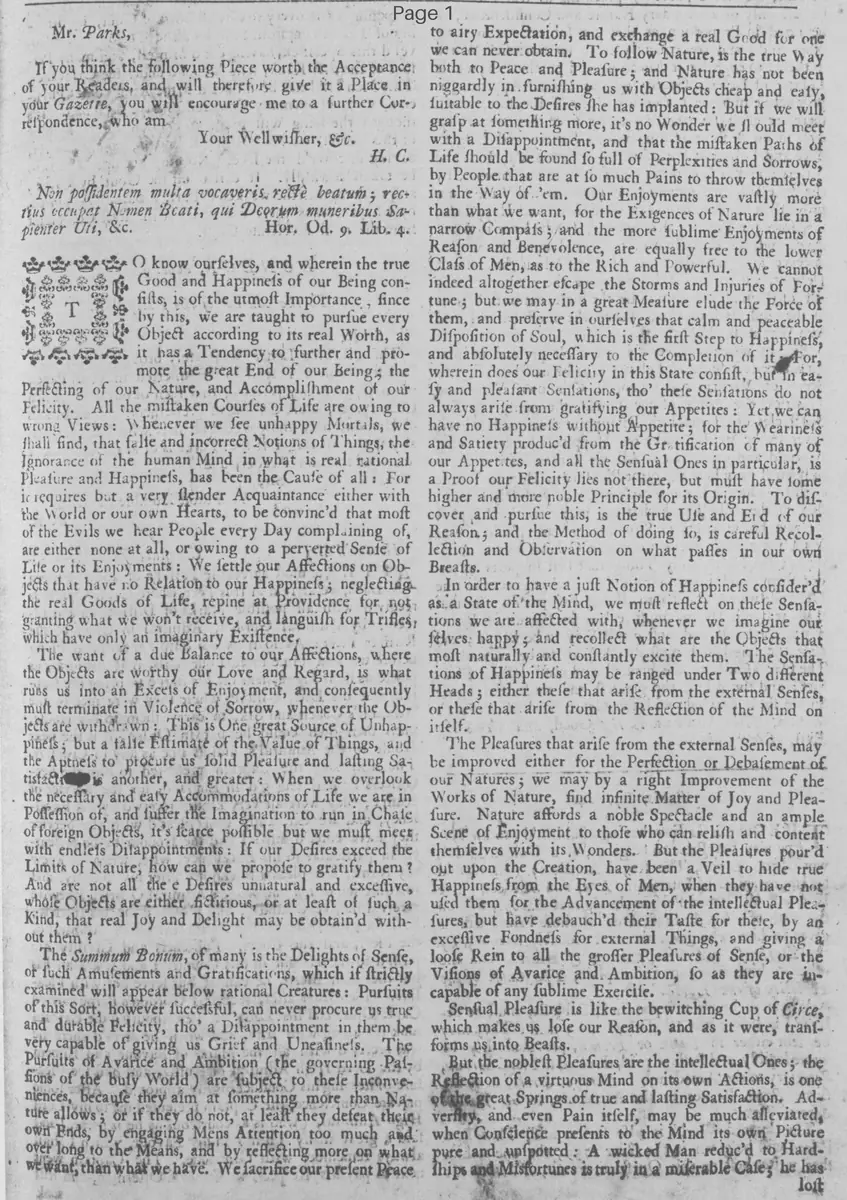
If you think the following Piece worth the Acceptance of your Readers, and will therefore give it a Place in your Gazette, you will encourage me to a further Correspondence, who am
Your Wellwisher, &c.
H. C.
Non quiescentem multa vocaveris recte beatum; rectius occupat Nomen beati, qui Deorum muneribus sapienter uti, &c.
Hor. Od. 9. Lib. 4.
To know ourselves, and wherein the true Good and Happiness of our Being consists, is of the utmost Importance, since by this, we are taught to pursue every Object according to its real Worth, as it has a Tendency to further and promote the great End of our Being; the Perfecting of our Nature, and Accomplishment of our Felicity. All the mistaken Courses of Life are owing to wrong Views: Whenever we see unhappy Mortals, we shall find, that false and incorrect Notions of Things, the Ignorance of the human Mind in what is real rational Pleasure and Happiness, has been the Cause of all: For it requires but a very slender Acquaintance either with the World or our own Hearts, to be convinc'd that most of the Evils we hear People every Day complaining of, are either none at all, or owing to a perverted Sense of Life or its Enjoyments: We settle our Affections on Objects that have no Relation to our Happiness; neglecting the real Goods of Life, repine at Providence for not granting what we would not receive, and languish for Trifles, which have only an imaginary Existence.
The want of a due Balance to our Affections, where the Objects are worthy our Love and Regard, is what runs us into an Excess of Enjoyment, and consequently must terminate in Violence of Sorrow, whenever the Objects are withdrawn: This is One great Source of Unhappiness; but a false Estimate of the Value of Things, and the Aptness to procure us solid Pleasure and lasting Satisfaction is another, and greater: When we overlook the necessary and easy Accommodations of Life we are in Possession of, and suffer the Imagination to run in Chase of foreign Objects, it's scarce possible but we must meet with endless Disappointments: If our Desires exceed the Limits of Nature, how can we propose to gratify them? And are not all these Desires unnatural and excessive, whose Objects are either fictitious, or at least of such a Kind, that real Joy and Delight may be obtain'd without them?
The Summum Bonum, of many is the Delights of Sense, of such Amusements and Gratifications, which if strictly examined will appear below rational Creatures: Pursuits of this Sort, however successful, can never procure us true and durable Felicity, tho' a Disappointment in them be very capable of giving us Grief and Uneasiness. The Pursuits of Avarice and Ambition (the governing Passions of the busy World) are subject to these Inconveniences, because they aim at something more than Nature allows; or if they do not, at least they defeat their own Ends; by engaging Mens Attention too much and over long to the Means, and by reflecting more on what we want, than what we have. We sacrifice our present Peace to airy Expectation, and exchange a real Good for one we can never obtain. To follow Nature, is the true Way both to Peace and Pleasure; and Nature has not been niggardly in furnishing us with Objects cheap and easy, suitable to the Desires She has implanted: But if we will grasp at something more, it's no Wonder we should meet with a Disappointment, and that the mistaken Paths of Life should be found so full of Perplexities and Sorrows, by People that are at so much Pains to throw themselves in the Way of 'em. Our Enjoyments are vastly more than what we want, for the Exigences of Nature lie in a narrow Compass; and the more sublime Enjoyments of Reason and Benevolence, are equally free to the lower Class of Men, as to the Rich and Powerful. We cannot indeed altogether escape the Storms and Injuries of Fortune; but we may in a great Measure elude the Force of them, and preserve in ourselves that calm and peaceable Disposition of Soul, which is the first Step to Happiness, and absolutely necessary to the Completion of it: For, wherein does our Felicity in this State consist, but in easy and pleasant Sensations, tho' these Sensations do not always arise from gratifying our Appetites: Yet, we can have no Happiness without Appetite; for the Weariness and Satiety produc'd from the Gratification of many of our Appetites, and all the Sensual Ones in particular, is a Proof our Felicity lies not there, but must have some higher and more noble Principle for its Origin. To discover and pursue this, is the true Use and End of our Reason; and the Method of doing so, is careful Recollection and Observation on what passes in our own Breasts.
In order to have a just Notion of Happiness consider'd as a State of the Mind, we must reflect on those Sensations we are affected with, whenever we imagine ourselves happy; and recollect what are the Objects that most naturally and constantly excite them. The Sensations of Happiness may be ranged under Two different Heads; either those that arise from the external Senses, or those that arise from the Reflection of the Mind on itself.
The Pleasures that arise from the external Senses, may be improved either for the Perfection or Debasing of our Natures; we may by a right Improvement of the Works of Nature, find infinite Matter of Joy and Pleasure. Nature affords a noble Spectacle and an ample Scene of Enjoyment to those who can relish and content themselves with its Wonders. But the Pleasures pour'd out upon the Creation, have been a Veil to hide true Happiness from the Eyes of Men, when they have not used them for the Advancement of the intellectual Pleasures, but have debauch'd their Taste for these, by an excessive Fondness for external Things, and giving a loose Rein to all the grosser Pleasures of Sense, or the Visions of Avarice and Ambition, so as they are incapable of any sublime Exercise.
Sensual Pleasure is like the bewitching Cup of Circe, which makes us lose our Reason, and as it were, transforms us into Beasts.
But the noblest Pleasures are the intellectual Ones; the Reflection of a virtuous Mind on its own Actions, is one of the great Springs of true and lasting Satisfaction. Adversity, and even Pain itself, may be much alleviated, when Conscience presents to the Mind its own Picture pure and unspotted: A wicked Man reduc'd to Hardships and Misfortunes is truly in a miserable Case; he has lost all the Enjoyments his Heart was set on, and having no Relish for those of another Kind, is left altogether dead to any Sense of Pleasure, and must of Course languish and sink under the Weight of a joyless and wearisome Being: On the contrary, a good Man can never be placed in such a Situation of Life that will not afford him Pleasures of the same Sort with those he has been always in Pursuit of. The Happiness of the Mind then does, in this Life, depend principally in our making wise and proper Elections of Pleasure, free from all Interruptions and Defects: But it's evident, the Goods of Life pursu'd by the Generality of Mankind with excessive Solicitude, are not capable of procuring us true Pleasure; but are only of a secondary Nature and Consideration, to be rated in Proportion as they are subservient to some other End; and consequently have no intrinsic Worth in them to engross our Affections and purchase the whole Labour of Lives. Gratifying our sensual Appetites, is productive of none but unruly Gusts of Pleasure, which therefore can't be true, especially since they are always and in an Instant terminated in Satiety and Disgust. Vice and Folly are but convertible Terms with Evil and Misery; and as Contraries best illustrate one another, by the same Way of Reasoning, WISDOM and VIRTUE prove themselves to be our chiefest Good and Happiness; for, since the Love of knowledge, Benevolence to Mankind, and the Reflection of the Mind upon its own Innocence and Integrity, are what afford us the calmest Delight, we Can never be weary of the constant Exercise of them: They must be the most natural Actions of the Soul, and of Consequence the most natural and sure Way to be happy.
But, by what we have said, we don't pretend to imagine perfect State of Felicity is to be had here, in this Scene of Vanity and Change: Our own Vices and Frailties, the Abuse of the World, the many offensive Spectacles of Humanity, Disappointments and Misfortunes in the World, make our Happiness far from being unmix'd and unbroken: All we can endeavour at, is only to know where the great Pleasure or Happiness does consist. Our VIRTUE can't make us perfectly happy; but it's the only Thing that can make us the happiest we can be, in whatever Situation we are plac'd: Our VIRTUE can't prevent common Calamities and Accidents; but it's the only Thing that best supports us under them; and if we escape them, what gives the true Use and sweetest Relish to all our Enjoyments: So that if we reason justly, we must reckon the Pursuit of VIRTUE the surest and most direct Way to be happy; and Vice the surest and most direct Way to be miserable: The One affords us the greatest and most lasting Pleasure; and the other, the greatest and most real Pain: So we shall conclude with the Great Lord Shaftesbury's Maxim, That Virtue is the Good, and Vice the Evil, of every one.
What sub-type of article is it?
What themes does it cover?
What keywords are associated?
What entities or persons were involved?
Letter to Editor Details
Author
H. C.
Recipient
Mr. Parks
Main Argument
true happiness consists in pursuing virtue, wisdom, and intellectual pleasures rather than sensual delights, avarice, or ambition, which lead to disappointment and misery; virtue provides the greatest and most lasting felicity despite life's imperfections.
Notable Details