Thank you for visiting SNEWPapers!
Sign up free
Editorial
September 14, 1803
Alexandria Advertiser And Commercial Intelligencer
Alexandria, Virginia
What is this article about?
This editorial, signed 'CALCULATOR,' critiques the potential US purchase of Louisiana or the Floridas, arguing it would strain national finances due to debt, scarce capital, settlement costs, and defense burdens, referencing Mr. Livingston's memorial on France's colonial disadvantages.
Clipping
OCR Quality
98%
Excellent
Full Text
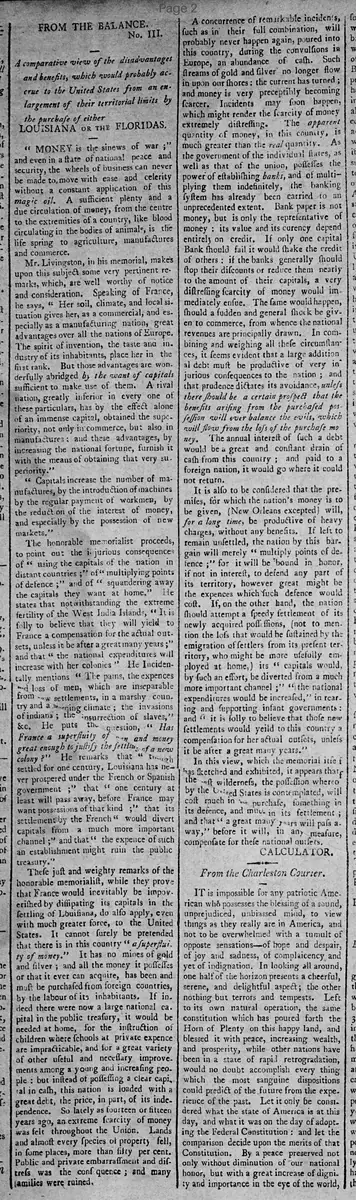
FROM THE BALANCE.
No. III.
A comparative view of the disadvantages and benefits, which would probably accrue to the United States from an enlargement of their territorial limits by the purchase of either LOUISIANA OR THE FLORIDAS.
"MONEY is the sinews of war;" and even in a state of national peace and security, the wheels of business can never be made to move with ease and celerity without a constant application of this magic oil. A sufficient plenty and a due circulation of money, from the centre to the extremities of a country, like blood circulating in the bodies of animals, is the life spring to agriculture, manufactures and commerce.
Mr. Livingston, in his memorial, makes upon this subject some very pertinent remarks, which are well worthy of notice and consideration. Speaking of France, he says, "Her soil, climate, and local situation gives her, as a commercial, and especially as a manufacturing nation, great advantages over all the nations of Europe. The spirit of invention, the taste and industry of its inhabitants, place her in the first rank. But those advantages are wonderfully abridged by the want of capitals sufficient to make use of them. A rival nation, greatly inferior in every one of these particulars, has by the effect alone of an immense capital, obtained the superiority, not only in commerce, but also in manufactures: and these advantages, by increasing the national fortune, furnish it with the means of obtaining that very superiority."
"Capitals increase the number of manufactures, by the introduction of machines by the regular payment of workmen, by the reduction of the interest of money, and especially by the possession of new markets."
The honorable memorialist proceeds, to point out the injurious consequences of "using the capitals of the nation in distant countries;" of "multiplying points of defence;" and of "squandering away the capitals they want at home." He states that notwithstanding the extreme fertility of the West India Islands, "It is folly to believe that they will yield to France a compensation for the actual outsets, unless it be after a great many years;" and that "the national expenditures will increase with her colonies." He incidentally mentions "The pains, the expences and loss of men, which are inseparable from new settlements, in a marshy country and a burning climate; the invasions of indians; the insurrection of slaves," &c. He puts the question, "Has France a superfluity of men and money great enough to justify the fettling of a new colony?" He remarks that "though settled for one century, Louisiana has never prospered under the French or Spanish government;" that "one century at least will pass away, before France may want possessions of that kind;" that its settlement by the French "would divert capitals from a much more important channel;" and that "the expence of such an establishment might ruin the public treasury."
These just and weighty remarks of the honorable memorialist, while they prove that France would inevitably be impoverished by dissipating its capitals in the settling of Louisiana, do also apply, even with much greater force, to the United States. It cannot surely be pretended that there is in this country "a superfluity of money." It has no mines of gold and silver; and all the money it possesses or that it ever can acquire, has been and must be purchased from foreign countries, by the labour of its inhabitants. If indeed there were now a large national capital in the public treasury, it would be needed at home, for the instruction of children where schools at private expence are impracticable, and for a great variety of other useful and necessary improvements among a young and increasing people: but instead of possessing a clear capital in cash, this nation is loaded with a great debt, the price, in part, of its independence. So lately as fourteen or fifteen years ago, an extreme scarcity of money was felt throughout the Union. Lands and almost every species of property fell, in some places, more than fifty per cent. Public and private embarrasment and distress was the consequence; and many families were ruined.
A concurrence of remarkable incidents, such as in their full combination, will probably never happen again, poured into this country, during the convulsions in Europe, an abundance of cash. Such streams of gold and silver no longer flow in upon our shores: the current has turned; and money is very perceptibly becoming scarcer. Incidents may soon happen, which might render the scarcity of money extremely distressing. The apparent quantity of money, in this country, is much greater than the real quantity. As the government of the individual states, as well as that of the union, possesses the power of establishing banks, and of multiplying them indefinitely, the banking system has already been carried to an unprecedented extent. Bank paper is not money, but is only the representative of money: its value and its currency depend entirely on credit. If only one capital Bank should fail it would shake the credit of others: if the banks generally should stop their discounts or reduce them nearly to the amount of their capitals, a very distressing scarcity of money would immediately ensue. The same would happen, should a sudden and general shock be given to commerce, from whence the national revenues are principally drawn. In combining and weighing all these circumstances, it seems evident that a large additional debt must be productive of very injurious consequences to the nation; and that prudence dictates its avoidance, unless there should be a certain prospect that the benefits arising from the purchased possession will over balance the evils, which will flow from the loss of the purchase money. The annual interest of such a debt would be a great and constant drain of cash from this country; and paid to a foreign nation, it would go where it could not return.
It is also to be considered that the premises, for which the nation's money is to be given, (New Orleans excepted) will, for a long time, be productive of heavy charges, without any benefits. If left to remain unsettled, the nation by this bargain will merely "multiply points of defence;" for it will be bound in honor, if not in interest, to defend any part of its territory, however great might be the expences which such defence would cost. If, on the other hand, the nation should attempt a speedy settlement of its newly acquired possessions, (not to mention the loss that would be sustained by the emigration of settlers from its present territory, who might be more usefully employed at home,) its "capitals would, by such an effort, be diverted from a much more important channel;" "the national expenditures would be increased," in rearing and supporting infant governments: and "it is folly to believe that those new settlements would yield to this country a compensation for her actual outsets, unless it be after a great many years."
In this view, which the memorialist has sketched and exhibited, it appears that the vast wilderness, the possession whereof by the United States is contemplated, will cost much in its purchase, something in its defence, and much in its settlement; and that "a great many years will pass away," before it will, in any measure, compensate for these national outsets.
CALCULATOR.
No. III.
A comparative view of the disadvantages and benefits, which would probably accrue to the United States from an enlargement of their territorial limits by the purchase of either LOUISIANA OR THE FLORIDAS.
"MONEY is the sinews of war;" and even in a state of national peace and security, the wheels of business can never be made to move with ease and celerity without a constant application of this magic oil. A sufficient plenty and a due circulation of money, from the centre to the extremities of a country, like blood circulating in the bodies of animals, is the life spring to agriculture, manufactures and commerce.
Mr. Livingston, in his memorial, makes upon this subject some very pertinent remarks, which are well worthy of notice and consideration. Speaking of France, he says, "Her soil, climate, and local situation gives her, as a commercial, and especially as a manufacturing nation, great advantages over all the nations of Europe. The spirit of invention, the taste and industry of its inhabitants, place her in the first rank. But those advantages are wonderfully abridged by the want of capitals sufficient to make use of them. A rival nation, greatly inferior in every one of these particulars, has by the effect alone of an immense capital, obtained the superiority, not only in commerce, but also in manufactures: and these advantages, by increasing the national fortune, furnish it with the means of obtaining that very superiority."
"Capitals increase the number of manufactures, by the introduction of machines by the regular payment of workmen, by the reduction of the interest of money, and especially by the possession of new markets."
The honorable memorialist proceeds, to point out the injurious consequences of "using the capitals of the nation in distant countries;" of "multiplying points of defence;" and of "squandering away the capitals they want at home." He states that notwithstanding the extreme fertility of the West India Islands, "It is folly to believe that they will yield to France a compensation for the actual outsets, unless it be after a great many years;" and that "the national expenditures will increase with her colonies." He incidentally mentions "The pains, the expences and loss of men, which are inseparable from new settlements, in a marshy country and a burning climate; the invasions of indians; the insurrection of slaves," &c. He puts the question, "Has France a superfluity of men and money great enough to justify the fettling of a new colony?" He remarks that "though settled for one century, Louisiana has never prospered under the French or Spanish government;" that "one century at least will pass away, before France may want possessions of that kind;" that its settlement by the French "would divert capitals from a much more important channel;" and that "the expence of such an establishment might ruin the public treasury."
These just and weighty remarks of the honorable memorialist, while they prove that France would inevitably be impoverished by dissipating its capitals in the settling of Louisiana, do also apply, even with much greater force, to the United States. It cannot surely be pretended that there is in this country "a superfluity of money." It has no mines of gold and silver; and all the money it possesses or that it ever can acquire, has been and must be purchased from foreign countries, by the labour of its inhabitants. If indeed there were now a large national capital in the public treasury, it would be needed at home, for the instruction of children where schools at private expence are impracticable, and for a great variety of other useful and necessary improvements among a young and increasing people: but instead of possessing a clear capital in cash, this nation is loaded with a great debt, the price, in part, of its independence. So lately as fourteen or fifteen years ago, an extreme scarcity of money was felt throughout the Union. Lands and almost every species of property fell, in some places, more than fifty per cent. Public and private embarrasment and distress was the consequence; and many families were ruined.
A concurrence of remarkable incidents, such as in their full combination, will probably never happen again, poured into this country, during the convulsions in Europe, an abundance of cash. Such streams of gold and silver no longer flow in upon our shores: the current has turned; and money is very perceptibly becoming scarcer. Incidents may soon happen, which might render the scarcity of money extremely distressing. The apparent quantity of money, in this country, is much greater than the real quantity. As the government of the individual states, as well as that of the union, possesses the power of establishing banks, and of multiplying them indefinitely, the banking system has already been carried to an unprecedented extent. Bank paper is not money, but is only the representative of money: its value and its currency depend entirely on credit. If only one capital Bank should fail it would shake the credit of others: if the banks generally should stop their discounts or reduce them nearly to the amount of their capitals, a very distressing scarcity of money would immediately ensue. The same would happen, should a sudden and general shock be given to commerce, from whence the national revenues are principally drawn. In combining and weighing all these circumstances, it seems evident that a large additional debt must be productive of very injurious consequences to the nation; and that prudence dictates its avoidance, unless there should be a certain prospect that the benefits arising from the purchased possession will over balance the evils, which will flow from the loss of the purchase money. The annual interest of such a debt would be a great and constant drain of cash from this country; and paid to a foreign nation, it would go where it could not return.
It is also to be considered that the premises, for which the nation's money is to be given, (New Orleans excepted) will, for a long time, be productive of heavy charges, without any benefits. If left to remain unsettled, the nation by this bargain will merely "multiply points of defence;" for it will be bound in honor, if not in interest, to defend any part of its territory, however great might be the expences which such defence would cost. If, on the other hand, the nation should attempt a speedy settlement of its newly acquired possessions, (not to mention the loss that would be sustained by the emigration of settlers from its present territory, who might be more usefully employed at home,) its "capitals would, by such an effort, be diverted from a much more important channel;" "the national expenditures would be increased," in rearing and supporting infant governments: and "it is folly to believe that those new settlements would yield to this country a compensation for her actual outsets, unless it be after a great many years."
In this view, which the memorialist has sketched and exhibited, it appears that the vast wilderness, the possession whereof by the United States is contemplated, will cost much in its purchase, something in its defence, and much in its settlement; and that "a great many years will pass away," before it will, in any measure, compensate for these national outsets.
CALCULATOR.
What sub-type of article is it?
Imperialism
Economic Policy
Foreign Affairs
What keywords are associated?
Louisiana Purchase
Territorial Expansion
National Debt
Capital Scarcity
Colonial Settlement Costs
Economic Disadvantages
What entities or persons were involved?
Mr. Livingston
France
United States
Louisiana
Floridas
Editorial Details
Primary Topic
Disadvantages Of Us Purchase Of Louisiana Or Floridas
Stance / Tone
Cautionary Against Territorial Expansion Due To Financial Risks
Key Figures
Mr. Livingston
France
United States
Louisiana
Floridas
Key Arguments
Lack Of Superfluity Of Money In The Us
Risk Of Increasing National Debt And Interest Payments To Foreign Nations
High Costs Of Defense For Unsettled Territories
Diversion Of Capitals From Domestic Improvements To New Settlements
Long Delay Before New Territories Yield Compensation
Potential Scarcity Of Money Due To Banking Vulnerabilities