Thank you for visiting SNEWPapers!
Sign up free
Editorial
March 13, 1864
Daily Ohio Statesman
Columbus, Franklin County, Ohio
What is this article about?
This editorial laments the decline of personal manliness in American society due to excessive partisanship, blaming it for public apathy during the Civil War. It sharply criticizes Charles Sumner for vengeful abolitionist zeal and Abraham Lincoln for timid leadership that prolonged the war, urging scrutiny of leaders' character to preserve constitutional rights.
Clipping
OCR Quality
95%
Excellent
Full Text
The Dangers of Timidity
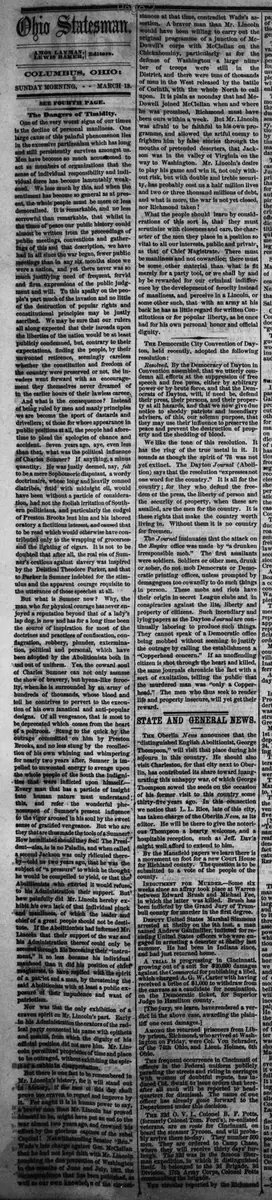
One of the very worst signs of our times is the decline of personal manliness. One large cause of this painful phenomenon lies in the excessive partisanship which has long and still persistently survives amongst us. Men have become so much accustomed to act as members of organizations that the sense of individual responsibility and individual force has become lamentably weak. We lose much by this, and when the sentiment has become so general as at present, the whole people must be more or less demoralized. It is remarkable, and no less sorrowful than remarkable, that whilst in the times of peace our public history could almost be written from the proceedings of public meetings, conventions and gatherings of this and that description, we have had in all since the war began, fewer public meetings than in any six months since we were a nation, and yet there never was so much justifying need of frequent, fervid and firm expressions of the public judgment and will. To this apathy on the people's part much of the invasion and no little of the destruction of popular rights and constitutional principles may be justly ascribed. We may be sure that our rulers all along expected that their inroads upon the liberties of the nation would be at least publicly condemned, but, contrary to their expectations, finding the people, by their unwonted reticence, seemingly careless whether the constitution and freedom of the country were preserved or not, the invaders went forward with an encouragement they themselves never dreamed of in the earlier hours of their lawless career. And what is the consequence? Instead of being ruled by men and manly principles we are become the sport of dastards and drivellers; of those for whose appearance in public positions at all, the people had aforetime to plead the apologies of chance and accident. Seven years ago, aye, even less than that, what was the political influence of Charles Sumner? If anything, a minus quantity. He was justly deemed, nay, felt to be a mere Sophomoric disputant, a wordy doctrinaire, whose long and heavily conned diatribes, fetid with midnight oil, would have been without a particle of consideration, had not the foolish irritation of Southern politicians, and particularly the cudgel of Preston Brooks lent him and his labored oratory a factitious interest, and caused that to be read which would otherwise have contributed only to the wrapping of groceries, and the lighting of cigars. It is not to be doubted that after all, the real vim of Sumner's orations against slavery was inspired by the Deistical Theodore Parker, and that to Parker is Sumner indebted for the stimulus and the apparent courage requisite to the utterance of those speeches at all. But what is Sumner now? Why, the man who for physical courage has never envied reputation beyond that of a lady's lap dog, is now and has for a long time been the source of inspiration for most of the doctrines and practices of confiscation, conflagration, robbery, plunder, extermination, political and personal, which have been adopted by the Abolitionists both in and out of uniform. Yes, the coward soul of Charles Sumner can not only assume the show of bravery, but hyena-like ferocity, when he is surrounded by an army of hundreds of thousands, whose blood and toil he contrives to pervert to the execution of his own fanatical and anti-popular designs. Of all vengeance, that is most to be deprecated which comes from the heart of a poltroon. Stung to the quick by the outrage committed on him by Preston Brooks and no less stung by the recollection of his own whining and whimpering for nearly two years after, Sumner is impelled to unwonted energy to avenge upon the whole people of the South the indignities that were inflicted upon himself. Every man that has a particle of insight into human nature must understand this, and refer the wonderful phenomenon of Sumner's present influence to the vigor aroused in his soul by the sweet sense of gratified vengeance. But who are they that are thus made the tools of a Sumner? How humiliated should they feel! The President-elect is no Paladin, and when called a second Jackson was only ridiculed therefor. He told us two years ago, that he was the subject of "a pressure" to which he thought he would be compelled to yield, or that the Abolitionists who exerted it would refuse to his Administration their support. But how painfully did Mr. Lincoln hereby exhibit his own lack of that individual pluck and manliness, of which the leader and chief of a great people should not be destitute. If the Abolitionists had informed Mr. Lincoln that their support of the war and his Administration thereof could only be secured through his becoming their "instrument," it no less became his individual manhood than it did his position of chief magistrate, to have replied with the spirit of a patriot and a man, by threatening the said Abolitionists with at least a public exposure of their impudence and want of patriotism. Nor was that the only exhibition of a craven spirit on Mr. Lincoln's part. Early in his Administration the orators of the radical party connected his name with epithets and insults, from which the dignity of his official position did not save him. Mr. Lincoln permitted proprieties of time and place to be outraged, without exhibiting the spirit of a rabbit in disapprobation. But there is one fact to be remembered in Mr. Lincoln's history, for it will stand out in history, if the men of this day shall prove too craven to regard and improve by it. For aught it is in human power to say, a braver man than Mr. Lincoln has proved himself to be, might have put an end to the war almost two years ago, and crowned his effort by the glorious capture of the rebel Capital! Notwithstanding Senator "Ben." Wade's late charge against Gen. McClellan that he had not kept faith with Mr. Lincoln touching the due protection of Washington in the months of June and July, 1862, the correspondence that has been published, as well as our own knowledge of the circumstances at that time, contradict Wade's assertion. A braver man than Mr. Lincoln would have been willing to carry out the original programme of a junction of McDowell's corps with McClellan on the Chickahominy, particularly as for the defense of Washington a large number of troops were still in the District, and there were tens of thousands of men in the West released by the battle of Corinth, with the whole North to call upon. It is plain as noonday that had McDowell joined McClellan when and where he was promised, Richmond must have been ours within a week. But Mr. Lincoln was afraid to be faithful to his own programme, and allowed the artful enemy to frighten him by false stories through the mouths of pretended deserters, that Jackson was in the valley of Virginia on the way to Washington. Mr. Lincoln's desire to play his game and win it, not only without risk, but with double and treble security, has probably cost us a half million lives and two or three thousand millions of debt, and what is more, the war is not yet closed, nor Richmond taken!
What the people should learn by considerations of this sort is, that they must scrutinize with closeness and care, the character of the men they place in a position so vital to all our interests, public and private, as that of Chief Magistrate. There must be manliness and not cowardice; there must be some other material than what is fit merely for a party tool, or we shall by and by be rewarded for our criminal indifference by the development of ferocity instead of manliness, and perceive in a Lincoln, or some other such, that with an army at his back he has as little regard for written Constitutions or for popular liberty, as he once had for his own personal honor and official dignity.
One of the very worst signs of our times is the decline of personal manliness. One large cause of this painful phenomenon lies in the excessive partisanship which has long and still persistently survives amongst us. Men have become so much accustomed to act as members of organizations that the sense of individual responsibility and individual force has become lamentably weak. We lose much by this, and when the sentiment has become so general as at present, the whole people must be more or less demoralized. It is remarkable, and no less sorrowful than remarkable, that whilst in the times of peace our public history could almost be written from the proceedings of public meetings, conventions and gatherings of this and that description, we have had in all since the war began, fewer public meetings than in any six months since we were a nation, and yet there never was so much justifying need of frequent, fervid and firm expressions of the public judgment and will. To this apathy on the people's part much of the invasion and no little of the destruction of popular rights and constitutional principles may be justly ascribed. We may be sure that our rulers all along expected that their inroads upon the liberties of the nation would be at least publicly condemned, but, contrary to their expectations, finding the people, by their unwonted reticence, seemingly careless whether the constitution and freedom of the country were preserved or not, the invaders went forward with an encouragement they themselves never dreamed of in the earlier hours of their lawless career. And what is the consequence? Instead of being ruled by men and manly principles we are become the sport of dastards and drivellers; of those for whose appearance in public positions at all, the people had aforetime to plead the apologies of chance and accident. Seven years ago, aye, even less than that, what was the political influence of Charles Sumner? If anything, a minus quantity. He was justly deemed, nay, felt to be a mere Sophomoric disputant, a wordy doctrinaire, whose long and heavily conned diatribes, fetid with midnight oil, would have been without a particle of consideration, had not the foolish irritation of Southern politicians, and particularly the cudgel of Preston Brooks lent him and his labored oratory a factitious interest, and caused that to be read which would otherwise have contributed only to the wrapping of groceries, and the lighting of cigars. It is not to be doubted that after all, the real vim of Sumner's orations against slavery was inspired by the Deistical Theodore Parker, and that to Parker is Sumner indebted for the stimulus and the apparent courage requisite to the utterance of those speeches at all. But what is Sumner now? Why, the man who for physical courage has never envied reputation beyond that of a lady's lap dog, is now and has for a long time been the source of inspiration for most of the doctrines and practices of confiscation, conflagration, robbery, plunder, extermination, political and personal, which have been adopted by the Abolitionists both in and out of uniform. Yes, the coward soul of Charles Sumner can not only assume the show of bravery, but hyena-like ferocity, when he is surrounded by an army of hundreds of thousands, whose blood and toil he contrives to pervert to the execution of his own fanatical and anti-popular designs. Of all vengeance, that is most to be deprecated which comes from the heart of a poltroon. Stung to the quick by the outrage committed on him by Preston Brooks and no less stung by the recollection of his own whining and whimpering for nearly two years after, Sumner is impelled to unwonted energy to avenge upon the whole people of the South the indignities that were inflicted upon himself. Every man that has a particle of insight into human nature must understand this, and refer the wonderful phenomenon of Sumner's present influence to the vigor aroused in his soul by the sweet sense of gratified vengeance. But who are they that are thus made the tools of a Sumner? How humiliated should they feel! The President-elect is no Paladin, and when called a second Jackson was only ridiculed therefor. He told us two years ago, that he was the subject of "a pressure" to which he thought he would be compelled to yield, or that the Abolitionists who exerted it would refuse to his Administration their support. But how painfully did Mr. Lincoln hereby exhibit his own lack of that individual pluck and manliness, of which the leader and chief of a great people should not be destitute. If the Abolitionists had informed Mr. Lincoln that their support of the war and his Administration thereof could only be secured through his becoming their "instrument," it no less became his individual manhood than it did his position of chief magistrate, to have replied with the spirit of a patriot and a man, by threatening the said Abolitionists with at least a public exposure of their impudence and want of patriotism. Nor was that the only exhibition of a craven spirit on Mr. Lincoln's part. Early in his Administration the orators of the radical party connected his name with epithets and insults, from which the dignity of his official position did not save him. Mr. Lincoln permitted proprieties of time and place to be outraged, without exhibiting the spirit of a rabbit in disapprobation. But there is one fact to be remembered in Mr. Lincoln's history, for it will stand out in history, if the men of this day shall prove too craven to regard and improve by it. For aught it is in human power to say, a braver man than Mr. Lincoln has proved himself to be, might have put an end to the war almost two years ago, and crowned his effort by the glorious capture of the rebel Capital! Notwithstanding Senator "Ben." Wade's late charge against Gen. McClellan that he had not kept faith with Mr. Lincoln touching the due protection of Washington in the months of June and July, 1862, the correspondence that has been published, as well as our own knowledge of the circumstances at that time, contradict Wade's assertion. A braver man than Mr. Lincoln would have been willing to carry out the original programme of a junction of McDowell's corps with McClellan on the Chickahominy, particularly as for the defense of Washington a large number of troops were still in the District, and there were tens of thousands of men in the West released by the battle of Corinth, with the whole North to call upon. It is plain as noonday that had McDowell joined McClellan when and where he was promised, Richmond must have been ours within a week. But Mr. Lincoln was afraid to be faithful to his own programme, and allowed the artful enemy to frighten him by false stories through the mouths of pretended deserters, that Jackson was in the valley of Virginia on the way to Washington. Mr. Lincoln's desire to play his game and win it, not only without risk, but with double and treble security, has probably cost us a half million lives and two or three thousand millions of debt, and what is more, the war is not yet closed, nor Richmond taken!
What the people should learn by considerations of this sort is, that they must scrutinize with closeness and care, the character of the men they place in a position so vital to all our interests, public and private, as that of Chief Magistrate. There must be manliness and not cowardice; there must be some other material than what is fit merely for a party tool, or we shall by and by be rewarded for our criminal indifference by the development of ferocity instead of manliness, and perceive in a Lincoln, or some other such, that with an army at his back he has as little regard for written Constitutions or for popular liberty, as he once had for his own personal honor and official dignity.
What sub-type of article is it?
Partisan Politics
War Or Peace
Constitutional
What keywords are associated?
Political Timidity
Personal Manliness
Civil War Leadership
Charles Sumner Criticism
Abraham Lincoln Cowardice
Constitutional Liberties
Abolitionist Influence
What entities or persons were involved?
Charles Sumner
Abraham Lincoln
Preston Brooks
Theodore Parker
Gen. Mcclellan
Ben Wade
Abolitionists
Editorial Details
Primary Topic
Dangers Of Political Timidity And Cowardice In Leaders During The Civil War
Stance / Tone
Strongly Critical Of Cowardice In Sumner And Lincoln, Exhorting Manliness And Scrutiny Of Leaders
Key Figures
Charles Sumner
Abraham Lincoln
Preston Brooks
Theodore Parker
Gen. Mcclellan
Ben Wade
Abolitionists
Key Arguments
Excessive Partisanship Weakens Individual Responsibility And Manliness
Public Apathy Enables Invasions Of Constitutional Rights
Sumner's Influence Stems From Vengeful Cowardice Inspired By Brooks' Attack
Lincoln's Timidity In Yielding To Abolitionist Pressure Shows Lack Of Pluck
Lincoln's Fear Prevented Mcdowell's Junction With Mcclellan, Prolonging The War
People Must Scrutinize Leaders' Character To Avoid Rule By Dastards