Thank you for visiting SNEWPapers!
Sign up free
Editorial
September 17, 1858
Clarksville Chronicle
Clarksville, Montgomery County, Tennessee
What is this article about?
An editorial defends the American Party against Democratic accusations of abolitionism in the Kansas controversy, citing the Washington Union to argue that Democrats aimed to make Kansas free while Americans sought to preserve slavery per popular sovereignty, critiquing partisan lies and the Dred Scott decision.
Clipping
OCR Quality
98%
Excellent
Full Text
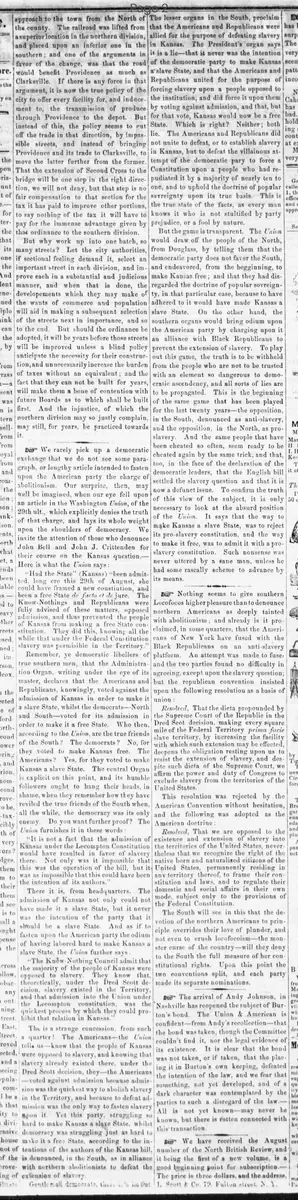
We rarely pick up a democratic exchange that we do not see some paragraph, or lengthy article intended to fasten upon the American party the charge of abolitionism. Our surprise, then, may well be imagined, when our eye fell upon an article in the Washington Union, of the 29th ult., which explicitly denies the truth of that charge, and lays its whole weight upon the shoulders of democracy. We invite the attention of those who denounce John Bell and John J. Crittenden for their course on the Kansas question.—Here is what the Union says:
"Had the State (Kansas) been admitted, long ere this 29th of August, she could have framed a new constitution, and been a free State de facto et de jure. The Know-Nothings and Republicans were fully advised of these matters, opposed admission, and thus prevented the people of Kansas from making a free State constitution. They did this, knowing all the while that under the Federal Constitution slavery was permissible in the Territory."
Remember, ye democratic libellers of true southern men, that the Administration Organ, writing under the eye of its master, declares that the Americans and Republicans, knowingly, voted against the admission of Kansas in order to make it a slave State, whilst the democrats—North and South—voted for its admission in order to make it a free State. Who then, according to the Union, are the true friends of the South? The democrats? No, for they voted to make Kansas free. The Americans? Yes, for they voted to make Kansas a slave State. The central Organ is explicit on this point, and its humble followers ought to hang their heads, in shame, when they remember how they have reviled the true friends of the South when, all the while, the democracy was its only enemy. Do you want further proof? The Union furnishes it in these words:
"It is not a fact that the admission of Kansas under the Lecompton Constitution would have resulted in favor of slavery there. Not only was it impossible that this was the operation of the bill, but it was as impossible that this could have been the intention of its authors."
There it is, from headquarters. The admission of Kansas not only could not have made it a slave State, but it never was the intention of the party that it should be a slave State. And as if to fasten upon the American party the odium of having labored hard to make Kansas a slave State, the Union further says:
"The Know-Nothing Council admit that the majority of the people of Kansas were opposed to slavery. They know that, theoretically, under the Dred Scott decision, slavery existed in the Territory, and that admission into the Union under the Lecompton constitution, was the quickest process by which they could prohibit that relation in Kansas."
This is a strange concession, from such a quarter! The Americans—the Union tells us—knew that the people of Kansas were opposed to slavery, and knowing that slavery already existed there, under the Dred Scott decision, they—the Americans—voted against admission because admission was the quickest way to abolish slavery in the Territory, and because to defeat admission was the only way to fasten slavery to the soil. Yet this party, struggling so hard to make Kansas a slave State, whilst the democracy was struggling just as hard to make it a free State, according to the intentions of the authors of the Kansas bill, is denounced, in the South, as in alliance with northern abolitionists to defeat the extension of slavery.
Gentlemen democrats, then, go no further out of your way to abuse the American party.
The lesser organs in the South, proclaim that the Americans and Republicans were allied for the purpose of defeating slavery in Kansas. The President's organ says it is a lie—that it never was the intention of the democratic party to make Kansas a slave State, and that the Americans and Republicans united for the purpose of forcing slavery upon a people opposed to the institution, and did force it upon them by voting against admission, and that, but for that vote, Kansas would now be a free State. Which is right? Neither; both lie. The Americans and Republicans did not unite to defeat, or to establish slavery in Kansas, but to defeat the villainous attempt of the democratic party to force a Constitution upon a people who had repudiated it by a majority of nearly ten to one, and to uphold the doctrine of popular sovereignty upon its true basis. This is the true state of the facts, as every man knows it who is not stultified by party prejudice, or a fool by nature.
But the game is transparent. The Union would draw off the people of the North, from Douglass, by telling them that the democratic party does not favor the South and endeavored, from the beginning, to make Kansas free; and that they had disregarded the doctrine of popular sovereignty, in that particular case, because to have adhered to it would have made Kansas a slave State. On the other hand, the southern organs would bring odium upon the American party by charging upon it an alliance with Black Republicans to prevent the extension of slavery. To play out this game, the truth is to be withheld from the people who are not to be trusted with an element so dangerous to democratic ascendency, and all sorts of lies are to be propagated. This is the beginning of the same game that has been played for the last twenty years—the opposition, in the South, denounced as anti-slavery, and the opposition, in the North, as pro-slavery. And the same people that have been cheated so often, seem ready to be cheated again by the same trick, and that too, in the face of the declaration of the democratic leaders, that the English bill settled the slavery question and that it is now a defunct issue. To confirm the truth of this view of the subject, it is only necessary to look at the absurd position of the Union. It says that the way to make Kansas a slave State, was to reject its pro-slavery constitution, and the way to make it free, was to admit it with a pro-slavery constitution. Such nonsense was never uttered by a sane man, unless he had some rascally scheme to advance by its means.
Nothing seems to give southern Locofocos higher pleasure than to denounce northern Americans as deeply tainted with abolitionism; and already is it proclaimed, in some quarters, that the Americans of New York have fused with the Black Republicans on an anti-slavery platform. An attempt was made to fuse and the two parties found no difficulty in agreeing, except upon the slavery question; but the republican convention insisted upon the following resolution as a basis of union:
Resolved, That the dicta propounded by the Supreme Court of the Republic in the Dred Scott decision, making every square mile of the Federal Territory prima facie slave territory, by increasing the facility with which such extension may be effected, deepens the obligation resting upon us to resist the extension of slavery, and despite such dicta of the Supreme Court, we affirm the power and duty of Congress to exclude slavery from the territories of the United States.
This resolution was rejected by the American Convention without hesitation and the following was adopted as the American doctrine:
Resolved, That we are opposed to the existence and extension of slavery into the territories of the United States, nevertheless that we recognize the right of the native born and naturalized citizens of the United States, permanently residing in any territory thereof, to frame their constitution and laws, and to regulate their domestic and social affairs in their own mode, subject only to the provisions of the Federal Constitution.
The South will see in this that the devotion of the northern Americans to principle overrides their love of plunder, and not even to crush locofocoism—the monster curse of the country—will they deny to the South the full measure of her constitutional rights. Upon this point the two conventions split, and each party made its separate nominations.
"Had the State (Kansas) been admitted, long ere this 29th of August, she could have framed a new constitution, and been a free State de facto et de jure. The Know-Nothings and Republicans were fully advised of these matters, opposed admission, and thus prevented the people of Kansas from making a free State constitution. They did this, knowing all the while that under the Federal Constitution slavery was permissible in the Territory."
Remember, ye democratic libellers of true southern men, that the Administration Organ, writing under the eye of its master, declares that the Americans and Republicans, knowingly, voted against the admission of Kansas in order to make it a slave State, whilst the democrats—North and South—voted for its admission in order to make it a free State. Who then, according to the Union, are the true friends of the South? The democrats? No, for they voted to make Kansas free. The Americans? Yes, for they voted to make Kansas a slave State. The central Organ is explicit on this point, and its humble followers ought to hang their heads, in shame, when they remember how they have reviled the true friends of the South when, all the while, the democracy was its only enemy. Do you want further proof? The Union furnishes it in these words:
"It is not a fact that the admission of Kansas under the Lecompton Constitution would have resulted in favor of slavery there. Not only was it impossible that this was the operation of the bill, but it was as impossible that this could have been the intention of its authors."
There it is, from headquarters. The admission of Kansas not only could not have made it a slave State, but it never was the intention of the party that it should be a slave State. And as if to fasten upon the American party the odium of having labored hard to make Kansas a slave State, the Union further says:
"The Know-Nothing Council admit that the majority of the people of Kansas were opposed to slavery. They know that, theoretically, under the Dred Scott decision, slavery existed in the Territory, and that admission into the Union under the Lecompton constitution, was the quickest process by which they could prohibit that relation in Kansas."
This is a strange concession, from such a quarter! The Americans—the Union tells us—knew that the people of Kansas were opposed to slavery, and knowing that slavery already existed there, under the Dred Scott decision, they—the Americans—voted against admission because admission was the quickest way to abolish slavery in the Territory, and because to defeat admission was the only way to fasten slavery to the soil. Yet this party, struggling so hard to make Kansas a slave State, whilst the democracy was struggling just as hard to make it a free State, according to the intentions of the authors of the Kansas bill, is denounced, in the South, as in alliance with northern abolitionists to defeat the extension of slavery.
Gentlemen democrats, then, go no further out of your way to abuse the American party.
The lesser organs in the South, proclaim that the Americans and Republicans were allied for the purpose of defeating slavery in Kansas. The President's organ says it is a lie—that it never was the intention of the democratic party to make Kansas a slave State, and that the Americans and Republicans united for the purpose of forcing slavery upon a people opposed to the institution, and did force it upon them by voting against admission, and that, but for that vote, Kansas would now be a free State. Which is right? Neither; both lie. The Americans and Republicans did not unite to defeat, or to establish slavery in Kansas, but to defeat the villainous attempt of the democratic party to force a Constitution upon a people who had repudiated it by a majority of nearly ten to one, and to uphold the doctrine of popular sovereignty upon its true basis. This is the true state of the facts, as every man knows it who is not stultified by party prejudice, or a fool by nature.
But the game is transparent. The Union would draw off the people of the North, from Douglass, by telling them that the democratic party does not favor the South and endeavored, from the beginning, to make Kansas free; and that they had disregarded the doctrine of popular sovereignty, in that particular case, because to have adhered to it would have made Kansas a slave State. On the other hand, the southern organs would bring odium upon the American party by charging upon it an alliance with Black Republicans to prevent the extension of slavery. To play out this game, the truth is to be withheld from the people who are not to be trusted with an element so dangerous to democratic ascendency, and all sorts of lies are to be propagated. This is the beginning of the same game that has been played for the last twenty years—the opposition, in the South, denounced as anti-slavery, and the opposition, in the North, as pro-slavery. And the same people that have been cheated so often, seem ready to be cheated again by the same trick, and that too, in the face of the declaration of the democratic leaders, that the English bill settled the slavery question and that it is now a defunct issue. To confirm the truth of this view of the subject, it is only necessary to look at the absurd position of the Union. It says that the way to make Kansas a slave State, was to reject its pro-slavery constitution, and the way to make it free, was to admit it with a pro-slavery constitution. Such nonsense was never uttered by a sane man, unless he had some rascally scheme to advance by its means.
Nothing seems to give southern Locofocos higher pleasure than to denounce northern Americans as deeply tainted with abolitionism; and already is it proclaimed, in some quarters, that the Americans of New York have fused with the Black Republicans on an anti-slavery platform. An attempt was made to fuse and the two parties found no difficulty in agreeing, except upon the slavery question; but the republican convention insisted upon the following resolution as a basis of union:
Resolved, That the dicta propounded by the Supreme Court of the Republic in the Dred Scott decision, making every square mile of the Federal Territory prima facie slave territory, by increasing the facility with which such extension may be effected, deepens the obligation resting upon us to resist the extension of slavery, and despite such dicta of the Supreme Court, we affirm the power and duty of Congress to exclude slavery from the territories of the United States.
This resolution was rejected by the American Convention without hesitation and the following was adopted as the American doctrine:
Resolved, That we are opposed to the existence and extension of slavery into the territories of the United States, nevertheless that we recognize the right of the native born and naturalized citizens of the United States, permanently residing in any territory thereof, to frame their constitution and laws, and to regulate their domestic and social affairs in their own mode, subject only to the provisions of the Federal Constitution.
The South will see in this that the devotion of the northern Americans to principle overrides their love of plunder, and not even to crush locofocoism—the monster curse of the country—will they deny to the South the full measure of her constitutional rights. Upon this point the two conventions split, and each party made its separate nominations.
What sub-type of article is it?
Partisan Politics
Slavery Abolition
Constitutional
What keywords are associated?
Kansas Admission
American Party
Slavery Extension
Democratic Lies
Popular Sovereignty
Dred Scott Decision
Lecompton Constitution
Partisan Fusion
What entities or persons were involved?
American Party
Democrats
Republicans
Washington Union
John Bell
John J. Crittenden
Know Nothings
Dred Scott Decision
Lecompton Constitution
Douglass
Editorial Details
Primary Topic
Defense Of American Party Against Abolitionism Charges In Kansas Controversy
Stance / Tone
Pro American Party And Southern Rights, Anti Democratic Deception
Key Figures
American Party
Democrats
Republicans
Washington Union
John Bell
John J. Crittenden
Know Nothings
Dred Scott Decision
Lecompton Constitution
Douglass
Key Arguments
Washington Union Denies Abolitionism Charge Against Americans, Blames Democrats
Democrats Voted For Kansas Admission To Make It Free State
Americans Opposed Admission To Allow Slavery Per Dred Scott And Popular Will
Admission Under Lecompton Would Not Result In Slavery
Americans Rejected Republican Anti Slavery Resolution To Uphold Territorial Rights
Partisan Lies Aim To Deceive North And South
True Motive: Uphold Popular Sovereignty Against Forced Lecompton Constitution