Thank you for visiting SNEWPapers!
Sign up free
Alexandria Advertiser And Commercial Intelligencer
Alexandria, Virginia
What is this article about?
A sarcastic open letter in the Washington Federalist criticizes Postmaster General Gideon Granger for politically motivated dismissals of deputy postmasters, accusing him of hypocrisy, revenge, and blind loyalty to President Jefferson, whose character is also impugned. Signed 'An Enemy to Hypocrisy' and to be continued.
Clipping
OCR Quality
Full Text
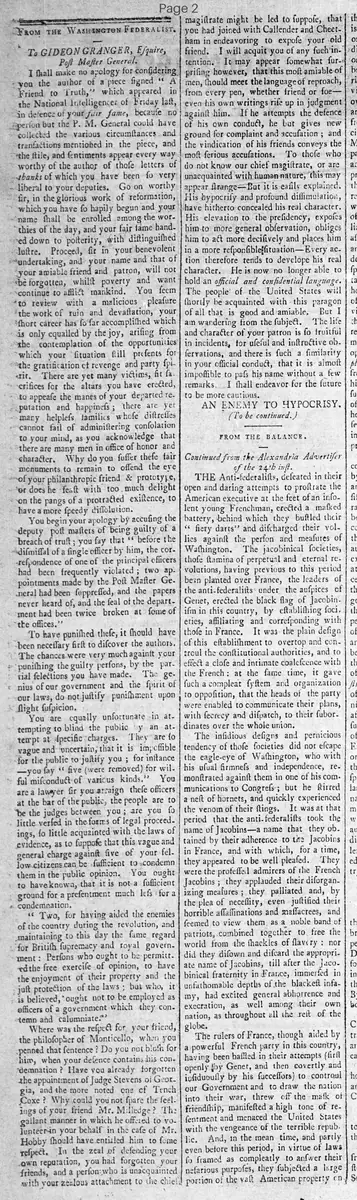
To GIDEON GRANGER, Esquire,
Post Master General.
I shall make no apology for considering you the author of a piece signed "A Friend to Truth," which appeared in the National Intelligencer of Friday last, in defence of your fair fame, because no person but the P. M. General could have collected the various circumstances and transactions mentioned in the piece, and the style, and sentiments appear every way worthy of the author of those letters of thanks of which you have been so very liberal to your deputies. Go on worthy sir, in the glorious work of reformation, which you have so happily begun and your name shall be enrolled among the worthies of the day, and your fair fame handed down to posterity, with distinguished lustre. Proceed, sir in your benevolent undertaking, and your name and that of your amiable friend and patron, will not be forgotten, whilst poverty and want continue to afflict mankind. You seem to review with a malicious pleasure the work of ruin and devastation, your short career has so far accomplished which is only equalled by the joy, arising from the contemplation of the opportunities which your situation still presents for the gratification of revenge and party spirit. There are yet many victims, fit sacrifices for the altars you have erected, to appease the manes of your departed reputation and happiness; there are yet many helpless families whose distress cannot fail of administering consolation to your mind, as you acknowledge that there are many men in office of honor and character. Why do you suffer these fair monuments to remain to offend the eye of your philanthropic friend & prototype, or does he feast with too much delight on the pangs of a protracted existence, to have a more speedy dissolution.
You begin your apology by accusing the deputy post masters of being guilty of a breach of trust : you say that " before the dismission of a single officer by him, the correspondence of one of the principal officers had been frequently violated; two appointments made by the Post Master General had been opposed, and the papers never heard of, and the seal of the department had been twice broken at one of the offices."
To have punished these, it should have been necessary first to discover the authors. The chances were very much against your punishing the guilty persons, by the partial selections you have made. The genius of our government and the spirit of our laws, do not justify punishment upon slight suspicion.
You are equally unfortunate in attempting to blind the public by an attempt at specific charges. They are so vague and uncertain, that it is impossible for the public to justify you ; for instance you say " five (were removed) for wilful misconduct of various kinds." You are a lawyer sir your arraign these officers at the bar of the public, the people are to be the judges between you; are you so little versed in the forms of legal proceedings, so little acquainted with the laws of evidence, as to suppose that this vague and general charge against five of your fellow citizens can be sufficient to condemn them in the public opinion. You ought to have known,-that it is not a sufficient ground for a presentment much less for a condemnation.
" Two, for having aided the enemies of the country during the revolution, and maintaining to this day the same regard for British supremacy and royal government : Persons who ought to be permitted the free exercise of opinion, to have the enjoyment of their property and the just protection of the laws ; but who, it is believed, ought not to be employed as officers of a government which they contemn and calumniate."
Where was the respect for your friend, the philosopher of Monticello, when you penned that sentence ? Do you not blush for him, when your defence contains his condemnation ? Have you already forgotten the appointment of Judge Stevens of Georgia, and the more noted one of Tench Coxe ? Why could you not spare the feelings of your friend Mr. Milledge? The gallant manner in which he offered to volunteer in your behalf in the case of Mr. Hobby should have entitled him to some respect. In the zeal of defending your own reputation, you had forgotten your friends, and a person who is unacquainted with your zealous attachment to the chief magistrate might be led to suppose, that you had joined with Callender and Cheetham in endeavoring to expose your old friend. I will acquit you of any such intention. It may appear somewhat surprising however, that this most amiable of men, should meet the language of reproach, from every pen, whether friend or foe- even his own writings rise up in judgment against him. If he attempts the defence of his own conduct, he but gives new ground for complaint and accusation ; and the vindication of his friends conveys the most serious accusations. To those who do not know our chief magistrate, or are unacquainted with human nature, this may appear strange=But it is easily explained. His hypocrisy and profound dissimulation, have hitherto concealed his real character. His elevation to the presidency, exposes him to more general observation, obliges him to act more decisively and places him in a more responsible situation--Every action therefore tends to develope his real character. He is now no longer able to hold an official and confidential language. The people of the United States will shortly be acquainted with -this paragon of all that is good and amiable, But I am wandering from the subject. The life and character of your patron is so fruitful in incidents, for useful and instructive observations, and there is such a similarity in your official conduct, that it is almost impossible to pass his name without a few remarks. I shall endeavor for the future to be more cautious.
AN ENEMY TO HYPOCRISY.
(To be continued.)
What sub-type of article is it?
What themes does it cover?
What keywords are associated?
What entities or persons were involved?
Letter to Editor Details
Author
An Enemy To Hypocrisy.
Recipient
Gideon Granger, Esquire, Post Master General.
Main Argument
the letter sarcastically condemns postmaster general gideon granger for dismissing deputy postmasters on vague, politically motivated charges rather than evidence, accusing him of hypocrisy, revenge, and loyalty to a duplicitous president jefferson.
Notable Details